Pool Light Not Working? Here’s Why — And What to Do Next
⚡ Key Takeaways
- Check the GFCI first — a tripped GFCI outlet or breaker is the most common reason pool lights go out, and it’s a simple reset.
- Don’t ignore a tripping GFCI — if it keeps resetting and tripping again, that’s a sign of water intrusion or a wiring fault that needs a licensed electrician.
- Burnt-out bulbs happen — but if a new bulb fails quickly, something deeper is wrong with the fixture or wiring.
- Water + electricity is a serious combination — pool lighting issues that involve wiring faults or cracked fixtures are a genuine safety hazard, not just an inconvenience.
- Most pool light problems can be diagnosed on a single visit — you don’t need a full rewire. Most repairs are straightforward once the cause is confirmed.
- DFW heat and pool chemicals accelerate wear — Texas summers are tough on pool electrical components, and annual inspections can prevent bigger problems.
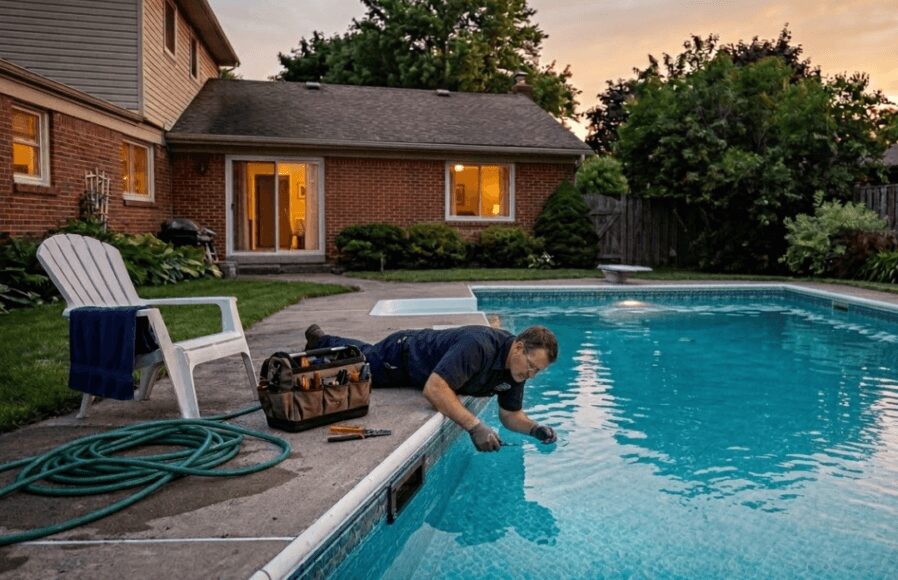
You planned a backyard evening by the pool. Maybe friends are coming over, maybe it’s just the family unwinding after a long week. You flip on the pool lights — and nothing. The water’s dark, and now you’re left wondering what’s wrong and whether it’s even safe to swim.
If this sounds familiar, you’re not alone. Pool lighting problems are one of the more common calls we get from homeowners across DFW, especially heading into and out of pool season. The good news: most causes are fixable, and most don’t require tearing anything apart.
The not-so-good news: because pool lights involve water and electricity together, some causes do carry real safety risks — and those shouldn’t be ignored or guessed at.
This guide walks you through the most common reasons pool lights stop working, what you can check yourself, and when it’s time to call a licensed electrician to take a look.
Start Here: The Most Common Culprit Is the GFCI
Before assuming the worst, check your GFCI protection. Pool lighting circuits are required by code to be protected by a Ground Fault Circuit Interrupter (GFCI) — either an outlet with the test/reset buttons on it, or a GFCI breaker in your panel.
GFCI devices trip when they detect even a tiny imbalance in the electrical current — which is exactly what happens when electricity starts leaking toward water. It’s a protective mechanism, and it works.
💡 How to Find Your GFCI
Pool GFCI protection is usually located near the equipment pad (where your pump and filter are), at an exterior outlet within reach of the pool equipment, or as a dedicated GFCI breaker in your main panel. Check all three locations. Look for the “TEST” and “RESET” buttons — if it’s tripped, the reset button will be popped out. Press it firmly until you feel it click back in.
If the GFCI resets and the lights come back on — great. Keep an eye on it. If it trips again soon after, don’t keep resetting it. A GFCI that trips repeatedly is trying to tell you something, and overriding it puts you at risk. That’s the point where you want a licensed electrician to find out why.
For a more detailed look at how GFCIs work and why they trip, check out our guide on why your GFCI won’t reset.
6 Reasons Your Pool Light Stopped Working
1. Tripped GFCI or Breaker
As covered above, this is the first thing to check. A one-time trip with no recurrence is often a minor event — a brief surge, a voltage spike, or temporary moisture. But if it happens repeatedly, you need to know why before you use the pool after dark.
⚠️ Recurring Trips Are a Warning Sign
A GFCI that keeps tripping on your pool circuit is not just inconvenient — it means there’s an ongoing electrical fault somewhere in the system. This could be water inside the fixture, deteriorating wiring, or a failing component. Don’t keep resetting it and hoping it holds. Have it diagnosed.
2. Burnt-Out Bulb
Pool light bulbs do burn out — especially incandescent and halogen fixtures, which were common in older pools. If your fixture uses a replaceable bulb, this is worth checking once you’ve confirmed the GFCI isn’t the issue.
That said, bulb replacement in a pool light fixture isn’t quite as simple as swapping a lamp at home. The fixture has to be removed from the niche, dried, resealed, and reinstalled correctly — if water gets into the socket, you’re dealing with a bigger problem. Many homeowners hire an electrician for this specifically to avoid creating a new issue while fixing the old one.
Also worth noting: if you replace the bulb and it fails again quickly, the issue isn’t the bulb. Something in the circuit or fixture is causing it to fail prematurely.
3. Water Intrusion Into the Fixture
Pool light fixtures have seals — gaskets and lenses — that keep water out of the electrical components. Over time, those seals degrade. Texas heat, pool chemicals, and normal wear all speed that process up.
When water gets inside the fixture housing, it can short out the light, damage the socket, and trigger the GFCI. You might also notice:
- Condensation or visible moisture inside the lens
- Discoloration or cloudiness on the inside of the fixture cover
- Corrosion on the screws or around the fixture ring
- A GFCI that trips shortly after the light turns on
💡 The “Dry Before You Reset” Rule
If you suspect water is in the fixture, resetting the breaker or GFCI and turning the light back on can cause additional damage — and creates a shock risk. The fixture needs to be removed, dried completely, and inspected before power is restored to it.
4. Corroded or Damaged Wiring at the Fixture
The conduit that runs from your pool light fixture back to the panel has to hold up against moisture, pool chemicals, ground movement, and Texas heat cycles year after year. Even with proper installation, the conductors inside that conduit can deteriorate over time.
Common signs of wiring issues at the fixture level:
- Corrosion visible on the fixture cord or connections
- The light works intermittently — sometimes on, sometimes not
- Burning smell near the pool light area
- GFCI trips immediately when the light is switched on
Wiring problems in pool environments aren’t a DIY situation. If you’re seeing any of these signs, it’s worth having a licensed electrician inspect the full circuit — not just the fixture end.
Water Intrusion Is the #1 Pool Light Failure Cause
The vast majority of pool light failures beyond a simple bulb or GFCI trip trace back to compromised seals, water intrusion into the fixture, or moisture-related wiring damage. Regular fixture inspections can catch these early.
5. Failed Transformer or Control System
If your pool has low-voltage LED lighting — particularly color-changing LED systems — there’s often a transformer or control module between the panel and the lights. These components can fail on their own, separate from any wiring issue.
Signs this might be the issue:
- Multiple lights went out at the same time
- Lights flash or cycle through colors erratically before going out
- Your automation system shows the lights are on, but they’re dark in the pool
- Lights work when wired directly but not through the control system
Transformer and controller replacement is typically straightforward once the failed component is confirmed. An electrician can test the output of the transformer to determine whether it’s the issue.
6. Timer or Automation Programming
This one is easy to overlook — especially if the pool hasn’t been used in a while or someone adjusted the automation settings. Pool light timers and smart automation systems can lose their programming after a power outage or if settings were inadvertently changed.
💡 Check the Timer Before Calling Anyone
If your pool lights are on a timer or connected to an automation system (Pentair, Hayward, Jandy, etc.), verify the schedule is still set correctly and that the timer hasn’t been knocked into manual-off mode. Sometimes the fix is as simple as a reprogramming.
When It’s More Than Just the Lights
Pool lighting problems occasionally point to something happening in the broader electrical system — not just the fixture itself. If you’re also experiencing circuit breakers tripping in other areas of the home, noticing outlets not working nearby, or seeing any signs of broader electrical problems in the house, the pool light issue may be a symptom rather than the root cause.
A thorough inspection of the pool circuit — from the panel to the fixture — can clarify whether this is an isolated issue or part of a bigger picture.
Any time an electrical fault is suspected near water — whether it’s a pool, spa, or outdoor water feature — the stakes are higher than a standard indoor wiring problem. Voltage present in pool water, even at low levels, can cause electric shock drowning (ESD), a condition that can incapacitate a swimmer and lead to drowning. This is rare, but it’s a known and documented hazard.
If your pool light issues are accompanied by any of the following, don’t use the pool until an electrician has inspected it:
- Anyone reports a tingling sensation in the water
- A GFCI is tripping frequently on the pool circuit
- You’ve noticed a burning smell near the pool equipment
- The wiring near the fixture is visibly damaged or corroded
We understand this might feel like an overreaction for what seems like a simple light out. But the honest answer is: pool electrical problems are one of the few situations where “wait and see” carries real risk. It’s worth getting eyes on it.
What a Pool Light Inspection Actually Involves
If you call an electrician for a pool light issue, here’s what a proper inspection should cover — so you know what to expect and can ask the right questions.
✅ Pool Light Electrical Inspection — What Should Be Checked:
- GFCI outlet and/or GFCI breaker — condition, tripping behavior, reset test
- Pool light circuit breaker in the main panel — correct size, no signs of heat damage
- Fixture condition — seal integrity, moisture inside the housing, lens clarity
- Fixture cord — visible damage, corrosion at the connection points
- Conduit from fixture to junction box — water ingress, physical damage
- Junction box (j-box) near pool equipment — seal, corrosion, proper bonding
- Bonding continuity — proper equipotential bonding of pool structure and equipment
- Transformer or control module (if low-voltage LED system)
- Timer/automation settings — verified and functional
A thorough inspection takes about an hour in most cases. The repair, if one is needed, often happens on the same visit — whether that’s replacing a fixture, resealing a niche, swapping a GFCI breaker, or addressing a wiring connection. We give you a clear picture of what’s wrong and what it will take to fix it before any work begins.
Pool Lighting Repairs: What to Expect for Cost
| Issue | Typical Cost Range | What’s Involved |
|---|---|---|
| GFCI breaker replacement | $150–$300 | Replacing a failed GFCI breaker in the panel |
| Pool light bulb replacement | $200–$400 | Remove fixture, replace bulb, reseal and reinstall |
| Fixture seal/gasket replacement | $200–$450 | Remove, dry, replace gasket and lens seal, reinstall |
| Full fixture replacement | $400–$900+ | New fixture installation, wiring connections, seal |
| LED upgrade (single light) | $500–$1,200 | New LED fixture, transformer if needed |
| Wiring repair / conduit work | $300–$800+ | Depends on scope and access |
These are general ranges — actual cost depends on the specific issue, pool configuration, and access. We’ll give you a clear quote before anything is done.
DFW Pool Owners: A Few Things Worth Knowing
Texas summers are brutal on pool electrical systems. The combination of intense UV exposure, extreme heat cycles, pool chemical exposure, and hard water create conditions that degrade gaskets, corrode connections, and stress wiring faster than in most other climates. DFW pool owners — especially in areas like Keller, Southlake, Colleyville, and Fort Worth — should plan on a pool electrical inspection every 2–3 years as a baseline, and immediately any time a GFCI starts tripping repeatedly.
Many DFW homes with pools were built in the 1980s–2000s with older incandescent or halogen pool lighting. If that’s your home, upgrading to modern LED pool and outdoor lighting is worth considering — not just for energy efficiency, but because LED fixtures run cooler and put less stress on seals and connections over time.
Code requirements for pool bonding and GFCI protection have also evolved over the years. If your pool was built before 2008 and hasn’t had an electrical inspection since, it may not meet current NEC requirements — which matters for both safety and homeowner’s insurance.
✅ When to Consider an LED Pool Light Upgrade
If your pool uses incandescent or halogen fixtures and you’re already having the fixture serviced, it’s often cost-effective to upgrade to LED at the same time. LED pool lights use 75–80% less energy, last significantly longer, and many offer color-changing options. Ask us about options when we’re on-site — we’ll give you a straight comparison so you can decide what makes sense.
Protecting Your Pool Electrical System Going Forward
Most pool light problems are preventable — or at least catchable early — with a little attention each season. Here are a few simple habits that help:
✅ Annual Pool Electrical Maintenance Checklist:
- Test the GFCI protection at the start of each pool season — press “TEST,” confirm the circuit de-energizes, then press “RESET”
- Visually inspect the pool light fixture lens for condensation, cloudiness, or water inside
- Check around the fixture ring for rust, corrosion, or loose screws
- Look at the conduit and junction box near the equipment pad for physical damage or standing water
- Note any flickering, intermittent operation, or unusual behavior — and report it before it becomes a failure
- Schedule a professional inspection every 2–3 years, or any time the GFCI trips more than once
One more thing worth mentioning: if your home doesn’t have a whole-house surge protector, pool equipment — including lighting — is vulnerable to voltage spikes from thunderstorms. DFW gets its share of those. Surge protection is one of those repairs that’s easy to put off until something gets fried. We’re happy to discuss it while we’re already on-site for the pool light.
Frequently Asked Questions About Pool Lights Not Working
Why did my pool light suddenly stop working?
The most common reasons are a tripped GFCI breaker or outlet, a burnt-out bulb, or water intrusion into the fixture. Start by checking the GFCI — if it’s tripped, reset it and see if the light comes back. If the GFCI keeps tripping, or the light still doesn’t work after a successful reset, it’s time for a closer look from an electrician.
Is it safe to swim if the pool light isn’t working?
It depends on why it stopped working. If the light simply burned out and the GFCI is holding fine, swimming is generally safe — though obviously limited visibility at night. But if the GFCI is tripping repeatedly, or there’s any sign of an electrical fault, we’d recommend holding off on night swimming until the cause is identified. Voltage in pool water is a serious hazard that’s hard to detect without equipment.
Can I replace a pool light bulb myself?
Technically yes — but it’s not as simple as changing a household bulb. The fixture has to be removed from the niche, the lens unsealed, the bulb replaced, and the fixture resealed and reinstalled. If the seal isn’t done correctly, you’ve traded a burnt bulb for a water intrusion problem. Many homeowners find it’s worth having an electrician handle it, especially if the fixture is older and the seal is already suspect.
Why does my pool light GFCI keep tripping?
A GFCI that keeps tripping on a pool circuit almost always means there’s an ongoing electrical fault — usually water inside the fixture, a deteriorating fixture cord, a wiring fault in the conduit, or a failing GFCI device itself. Each of these needs to be diagnosed and addressed specifically. Repeatedly resetting a tripping GFCI bypasses the protection it’s designed to provide.
How much does it cost to fix a pool light in the DFW area?
Simple repairs like a GFCI breaker replacement or bulb swap with resealing typically run $150–$450. A full fixture replacement runs $400–$900+ depending on the fixture type. If there’s wiring or conduit work involved, that adds to the cost. We’ll diagnose the issue and quote the repair before starting — no surprises.
Should I upgrade my pool light to LED?
If your pool still has incandescent or halogen fixtures, an LED upgrade is worth considering — especially when you’re already having electrical work done on the pool. LED fixtures use significantly less energy, run cooler (which reduces seal stress), and modern options often include color-changing capabilities. It’s a reasonable upgrade conversation to have while an electrician is already on-site.
We’ll Diagnose It — No Guessing, No Pressure
A dark pool light is frustrating. What makes it worse is not knowing whether it’s a $20 fix or something more serious. Our approach is straightforward: we come out, we diagnose the actual issue, we explain what we found in plain language, and we give you options.
We’re not going to tell you need a full rewire when a GFCI breaker will do the job. And if something more significant does need addressing — like a fixture that’s been leaking for a while and has damaged the wiring — we’ll show you exactly what we found so you can make an informed decision.
That’s how we work. If you’ve got a pool light that’s out — or one that keeps tripping the GFCI — give us a call. We serve Fort Worth, Arlington, Keller, Southlake, Colleyville, Grapevine, Lewisville, and all of DFW.
You can also check out our electrical safety inspection guide or learn more about our outdoor and pool lighting services if you want more context before reaching out.
What to Do Right Now
If your pool light is out: check the GFCI first (near the pool equipment pad or in your panel). If it resets and holds — watch it. If it trips again, or the light still doesn’t work — call us. We’ll get out there, find the real cause, and fix it the right way. No long waits, no upsells, no jargon.
Call or Text: (682) 478-6088
Serving Fort Worth, Arlington, Keller, Southlake, Colleyville, Grapevine, Lewisville, and all of DFW