Portable Generator Inlet Outlet & Interlock Installation | North Richland Hills, TX
Connect your portable generator safely to your home — licensed installation, correct amperage, permitted and inspected — serving the DFW Mid-Cities since 2009
Already Have a Portable Generator? Here's How to Connect It Safely.
A portable generator sitting in your garage is only useful if you can connect it to your home safely. Extension cords running through windows aren't a real solution — they're a hazard, they're inconvenient, and they leave most of your home without power anyway.
A properly installed generator inlet outlet lets you plug your portable generator directly into your home's electrical system through a safe, code-compliant connection. Pair that with a transfer switch or interlock kit on your panel and you can power the circuits that matter most — refrigerator, AC, lights, sump pump — without back-feeding the utility line or risking anyone's safety.
We install generator inlet outlets, interlock kits, and manual transfer switches throughout North Richland Hills and the DFW Mid-Cities — sized correctly for your generator, permitted, and done right.
EXCELLENT Based on 113 reviews
 Posted on Google
 Itzayani MartinezEpic was punctual, straightforward, and they do honest work. We appreciated their services and would recommend them wholeheartedly. Thank you again!Posted on Google
 Adam RauschuberProfessional and they care about the work. Best in Fort WorthPosted on Google
 Issam TianiExcellent communication, professional, on-time and quality work with highly skilled personnel. I would recommend Epic Electrical for any electrical work.Posted on Google
 SeanAlways on time and professional. Great company.Posted on Google
 tyler kreisI highly recommend Epic Electrical, I have used the on multiple projects.Posted on Google
 Jim MorganI encountered multiple issues with GFCI outlets, which Epic Electrical diagnosed. One problem was caused by an indoor extension cord that kept tripping the GFCI. Another GFCI tripped because the supplementary hot water heating system had burned out, so I left the breaker off. Additionally, a third GFCI tripped due to a faulty pool light. Since we weren’t using the pool light, we decided to turn the switch off. I initially anticipated that the bill would be several hundred dollars, but I was pleasantly surprised to learn that there would be no charge, as the technicians only found electrical issues that were easy to fix. I would highly recommend EPIC Electrical for their honesty, prompt appointment times, and exceptional courtesy. J MorganPosted on Google
 Kerrie BarkerThey were on time, over the too helpful and fast!!Posted on Google
 James TreadwayMay 2025: These guys were able to come out the same day that I called them. They were on time, professional, and got the job done the first call. I'll be using them again. Oct 2025 Update: Used these guys again at a different house, and again they were awesome! Highly recommend.Verified by TrustindexTrustindex verified badge is the Universal Symbol of Trust. Only the greatest companies can get the verified badge who has a review score above 4.5, based on customer reviews over the past 12 months. Read more



Inlet Outlet, Interlock Kit, or Manual Transfer Switch — What's the Difference?
These three terms get used interchangeably, but they're different components that work together. Here's what each one is and what you actually need.
Generator Inlet Outlet (Power Inlet Box)
The inlet outlet is the external receptacle mounted on the outside of your home — typically on the garage wall or exterior near the panel. Your generator plugs into it via a heavy-duty cord. It's the physical connection point between your generator and your home's wiring. Without this, you're running extension cords. This is always required as part of a proper portable generator hookup.
Generator Interlock Kit
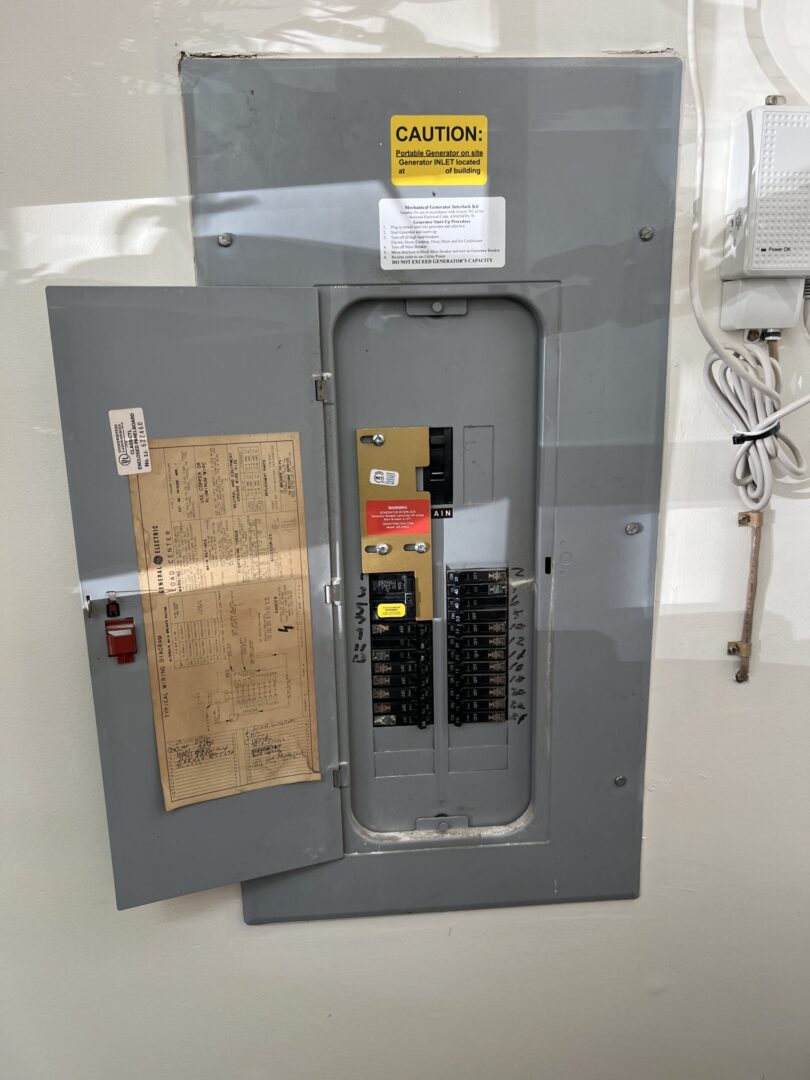
An interlock kit is a mechanical device installed on your existing breaker panel that physically prevents the main breaker and the generator breaker from both being on at the same time. This is what stops back-feed — the dangerous situation where generator power flows back onto the utility line, creating a risk for utility workers and your own equipment. An interlock kit is the most cost-effective way to safely connect a generator to your whole panel. Read our full breakdown: generator interlock kits explained.
Manual Transfer Switch
A manual transfer switch is a separate sub-panel installed next to your main panel with 6–10 dedicated circuits that you want powered during an outage. You flip a switch to transfer those circuits from utility to generator power. It's slightly more than an interlock in cost but gives you dedicated circuit organization — you always know exactly what's on generator power and what isn't. A good option if your panel doesn't support an interlock kit or you want a cleaner setup.
⚠️ What You Should Never Do: Plug a generator into a standard household outlet (a "suicide cord" or "backfeed cord"). This sends power back through your meter onto the utility lines — it can kill utility workers, damage your generator and appliances, and is illegal. A proper inlet outlet with an interlock or transfer switch is the only safe way to connect a portable generator to your home.
30 Amp or 50 Amp Inlet — Which Do You Need?
The inlet outlet amperage has to match your generator's output. Getting this wrong means either wasted capacity or an overloaded connection. Here's a straightforward guide — we also have a full article on 30 amp vs. 50 amp generator inlets if you want the full breakdown.
| Feature | 30 Amp Inlet (NEMA L14-30) | 50 Amp Inlet (NEMA 14-50) |
|---|---|---|
| Generator wattage | Up to ~7,500 watts | 8,000–12,000+ watts |
| Typical generator size | 3,500–7,500W portable generators | 8,000W+ dual-fuel or inverter generators |
| What it can power | Essentials: fridge, lights, outlets, window AC or fans | More circuits including central AC (smaller units) |
| Connector type | 4-prong twist-lock (L14-30) | 4-prong straight blade (14-50) |
| Circuit breaker size | 30 amp double-pole | 50 amp double-pole |
| Best for | Most portable generators under 7,500W | Larger portables, dual-fuel, or inverter generators |
Not sure what your generator outputs? Check the nameplate on your generator or the manual — it will list running watts and the outlet type. We confirm the correct inlet size during our assessment before ordering anything.
What a Generator Inlet & Interlock Installation Involves
Generator Assessment
We start by confirming your generator's output, outlet type, and wattage. The inlet, cord, breaker, and interlock all need to match — we verify before we order or install anything.
Inlet Outlet Location & Mounting
We mount the power inlet box on the exterior of your home — typically on the garage wall or exterior near the panel — at the right height, weatherproofed correctly, and close enough to the panel to keep the wiring run clean. We also advise on the best generator parking position relative to the inlet so your cord reaches without a hazardous stretch.
Dedicated Circuit & Wiring
A new dedicated circuit runs from the inlet box to your main panel — correct wire gauge for the amperage, properly protected in conduit where needed. This isn't a job for undersized wire or shortcuts. We size and run it correctly.
Interlock Kit or Transfer Switch Installation
We install the interlock kit on your panel (or a manual transfer switch if your panel requires it) and wire the generator breaker. The interlock physically prevents the main and generator breakers from both being on simultaneously — eliminating back-feed risk. We confirm the interlock kit model is compatible with your specific panel brand and model before installation. See our comparison of manual vs. automatic transfer switches if you're weighing your options.
Permit & Inspection
Generator inlet and interlock installations require an electrical permit in North Richland Hills and most surrounding DFW cities. We pull the permit, do the work to code, and pass inspection. Unpermitted electrical work creates problems with homeowner's insurance and home sales — we don't cut corners here.
Test Run & Walkthrough
Once installed, we do a full test — start your generator, plug in the inlet cord, flip the interlock, transfer the load, and verify every circuit you intend to power is working correctly. We walk you through the exact steps you'll follow during an actual outage so there's no guesswork when the lights go out.


How We Handle Generator Inlet & Interlock Installations
Our Process — Start to Finish
- We confirm your generator specs first — Outlet type, wattage, and what circuits you want to power. We won't install the wrong inlet size.
- We assess your panel — Confirm it's compatible with an interlock kit, has an available slot for the generator breaker, and is in good condition. If there's a panel issue, we tell you honestly.
- Clear upfront quote — Inlet, interlock or transfer switch, wiring, breaker, permit — all itemized before we start. Check out our guide on electrical project financing if needed.
- We pull the permit — Required in most DFW jurisdictions. We handle it so you don't have to.
- We install, inspect, and test — Pass inspection the first time and do a live test with your generator before we're done.
- We walk you through every step — You'll know exactly what to do when the power goes out — no fumbling in the dark.
What Portable Generators Work With This Setup?
Almost any portable generator with a 30 amp or 50 amp 240V outlet can be connected this way. Here are the most common generators we see in the DFW area and how they fit in:
Champion, Westinghouse, DuroMax (Budget to Mid-Range)
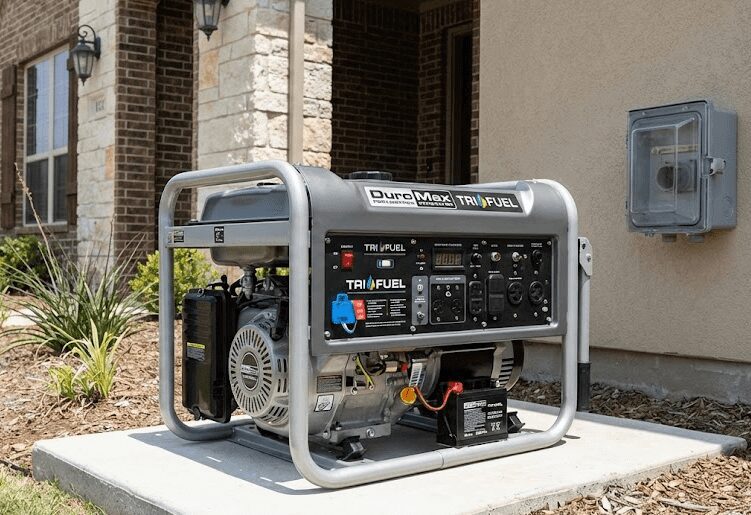
The most common portable generators in the DFW area — typically 3,500W to 10,000W, most with a 30 amp L14-30 outlet. These pair directly with a standard 30 amp inlet and interlock setup. See our honest comparisons: Champion vs. Westinghouse and Champion vs. Predator.
Generac Portable (GP & GP Series)
Generac's portable lineup (not the standby units) ranges from 3,600W to 17,500W. Most mid-size models use the L14-30 outlet — larger models may have a 50 amp outlet. These connect cleanly to an inlet and interlock setup.
Kohler, Briggs & Stratton Portable
Both brands offer quality portable generators in the 5,000W–12,000W range. Outlet type varies by model — we confirm before sizing the inlet. See our Kohler vs. Briggs & Stratton comparison if you're still deciding on a generator.
Dual-Fuel Inverter Generators (Honda, Yamaha, etc.)
High-quality inverter generators are quieter and more fuel-efficient but typically max out at 30 amp output. They connect the same way — 30 amp inlet and interlock — and are a great option for homeowners who want a quieter setup.
⚠️ Don't Have a Generator Yet? We're happy to advise on what size and type makes sense for your home's needs and budget before you buy. It's much easier to match the install to the generator than to retrofit the wrong setup later. Call us before you purchase and we'll point you in the right direction.


Want Fully Automatic Backup Power Instead?
A Generac whole home standby generator starts itself within 10 seconds of an outage — no action required, runs on natural gas, covers your entire home. If you're weighing both options, we can walk you through the difference in cost and coverage.
Learn About Whole Home Generac Installation →Why North Richland Hills Homeowners Choose Epic Electrical
What Makes Us Different
- We size the inlet correctly — 30 amp vs. 50 amp depends on your specific generator. We confirm before we install, not after.
- We verify panel compatibility — Not every panel works with every interlock kit. We check your panel model before recommending an approach.
- We pull permits — Required for this work in most DFW cities. Skipping permits affects your insurance and creates issues at resale.
- Honest, upfront pricing — No surprise costs. You know what it costs before we start. See our pricing for North Richland Hills.
- We test it with your actual generator — We don't leave until we've done a live test and you know exactly how to use the system.
- Family-owned and local since 2009 — We've done this throughout NRH, Hurst, Keller, Colleyville, Southlake, and across Tarrant County.
Generator Inlet & Interlock Installation Service Area
We install generator inlet outlets and interlock kits throughout North Richland Hills and the DFW Mid-Cities area, including:
Not sure if we cover your area? View our full service area map.
Related Electrical Services
Whole Home Generac Standby Generator
Want fully automatic backup that starts itself and runs on natural gas? We install Generac whole home standby generators — sized correctly, permitted, and coordinated start to finish.
Whole Home Generator InstallationElectrical Panel Replacement
Some panels aren't compatible with interlock kits or don't have available slots for a generator breaker. If your panel needs attention before or alongside the generator install, we handle it honestly.
Panel Replacement ServicesWhole-Home Surge Protection
Generator power can carry voltage spikes when it starts, stops, or shifts load. A whole-home surge protector shields your appliances and electronics from those spikes — worth adding at the same time.
Is a Whole-Home Surge Protector Worth It?Circuit Breaker Repair & Replacement
Adding a generator breaker gives us a chance to check the rest of your panel. If we spot any issues, we'll tell you — and fix only what needs fixing.
Circuit Breaker ServicesFrequently Asked Questions About Generator Inlet & Interlock Installation
How much does generator inlet and interlock installation cost in North Richland Hills?
A complete generator inlet outlet and interlock kit installation — inlet box, dedicated circuit wiring, interlock kit, generator breaker, and permit — typically runs $500–$1,200 in most DFW homes depending on panel location, wire run distance, and whether a manual transfer switch is used instead of an interlock. We provide a full itemized quote after seeing your home and generator.
Do I need a permit to install a generator inlet outlet in North Richland Hills?
Yes — a generator inlet outlet installation involves new electrical wiring connected to your panel, which requires an electrical permit in North Richland Hills and most surrounding DFW cities. We pull the permit, do the work to code, and pass inspection. Unpermitted generator connections can create issues with homeowner's insurance claims and home resale.
What's the difference between an interlock kit and a transfer switch?
An interlock kit is a mechanical device fitted to your existing main panel that prevents the main breaker and generator breaker from being on simultaneously — it uses your existing breakers and lets you select which circuits to power by switching them on or off individually. A manual transfer switch is a separate small sub-panel with dedicated circuits pre-selected for generator use. Both are safe and code-compliant. Interlock kits are generally less expensive; transfer switches are a better fit when your panel isn't interlock-compatible or you want a cleaner, pre-organized setup.
Will my portable generator run my central air conditioning?
It depends on your generator's wattage and your AC unit's size. A standard 3-ton central AC unit draws roughly 3,500–5,000 running watts plus a surge of 7,000–9,000 watts on startup. Most portable generators under 7,500W can't reliably handle a central AC unit — especially on a hot Texas day when the compressor is working hard. A 10,000W+ generator may manage a smaller AC unit. We give you an honest assessment based on your specific generator and AC equipment before promising anything.
Do I need a 30 amp or 50 amp inlet outlet?
The inlet amperage must match your generator's output. Most portable generators up to 7,500 watts use a 30 amp L14-30 outlet — these get a 30 amp inlet. Generators 8,000 watts and above often have a 50 amp outlet — these get a 50 amp inlet. We verify your generator's specs before ordering anything. Read our full breakdown of 30 amp vs. 50 amp generator inlets for more detail.
Where should the generator inlet outlet be installed?
The inlet outlet is typically mounted on an exterior wall of the garage or the home's exterior near the electrical panel — close enough to keep the wiring run short and the install clean. Code requires the generator itself to be positioned at least 5 feet from any opening (doors, windows, vents) to prevent carbon monoxide from entering the home. We assess the best location for both the inlet and where you'll park the generator during an outage as part of our planning.
Can I use my portable generator without an inlet outlet — just extension cords?
Technically yes for small individual appliances, but it has real limitations and risks. Extension cords can only power individual items — not hardwired appliances like your HVAC, well pump, or garage door. Heavy-gauge cords running through doorways or windows are trip hazards and aren't rated for long-term load. And running cords through closed doors or windows can damage the cord insulation. A proper inlet outlet and interlock gives you real whole-home backup capability safely and cleanly.
Let's Get Your Generator Connected the Right Way.
Inlet outlet, interlock kit, permit, and a live test with your generator — done right the first time. Call Epic Electrical, serving North Richland Hills and the DFW Mid-Cities since 2009.
Call (682) 478-6088Or schedule online: epicelectrical.com/contact-us