
Champion vs Predator Generator: Which Budget Brand is Worth Your Money in 2026?
⚡ Key Takeaways
- Warranty Winner: Champion offers 3 years vs Predator’s 90 days (unless you buy extended coverage)
- Price Winner: Predator costs $200-300 less upfront for comparable wattage models
- Fuel Flexibility: Champion dominates dual-fuel and tri-fuel options—critical for Texas fuel storage challenges
- Quietest Operation: Predator’s Super Quiet line edges out Champion for strict DFW noise ordinances
- Texas Heat Reality: Predator has documented overheating issues above 95°F; Champion handles heat better
- Best Overall Value: Champion 3500W Dual-Fuel ($901) balances features, warranty, and fuel flexibility
- Best Budget Pick: Predator 3500W Super Quiet ($799) if you need the lowest noise and lowest price
- Neither is Perfect: Both are Chinese-made budget brands—not Honda quality, but good enough for backup power
- Safety First: Both need proper transfer switch installation by a licensed electrician (never backfeed through outlets)
You Need Backup Power, But You’re Stuck Between Two Choices
You’re researching generators because the power keeps going out in DFW. Maybe it was the summer heat that pushed ERCOT to the edge again, or maybe it was a winter storm that knocked out your neighborhood for three days. Either way, you know you need backup power.
But now you’re stuck. You’ve read reviews that say Champion is worth every penny. Then you see the Predator at Harbor Freight for $200 less and wonder if you’re about to waste money on the wrong one. Someone online swears by their Predator that’s lasted five years. Another person says theirs died after 30 hours.
Here’s what nobody tells you upfront: It’s not about which brand is “better.” It’s about which one fits your situation—your budget, your fuel situation, and whether your city’s noise rules will even let you run it at night.
As electricians who install and service generators across Fort Worth, Arlington, and the DFW metroplex, we’ve seen both brands work well and both brands fail. We’ve also seen homeowners make expensive mistakes by choosing based on price alone. This comparison will help you understand what you’re actually getting with each brand—the good, the frustrating, and the stuff the reviews don’t mention.
💡 What You Really Need to Know
Champion and Predator both make functional backup generators for under $1,200. Champion trades higher price for better warranty and fuel flexibility. Predator trades warranty length for lower upfront cost. Neither is Honda-level quality, but both can keep your fridge and AC running when the power goes out—if you pick the right one and install it correctly.
The Honest Truth About Budget Generators
Let’s address the elephant in the room: both Champion and Predator generators are manufactured in China. They’re not Honda. They’re not Generac. And that’s okay for most homeowners who need backup power a few times a year.
Champion Power Equipment has been around since 2003 and designs its own engines, sourcing from established Chinese manufacturers like Zongshen and Loncin. Harbor Freight’s Predator line uses engine designs that are widely recognized as “Honda clones”—essentially reverse-engineered copies of proven Honda GX series engines.
The term “clone” sounds negative, but it’s resulted in a surprisingly reliable engine with a massive DIY repair community. You can find parts, tutorials, and troubleshooting guides for both brands all over YouTube and RV forums.
What We Believe
You don’t need the most expensive generator. You need one that actually works when the power goes out. That means picking based on warranty, fuel type, and whether you can legally run it in your neighborhood at night—not just the wattage number on the box.
What “worth your money” actually means: It’s not just the sticker price. It’s the total cost over five years including maintenance, fuel, and the likelihood you’ll need to replace it. A $500 generator that dies in two years costs more than a $900 generator that lasts ten.
For DFW homeowners, there’s another factor most reviews ignore: fuel storage. Texas humidity and 100-degree heat turn gasoline into varnish in about 30 days if you don’t add stabilizer. That’s why dual-fuel generators that run on propane are so popular here—propane doesn’t go bad.
If you’re planning to connect a generator to your home’s electrical system, you’ll need a licensed electrician to install a transfer switch or interlock kit. Backfeeding power through a regular outlet isn’t just illegal in Texas—it can kill utility workers trying to restore your power.
Champion Generators: What You’re Actually Getting
Champion Power Equipment built its reputation on one thing: fuel flexibility. In 2026, Champion offers more dual-fuel and tri-fuel models under $1,200 than any other budget brand. For DFW residents dealing with fuel storage challenges, this is a major advantage.
The Champion Advantage
Here’s what you get when you buy Champion:
Dual-fuel and tri-fuel options: Champion’s portable lineup includes models that run on gasoline, propane, or natural gas. The carburetor design switches between fuel types without hardware modifications. You flip a valve, and it works. This is huge for Texas homeowners who don’t want to store gasoline that goes stale in the heat.
3-year warranty: Champion’s standard residential warranty covers parts and labor for one year, then parts-only for years two and three. That’s 12 times longer than Predator’s 90-day standard coverage. For commercial use, the warranty drops to 270 days, but most homeowners qualify for the full three years.
Better for DFW’s fuel challenges: High humidity and temperature swings make gasoline break down faster. Champion’s propane capability means you can store 20-pound tanks indefinitely without worrying about fuel going bad. Propane also burns cleaner, which means less carbon buildup in the engine.
More models in the $400-$1,200 range: Champion offers eight different models in this price bracket, from lightweight 2000W inverters to heavy-duty 9000W units. That gives you more options to match your actual power needs.
Champion’s Warranty Edge
Champion’s residential warranty is 12 times longer than Predator’s standard 90-day coverage. That’s 1,095 days vs 90 days of protection against defects.
Champion’s Trade-Offs
Nothing’s perfect. Here’s what you sacrifice with Champion:
Slightly higher initial cost: Comparable Champion models typically cost $100-300 more than Predator equivalents. A Champion 3500W inverter runs about $901, while Predator’s 3500W is $799.
Heavier units: Champion’s dual-fuel models weigh 10-15 pounds more than Predator’s gas-only versions because of the additional fuel system components. If you’re in your 70s or have mobility issues, the extra weight matters.
Sometimes harder to find locally: Champion is sold through Home Depot, Lowe’s, and Tractor Supply. If your local store is out of stock, you’re ordering online and waiting. Harbor Freight has over 100 Texas locations, making Predator easier to find immediately.
Popular Champion Models for DFW Homes
| Model | Running Watts | Fuel Type | Noise Level | Weight | Price |
|---|---|---|---|---|---|
| 201317 (2500W) | 2,000W | Gasoline | 53 dBA | 39 lbs | $479 |
| 201319 (3500W) | 3,500W | Dual-Fuel | 61 dBA | 95 lbs | $901 |
| 201223 (4000W) | 4,000W | Tri-Fuel | 68 dBA | 124 lbs | $661 |
| 201407 (9000W) | 9,000W | Gasoline | 72 dBA | 152 lbs | $1,100 |
Our pick for most DFW homeowners: The Champion 201319 (3500W Dual-Fuel at $901) hits the sweet spot. It’s quiet enough for most neighborhoods, powerful enough to run a fridge and window AC unit, and the dual-fuel capability solves the gasoline storage problem.
For those in Plano or Dallas with strict 55-58 dBA nighttime noise limits, the Champion 201317 (2500W at $479) is the only budget option that consistently meets code. At 53 dBA, it’s quieter than a normal conversation.
Predator Generators: The Harbor Freight Gamble
Predator’s business model is fundamentally different from Champion’s. Harbor Freight sells Predator generators through its own stores, which gives them control over warranty service. Instead of shipping a broken unit back to the manufacturer, you walk into Harbor Freight and exchange it. For many DFW homeowners, that convenience is worth more than a longer warranty.
The Predator Advantage
Lowest upfront cost: Predator consistently undercuts Champion by $200-300 on comparable models. The Predator 3500W Super Quiet inverter is $799 vs Champion’s $901 for similar specs. If your budget is tight, Predator lets you get backup power now instead of waiting.
Super Quiet models are actually quieter: Predator’s “Super Quiet” line operates at 56-58 dBA, which is 3-5 decibels quieter than Champion’s equivalent inverters. That difference is noticeable to your neighbors and critical for meeting strict DFW noise ordinances.
Easy warranty process: Harbor Freight’s “exchange-based” warranty means you don’t ship anything. You bring the broken generator to the store, they give you a new one. During an emergency, when you need power immediately, this beats waiting for parts to arrive.
Bigger fuel tanks = longer runtime: The Predator 5000W inverter has a 3.8-gallon tank vs Champion’s 2.3-gallon tank in comparable models. That translates to 18+ hours of runtime at 25% load vs 14 hours for Champion. Fewer refills during extended outages.
💡 The Predator Sweet Spot
Predator excels for homeowners who prioritize upfront savings and have access to a Harbor Freight location nearby. If you’re mechanically inclined and comfortable with basic generator maintenance, Predator’s lower price and easy exchange warranty make it a compelling choice.
Predator’s Trade-Offs
The lower price comes with real compromises:
Only 90-day standard warranty: Three months of coverage is barely enough to get through a single Texas summer. If something breaks in month four, you’re paying for repairs. Harbor Freight offers Extended Service Plans, but they cost $139-299 depending on the model.
Fewer dual-fuel options in budget range: As of 2026, Predator offers dual-fuel in the 5000W ($1,099) and 13000W ($1,299) models. If you want dual-fuel below $1,000, Champion is your only option.
Known overheating issues in Texas summer heat: This is documented across RV forums and verified by user reports. Predator inverters, especially the 3500W model, can overheat and shut down when running in direct sunlight above 95°F. The solution is shade or a reflective tarp, but it’s an extra hassle Champion owners don’t deal with as often.
CO sensor failures: The CO Secure carbon monoxide sensor has a higher failure rate on Predator units. When it malfunctions, it thinks there’s dangerous CO present and shuts down the generator even in well-ventilated outdoor spaces. This is fixable, but it’s frustrating during an outage.
Predator Overheating in DFW Conditions
Multiple users report Predator 3500 and 5000 models shutting down after 15-30 minutes when running in 90°F+ heat in direct sun. The unit gets hot, thermal protection kicks in, and power cuts off. Some users drill ventilation holes in the case (voiding warranty) or cover the generator with reflective tarps to manage heat. Champion units have better heat dissipation and handle Texas summers more reliably.
Popular Predator Models for DFW Homes
| Model | Running Watts | Fuel Type | Noise Level | Weight | Price |
|---|---|---|---|---|---|
| 2500W Super Quiet | 2,000W | Gasoline | 58 dBA | 46 lbs | $550 |
| 3500W Super Quiet | 3,000W | Gasoline | 56 dBA | 99 lbs | $799 |
| 5000W Dual-Fuel | 3,900W | Dual-Fuel | 61.7 dBA | 118 lbs | $1,099 |
| 9500W Super Quiet | 7,600W | Gasoline | 67 dBA | 196 lbs | $1,999 |
Our pick for budget-focused buyers: The Predator 3500W Super Quiet ($799) offers the best noise-to-price ratio. At 56 dBA, it meets Dallas and Plano’s strict nighttime noise requirements and costs $100 less than Champion’s equivalent. Just keep it out of direct sunlight during use.
Champion vs Predator: The Real Differences That Matter
Now that you know what each brand offers, let’s break down the specific differences that affect your daily use and long-term satisfaction.
Warranty: 3 Years vs 90 Days
This is the most significant difference between the two brands.
Champion’s 3-year warranty covers:
- Year 1: Parts and labor
- Years 2-3: Parts only (you pay for labor)
- Residential use only (drops to 270 days for commercial)
- You ship the unit to an authorized service center at your expense
Predator’s 90-day warranty covers:
- 90 days: Full replacement at Harbor Freight store
- Emissions system: 2 years (engine components only)
- After 90 days: Out of warranty unless you bought Extended Service Plan
Real cost of extended service plans: Harbor Freight’s Extended Service Protection runs $139-299 depending on generator price. It adds 1-2 years of coverage and works as a one-time replacement—meaning once you use it for any repair, the plan is done. If your battery dies in month six and you use the plan, you’re unprotected for the rest of the coverage period.
For most DFW homeowners who run generators 20-50 hours per year, Champion’s 3-year warranty provides more value even though the generator costs more upfront. If something breaks in year two, you’re covered for parts. With Predator, you’re paying out of pocket or hoping you bought the extended plan.
Warranty Value Comparison
The cost difference between Champion ($901) and Predator ($799) is $102. Adding Predator’s extended plan ($139) makes total cost $938—$37 more than Champion with inferior coverage. Champion wins on warranty value.
Fuel Options: Why This Matters in DFW
Gasoline is convenient, but it’s a terrible fuel for backup generators in North Texas.
The gasoline problem: In Texas heat and humidity, gasoline begins breaking down in 30 days. The ethanol in pump gas attracts moisture, which creates varnish that clogs carburetor jets. By month three, that untreated gas will prevent your generator from starting—exactly when you need it most during an outage.
Why propane solves this: Propane (LPG) has an indefinite shelf life. A 20-pound tank sitting in your garage for two years will work perfectly when you need it. Propane also burns cleaner, producing less carbon buildup in the engine and exhaust system. It’s slightly less efficient than gasoline (you get about 10% less runtime), but the trade-off is worth it for peace of mind.
Champion’s fuel flexibility advantage: Champion offers eight models with dual-fuel or tri-fuel capability under $1,200. Predator offers two. If you want the ability to run on propane without spending over $1,000, Champion is your only realistic option.
💡 DFW Fuel Storage Tip
Store two 20-pound propane tanks (the kind for gas grills) and connect them to a dual-fuel generator. Each tank provides 8-10 hours of runtime at 50% load. You’ll never worry about stale gasoline again, and propane is available everywhere—even when gas stations lose power.
Noise Levels: Can You Legally Run It at Night?
DFW’s suburbs have some of the strictest noise ordinances in Texas. Running an illegal generator at night can result in police visits and fines of $200-500.
Dallas requires generators to operate below 56-58 dBA at night (10 PM – 7 AM). Plano is even stricter at 55 dBA. Fort Worth allows 60 dBA. Most open-frame generators run at 72-78 dBA, which means they’re illegal to operate overnight in these cities.
Which models meet DFW noise requirements:
| City | Nighttime Limit | Legal Champion Models | Legal Predator Models |
|---|---|---|---|
| Dallas | 56-58 dBA | 201317 (53 dBA) | 3500W (56 dBA), 2500W (58 dBA) |
| Plano | 55 dBA | 201317 (53 dBA) | None consistently under 55 dBA |
| Fort Worth | 60 dBA | Most inverter models | Most inverter models |
| Arlington | 65 dBA | All models | All models |
If you live in Plano or Dallas, the Champion 201317 (2500W at 53 dBA) is realistically the only budget generator that consistently meets code for overnight use. Predator’s 3500W Super Quiet is close at 56 dBA, but it’s right at the threshold and could exceed limits under heavy load.
Reliability in Texas Heat
Texas summers are brutal on small engines. Air-cooled generators rely on proper ventilation to dissipate heat, and when ambient temperatures hit 100-110°F, the engines struggle.
Predator’s documented overheating problems: User reports from RV forums, Reddit, and product reviews consistently mention Predator units shutting down when running in direct sunlight above 95°F. The thermal protection system detects overheating and cuts power to prevent engine damage. Some users have drilled additional ventilation holes in the case (which voids the warranty) or operate the unit under reflective tarps.
Champion’s better heat management: Champion inverters use a slightly different cooling design with larger intake vents. While they still generate significant heat, the failure rate from thermal shutdown is lower. Champion owners report fewer issues running in direct summer sun, though best practice for any generator is to operate in shade when possible.
Oil requirements for 100°F+ operation: Both brands ship with conventional 10W-30 oil. For DFW summers, switching to full synthetic 5W-30 after the break-in period (first 20 hours) significantly improves heat tolerance. Synthetic oil maintains viscosity better at extreme temperatures, reducing wear and the risk of thermal shutdown.
✅ Heat Management Checklist for DFW Generators:
- Switch to full synthetic oil after break-in period
- Run generator in shade whenever possible
- Ensure 3-4 feet of clearance on all sides for airflow
- Clean cooling vents every 50 hours of use
- Never run generator inside garage, shed, or carport (carbon monoxide risk)
- Monitor oil level every 8-10 hours during extended outages
Runtime & Fuel Efficiency
During an extended outage (like the 2021 freeze when some DFW homes lost power for 72+ hours), runtime between refills becomes critical. Refueling in the dark, in freezing rain, or in 100-degree heat is dangerous and exhausting.
Side-by-side comparison at 25% and 50% load:
| Model | Fuel Tank | Runtime @ 25% | Runtime @ 50% | Consumption Rate |
|---|---|---|---|---|
| Champion 3500W | 2.3 gallons | 14 hours | ~8 hours | 0.16 GPH |
| Predator 3500W | 2.9 gallons | 11 hours | ~7 hours | 0.26 GPH |
| Champion 4500W | 2.3 gallons | 14 hours | ~8 hours | 0.16 GPH |
| Predator 5000W | 3.8 gallons | 18.2 hours | ~10.5 hours | 0.20 GPH |
Why bigger fuel tanks matter: The Predator 5000W’s 3.8-gallon tank is 65% larger than Champion’s 2.3-gallon tanks. That extra capacity means you can sleep through the night without refueling. During the 2021 freeze, homeowners with smaller tanks had to set alarms every 6-8 hours to refuel. With an 18-hour runtime, you refuel once a day instead of three times.
However, keep in mind that larger tanks also mean heavier generators. The Predator 5000W weighs 118 pounds, which makes it difficult for one person to move.
What Actually Goes Wrong With These Generators
No generator is perfect. Here’s what we’ve seen fail on both brands based on service calls, warranty claims, and user reports from DFW homeowners.
Champion’s Most Common Issues
Heavier weight creates portability problems: Champion’s dual-fuel models weigh 95-124 pounds. For homeowners over 65 or with limited mobility, moving the generator from storage to the driveway during an outage is physically challenging. Some customers add aftermarket wheel kits, but that’s an extra $50-80.
Carburetor issues if gas goes stale: This affects both brands equally, but Champion owners sometimes assume dual-fuel capability means they don’t need to maintain the carburetor. If you run gasoline through a Champion once and then store it for six months, the gasoline in the carburetor jets will varnish. The fix is to run the carburetor dry before storage (Champion includes a fuel shutoff valve to make this easy) or use fuel stabilizer.
Plastic fuel valves crack over time: Some Champion models use plastic petcocks (fuel shutoff valves) that become brittle in UV exposure and can crack after 3-4 years. The replacement part costs $15, but it’s frustrating when it fails mid-outage. Later model years have switched to metal valves.
Predator’s Most Common Issues
Overheating in direct sunlight: We’ve covered this already, but it’s worth repeating because it’s the #1 complaint. Predator 3500W and 5000W inverters overheat and shut down in 90°F+ temperatures when running in direct sun. The solution is shade or reflective coverings, but it shouldn’t be necessary for a unit operating within its rated specifications.
CO sensor failures shut down the unit incorrectly: The CO Secure sensor is supposed to detect dangerous carbon monoxide levels and shut down the generator. However, the sensor has a higher failure rate on Predator units. When it malfunctions, it reads false positive CO levels and shuts down the generator even when operating in a well-ventilated outdoor space. The sensor costs $30-50 to replace, but during an outage, you’re stuck without power until you can get to Harbor Freight.
Carburetor gumming from ethanol gas: Same issue as Champion. Ethanol-blend gasoline attracts moisture and creates varnish deposits in carburetor jets. The Predator carburetor is slightly harder to access for cleaning than Champion’s, requiring removal of more external components.
Pull cord failures after heavy use: Some users report the recoil starter pull cord fraying or breaking after 50-100 pulls. This is often due to improper starting technique (yanking too hard) or storing the unit with tension on the spring. The replacement part is cheap ($15), but installation requires partial disassembly.
Battery issues on electric start models: The included battery on Predator electric-start models doesn’t always hold a charge long-term. If the generator sits unused for 4-6 months, the battery may be dead when you need it. Some owners bypass this by jump-starting from a car battery or using the manual recoil starter as backup.
⚠️ Both Brands Use Carburetors That Hate Ethanol
The #1 preventable failure for both Champion and Predator is carburetor varnish from stale ethanol gasoline. Use ethanol-free gas (available at some Texas stations), add fuel stabilizer, or switch to propane. If storing for more than 30 days, run the carburetor dry by shutting off the fuel valve and letting the engine run until it stalls.
How to Prevent These Problems
✅ Maintenance Checklist for Texas Conditions:
- Use ethanol-free gasoline or add fuel stabilizer to every tank
- Switch to propane for long-term storage (Champion dual-fuel models)
- Change oil every 50 hours or twice a year, whichever comes first
- Use full synthetic 5W-30 oil in DFW summers (after break-in period)
- Store generator in shade during operation (especially Predator units)
- Run the generator every 2-3 months for 20-30 minutes to keep seals lubricated
- Clean or replace air filter every 50 hours or when visibly dirty
- Check spark plug every 100 hours; replace if fouled
- Run carburetor dry before storage longer than 30 days
- Keep battery charged on electric-start models (use trickle charger during storage)
Following this maintenance schedule extends generator life from 1,500 hours to 3,000+ hours for both brands. That’s the difference between 10 years of service and 5 years.
The Bottom Line: Champion or Predator?
After comparing specs, warranty, real-world performance, and common failures, here’s our recommendation based on different buyer priorities.
Choose Champion If:
- You want fuel flexibility (dual-fuel or tri-fuel models)
- You value a real 3-year warranty over extended service plans
- You can afford $100-300 more upfront for better long-term value
- You want fewer long-term headaches and better corporate support
- You’re buying for long-term use (10+ years with proper maintenance)
- You prioritize parts availability through national dealer networks
Choose Predator If:
- Budget is your #1 priority and you need backup power now
- You’re comfortable with DIY repairs and basic maintenance
- You need the quietest option available (3500W Super Quiet at 56 dBA)
- You live near a Harbor Freight for easy warranty exchanges
- You’re willing to manage heat issues (shade, ventilation mods)
- You prefer a “replacement-based” warranty over traditional repair networks
For Most DFW Homeowners, We Recommend:
Best Overall Value: Champion 3500W Dual-Fuel (Model 201319, $901)
- Runs on gasoline or propane (solves fuel storage issues)
- 3-year warranty provides real protection
- Quiet enough at 61 dBA for most DFW neighborhoods
- 3,500 running watts handles fridge, window AC, and essentials
Best Budget Pick: Predator 3500W Super Quiet ($799)
- Meets Dallas and Plano’s strict nighttime noise limits (56 dBA)
- $100+ cheaper than Champion equivalent
- Easy Harbor Freight exchange warranty
- Just keep it out of direct sunlight during use
Best Lightweight Option: Champion 2500W Inverter (Model 201317, $479)
- Only 39 pounds—easy for anyone to move
- Quietest option at 53 dBA (legal everywhere in DFW)
- Perfect for camping, tailgating, or small backup needs
- Long 3-year warranty on a budget-friendly unit
| Your Situation | Best Choice | Why |
|---|---|---|
| Tight budget, need power now | Predator 3500W ($799) | Lowest price, quietest, easy exchange warranty |
| Want to avoid fuel storage hassles | Champion 3500W Dual-Fuel ($901) | Propane doesn’t go stale, runs clean, 3-year warranty |
| Live in Dallas or Plano (strict noise rules) | Champion 2500W ($479) | 53 dBA meets even the strictest codes |
| Need whole-home backup power | Champion 9000W ($1,100) | Enough power for central AC, well pump, appliances |
| Want longest runtime per tank | Predator 5000W Dual-Fuel ($1,099) | 3.8-gallon tank = 18+ hours at 25% load |
How to Actually Use This Thing Safely
Buying a generator is the easy part. Using it safely and legally is where most homeowners make dangerous mistakes. As electricians, we’ve seen improper generator connections cause house fires, electrocute utility workers, and destroy expensive appliances.
Carbon Monoxide Is No Joke
Both Champion and Predator include CO Secure/CO Shield sensors that automatically shut down the generator if carbon monoxide levels get dangerous. But the sensor isn’t foolproof—especially on Predator units where sensor failures are more common.
Safe generator placement rules:
- Minimum 20 feet from any door, window, or vent opening
- Never in garage, shed, carport, or covered patio (even with door open)
- Exhaust must point away from house
- Place on hard, level surface (concrete or gravel—not grass)
- Ensure adequate ventilation on all four sides (3-4 feet clearance)
Carbon monoxide is odorless and colorless. By the time you feel symptoms (headache, dizziness, nausea), you’ve already been exposed to dangerous levels. During the 2021 freeze, improper generator placement led to multiple CO poisoning incidents across DFW.
Never Backfeed Through a Dryer Outlet
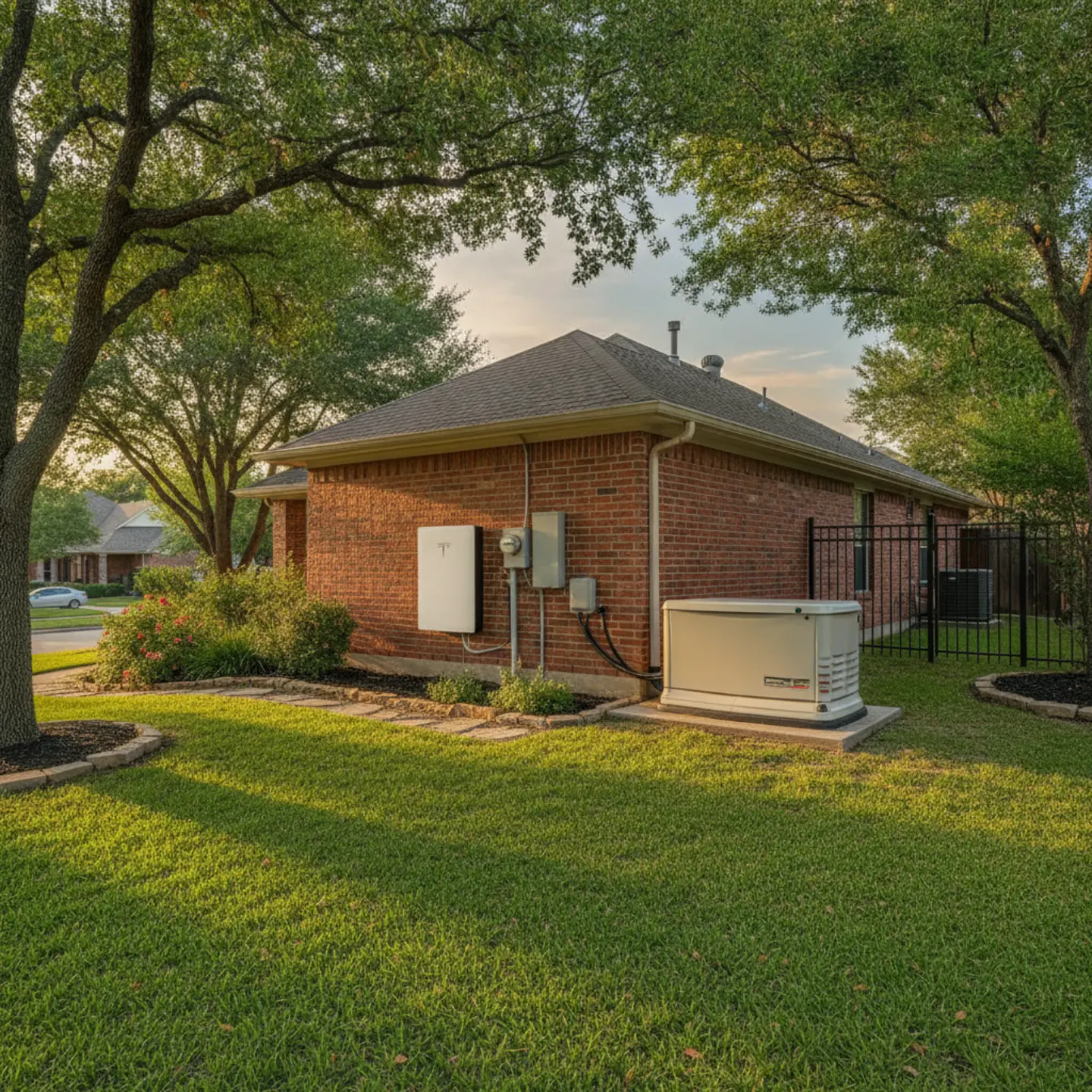
We’ve seen homeowners try to power their house by plugging a generator into a dryer outlet or range outlet. This is called “backfeeding” and it’s illegal in Texas for three reasons: (1) It can electrocute utility workers trying to restore power to your neighborhood, (2) It can destroy your generator and appliances when grid power returns, and (3) It bypasses overcurrent protection, creating a house fire risk. The ONLY safe way to connect a generator to your home is through a UL-listed transfer switch or interlock kit installed by a licensed electrician.
Connecting to Your Home: The Legal Way
If you want to power more than a few extension cords, you need a proper connection system. Texas electrical code allows two methods:
Generator Interlock Kit: This is a metal sliding plate installed on your main electrical panel that prevents the main breaker and generator breaker from being on at the same time. You manually flip breakers to select which circuits the generator powers. Interlock kits cost $150-300 installed and are the most budget-friendly option.
Manual Transfer Switch: This is a separate sub-panel that permanently connects specific circuits to a generator inlet. You flip a switch to choose grid power or generator power for those circuits. Transfer switches cost $500-1,200 installed but provide better circuit management.
DFW Installation Note: If you’re in the Tri-County Electric (TCEC) service area (parts of Tarrant, Denton, Parker counties), TCEC requires UL-listed transfer switches and explicitly prohibits interlock kits. Check with your utility provider before installation.
What Epic Electrical Recommends
We install both interlock kits and transfer switches across the DFW metroplex. For homeowners with Champion or Predator generators in the $800-1,100 range, here’s what we typically recommend:
- UL-listed interlock kit for most residential installations (budget-friendly, code-compliant)
- Proper grounding to prevent shock hazards and protect sensitive electronics
- 30-amp generator inlet mounted on exterior wall with weatherproof cover
- Whole-house surge protector to protect appliances from voltage spikes when switching power sources
- Professional installation to meet 2023 National Electrical Code and local requirements
The cost for professional interlock kit installation typically runs $400-650 including parts and labor. A transfer switch installation runs $800-1,500 depending on the number of circuits. This is money well spent—improper installation voids generator warranties and creates liability if something goes wrong.
What to Do If You Already Have a Generator
If you bought a Champion or Predator generator but haven’t had it professionally connected, schedule an electrical safety assessment. We’ll evaluate your electrical panel, recommend the right connection method for your setup, and install it to code. Don’t risk your safety or your home with extension cords running through windows.
Your Generator Questions Answered
Is Champion better than Predator?
Not “better,” just different. Champion offers better warranty (3 years vs 90 days) and more dual-fuel options, which makes it ideal for homeowners who value long-term support and fuel flexibility. Predator offers lower upfront cost and slightly quieter operation, making it better for budget-focused buyers who can handle basic maintenance. Both brands work fine for backup power—the right choice depends on your priorities.
How long do Champion and Predator generators last?
With proper maintenance, Champion generators typically last 2,000-3,500 hours before needing major repairs. Predator generators last 1,500-2,500 hours on average. For most DFW homeowners using generators 20-50 hours per year for backup power, that translates to 15-25 years of service for Champion and 10-20 years for Predator. The key is regular oil changes, using clean fuel, and running the generator every 2-3 months to keep internal seals lubricated.
Will a Predator generator overheat in Texas summer?
Yes, Predator inverters (especially the 3500W and 5000W models) have documented overheating issues when running in direct sunlight above 95°F. The thermal protection system detects excessive heat and shuts down the generator to prevent engine damage. The solution is to run the generator in shade, use a reflective tarp cover, or ensure maximum airflow on all sides. Champion generators have better heat dissipation and experience fewer thermal shutdowns in Texas summer conditions.
Can I run my AC on a budget generator?
Yes, but you need at least 3,500 running watts to start and run a typical 15,000 BTU window AC unit or a small central AC system. Both the Champion 3500W and Predator 3500W can handle this load. For larger central AC systems (3-ton or bigger), you’ll need 7,000+ running watts, which means the Champion 9000W or Predator 9500W models. Keep in mind that AC draws the most power at startup (surge watts), so check your generator’s starting watts specification.
Do I need a transfer switch or can I use extension cords?
Extension cords work for powering a few items (fridge, fans, lights) but they’re not a whole-home solution. For safety and convenience, you need a UL-listed transfer switch or interlock kit installed by a licensed electrician. This is Texas electrical code for connecting a generator to your home’s electrical panel. Extension cords through windows create tripping hazards, let in bugs and weather, and can’t safely handle the load of large appliances like AC units or well pumps.
Where can I buy these in the DFW area?
Champion generators are sold at Home Depot, Lowe’s, and Tractor Supply stores throughout DFW. Predator generators are sold exclusively at Harbor Freight Tools, which has over 100 locations in Texas including multiple stores in Dallas, Fort Worth, Arlington, Plano, and surrounding suburbs. For immediate availability during outages, Harbor Freight’s dense store network gives Predator an advantage—you can drive to a store and buy one the same day.
Is the extended warranty worth it for Predator?
Absolutely. Predator’s standard 90-day warranty is too short to provide meaningful protection. For $139-299 depending on the model, Harbor Freight’s Extended Service Plan adds 1-2 years of coverage and makes the warranty competitive with Champion. However, understand that it’s a one-time replacement plan—once you use it for any repair, the coverage ends. If you’re buying Predator without the extended plan, you’re essentially self-insuring after 90 days.
You Don’t Need Perfect—You Need Prepared
After comparing warranty, fuel options, noise levels, reliability in Texas heat, and real-world failures, here’s what matters most:
Both brands work. Neither is perfect. Champion offers better warranty and fuel flexibility. Predator offers lower price and quieter operation. The “best” generator isn’t the one with the highest specs—it’s the one you actually buy and install correctly before the next outage.
The next ERCOT event is coming. Power demand in the DFW metroplex is growing faster than grid capacity. Summer peaks keep breaking records. Winter freezes expose distribution weaknesses. Whether it’s a 3-hour rolling blackout or a 3-day weather event, you need backup power ready to go.
Don’t wait until the power goes out. When outages hit, generators sell out within hours. Prices spike. Installation delays stretch to weeks. The time to prepare is now, while you can compare options, get proper installation, and test everything before an emergency.
Pick based on your priorities:
- Want fuel flexibility and better warranty? → Champion 3500W Dual-Fuel ($901)
- Need lowest price and quietest operation? → Predator 3500W Super Quiet ($799)
- Live in strict noise zones? → Champion 2500W Inverter ($479)
Then get it installed safely by a licensed electrician. Extension cords through windows aren’t a backup plan. A properly installed transfer switch or interlock kit is.
Final Recommendation from Epic Electrical
For most DFW homeowners, the Champion 3500W Dual-Fuel offers the best balance of features, warranty, and long-term value. The ability to run on propane solves Texas fuel storage challenges, and the 3-year warranty provides real protection beyond the break-in period. If budget is tight, the Predator 3500W Super Quiet is a solid choice—just add the extended warranty and keep it out of direct sunlight during use.
Call or Text: (682) 478-6088
Serving Fort Worth, Arlington, Keller, Southlake, Colleyville, Grapevine, Lewisville, and all of DFW