Key Takeaways
- Installed cost in DFW — SPAN smart panel installations range from $4,500 to $15,000+ depending on your home’s existing electrical system, integration complexity, and required upgrades.
- Hardware is only part of the bill — The SPAN panel itself costs $2,500–$3,000; the rest is licensed labor, permits, inspections, and any necessary service upgrades.
- Federal tax credits may apply — The IRA Section 25C credit can cover up to 30% of qualifying costs, potentially worth $600–$1,200 annually (consult a tax professional).
- Installer quality is the biggest variable — Customer satisfaction with SPAN depends heavily on whether your installer holds SPAN Pro Certification and a valid Texas TECL license.
- Real energy savings are modest but real — Typical bill savings are $50–$300/year through TOU rate optimization; EV charging optimization can save $500–$1,500/year.
- SPAN isn’t for everyone — If your panel is less than 10 years old and you have no solar, battery, or EV plans, a traditional upgrade may serve you better.
- Always verify credentials — Check any DFW electrician’s TECL license at tdlr.texas.gov before signing anything. Never let anyone skip permits.
- DFW-specific drivers are real — ERCOT grid instability, rising EV adoption, and growing solar installations make smart panels more relevant in North Texas than in most U.S. markets.
Your electrician just told you that your 30-year-old panel is a fire hazard. You’re looking at an upgrade anyway — so why not go smart? But then you see SPAN panels cost $4,500 to $15,000 or more installed, and suddenly you’re asking three very reasonable questions: Is it actually worth it? Will it save me real money? And how do I know if the installer knows what they’re doing?
Those aren’t paranoid questions. They’re the right ones. A SPAN installation is a significant investment — and the honest answer is that it’s a great choice for some DFW homeowners and completely unnecessary for others. This guide gives you the straight story on costs, what real users think, how much you can actually save on your electricity bill, and how to find a qualified installer who won’t leave you holding a half-configured app and a stack of unpulled permits.
We’re a family electrical business — father and son, third generation — and we’ve built our reputation on telling people the truth, even when the truth is “you don’t need the expensive option.” So let’s get into it.
What Is a SPAN Smart Electrical Panel — and Why DFW Homeowners Are Considering Them
If you’re weighing residential electrical panel replacement options, understanding what makes SPAN different from a standard panel swap is the essential first step. A traditional electrical panel is a mechanical device — breakers trip, power flows or stops, and that’s about it. You have no visibility into which circuits are drawing power, no way to control them remotely, and no integration with solar, batteries, or EV chargers beyond basic wiring.
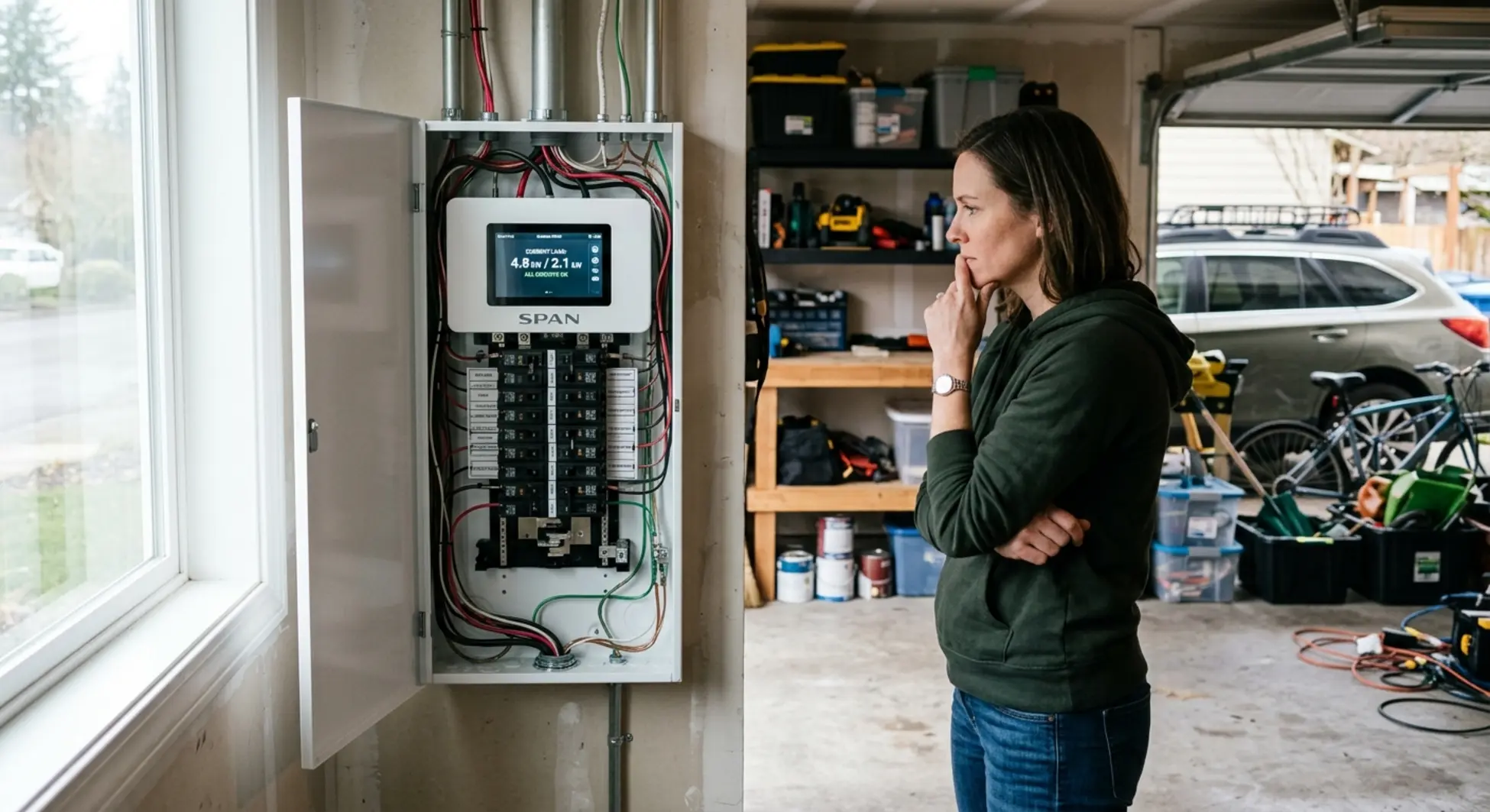
SPAN replaces your main electrical panel with a fully digital version that communicates with your home’s circuits via WiFi and connects to a smartphone app. It’s not a gadget bolted onto your existing panel — it is the panel. Every breaker is software-controlled, every circuit is monitored in real time, and the whole system integrates with solar inverters, battery backup systems like Tesla Powerwall, EV chargers, and smart home platforms.
How SPAN Works: The Basics
The SPAN app shows you real-time energy consumption per circuit — not just your total usage, but specifically how much power your HVAC, kitchen outlets, master bedroom, pool pump, or EV charger is drawing at any given moment. That level of visibility is genuinely useful. Most homeowners have no idea which circuits are their biggest energy consumers until they see it laid out in front of them.
Beyond monitoring, you can remotely control circuits, set automation rules (like “only charge the EV between 9 PM and 6 AM when rates are lowest”), and receive alerts when something unusual happens — a circuit drawing abnormally high power, for instance, which can be an early warning sign of a failing appliance or an electrical fault. During a grid outage, SPAN can automatically shed non-essential loads to extend your battery backup and prioritize critical circuits like your refrigerator, medical equipment, or internet router.
Why DFW Homeowners Are Upgrading Now
Several factors make the Dallas-Fort Worth market particularly relevant for smart panel adoption right now. Texas leads the nation in EV growth, and DFW counties — Dallas and Tarrant chief among them — are key markets with rapidly increasing EV registrations. Home charging is both more convenient and significantly cheaper than public charging, but it adds substantial electrical load. SPAN helps manage that load intelligently.
DFW has a specific grid reliability problem that most of the country doesn’t. Winter Storm Uri in 2021 wasn’t just a bad week — it was a wake-up call that ERCOT’s grid can fail when you need it most. That experience fundamentally changed how a lot of North Texas homeowners think about backup power, and it’s a legitimate driver for smart panel interest in this market.
Solar and battery storage adoption in DFW is also increasing as costs decline. SPAN is the natural control hub for a home that has solar panels, a battery backup system, and an EV charger — it coordinates all three to maximize self-consumption, minimize grid purchases during peak rate hours, and provide resilience during outages. And a substantial portion of DFW’s housing stock was built before 2000, meaning many homes have panels that are due for replacement anyway. If you’re upgrading regardless, the question becomes whether the premium for SPAN is justified — and for the right homeowner, it often is.
Time-of-Use (TOU) rate programs from DFW utilities like Oncor incentivize shifting high-load tasks to off-peak hours. SPAN automates this process, turning a theoretical savings opportunity into something that actually happens without you having to think about it every day.
SPAN Panel Installation Costs in Dallas-Fort Worth: What You’ll Actually Pay
Let’s talk numbers — real ones, not the “starting at” figures that disappear the moment an electrician walks through your door. Working with a licensed residential panel installation electrician in DFW means your costs will fall into one of three general ranges, depending on your home’s existing electrical system and what you’re integrating.
💬 You’re Not Alone in Wondering About Cost
Most homeowners are genuinely surprised by the $4,500–$15,000+ price tag for a SPAN installation. That’s a completely normal reaction — it’s a significant investment. The good news is that financing options, federal tax credits, and long-term energy savings can make it more affordable than it first appears. The key is understanding exactly what’s driving your specific cost before you sign anything.
Here’s the honest breakdown for the DFW market in 2026:
- Entry-level: $4,500–$6,500 — Standard 200A panel swap, basic configuration, no major service upgrades needed
- Mid-range: $6,500–$9,000 — Includes some upgrades, basic solar or EV integration
- Premium full-home integration: $9,000–$15,000+ — Service upgrade required, extensive solar/battery/EV integration, subpanel work
DFW labor rates run comparable to or slightly above the Texas state average, reflecting strong demand, a higher cost of living than most Texas metros, and the specialized nature of smart panel work. If you’ve been comparing quotes to national averages you found online, those figures likely undercount what you’ll actually pay here.
Breaking Down the Cost: Hardware vs. Labor vs. Permits
| Cost Component | Typical Range | Notes |
|---|---|---|
| SPAN Panel hardware | $2,500–$3,000 | MSRP; actual cost may vary by model |
| Licensed electrician labor | $1,500–$4,000+ | Depends on complexity and existing panel condition |
| Permits and inspections | $100–$500+ | Varies by DFW municipality |
| Service entrance upgrade (if needed) | $1,000–$5,000+ | Required if upgrading from 100A to 200A |
| Subpanel installation | $1,500–$3,000+ | Common for solar or EV setups |
| Trenching (outdoor work) | $500–$2,000+ | Meter relocation or outdoor subpanel |
| Drywall patching and finishing | $200–$500 | If wall access is required |
Hidden Costs That Surprise Homeowners
Permit fees vary significantly across DFW municipalities. Dallas, Fort Worth, Arlington, Plano, and Frisco all have different fee schedules, and some cities charge separate fees for the permit application and the post-installation inspection. Always ask your installer to itemize the full permit cost before work begins — not just the permit fee, but the inspection fee as well.
Existing wiring condition is another wildcard. Older DFW homes — and there are a lot of them, given that a substantial portion of the housing stock predates 2000 — sometimes have aluminum wiring, deteriorated insulation, or undersized conductors that need to be addressed before or during a panel upgrade. If your electrician discovers these issues mid-project, costs can escalate quickly. A thorough pre-installation assessment should catch most of these, which is one reason why the consultation phase matters.
Factors That Drive SPAN Costs Up or Down in DFW
The age and condition of your existing panel is the single biggest cost variable. A home with a relatively modern 200A panel in good condition is a straightforward swap. A home with a 100A service, deteriorated wiring, and a panel that hasn’t been touched since 1988 is a different project entirely — and potentially a much more expensive one. You can use our panel upgrade cost calculator to get a rough sense of what your specific situation might cost before you start calling installers.
Integration complexity also drives costs significantly. A SPAN panel installed as a standalone upgrade costs less than one that’s being integrated with an existing solar system, a Tesla Powerwall, and a Level 2 EV charger — but that more complex installation also delivers more value. Seasonal demand matters too: summer in DFW is peak season for electrical work, and you may face longer wait times and potentially higher pricing during July and August when every HVAC-related call is competing for the same licensed electricians.
Financing and Incentives: Making SPAN More Affordable
The sticker price is real, but it’s not the whole story. Understanding what incentives and financing options are available for electrical upgrades and home improvements can significantly reduce your out-of-pocket cost — sometimes by thousands of dollars.
Federal Tax Credits and How to Claim Them
The Inflation Reduction Act (IRA) Section 25C provides tax credits for qualified energy-efficient home improvements. SPAN’s smart electric load controller component may qualify if it meets specific efficiency criteria — the credit is up to 30% of the qualifying cost, capped at $600–$1,200 annually. This isn’t a rebate that arrives in the mail; it’s a credit against your federal tax liability, claimed on your return for the year the installation is completed.
The specifics matter here. Not every component of a SPAN installation necessarily qualifies, and eligibility depends on your income, the specific SPAN model installed, and how it’s classified by the IRS. Always verify current eligibility on Energy.gov and consult SPAN.IO for the latest manufacturer guidance before assuming the credit applies to your situation. And talk to a tax professional — this is not an area where you want to guess.
Local DFW Financing Options
SPAN.IO offers manufacturer-provided financing options — check their website for current APR, terms, and eligibility requirements, as these change periodically. Many DFW electrical contractors also partner with third-party lenders to offer 12–60 month payment plans, which can make a $7,000 installation feel much more manageable.
Home equity loans and HELOCs are widely available from DFW banks and credit unions. Rates have been in the 6–10% range in recent years, and for homeowners with significant equity, these options often offer lower rates than contractor financing. HELOCs are particularly useful if you’re planning a phased upgrade — adding solar now, battery storage later — because you can draw on the credit line as needed rather than borrowing everything upfront.
PACE (Property Assessed Clean Energy) financing may be available for some DFW homeowners doing energy efficiency upgrades. It’s worth checking whether your municipality participates, though PACE programs vary significantly in availability and terms across North Texas.
Total Cost of Ownership: 3–5 Year Outlook
Here’s an honest look at the numbers over time. Initial cost: $4,500–$15,000+. Annual subscription for core SPAN features: currently $0 (verify this on SPAN.IO, as premium features may carry future costs). Annual energy savings through TOU optimization: $50–$300+ for most homeowners. EV charging savings if you shift to off-peak home charging: potentially $500–$1,500/year compared to public fast charging.
For a homeowner spending $7,000 on a mid-range SPAN installation with EV charging integration, saving $800/year between TOU optimization and avoided public charging costs, and claiming a $1,200 federal tax credit, the effective out-of-pocket is closer to $5,800 — and the payback period is roughly 7 years. That’s a reasonable ROI for a system that also upgrades an aging panel, adds backup power capability, and increases home value. For homeowners without an EV or solar, the math is slower — closer to 10–15 years — which is why we’ll tell you honestly if a traditional panel upgrade makes more sense for your situation.
Not sure whether SPAN financing or tax credits apply to your specific situation? A free consultation with a certified installer can clarify your options and provide a detailed cost breakdown with no obligation.
SPAN Panel Reviews: What Real Users and DFW Homeowners Are Saying
Aggregate reviews for SPAN panels are generally positive, but the picture is more nuanced than a star rating suggests. The technology itself earns consistent praise. The installation experience is where things get variable — and that variability is almost entirely explained by whether the installer was SPAN-certified or not. Working with an experienced electrician for smart home installations in DFW makes the difference between a seamless setup and weeks of troubleshooting an app that was never properly commissioned.
📊 Installer Variability Is Real
Customer satisfaction with SPAN depends heavily on installer quality. A SPAN-certified installer will properly commission your app, configure integrations, and provide ongoing support. A non-certified electrician may leave you struggling with a setup that was never completed correctly. This is why credentials matter more with SPAN than with a standard panel swap.
What Users Love About SPAN
The app interface earns consistent praise across review platforms — Reddit threads, the App Store, and tech forums all note that it’s intuitive and visually clear. Most users can navigate it without any training. The circuit-level monitoring is genuinely eye-opening for many homeowners; seeing exactly how much power your pool pump draws versus your HVAC versus your EV charger gives you actionable information that a traditional panel simply can’t provide.
Automation rules work reliably for most users. Setting up “charge EV only between 9 PM and 6 AM” or “run the pool pump during off-peak hours” and then forgetting about it is exactly the kind of hands-off energy management that makes SPAN worth the investment for households with complex electrical loads. Integration with Tesla Powerwall, Enphase batteries, and most Level 2 EV chargers is reported as seamless by the majority of users who have these systems.
The mobile alerts feature — which notifies you when a circuit draws unusually high power — adds a meaningful safety dimension. Several users report catching appliance failures or electrical anomalies early because SPAN flagged unusual activity before it became a bigger problem.
Common Complaints and How to Avoid Them
The most common complaint isn’t about the technology — it’s about the setup. Users who had their SPAN installed by a non-certified electrician frequently report that the app commissioning was incomplete, circuits were mislabeled or not labeled at all, and integrations with solar or battery systems weren’t properly configured. These aren’t hardware failures; they’re installation failures that a certified installer would have handled correctly from the start.
WiFi connectivity issues are the second most common complaint. SPAN requires a stable WiFi connection to function properly, and homes with weak signal near the electrical panel — which is often in a garage, basement, or utility room — can experience dropouts. The fix is usually a WiFi extender or mesh node placed near the panel, and it’s worth addressing before installation day rather than after.
Some early adopters reported more app glitches and firmware issues than current users experience. SPAN has pushed significant updates over the past two years, and the current software is considerably more stable than what reviewers were describing in 2023 and 2024. If you’re reading older reviews, keep that context in mind.
How SPAN Compares to Competitors (Leviton, Lumin, Traditional Panels)
SPAN’s closest competitors in the smart panel space are Leviton’s Load Center and the Lumin Smart Panel. Leviton is more traditional in its approach — reliable and well-established, but without SPAN’s granular circuit-level control or the same depth of solar and battery integration. Lumin offers app control and monitoring, but SPAN’s ecosystem and user experience are generally considered more mature and more capable for complex energy management scenarios.
Compared to a traditional panel upgrade — which runs $2,000–$5,000 for a quality installation — SPAN carries a meaningful premium. That premium is justified for homeowners who want smart load management, have solar or battery systems to integrate, or are concerned about grid resilience. It’s not justified for a homeowner who just needs a safe, functional panel and has no interest in app-based controls. We’ll always tell you which category you’re in. If you’re curious how the costs compare in more detail, our breakdown of why panel replacement costs what it does is worth reading before you start getting quotes.
Energy Efficiency and Savings: How Much Can You Actually Save?
Here’s where we need to be straight with you, because a lot of SPAN marketing — and frankly a lot of content about smart panels in general — overpromises on energy savings. Investing in home electrical safety and efficiency is genuinely valuable, but the savings from SPAN alone are real and meaningful without being transformative for most households.
💡 How SPAN Saves Money (It’s Not Magic)
SPAN doesn’t reduce your electricity consumption — it optimizes when you use it. By shifting high-load tasks (EV charging, laundry, dishwasher, pool pump) to off-peak hours when rates are lower, you save money on the same amount of electricity. Typical savings are $50–$300/year for most households, but can be substantially higher if you have an EV, solar panels, or a battery backup system.
Time-of-Use (TOU) Rates and How SPAN Helps You Capitalize
Many DFW utilities offer TOU rates: lower rates during off-peak hours (typically 9 PM–6 AM) and higher rates during peak demand periods (typically 4 PM–9 PM). SPAN’s automation rules let you schedule high-load tasks during off-peak hours automatically — you set it once and forget about it.
The math is straightforward: shifting EV charging from peak to off-peak can save $0.10–$0.30 per kWh depending on your utility’s rate structure. For a 40 kWh charge, that’s $4–$12 per charging session. If you charge three times a week, that’s potentially $600–$1,800 per year in savings just from timing your EV charging correctly. SPAN makes that happen automatically. Oncor and other DFW utilities also offer demand response programs that reward load shifting; SPAN facilitates participation in these programs by automating the load management they require. If you’re weighing whether an EV charger requires a panel upgrade at all, our guide on EV charger panel upgrade requirements in Fort Worth walks through the specifics.
Solar and Battery Integration: Maximizing Self-Consumption
For DFW homeowners with solar panels, SPAN’s value proposition gets significantly stronger. SPAN coordinates solar production, battery storage, and home loads to maximize self-consumption — meaning you use your own solar energy instead of selling it back to the grid at low net metering rates and then buying it back at full retail price when the sun goes down.
During the day, SPAN can prioritize charging your battery or running high-load appliances with solar energy. During evening peak hours, it discharges your battery to power your home instead of purchasing expensive grid electricity. For DFW homeowners with solar, this kind of coordinated management can increase overall savings by 20–40% compared to solar alone. And during grid outages — which remain a real concern in North Texas — SPAN with battery backup enables automatic load shedding that keeps your critical circuits running without you having to do anything manually.
EV Charging Optimization and Real Cost Savings
Home EV charging costs roughly $0.03–$0.06 per mile depending on your electricity rates, compared to $0.10–$0.15 per mile at public fast chargers. SPAN’s off-peak automation pushes that home charging cost down further, to $0.02–$0.04 per mile in some cases. For a typical EV owner driving 12,000 miles per year, optimized home charging saves $500–$1,500 annually compared to relying on public charging networks. That’s a meaningful number — and it’s one of the clearest, most quantifiable ROI arguments for SPAN if you own or plan to own an EV. Our EV charging cost calculator can help you estimate your specific savings based on your driving habits and local rates.
Beyond Energy Savings: Safety, Insurance, and Peace of Mind
Upgrading from an aging, potentially unsafe panel reduces fire risk and potential liability — and that has real financial value even if it doesn’t show up directly on your electricity bill. Some homeowners insurance companies offer premium reductions for homes with modern electrical systems; it’s worth calling your provider to ask. The real-time monitoring that SPAN provides — alerting you to unusual circuit activity — catches problems early, before they become dangerous or expensive.
Grid outage resilience, particularly with battery backup, protects your home and family during ERCOT instability events. The cost of a single extended outage — spoiled food, hotel stays, generator fuel, potential damage to HVAC systems — can easily exceed $500–$1,000. SPAN with battery backup is insurance against that scenario in a way that a traditional panel simply isn’t.
Finding a Qualified SPAN Installer in Dallas-Fort Worth: What to Look For
This is where homeowners get burned most often — not by SPAN itself, but by choosing the wrong installer. SPAN-certified installers are limited in DFW. This is a niche specialty, not a commodity service, and the difference between a certified and a non-certified installer is the difference between a system that works beautifully and one that never gets properly set up. Always verify that your installer is a licensed panel installation electrician with a valid TECL license and proper insurance before you sign anything.
💡 Pro Tip: Ask About SPAN Pro Certification
Not all licensed electricians are SPAN-certified. When getting quotes, specifically ask whether the installer has SPAN Pro Certification — formal training directly from SPAN. Certified installers deliver better results, faster commissioning, and more reliable app setup. If an installer can’t answer basic SPAN-specific questions confidently, that’s a red flag regardless of how long they’ve been in business.
How to Find SPAN Installers in DFW
Start with SPAN.IO’s installer locator tool — search by zip code for certified professionals in your area. This is the most reliable starting point because it filters for installers who have completed SPAN’s formal training program. Google searches using terms like “SPAN Panel installer DFW,” “smart electrical panel electrician Plano,” or “SPAN certified electrician Dallas” will surface additional options, but you’ll need to verify credentials independently for anyone you find this way.
Trusted solar installers are often excellent referral sources for SPAN work, because solar companies frequently partner with or employ electricians who specialize in energy management integration. If you already have a solar installer you trust, ask them who they’d recommend for a SPAN installation. DFW neighborhood groups and homeowner forums are also worth checking — recent first-hand recommendations from people who’ve been through the process in your specific city or suburb are genuinely valuable.
Vetting an Installer: Questions to Ask
When you’re talking to potential installers, these questions separate the qualified from the questionable:
- “Are you SPAN Pro certified?” — Non-negotiable. Certification ensures proper training and access to SPAN’s installer support resources.
- “Can you show me your TECL license number so I can verify it at tdlr.texas.gov?” — Always verify independently; don’t just take their word for it.
- “How many SPAN installations have you completed in DFW?” — Aim for at least 5–10 completed projects; experience with the specific product matters.
- “Do you handle all permits and inspections, or do I need to coordinate?” — Professional installers manage the full process; if they expect you to handle permits, that’s a concern.
- “What is your warranty on installation labor?” — Typical is 1–2 years on workmanship; get it in writing.
- “Can you explain how SPAN integrates with my specific solar/battery/EV setup?” — A certified installer should be able to answer this confidently and specifically.
- “Can you provide references from recent DFW installations?” — Always call references; ask specifically about app commissioning and post-installation support.
⚠️ Red Flag: Unlicensed Work and Skipped Permits
If an electrician offers to skip permits or work “under the table,” walk away immediately. Unlicensed work is illegal in Texas, voids your SPAN hardware warranty, creates genuine safety hazards, and can cost you thousands in corrections when you eventually sell your home or file an insurance claim. Always verify TECL licensing at tdlr.texas.gov before any work begins. A low price that comes with skipped permits isn’t a deal — it’s a liability.
Verifying Contractor Credentials in Texas
The process is straightforward: visit tdlr.texas.gov, go to “Search Licensees,” and enter the contractor’s name or TECL number. Check that the license status is “Active,” that the license type is “Electrical Contractor,” and that a Master Electrician is listed as the supervising electrician. Review any disciplinary history — a few minor issues over a long career aren’t necessarily disqualifying, but patterns of complaints are a serious red flag. Also request proof of liability insurance ($1 million minimum is the standard for this scope of work) and bonding.
Ready to vet installers and get quotes? We can help you find a SPAN-certified electrician in DFW and answer any questions about your specific installation — no pressure, no obligation.
SPAN Panel Installation Process: What to Expect from Start to Finish
One of the things that makes homeowners nervous about a SPAN installation is not knowing what they’re getting into. The full process — from initial consultation to final app commissioning — typically takes 2–4 weeks, though the actual installation work is usually completed in 1–2 days. All residential electrical panel installations must meet code compliance standards; your inspector ensures everything is done correctly before you receive your Certificate of Compliance.
Phase 1: Consultation and Proposal
A qualified installer visits your home to assess your current panel, service size, and integration needs. This is where they identify any existing issues — deteriorated wiring, undersized service, panel location challenges — that will affect cost and complexity. You discuss your goals: energy savings, backup power, EV charging, solar integration. The output is a detailed written proposal covering hardware cost, labor, permits, timeline, and warranty. Don’t sign anything without a written proposal that itemizes every cost component.
Phase 2: Permits and Pre-Installation
Your electrician pulls all necessary permits from your city — Dallas, Fort Worth, Arlington, Plano, wherever you are in the metro. Permit fees vary by municipality and typically run $100–$500+. In most DFW cities, permit approval takes 1–2 weeks, though this varies. Your job during this phase is to clear access to your electrical panel and ensure someone will be home on installation day.
Phase 3: Installation Day
Installation begins with a brief power outage — typically 30 minutes to 2 hours — while your old panel is removed and the SPAN panel is installed and wired. All circuits are reconnected and tested. If a service entrance upgrade or meter relocation is needed, that work happens here as well. Most standard SPAN installations are completed in a single day; more complex integrations may require a second day.
Phase 4: Municipal Inspection and Approval
A city inspector visits to verify code compliance — checking the panel installation, grounding, bonding, circuit configuration, and GFCI/AFCI protection. Inspections typically take 1–2 hours. If the inspector identifies any issues, your electrician makes corrections and reschedules. Once approved, you receive a Certificate of Compliance, which is your documentation that the work is legal and code-compliant. This matters for insurance purposes and when you eventually sell your home.
Phase 5: App Commissioning and Training
This is the phase that separates a great installation from a mediocre one. Your certified installer sets up your SPAN app account, labels every circuit clearly (not just “Circuit 14” but “Kitchen Outlets,” “Master Bedroom AC,” “Garage EV Charger”), configures integration with your solar, battery, or EV charger, and sets up your automation rules. You receive hands-on training so you understand how to read the app, adjust settings, and interpret the data you’re seeing. A non-certified installer often skips or rushes this phase — which is exactly why so many negative SPAN reviews are really negative installer reviews.
Post-Installation: Warranty and Ongoing Support
Installation labor warranties typically cover 1–2 years of workmanship defects. The SPAN hardware itself carries a manufacturer warranty — typically 5–10 years — covering defects in the panel. SPAN provides ongoing app and firmware updates, and their customer support team handles software-related issues. Some DFW installers offer annual maintenance visits to verify everything is functioning optimally and to update automation rules as your energy needs change.
Texas Electrical Codes and Licensing: What Protects You
Understanding the regulatory framework around SPAN installations isn’t just bureaucratic background — it’s your protection as a homeowner. Electrical code compliance and safety are non-negotiable; the permit and inspection process exists specifically to ensure your installation meets all standards and that someone with authority has verified the work. If something goes wrong with an unpermitted installation, your insurance company has grounds to deny the claim.
TECL Licensing and Master Electrician Requirements
Texas requires a TECL (Texas Electrical Contractor License) for all electrical work. This license is issued by TDLR (Texas Department of Licensing and Regulation) and requires meeting experience requirements — typically 4–8 years — passing an exam, and carrying adequate insurance with a $1 million liability minimum. Every electrical project must be supervised by a licensed Master Electrician, who is personally responsible for code compliance. This isn’t a technicality; it’s the system that ensures someone with deep expertise is accountable for the work done in your home.
National Electrical Code (NEC) and DFW Local Amendments
Texas adopts the National Electrical Code (NEC), typically on a 3-year update cycle; the current standard in most DFW municipalities is NEC 2020, with some cities having adopted NEC 2023. DFW municipalities enforce the NEC plus any local amendments, which can address specific regional concerns like GFCI/AFCI requirements, EV charger installations (governed by NEC Article 625), and solar interconnection (NEC Article 690). Your installer needs to be current on both the NEC version adopted by your specific city and any local amendments — ask them directly about this during the vetting process.
Consumer Protection and Recourse in Texas
If you have a problem with a licensed electrician in Texas, you have real recourse. The Texas DTPA (Deceptive Trade Practices Act) protects consumers against deceptive or unfair practices by contractors. TDLR handles complaints against licensed electricians and can investigate violations, impose fines, and suspend or revoke licenses. If you encounter unlicensed electrical work, you can report it to TDLR directly. Always get written contracts and warranties — they’re your documentation if something goes wrong.
DFW Market Trends and the Future of Smart Electrical Panels
The smart panel market in DFW is moving in one direction. Investing in a smart panel now helps future-proof your home’s electrical system for the next 20+ years — and the trends driving that investment are only accelerating.
EV Adoption and Home Charging Infrastructure
Texas leads the nation in EV growth, and DFW counties are key markets with rapidly increasing EV registrations. Home charging is more convenient and significantly cheaper than public charging — and as EV adoption accelerates, the electrical infrastructure to support it becomes more important. SPAN integrates seamlessly with most Level 2 home chargers, and it’s positioned to support Vehicle-to-Home (V2H) technology as it matures — a future capability that would allow your EV to discharge power back to your home during outages. If you’re thinking about an EV charger installation alongside a panel upgrade, our guide on EV charger load management vs. panel upgrades in DFW explains when you need one versus the other.
DFW’s rapid population growth — driven by job growth and an influx of new residents to suburbs like North Richland Hills, Frisco, and Plano — is creating sustained demand for electrical upgrades across the metro. The median household income in DFW is approximately $85,000, with significant affluent pockets where the economics of a SPAN installation make clear sense.
Solar and Battery Storage Integration
DFW solar adoption is increasing as panel costs continue to decline and battery storage becomes more affordable. Tesla Powerwall and Enphase IQ Battery installations are becoming more common in North Texas, and SPAN is the natural control hub for a home that has all three — solar, battery, and smart panel. Bundling SPAN with solar and battery is becoming the standard approach for DFW installers who specialize in whole-home electrification.
Grid Reliability and Backup Power Resilience
ERCOT’s grid reliability challenges — from Winter Storm Uri to summer peak demand events — have fundamentally changed how DFW homeowners think about backup power. Backup capability is no longer a luxury consideration; it’s becoming a practical necessity for many families. SPAN with battery backup enables automatic load shedding during outages, prioritizing critical circuits (refrigerator, medical equipment, internet, lighting) without any manual intervention. Future utility programs may incentivize or even require smart panels for demand response participation — installing SPAN now positions your home to benefit from those programs as they develop.
Utility Rate Evolution and Time-of-Use Programs
DFW utilities are expanding TOU rate offerings, and the trend toward more granular, dynamic pricing is accelerating. As pricing structures become more complex — with rates potentially varying hour by hour — smart panels become increasingly valuable for automating the optimization that would otherwise require constant manual attention. Early adoption of SPAN positions you to benefit from these evolving rate structures rather than scrambling to catch up when they become the norm.
Frequently Asked Questions About SPAN Electrical Panels in DFW
How much does a SPAN Smart Panel cost to install in Dallas-Fort Worth?
The typical installed cost in DFW ranges from $4,500 to $15,000+, depending on your home’s electrical system, the complexity of integration (solar, EV, battery backup), and any necessary service upgrades. This includes the panel hardware ($2,500–$3,000 for the SPAN unit itself), licensed labor, permits, and inspections. Homes with older 100A service, deteriorated wiring, or complex solar and battery setups fall toward the higher end of that range. Getting a detailed written proposal from a certified installer — one that itemizes every cost component — is the only way to know your specific number.
Does the SPAN Panel require a monthly subscription fee?
Currently, SPAN offers its core energy monitoring and circuit control features through its app without a mandatory monthly subscription fee. That said, it’s worth verifying the latest terms directly on SPAN.IO before making any financial assumptions, as future premium features or expanded services may carry associated costs. The absence of a subscription fee is one of SPAN’s competitive advantages right now, but the smart home industry’s subscription model landscape is always evolving.
Can I install a SPAN Panel if I don’t have solar or a battery backup system?
Yes — SPAN functions as a fully capable smart circuit breaker panel even without solar or battery integration. You still get real-time circuit-level energy monitoring, remote circuit control, automation rules for load scheduling, and mobile alerts for unusual activity. The full value of SPAN’s energy management and backup power capabilities is realized when it’s paired with solar and battery systems, but the standalone smart panel functionality is genuinely useful for any homeowner who wants visibility and control over their electrical system.
Are there tax credits or rebates for installing a SPAN Panel in Texas?
The Federal Inflation Reduction Act (IRA) Section 25C provides tax credits for qualified energy-efficient home improvements, and SPAN’s smart electric load controller component may qualify for up to 30% of the qualifying cost, capped at $600–$1,200 annually. Specific eligibility depends on your income, the SPAN model installed, and how the IRS classifies the components — always verify current eligibility on Energy.gov and consult a tax professional before assuming the credit applies to your situation. Direct utility rebates for the SPAN panel itself are uncommon in Texas, though demand response or EV charging programs from Oncor and other DFW utilities may offer related incentives worth investigating.
How do I find a qualified SPAN installer in DFW?
Start with SPAN’s official “Find an Installer” tool on SPAN.IO, which filters for installers who have completed SPAN’s formal certification program. You can also search Google for “SPAN Panel installer DFW” or ask trusted solar installers for referrals, as solar companies frequently partner with electricians who specialize in energy management integration. Regardless of how you find a candidate, always verify their TECL license at tdlr.texas.gov, confirm SPAN Pro Certification, and ask for references from recent DFW installations — then actually call those references and ask specifically about app commissioning and post-installation support.
How much can I actually save on my electricity bill with a SPAN Panel?
Honest answer: typical bill savings from TOU rate optimization alone range from $50–$300+ per year for most DFW households. That’s real money, but it’s not transformative on its own. The bigger savings come from EV charging optimization — shifting to off-peak home charging can save $500–$1,500/year compared to public charging — and from solar and battery integration, which can increase overall solar savings by 20–40%. Your actual savings depend on your utility’s specific rate structure, your consumption patterns, and how actively you use SPAN’s automation features. SPAN gives you the tools; how much you save depends on your situation.
Is SPAN Worth It? A Straightforward Framework for Making Your Decision
We’re not going to tell you SPAN is right for everyone, because it isn’t. Here’s the honest framework for evaluating whether it makes sense for your home and your situation.
SPAN Is a Good Fit If…
- Your electrical panel is 20+ years old or showing signs of wear — rust, corrosion, tripping breakers, or a panel brand with known safety issues. If you’re upgrading anyway, the premium for SPAN is much easier to justify. Our comparison of Square D vs. Eaton panels for DFW homes can help if you’re weighing traditional upgrade options.
- You’re planning to install solar panels, a battery backup system, or an EV charger in the next 1–5 years. SPAN is the ideal control hub for all three.
- Your utility offers Time-of-Use rates and you want to automate load shifting without thinking about it every day.
- You’re concerned about grid reliability and want backup power capability during ERCOT instability events.
- You value granular energy monitoring and want to understand where your electricity actually goes.
- You’re building a new home or doing a major electrical upgrade and can bundle SPAN into the overall project cost.
SPAN May Not Be the Right Choice If…
- Your electrical panel is less than 10 years old, functioning well, and from a reputable manufacturer. There’s no compelling reason to replace a safe, modern panel just for smart features.
- You have no plans for solar, battery, or EV charging in the foreseeable future and your utility doesn’t offer TOU rates. The ROI timeline stretches to 15+ years in this scenario.
- You’re on a tight budget and the $4,500–$15,000 investment isn’t feasible right now, even with financing. A quality traditional panel upgrade is a responsible choice that keeps your home safe without overextending financially.
- You prefer simple, mechanical systems and aren’t interested in app-based controls. SPAN’s value is tied to active engagement with its features.
- You’re renting or planning to move within 2–3 years. The ROI timeline doesn’t work for short-term ownership.
Questions to Ask Yourself Before Deciding
Is my current panel safe and functioning well, or does it need upgrading regardless? Do I have plans for solar, battery, or EV charging in the next 5–10 years? Is my utility on a TOU rate plan? How important is backup power and grid resilience to my family? Can I afford the investment, or do I need financing? How long do I plan to stay in this home — because longer ownership means better ROI?
If you’re unsure about any of these, a consultation with a certified installer who will give you honest answers — not a sales pitch — is the right next step. That’s exactly what we offer. We’ll tell you if SPAN makes sense for your home, and we’ll tell you if it doesn’t. That’s how a family business operates.
Epic Electrical serves homeowners throughout the Dallas-Fort Worth metro from our North Richland Hills location at 7304 Hialeah Cir W. Whether you’re in Arlington, Keller, Southlake, Grapevine, or anywhere across the metro, we’re here to give you a straight answer about what your home actually needs.
“We’ve been doing electrical work in North Texas for three generations. The best thing we can do for a homeowner is tell them the truth — even if that means recommending a $3,000 traditional panel upgrade instead of a $9,000 SPAN installation. The right answer depends on your home, your goals, and your budget. Not on what makes us the most money.”
Ready to Find Out If SPAN Is Right for Your DFW Home?
You’ve done the research. You understand the costs, the savings, and what to look for in an installer. The next step is getting a real assessment of your specific home — not a generic quote, but an honest evaluation of what your panel needs and whether SPAN delivers the right value for your situation.
We’re a father-son electrical team, third generation, and we’ve built our reputation in North Texas on giving people straight answers. If SPAN is right for you, we’ll tell you why and what it will cost. If a traditional upgrade serves you better, we’ll tell you that too.
Or call us directly: (682) 478-6088
Serving Fort Worth · Arlington · Keller · Southlake · Colleyville · Grapevine · North Richland Hills · Euless · Watauga · Lewisville · Denton · Irving · and all of DFW