
Key Takeaways
- 30 amp provides 7,200 watts (5,760 continuous); 50 amp provides 12,000 watts (9,600 continuous)
- If you have central AC or electric heat, 50 amp is almost always the right choice
- Gas heat + gas appliances? 30 amp might work fine with some load management
- The cost difference is usually $50-$150 — not thousands like many people think
- You can install a 50 amp inlet and use your existing 30 amp generator with a simple adapter
- Future-proofing matters: Electric vehicles and V2H systems need 50 amp infrastructure
One electrician says you need 50 amp. Another says 30 amp is plenty. Your neighbor swears by his 30 amp setup, but the guy at the hardware store looks at you like you’re crazy for even considering it.
And then there’s the price question. You’ve heard that upgrading to 50 amp costs thousands more, but you’ve also heard it’s only a couple hundred bucks. What’s the truth?
Here’s what makes this decision frustrating: you’re not trying to build a perfect system. You just want to keep your fridge running and your family comfortable during a power outage. You don’t want to overspend on something you’ll never use, but you also don’t want to install the wrong size and regret it later.
The good news? This decision is actually simpler than it seems once you understand what you’re really choosing between.
What we’ll cover in this guide:
- The actual wattage difference (and what it means in real life)
- Which appliances push you from 30 to 50 amp
- The real cost difference (it’s probably less than you think)
- How to make the right choice for YOUR home
Let’s break it down.
The Real Difference Between 30 Amp and 50 Amp
The Basic Math (But in Plain English)
A 30 amp inlet gives you 7,200 watts maximum. But you shouldn’t actually use all of that continuously — the safe limit is about 5,760 watts for things that run longer than a few minutes.
A 50 amp inlet gives you 12,000 watts maximum, with a safe continuous limit of about 9,600 watts.
What does that actually mean?
Think of it this way: the difference is like having an extra 4,000 watts to work with. That’s roughly the amount your electric water heater uses, or your microwave plus your coffee maker plus your toaster all running at once.
It’s not a small difference. It’s the difference between carefully managing every appliance you turn on versus running your home almost normally during an outage.
The Hardware Difference
The plugs look different, and the wiring is different:
30 amp uses a NEMA L14-30 plug — it’s the twist-lock plug you see on most mid-sized portable generators. Four prongs, twists to lock in place.
50 amp typically uses one of two types:
- CS6365 (a heavy-duty twist-lock) — the professional standard
- NEMA 14-50 (straight blade, same as electric ranges and EV chargers) — becoming more common
The wiring behind the scenes:
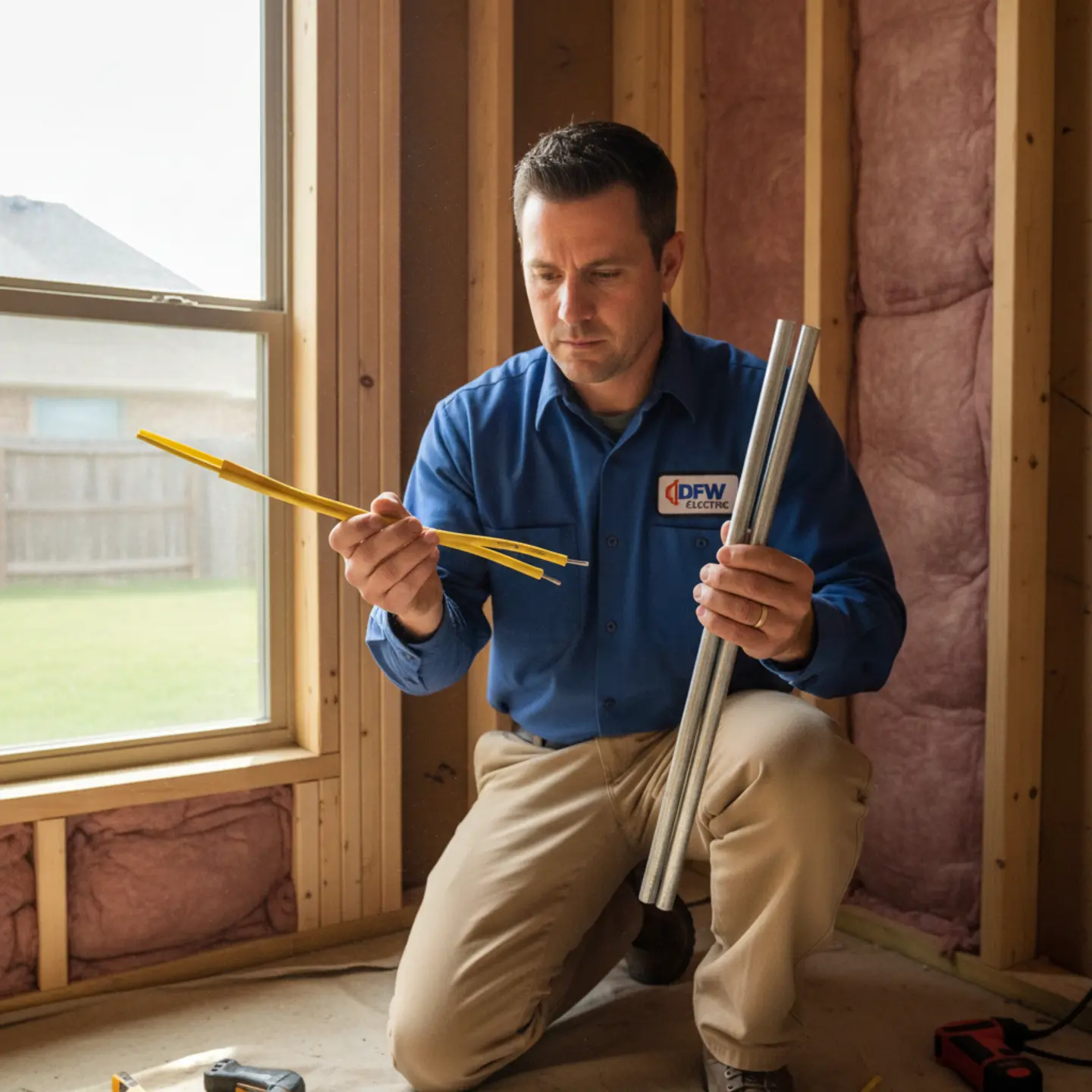
- 30 amp needs 10-gauge copper wire
- 50 amp needs 6-gauge copper wire (thicker, heavier, holds more current)
Why does this matter? The wire gauge determines how much current can flow without the wire overheating. Trying to push 50 amps through 10-gauge wire would create heat, potentially causing a fire. The thicker 6-gauge wire stays cool even under heavy load.
The plug is just the connection point. The real difference is in how much power can safely flow through the entire system.
What Can You Actually Run?
This is where theory meets reality. Let’s talk about what you can power with each system.
On a 30 Amp Inlet (7,200 watts)
✅ Easy to run:
- Gas furnace (just the blower fan — about 600 watts)
- Refrigerator and freezer (700-1,500 watts combined)
- Lights throughout the house (500-1,000 watts)
- TV, internet, phone chargers (200-400 watts)
- Sump pump (800-1,200 watts)
- Well pump (2,000 watts running, but surges to 6,000 watts when starting)
If you have gas heat and gas appliances, a 30 amp system can handle your essentials pretty comfortably.
⚠️ Difficult or impossible:
- Central air conditioning — This is the big one. A 3-ton AC unit uses about 3,500 watts once it’s running, but it needs 10,000-16,000 watts for that first second when the compressor kicks on. A 30 amp generator (7,200 watts) physically can’t provide that surge. The AC either won’t start, or the generator will stall trying.
- Electric furnace or heat strips — These use about 10,000 watts. They won’t even fit on a 30 amp system. Your breaker will trip immediately.
- Electric water heater — 4,500 watts. It’ll work, but it uses 60% of your total capacity just by itself. You won’t be able to run much else while it’s heating.
- Electric dryer — 5,400 watts. Same issue — it dominates your capacity.
- Multiple high-draw appliances at once — You’ll spend a lot of time flipping breakers off and on, managing what can run when.
On a 50 Amp Inlet (12,000 watts)
✅ You can run:
- Everything from the 30 amp list, PLUS:
- Central AC (with enough headroom for the startup surge)
- Electric water heater (without monopolizing your power)
- Well pump without worrying about other appliances tripping it
- Multiple rooms running normally — lights, TV, fans, kitchen appliances
- EV charging at a reasonable speed (40 amps continuous, about 9.6 kW)
The 50 amp system gives you breathing room. You’re not constantly doing mental math about whether turning on the microwave will crash the generator.
The “Load Stacking” Problem
Here’s where 30 amp systems often fail in real life.
It’s not about whether one appliance fits within your wattage limit. It’s about what happens when multiple things turn on at the same moment.
Let’s say your well pump kicks on (6,000 watt surge). At the exact same time, your refrigerator compressor starts (2,200 watt surge), and someone in the kitchen turns on the microwave (1,500 watts).
Total demand: 9,700 watts.
Your 30 amp generator is rated for 7,200 watts. It’s going to overload and shut down. Or the circuit breaker trips. Either way, you’re resetting things in the dark.
On a 50 amp system with 12,000 watts available? That surge barely registers. No problem.
This is why people who “should” be fine on 30 amp often end up frustrated. On paper, their loads fit. In practice, everything kicks on at once and the system crashes.
The One Thing That Pushes Most People to 50 Amp
Central air conditioning.
If you have it, this is probably your decision-maker.
The AC Compressor Problem
Air conditioners use compressors — motors that squeeze refrigerant to move heat. When a compressor sits idle, the pressure inside equalizes. To get it moving again, the motor has to overcome all that static pressure at once.
This creates what’s called “Locked Rotor Amps” — a massive surge of power needed for that first second.
A typical 3-ton central AC unit might only use 3,500 watts once it’s running smoothly. But to start? It needs 10,000 to 16,000 watts for just that first moment.
A 30 amp generator (7,200 watts) can’t provide that surge. The voltage will drop, the compressor won’t start, and either the generator stalls or the AC just sits there humming without cooling anything.
A 50 amp generator has a bigger engine and a heavier alternator. That extra mass acts like a flywheel — it can absorb the surge and keep the voltage stable while the compressor gets up to speed.
There’s One Workaround
Devices called soft starters (like Micro-Air EasyStart) can reduce the startup surge by about 60-70%. They cost $300-$400 and basically “ramp up” the compressor more gradually instead of slamming it with full power all at once.
This can sometimes let you run central AC on a 30 amp system.
Our take: If you already have a 30 amp setup and you’re trying to make it work, a soft starter is worth trying. But if you’re installing from scratch? Just go with 50 amp and skip the workaround. You’re adding complexity and another thing that can break.
Regional Considerations: Where You Live Matters
If You Have Gas Heat
This includes most of Texas, much of the South, and parts of the Midwest.
30 amp can work well here. Your gas furnace only needs electricity for the blower fan — about 600 watts. You’re not trying to power massive electric heating elements in January.
If you also have a gas water heater and a gas stove, your electrical demand during an outage is genuinely lower. You might be fine with 30 amp, especially if you don’t have central AC or you’re willing to use a soft starter.
If You Have Electric Heat
This includes parts of the Northeast, Pacific Northwest, and Mountain States where heat pumps are common.
You need 50 amp. Full stop.
Electric furnaces and heat pump emergency backup strips use 10,000+ watts. A 30 amp system won’t even come close. If the power goes out in February and you can’t run your heat, the generator isn’t doing its job.
If You’re on a Well
50 amp gives you breathing room.
Well pumps surge to about 6,000 watts when starting. On a 30 amp system (7,200 watts max), that surge leaves you with only 1,200 watts for everything else at that exact moment. If your fridge happens to kick on at the same time, you’re overloaded.
On a 50 amp system, the well pump surge is no big deal. You’ve got plenty of capacity left over.
The Cost Difference (It’s Not What You Think)
The Big Myth
“Upgrading to 50 amp costs thousands more.”
You hear this all the time. And it’s just not true.
The Reality
The actual cost difference for the installation is usually $50 to $150. Sometimes as little as $75.
Here’s the breakdown for a typical 25-foot run from your main panel to the outside wall:
| Component | 30 Amp Cost | 50 Amp Cost | Difference |
|---|---|---|---|
| Inlet box | ~$60 | ~$85 | +$25 |
| Circuit breaker | ~$20 | ~$30 | +$10 |
| Wire (25 ft run) | ~$56 | ~$115 | +$60 |
| Total Materials | ~$136 | ~$230 | +$94 |
Even if you have a longer run — say 50 feet — the wire cost difference is only about $120.
What about labor?
Here’s the thing: the electrician is doing the same work either way.
They’re drilling the hole through your exterior wall. They’re mounting the inlet box. They’re opening up your main panel. They’re installing the breaker and connecting everything. They’re testing it to make sure it’s safe.
Pulling 6-gauge wire (for 50 amp) is a little more physically demanding than pulling 10-gauge wire. It’s stiffer, heavier. But unless you have a really long or complicated run with lots of tight bends, most electricians don’t charge extra for it.
Total project cost: Usually $800 to $1,200, with 50 amp adding $50 to $150 to that total.
Why Does Everyone Think It’s Way More Expensive?
Because they’re confusing the inlet installation with the generator purchase.
Yes, a 12,000-watt generator costs more than a 7,500-watt generator — usually $500 to $1,000 more.
But the inlet? The infrastructure in your house? That’s a small difference.
And here’s the key: you don’t have to buy a bigger generator just because you install a 50 amp inlet.
The Smart Strategy — Decouple the Decisions
Here’s what we recommend to most homeowners who are on the fence:
Install the 50 amp inlet now, even if you don’t have a 50 amp generator yet.
Why This Works
1. You can use your existing 30 amp generator
Buy a simple adapter cable (NEMA L14-30P to 14-50R) for about $30-$50. Plug your 30 amp generator into the adapter, then plug that into your 50 amp inlet.
Your generator won’t magically produce more power just because it’s plugged into a bigger inlet. It’ll still only give you 7,200 watts. But the infrastructure is ready when you upgrade.
2. You’re future-proofed
Maybe you upgrade your generator in three years. Maybe you never do. Either way, the inlet is ready.
3. You avoid a complete re-installation
If you install 30 amp now and change your mind later, you’re paying for the entire project all over again — $800 to $1,200. The electrician has to pull out the old inlet, replace the breaker, run new wire, everything.
For an extra $100 now, you avoid that possibility completely.
The Adapter Strategy in Detail
Let’s say you have a 7,500-watt generator with a 30 amp outlet (NEMA L14-30).
You install a 50 amp inlet on your house.
You buy a 30 amp plug to 50 amp receptacle adapter. These are readily available online and at electrical supply stores.
When you need to use the generator:
- Plug the generator’s 30 amp cord into the adapter
- Plug the adapter into your 50 amp inlet
- Start the generator
The adapter safely limits the current to what your generator can provide. The inlet doesn’t care — it’s just a pipe, and you’re not filling it all the way.
Later, if you upgrade to a 50 amp generator, you remove the adapter and plug directly into the inlet. Done.
Future-Proofing for Electric Vehicles
If you have (or plan to get) an electric vehicle, this decision matters even more.
Charging Your EV During an Outage
Let’s say there’s a prolonged power outage — think hurricane aftermath, ice storm, multi-day grid failure. You might need to charge your car to evacuate, get to work, or make supply runs.
On a 30 amp generator:
You can charge at about 24 amps continuous (5.7 kW). That’s slow Level 2 charging. It works, but you’re dedicating most of your generator’s capacity to the car while it charges.
On a 50 amp generator:
You can charge at 40 amps (9.6 kW). That’s much faster, and you still have headroom to run other things in the house.
Vehicle-to-Home (V2H) Systems
This is newer technology, but it’s coming fast.
Trucks like the Ford F-150 Lightning and upcoming GM vehicles can power your entire home using their onboard battery. Think of it as a giant generator on wheels that doesn’t need gas.
The catch: Most of these systems require 50 amp (or higher) infrastructure to work properly.
The Lightning, for example, has sensitive ground-fault detection. It needs specific types of transfer equipment to power a home safely. If you install a 30 amp inlet today, you’re locking yourself out of this technology.
Bottom line: If there’s any chance you’ll own an EV in the next 5-10 years, install 50 amp infrastructure now. Learn more about EV charging infrastructure costs. It’s a lot cheaper to build it right the first time than to retrofit later.

When 30 Amp Actually Makes Sense
We’re not saying 30 amp is always wrong. Here’s when it’s genuinely the right choice:
✅ You have gas heat, gas water heater, and gas stove
Electricity is only for lights, fridge, fans, and TV. Your electrical load during an outage is genuinely minimal.
✅ You live in a mild climate
No central AC needed, or you only use window units that you can turn on one at a time.
✅ You have a small home
Under 1,500 square feet, minimal circuits, low overall demand.
✅ You already own a 30 amp generator and don’t plan to upgrade
If you already have the equipment and it’s meeting your needs, there’s no reason to change.
✅ Physical limitations
You can’t safely lift or move a generator over 100 pounds. Most 30 amp generators weigh 80-100 lbs; most 50 amp generators are 150-200+ lbs.
✅ Tight budget
If saving $100-$150 today is critical, 30 amp will get you up and running.
For these situations, 30 amp is a perfectly reasonable choice. Just go into it knowing the limitations.
Common Mistakes We Fix
Mistake 1: Installing 30 Amp “Because That’s What I Have Now”
Just because your current generator is 30 amp doesn’t mean your inlet should be.
The generator is portable equipment you might replace in a few years. The inlet is permanent infrastructure in your house. Build the infrastructure to last.
Mistake 2: Buying the Inlet to Match the Generator
You’re doing it backward.
The inlet determines what you CAN use. The generator determines what you DO use. Install the bigger inlet, use adapters if needed, and you’re ready for anything.
Mistake 3: Assuming They Can’t Afford 50 Amp
The cost difference is one tank of gas for your generator. Maybe two tanks.
If you can afford the generator itself, you can afford the extra $100 for better infrastructure.
Mistake 4: Not Considering Actual Power Needs
People focus on what they think they’ll run during an outage. Then it’s 2 AM, it’s 95 degrees, the kids are crying because they’re hot, and the AC won’t start because the inlet is undersized.
Plan for reality, not for your best-case scenario.
Frequently Asked Questions
Can I plug a 30 amp generator into a 50 amp inlet?
Yes, with a simple adapter cable.
The inlet doesn’t force the generator to produce more power. It just allows for more capacity IF you have it. Your 30 amp generator will still only provide 7,200 watts — but the inlet is ready if you upgrade later.
What happens if I try to run too much on a 30 amp inlet?
The breaker trips, or the generator overloads and shuts down.
You’ll have to turn things off and reset the system. If you overload repeatedly, you risk damaging the generator or wearing out the breaker.
Do I need a 30 amp or 50 amp generator cord?
Match the cord to your inlet.
If you installed a 50 amp inlet, use a 50 amp cord (6-gauge wire). It’s heavier and rated for more current, which means it stays cooler and safer under load.
If you have a 30 amp inlet, use a 30 amp cord (10-gauge).
What’s the difference between 30 amp and 50 amp wiring?
Wire thickness.
50 amp uses 6-gauge copper wire. It’s thicker, heavier, and can carry more current without overheating.
30 amp uses 10-gauge copper wire. It’s thinner and lighter.
Using wire that’s too thin for the amperage creates heat, which can damage insulation and create fire hazards. That’s why electrical safety standards are strict about matching wire gauge to circuit size.
Will a 30 amp generator run my whole house?
Probably not “normally.”
You can keep essentials running — fridge, lights, gas furnace fan, some outlets. But you’ll need to manage loads carefully. You can’t just flip every switch and expect it to work like when the grid is up.
You’ll be turning things off to run other things. That’s the trade-off with 30 amp.
What size generator do I need for a 50 amp inlet?
Most generators rated 9,000 watts or larger will work with a 50 amp inlet.
But remember: you can use smaller generators with adapters. The inlet size doesn’t dictate your generator size — it just sets the upper limit.
Is it worth upgrading from 30 amp to 50 amp if I already have 30 amp?
It depends.
If your 30 amp system is working and meeting your needs, you might not need to change it.
But if you’re frustrated with constantly managing loads, or if you can’t run your AC, or if you’re planning to buy an EV, then yes — upgrading is worth it.
For new installs, though? 50 amp is almost always the better choice.
Not sure which size is right for your home?
So, Which One Do You Actually Need?
Here’s the short version.
Choose 30 Amp If:
- You have gas heat, gas water heater, and no central AC
- Your electrical needs are genuinely minimal
- You’re on a very tight budget and won’t upgrade equipment later
- You already own a 30 amp generator and it’s meeting your needs
Choose 50 Amp If:
- You have central AC (3 tons or larger)
- You have electric heat or a heat pump
- You’re on a well
- You have (or plan to get) an EV
- You want to run your home more normally during outages
- You want flexibility for the future
For Most Homes?
50 amp is the right call.
Yes, maybe you have gas heat. But you also probably have AC that runs half the year. You probably have multiple high-draw appliances. And the cost difference is minimal compared to the flexibility you’re buying.
The Bottom Line
You’re not trying to build a perfect system. You’re trying to keep your family safe and comfortable when the power goes out.
A 50 amp inlet gives you room to breathe. It means you’re not constantly doing mental math about whether you can turn on the microwave while the fridge is running. It means if you upgrade your generator in five years, the infrastructure is already ready. It means if you buy an electric vehicle, your home can support it.
For an extra $50 to $150 in generator inlet installation costs, you’re buying peace of mind and flexibility. That’s worth it.
Not sure which size is right for your home? We can help. We’ll look at your actual electrical setup — your panel, your appliances, your needs — and give you honest guidance. No upselling. Just the truth about what will work.
Professional installation ensures proper electrical permit compliance in Texas and keeps your home safe.
Ready to install your generator inlet the right way?