
Champion vs Westinghouse Generator: What DFW Electricians Tell Homeowners About Safe Installation
⚡ Key Takeaways
- Both Champion and Westinghouse make solid 4500W generators – Champion wins on reliability and cold-weather performance; Westinghouse wins on quiet operation and features
- The real cost isn’t the generator – Add $600-$1,200 for safe, legal installation with transfer switch or interlock kit (plus permits)
- Never plug a generator into a wall outlet – Backfeeding can kill utility workers, destroy your home, and void your insurance
- Tri-County Electric customers cannot use interlock kits – This DFW-specific rule requires transfer switches instead
- A soft starter changes everything – For $550-$800, you can run central AC on a 4500W generator instead of buying a massive 12,000W unit
- Winter Storm Uri changed the calculation – Texas grid instability makes backup power essential, but only if it’s installed safely
- DIY installation = insurance claim denial – Unpermitted work or code violations mean you’re on your own when something goes wrong
Why Generator Safety Matters in DFW
Shopping for a generator after Winter Storm Uri is confusing—and most of the information online comes from people trying to sell you something. You’ll find endless comparisons of wattage and runtime, but nobody mentions what happens after you bring it home.
Here’s the reality we see as licensed electricians in Dallas-Fort Worth: homeowners spend $900 on a Champion or Westinghouse generator at Home Depot, then discover they need another $600-$1,200 for safe, legal installation. The generator sitting in your garage isn’t backup power—it’s a liability until a licensed electrician connects it properly to your home’s electrical panel.
After ERCOT’s grid failure in 2021 and the recurring strain of triple-digit summers, backup power isn’t a luxury anymore. But the difference between a properly installed generator and a dangerous DIY hookup can be the difference between keeping your family safe and creating a hazard that kills utility workers or burns down your home.
In DFW, every city from Dallas to Fort Worth to Plano requires permits for generator installations. Your insurance policy likely has clauses denying coverage for unpermitted electrical work. We’re not here to upsell you—we’re here to make sure whatever generator you buy gets installed the right way.
This post covers what actually matters when choosing between Champion and Westinghouse, the real installation costs nobody mentions, and the Texas-specific code requirements that trip up DIYers.
Champion vs Westinghouse: What Actually Matters
Before we get into specs, let’s be clear: both Champion and Westinghouse make solid generators. The “which is better” question depends on your priorities—and what matters most is what happens after you buy it.
Here’s what we tell homeowners: you’re not just buying a generator. You’re buying a piece of equipment that needs to start reliably during a crisis, run for days without failure, and integrate safely with your home’s electrical system. The $100 price difference between brands matters less than whether you’ll maintain it properly and install it legally.
Champion – The Reliable Workhorse
Champion Power Equipment has built a reputation on customer support and cold-weather reliability—both critical factors for Texas homeowners after Uri.
Why electricians recommend Champion:
- Lifetime technical support – When you’re troubleshooting a generator during a power outage at 2 AM, having someone answer the phone matters
- Cold start technology – Optimized fuel delivery and ignition timing for freezing temperatures (remember February 2021?)
- Manual recoil backup – When batteries fail in extreme cold, you can still pull-start the unit
- Simpler mechanical design – Fewer electronics means fewer failure points
- Better dual-fuel transitions – Smoother switching between gasoline and propane
💡 Electrician’s Insight
For Winter Storm scenarios, Champion’s manual recoil backup is your insurance policy. We’ve seen Westinghouse units fail to start because the battery died in the cold, while Champion owners just grabbed the pull cord and got power running.
Typical price range: $800-$1,000 for the Champion 4500W inverter (Model 201318)
Westinghouse – The Quiet, Feature-Rich Option
Westinghouse leverages its legacy brand name to deliver generators with higher specifications and more features per dollar. They’re particularly aggressive with convenience technology.
Why homeowners choose Westinghouse:
- Significantly quieter operation – 52 dBA vs 61 dBA (that’s perceived as half the volume for HOA neighborhoods)
- Remote start and electric start – Key fob convenience instead of pull cords
- Slightly more power – 3,700W running vs 3,500W on Champion (room for 2-3 extra ceiling fans)
- Advanced features – Digital fuel gauge, LED data display, CO sensor shutoff
- Larger fuel tank – 3.4 gallons vs 2.25 gallons (18 hours runtime vs 14 hours at 25% load)
⚠️ The Battery Drain Issue
Westinghouse’s remote start receiver draws power even when the unit is “off,” killing the battery within weeks. If you choose Westinghouse, keep it on a trickle charger or install a battery disconnect switch. We’ve done service calls where homeowners couldn’t start their generator during an outage because the battery was dead from sitting in the garage.
Typical price range: $950-$1,100 for the Westinghouse iGen4500
Side-by-Side Comparison: The 4500W Sweet Spot
The 4500W inverter class is the perfect size for DFW homes. It provides enough power to run essentials including central AC (with a soft starter), yet remains portable enough for one person to move.
| Feature | Champion 201318 | Westinghouse iGen4500 | What It Means |
|---|---|---|---|
| Starting Watts | 4,500W | 4,500W | Both handle motor startup surges equally |
| Running Watts | 3,500W | 3,700W | Westinghouse offers ~200W more continuous power |
| Noise Level | 61 dBA | 52 dBA | Westinghouse is significantly quieter (perceived as half the volume) |
| Runtime @ 25% Load | 14 hours | 18 hours | Westinghouse’s larger tank extends operation |
| THD (Power Quality) | <3% | <3% | Both produce “clean power” safe for electronics |
| Starting Method | Recoil (Manual) | Electric + Remote Fob | Westinghouse = convenience; Champion = reliability |
| Weight | 95 lbs | 98 lbs | Both require wheels for movement |
| Price | $800-$1,000 | $950-$1,100 | Westinghouse costs ~$100-$150 more |
Noise Comparison
Westinghouse is 9 decibels quieter than Champion. Because the decibel scale is logarithmic, this difference is perceived as nearly half the volume—critical for tight suburban neighborhoods with HOA noise restrictions.
What This Means for DFW Homeowners
Both generators produce clean power with less than 3% Total Harmonic Distortion (THD), which means they’re safe for sensitive electronics, modern HVAC control boards, and smart appliances. Both offer dual-fuel capability—essential for DFW where gas stations fail during widespread outages but propane stored in tanks is always available.
Your decision point comes down to priorities:
- Choose Champion if: You prioritize reliability over convenience, want set-it-and-forget-it simplicity, and need confidence it’ll start in extreme cold. Best for Winter Storm preparedness.
- Choose Westinghouse if: You’ll commit to battery maintenance (trickle charging), want the quietest operation possible, and value remote start convenience. Best for HOA neighborhoods where noise matters.
Either way, the generator itself is only half the story. Let’s talk about what electricians wish every buyer knew before checking out.
The Real Cost – Safe Installation Requirements
Here’s what happens: homeowners spend $900 on a generator, then discover they need another $600-$1,200 for safe, legal installation. Nobody mentions this at the register. The generator sitting in your garage isn’t backup power—it’s a liability until it’s connected properly.
As electricians, we’ve seen the aftermath of DIY generator hookups gone wrong. Burnt panels. Insurance claims denied. And in the worst cases, utility workers put in danger because someone didn’t understand backfeeding.
Why You Cannot Just Plug Into a Wall Outlet
This is the most dangerous myth about portable generators: that you can just plug them into any outlet and backfeed power through your home. Let’s be clear about what happens when you do this.
The backfeeding hazard: When you plug a generator into a regular outlet using a “male-to-male” extension cord (accurately called a “suicide cord”), electricity flows backwards through your home’s wiring, into the main panel, and out through the main breaker onto the utility grid.
What kills utility workers: A lineman from Oncor or CoServ working to restore power expects the line to be dead. Backfed power from your generator re-energizes that line. Because transformers work bi-directionally, the 120/240V from your generator is stepped up to 7,200 volts or higher on distribution lines—creating a lethal hazard for workers trying to fix the grid.
What destroys your home: When grid power is restored, utility voltage clashes with your generator voltage (which is out of phase). This catastrophic event can cause the generator to explode, your electrical panel to arc flash, and house fires.
⚠️ Real Consequence
During a major outage in North Texas, a homeowner used a suicide cord to backfeed their panel. When grid power was restored, the phase mismatch caused an arc flash that melted their main panel bus bars and started a fire in the wall. The insurance claim was denied because the installation violated NEC code Section 702.6. The homeowner paid $18,000 out of pocket for repairs.
National Electrical Code Section 702.6 strictly prohibits any connection that allows your backup system to run parallel with utility power. You need a physical barrier—which brings us to your two legal options.
Your Two Legal Options in DFW
To comply with Texas Electrical Safety Code and keep your family (and utility workers) safe, you need a device that physically prevents your generator and the grid from being connected simultaneously.
Option 1: Interlock Kit (The Cost-Effective Standard)
For portable generators in the 4500W-12,000W range, a mechanical interlock kit is the most common solution in Texas residential installations.
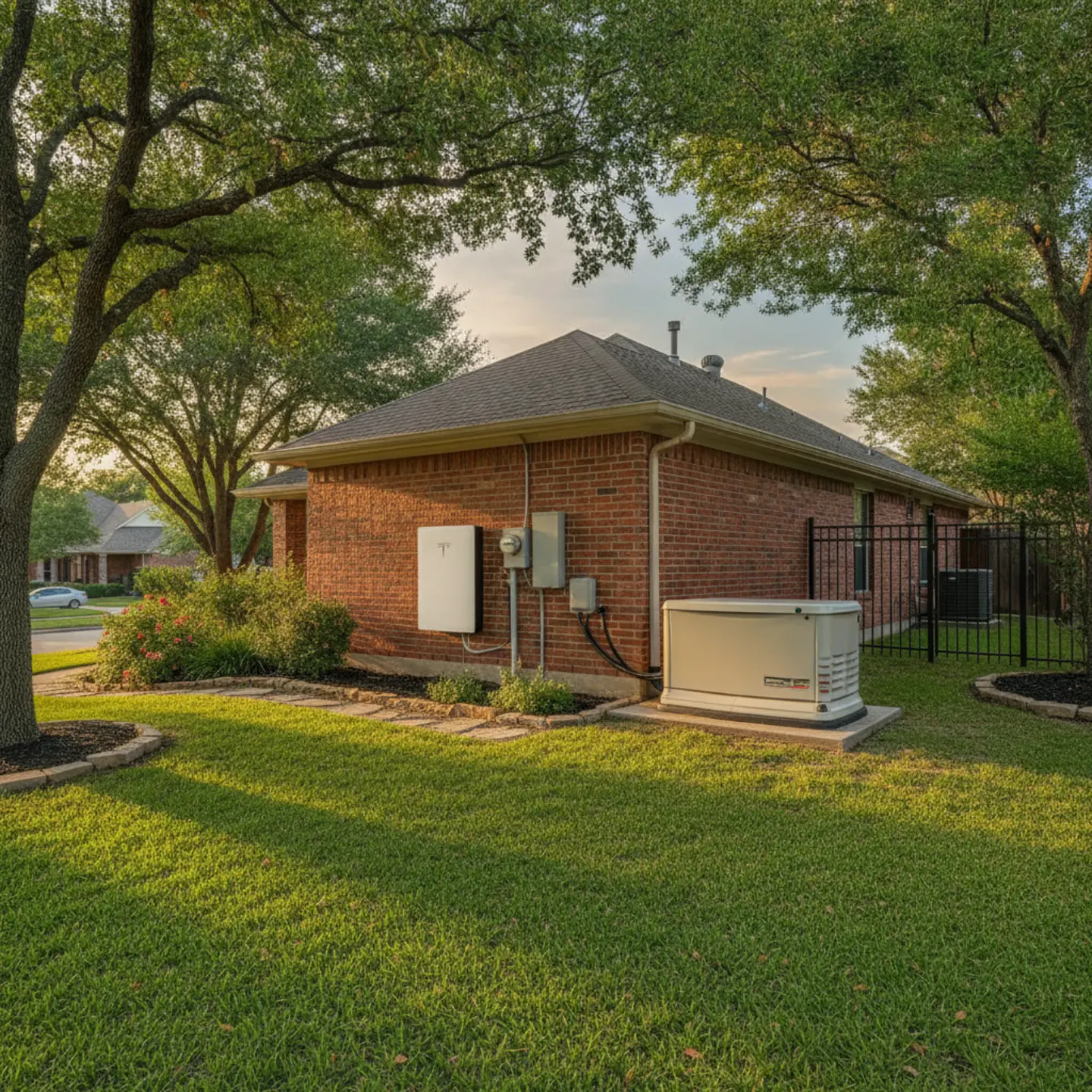
How it works: An interlock is a sliding metal plate installed on the front of your electrical panel. It’s designed so that the Main Breaker (utility power) and the Generator Breaker cannot both be in the “ON” position at the same time. It’s physically impossible—the plate blocks one or the other.
Operation process:
- Turn OFF the Main Breaker (disconnecting from grid)
- Slide the Interlock Plate
- Turn ON the Generator Breaker
- Start your generator and plug into the inlet box
Cost installed: Typically $600-$1,200 total ($150-$250 for the kit and inlet box, $400-$800 labor, $100-$300 permit)
Advantages: Powers your entire panel (you choose which circuits to use), flexible load management, lower cost than transfer switches
🔍 Critical DFW Exception
Tri-County Electric Cooperative customers CANNOT use interlock kits. TCEC explicitly requires UL 1008 listed transfer switches. This affects homeowners in parts of Fort Worth, Keller, and Azle. Most Oncor and CoServ customers can use interlocks, but always verify with your electrician first.
Option 2: Manual Transfer Switch (Required for Some Co-ops)
A manual transfer switch is a separate sub-panel containing 6-10 pre-selected circuits that you’ve chosen as “essential.”
How it works: The switch physically toggles those specific circuits between “Line” (utility) and “Gen” (generator). Only the pre-wired circuits receive generator power—the rest of your panel stays dead.
Cost installed: Typically $1,000-$2,500 (higher labor due to sub-panel installation and circuit selection)
Advantages: Impossible to overload your generator (only selected circuits are powered), accepted by all co-ops including Tri-County, prevents accidental backfeeding
Disadvantages: More expensive, less flexible (can’t decide during an outage to power different circuits unless they were pre-wired)
For most Oncor territory customers in Dallas, Plano, Frisco, and Arlington, the interlock kit is the superior choice due to flexibility and cost. For Tri-County members or those who want foolproof load management, a transfer switch is the right solution.
The Permit Reality Nobody Mentions
Every DFW city requires electrical permits for generator installations. This isn’t optional—it’s the law. Here’s why it matters:
Dallas: Requires a “Stand-Alone Electrical Permit” for service alterations including transfer switches and interlocks (base fee ~$100-$181 plus technology fee)
Fort Worth: Requires electrical permit, with particular focus on inlet box location and grounding requirements (two ground rods required)
Plano: Strict enforcement on “Simple Trade Permits,” with inspectors paying close attention to neutral bonding and separately derived systems
Learn more about electrical work that requires permits in Texas.
⚠️ The Insurance Trap
Texas homeowners insurance policies frequently contain clauses denying coverage for damages resulting from unpermitted work or code violations. If a DIY generator installation causes a fire (due to undersized wire or loose connections), or if backfeeding damages neighbors’ property, your claim will almost certainly be denied. You’ll be personally liable for all damages.
Typical permit costs: $100-$300 depending on municipality
What inspectors look for: Proper grounding (two ground rods), appropriate wire gauge, inlet box installation, neutral bonding configuration, interlock/transfer switch UL listing for your specific panel brand
Total Installation Cost Breakdown
Here’s what you’re actually paying when you do it right:
| Item | Low Cost | High Cost | Notes |
|---|---|---|---|
| Generator (4500W Inverter) | $800 | $1,100 | Champion vs Westinghouse models |
| Interlock Kit + Inlet Box | $150 | $250 | Parts only (UL-listed for your panel brand) |
| Licensed Electrician Labor | $600 | $1,200 | Installation, permit pulling, testing, inspection coordination |
| Permit Fees | $100 | $300 | Varies by city (Dallas/Plano/Fort Worth) |
| Heavy-Duty Power Cord | $50 | $150 | 25-50ft twist-lock cord (30A or 50A) |
| AC Soft Starter (Optional) | $550 | $800 | If you want to run central AC (highly recommended) |
| TOTAL INVESTMENT | $2,250 | $3,800 | Complete, code-compliant system |
Cost Comparison
This is what a permanently installed whole-home standby generator (like a Generac 22kW) costs in DFW. The portable generator + interlock solution offers 80% of the utility for 25% of the cost—if you’re physically able to wheel out and connect the generator during outages.
Need help with proper installation? We handle everything from panel installations to generator hookups throughout DFW.
Do You Really Need a 12,000W Generator?
The biggest mistake we see: homeowners buying generators way bigger than they need, then wondering why it’s so loud and burns through fuel so fast.
Here’s the reality—a properly managed 4500W generator can run everything you need to survive comfortably in Texas, including central AC. The key word is “managed.” You can’t run everything at once, but you don’t need to.
What a 4500W Generator Actually Powers
Essential Load Calculation
This is your base load: refrigerator + freezer + gas furnace blower + LED lights + internet router. That leaves 1,500-2,000W of headroom on a 4500W generator—enough for central AC with a soft starter.
✅ What Runs on 4500W:
- Refrigerator: 100-800W running / 1,200-2,000W starting
- Deep Freezer: 500-1,000W running / 1,500W starting
- Gas Furnace Blower: 400-800W running / 1,000-1,500W starting
- LED Lighting: 10-100W total (whole house)
- Internet Router/Modem: 20W
- TV/Laptop: 100-200W
- Central AC (with soft starter): 1,200-1,800W running / 2,500W starting
Total base load before AC: Approximately 1,500-2,000W, leaving room for the biggest challenge in Texas survival—air conditioning.
The Central AC Challenge (And the Game-Changing Solution)
In Texas, “survival” includes air conditioning. But here’s the problem: a standard 3-ton to 5-ton central AC unit requires a massive surge of power to start the compressor—often 7,000W to 16,000W. This instant demand exceeds the capacity of a 4500W generator, causing it to stall or trip its breaker immediately.
The solution that changes everything: A soft starter device.
The Micro-Air EasyStart 368 is installed on your AC condenser unit outside. It uses a microprocessor to gradually ramp up the compressor’s startup amperage over milliseconds rather than hitting it all at once.
Impact: Reduces startup amperage (LRA – Locked Rotor Amps) by 65-75%
Result: A 3-ton AC that normally requires 7,000W to start can now start on approximately 2,500W—comfortably within the range of your Champion or Westinghouse 4500W inverter.
💡 Why This Matters
Installing a soft starter is the single most cost-effective upgrade for backup power. It allows you to buy a smaller, quieter, more fuel-efficient 4500W generator instead of a massive, loud 12,000W unit—while still keeping your house cool during Texas summers. The soft starter also reduces wear on your compressor during normal grid operation, extending its lifespan.
Cost: $350-$400 for the device, plus $200-$400 for professional installation by an HVAC tech or electrician = $550-$800 total
Without a soft starter, you’re forced to buy a 10,000W or 12,000W generator to handle AC startup—spending an extra $800-$1,500 on the generator alone, plus the higher ongoing fuel costs.
Load Management Reality Check
With a 4500W generator and a soft-started AC, you still can’t run everything simultaneously. You need to actively manage your loads—turning things off and on based on immediate needs.
✅ Sample Load Management Scenarios:
- Daytime Heat Scenario: Run central AC + refrigerator + internet. Turn OFF electric water heater, microwave, hair dryers, and pool pumps.
- Cooking/Evening Scenario: Turn OFF AC temporarily. Run microwave or air fryer + lights + TV + laptop charging.
- Sleep Mode: Run AC + refrigerator/freezer cycling overnight. Turn off unnecessary lights and electronics.
- Laundry Day: Turn OFF AC. Run washing machine (not dryer—electric dryers pull 5,000W+). Hang clothes to dry or use gas dryer if available.
This manual “dance” is the trade-off for saving $7,000-$10,000 compared to a fully automated whole-home standby system. For most DFW families, it’s worth it—you get reliable backup power for essential circuits without breaking the bank.
Why Texas Grid Instability Changes the Calculation
Backup power used to be something RV owners and rural homeowners worried about. Winter Storm Uri changed that calculation for every DFW resident.
Winter Storm Uri Changed Everything
Winter Storm Uri Impact
The death toll from Winter Storm Uri in February 2021. The catastrophic failure of the ERCOT grid caused 3-7 day power outages across DFW during sub-freezing temperatures. The total economic damage exceeded $20 billion across Texas.
For North Texas homeowners, Uri wasn’t just a storm—it was a wake-up call. The grid we thought was reliable proved it wasn’t. Millions of Texans were left without heat, light, or the ability to cook food during the coldest days in decades.
The Winter Storm Challenge for Generators:
Battery performance drops dramatically in extreme cold. Westinghouse’s electric start and remote fob features become liabilities when the battery voltage drops below the threshold needed to turn the starter motor or cycle the automatic choke. We responded to multiple service calls during Uri where homeowners couldn’t start their Westinghouse generators because the battery was too cold.
Champion’s manual recoil backup became the difference between having power and sitting in the dark. The pull cord doesn’t care if it’s 10°F outside—it works.
Propane pressure issues. Propane vaporization slows in extreme cold. If your propane tank is too small (20lb tanks) or the regulator freezes, the generator can starve for fuel. Larger 100lb tanks and keeping tanks above freezing (insulation blankets, bringing them indoors briefly) becomes necessary for sustained operation.
💡 Cold Weather Recommendation
If you’re primarily concerned about winter storms like Uri, Champion’s cold start technology and manual recoil backup make it the better choice. Keep a trickle charger on it year-round, but you’ll have the manual fallback when you need it most.
Summer Load Shedding and Heat Events
While Uri gets the headlines, DFW faces a different threat every summer: load shedding during triple-digit heat waves when ERCOT demand exceeds supply.
In Texas, air conditioning isn’t a luxury—it’s survival equipment. Heat-related deaths occur when vulnerable populations lose AC during extended outages. A generator that can’t run your central AC is only solving half the problem.
The Summer Challenge for Generators:
Generator derating in extreme heat. Air-cooled engines (like those in portable generators) lose efficiency as ambient temperature rises. A generator rated for 4500W at 60°F might only produce 3,800W at 105°F. This thermal derating makes the soft starter even more critical—your AC unit works harder while your generator produces less power.
Fuel supply disruptions. During widespread DFW outages, gas stations without backup power can’t pump fuel. Those that can often have mile-long lines. We saw this during the 2022 heat wave when rolling blackouts affected parts of Dallas County—homeowners who relied on gasoline-only generators were stranded.
Propane advantage: Propane stored in tanks doesn’t degrade and doesn’t depend on functional gas stations. This is why dual-fuel capability (gasoline + propane) is non-negotiable for DFW preparedness.
Fuel Strategy for Texas Preparedness
Gasoline: Degrades in 3-6 months. Ethanol in pump gas attracts moisture and gums up carburetors—this is the #1 cause of generator failure when you actually need it. Even with fuel stabilizer, you’re fighting chemistry.
Propane (LPG): Shelf-stable indefinitely. Safer to store in quantity (100lb or 250lb tanks). No carburetor varnish, no moisture contamination. During widespread outages, propane suppliers can refill tanks even when gas stations are offline.
Natural Gas (caution): Some homeowners modify portable generators to run on their home’s natural gas supply via quick-connect. Warning: Running on natural gas significantly reduces wattage output—often by 15-20% compared to gasoline. A 4500W generator might drop to 3,600W starting / 3,000W running on NG, which may not be enough for AC even with a soft starter.
What to Do
Recommended fuel strategy for DFW: Keep both gasoline (with stabilizer, rotated every 3-4 months) and a 100lb propane tank. Run the generator monthly on propane to keep it exercised and verify operation. During actual outages, use propane first to preserve your gasoline supply for potential multi-day events.
Real Problems Electricians Fix in DFW Generator Installations
Every year we get called to fix DIY generator hookups that are code violations, safety hazards, or simply don’t work. Here are the most common problems we see—and why they matter.
The Neutral Bonding Problem (Why Your Generator Trips GFCI)
This is the technical issue that trips up most DIYers and even some handymen. Here’s the simplified explanation:
The issue: Most Champion and Westinghouse portable generators come from the factory with the neutral wire bonded to the generator frame. This is an OSHA requirement for standalone use on job sites (prevents shock hazards). Your home’s main electrical panel is also bonded—the neutral bus bar is connected to the ground bus bar and the grounding electrode system.
The conflict: When you connect a bonded generator to a bonded house panel via a standard interlock kit (which doesn’t switch the neutral), you create parallel return paths for neutral current. Current flows on the ground wire back to the generator.
The result: This violates NEC 250. It can create a shock hazard on the generator frame and will often cause the generator’s GFCI breaker to trip immediately, cutting off all power.
⚠️ Why You Need a Licensed Electrician
An electrician will modify the generator’s neutral bond (usually by removing a bonding screw or cutting a bonding wire inside the generator) to convert it to a “floating neutral” for home connection. They’ll tag the generator accordingly. This ensures bonding occurs only at your main service panel, as required by code. Get this wrong and your generator either won’t work or creates a safety hazard.
Westinghouse Battery Maintenance Failures
We mentioned this earlier, but it’s worth repeating because we see it constantly: Westinghouse’s remote start receiver draws parasitic power even when the unit is “off,” killing the small battery within 2-3 weeks.
Symptoms: Unit won’t start via key fob or electric start button after sitting in the garage between uses.
Solutions:
- Keep the unit plugged into a battery tender/trickle charger year-round
- Install a physical battery disconnect switch to stop parasitic drain during storage
- If the automatic choke stepper motor binds (often happens when battery is weak), you may need to manually manipulate the choke by removing the side panel—this is an emergency field fix during outages
Undersized Wire and Improper Inlet Box Placement
Code requires specific wire gauges based on amperage and circuit length. We routinely see “handyman specials” where someone installed 10-gauge wire on a 30-amp generator circuit (code requires 10-gauge minimum, but many installations need 8-gauge depending on distance).
The hazard: Undersized wiring heats up under load. During an extended outage when you’re running the generator at high load for hours or days, that wire gets hot inside your walls. This is a fire hazard.
Inlet box placement errors:
- Too close to windows or doors (carbon monoxide hazard)
- Not weatherproof rated (water intrusion causes shorts)
- Mounted on combustible siding without proper clearances
- Cable strain relief not installed (vibration loosens connections)
This is why permits and inspections exist—to catch these problems before they cause injuries or property damage.
Need a professional electrical safety inspection of your existing setup? We check grounding, wire sizing, neutral bonding, and code compliance.
Generator Installation Questions DFW Homeowners Ask
Can I install a generator myself in Texas?
Technically yes, but not recommended. All DFW cities (Dallas, Fort Worth, Plano, Frisco, Arlington) require permits for generator installations. Texas homeowners insurance policies often contain clauses denying coverage for damages from unpermitted electrical work. The most common DIY mistakes we see: improper neutral bonding (causes GFCI tripping), undersized wiring (fire hazard), no backfeeding protection (deadly for utility workers), and incorrect grounding. The permit fees and inspection costs exist to catch these problems before they hurt someone. A licensed electrician handles permits, installation, modifications, and coordinates inspections—typically costing $600-$1,200 labor, which is worth it for peace of mind and legal compliance.
What size generator do I need to run my whole house in DFW?
Most DFW homes don’t need “whole house” power during outages. A properly managed 4500W inverter generator with a soft starter can run all essentials: refrigerator, freezer, gas furnace blower, LED lights, internet, and central AC. You practice active load management—you can’t run the electric dryer, pool pump, and AC simultaneously, but you don’t need to. True “whole house” operation (running everything as if the grid is up) requires 12,000W-20,000W generators that are louder, more expensive, and burn significantly more fuel. For most families, the 4500W class offers the best balance of capability, cost, and portability. Add a Micro-Air EasyStart soft starter ($550-$800 installed) to make your AC compatible with the smaller generator.
How much does generator installation cost in Fort Worth and DFW?
Professional code-compliant installation with a mechanical interlock kit costs $850-$1,750 total for labor, permits, and parts (not including the generator itself). Breakdown: Licensed electrician labor runs $600-$1,200 depending on panel complexity, wire run length, and scheduling. Interlock kit and inlet box parts cost $150-$250 (must be UL-listed for your specific panel brand—Square D, Eaton, Siemens, etc.). Permit fees range $100-$300 depending on municipality. Heavy-duty generator cord (30A or 50A twist-lock) adds $50-$150. Optional AC soft starter installation adds $550-$800 if you want to run central air conditioning. Total investment including a 4500W generator: $2,250-$3,800 for a complete, legal, safe backup power system. Compare this to $10,000-$15,000 for a permanently installed whole-home Generac or Kohler system.
Are Champion generators better than Westinghouse for DFW homes?
It depends on your priorities—both are excellent choices but excel in different areas. Choose Champion if: reliability and cold-weather performance are top priorities, you want set-it-and-forget-it simplicity, and you need confidence it’ll start manually during extreme cold like Winter Storm Uri. Champion offers superior customer support, cold start technology, and manual recoil backup. Choose Westinghouse if: you’ll commit to battery maintenance (trickle charging), want the quietest operation possible (52 dBA vs 61 dBA—perceived as half the volume), and value remote start convenience. Westinghouse offers more features per dollar and slightly higher running watts. Both produce clean power (<3% THD) safe for sensitive electronics and modern HVAC control boards. Both offer critical dual-fuel capability (gasoline + propane). The real answer: either generator will serve you well if installed properly by a licensed electrician with the correct transfer switch or interlock kit.
Can Tri-County Electric customers use generator interlock kits?
No. Tri-County Electric Cooperative explicitly states in their interconnection requirements that interlock kits are not accepted. They require UL 1008 listed transfer switches for all generator installations. This affects homeowners in Tri-County’s service territory, which includes parts of Fort Worth, Keller, Azle, Rhome, and surrounding areas. If you’re a Tri-County member, you must install a manual or automatic transfer switch ($1,000-$2,500 installed) instead of the more affordable interlock kit option. Most Oncor customers (Dallas, Plano, Frisco, Arlington, Grapevine) and CoServ customers can use interlock kits, but always verify with your utility provider and electrician before purchasing equipment. This is a critical DFW-specific requirement that surprises many homeowners shopping for generators.
Do I need a soft starter to run AC on a portable generator?
Yes, if you want to run central AC on a 4500W generator. Standard 3-ton to 5-ton central AC units require 7,000W-16,000W surge power to start the compressor (Locked Rotor Amps), which exceeds the capacity of 4500W generators. The Micro-Air EasyStart soft starter device installs on your outdoor AC condenser and uses a microprocessor to gradually ramp up compressor startup over milliseconds. This reduces startup amperage by 65-75%—bringing a typical 3-ton AC from 7,000W down to approximately 2,500W starting power. Cost is $350-$400 for the device plus $200-$400 professional installation = $550-$800 total. Without a soft starter, you’re forced to buy a much larger, louder 10,000W-12,000W generator to handle AC startup (costing $800-$1,500 more for the generator alone, plus ongoing higher fuel costs). The soft starter also reduces wear on your compressor during normal grid operation, extending its lifespan year-round.
Will a generator installation increase my home value or lower insurance?
Home value: An installed interlock kit and generator inlet box adds “generator ready” status to your home—a meaningful differentiator in the post-Uri Texas real estate market. While it’s not a massive dollar-for-dollar value add, it signals to buyers that the home has prepared backup power capability without the ongoing maintenance costs of a permanently installed system. It’s particularly attractive to families with medical equipment needs or those prioritizing resilience. Insurance discounts: Portable generators with transfer switches generally do not qualify for homeowners insurance discounts in Texas. Discounts (typically 5-10%) are usually reserved for permanently installed automatic standby generators (Generac, Kohler) because they provide automatic protection even when you’re away from home (preventing frozen pipes, sump pump failures, etc.). However, a properly permitted and inspected portable generator installation protects you from insurance claim denials related to electrical fires or damage—unlike DIY installations that violate code.
Your Next Step: Safe, Legal Generator Installation in DFW
The generator itself is the easy part—any homeowner can write a check at Home Depot or click “buy now” on Amazon. The hard part is connecting it safely and legally to your home’s electrical system. That’s where licensed electricians come in.
Whether you choose Champion or Westinghouse, the most important decision you’ll make is how you install it. The difference between a proper installation and a dangerous DIY hookup can be the difference between keeping your family safe and creating a hazard that kills utility workers, burns down your home, or gets your insurance claim denied.
What We Do
At Epic Electrical, we install code-compliant generator systems throughout Dallas-Fort Worth. Here’s what that includes:
- Install UL-listed interlock kits or transfer switches matched to your specific panel brand
- Pull permits in Dallas, Fort Worth, Plano, Frisco, Arlington, Keller, Southlake, and all DFW cities
- Install weatherproof inlet boxes with proper strain relief and grounding
- Modify generator neutral bonding to prevent GFCI tripping and meet NEC code requirements
- Install proper grounding system (two ground rods required in most jurisdictions)
- Size wire correctly for amperage and distance (prevent fire hazards from undersized conductors)
- Coordinate electrical inspections and provide documentation for insurance and home sales
- Test the complete system under load to verify safe operation before we leave
✓ Not a Sales Pitch
We’re not here to upsell you on expensive upgrades you don’t need. If your panel is safe and your generator is adequate for your essential loads, we’ll tell you. Our job is to make sure your family is protected—from both power outages and electrical hazards. We give you options, not pressure.
We also handle related electrical work that makes backup power more effective:
- Panel upgrades if your existing panel can’t accommodate an interlock kit
- Circuit breaker repairs and replacements
- Dedicated generator circuits and proper load balancing
- Electrical safety inspections of existing generator installations
- Consultation on generator sizing and load management strategies
Call or Text: (682) 478-6088
Serving Fort Worth, Arlington, Keller, Southlake, Colleyville, Grapevine, Lewisville, and all of DFW