
- Age matters most — If your Fort Worth home is over 40 years old and has never had a professional electrical inspection, that alone is reason enough to schedule one.
- Warning signs are real — Flickering lights, warm outlets, burning smells, and frequent breaker trips are not quirks of an older home; they are fire and shock hazards that need professional evaluation.
- Inspections are affordable — A standard residential electrical safety inspection in the DFW area typically costs $150–$300, a fraction of the cost of dealing with an electrical fire or code violation at closing.
- Know what you’re paying for — A thorough inspection covers your breaker panel, wiring, grounding, outlets, load capacity, and code compliance, and should end with a written report and photos — not a verbal summary and a repair estimate.
- Trust Epic Electrical for honest electrical inspections, no-pressure diagnosis, and 50+ years of combined DFW experience — visit Epic Electrical to learn more about how we serve Fort Worth homeowners.
Do You Really Need an Electrical Safety Inspection for Your Fort Worth Home?
If your home is over 40 years old, you’ve noticed flickering lights, outlets feel warm, or you’re planning a major renovation, a professional electrical safety inspection is worth the investment. An inspection identifies hidden hazards—outdated wiring, overloaded circuits, code violations—before they become fire risks or expensive emergencies. Most homeowners in the DFW area benefit from at least one inspection during ownership, especially if they’ve never had one done.
Here’s what you need to know to decide if an inspection makes sense for your situation, what inspectors actually look for, and how to avoid unnecessary work.
Epic Electrical
Free Quote & Honest Diagnosis — No Upsells
Core Service Programs:
- Electrical Repairs, Wiring & Lighting for tripping breakers, faulty wiring, GFCI issues, and indoor/outdoor lighting
- EV Chargers, Generators & Panel Upgrades for Level 2 EV charging, whole-home generator installs, panel replacements, and surge protection
- Commercial, Warehouse & Industrial Electrical for restaurants, offices, industrial buildouts, LED retrofits, and dedicated circuits
Why Choose Epic Electrical:
- ✓ Trusted by customers with 123+ five-star Google reviews
- ✓ Father-and-son master electricians — a third-generation electrical family
- ✓ Serving North Richland Hills and the DFW Metroplex since 2009
- ✓ 50+ years of combined electrical experience on every job
- ✓ No upsells, no jargon, no pressure — we fix what’s actually broken
- ✓ Small repairs fixed same-visit; big jobs get a written quote with no hidden costs
- ✓ Texas-licensed electrical contractor (TECL #33192)
Common Signs Your Home Needs an Electrical Safety Inspection
Some electrical problems announce themselves loudly — a breaker that trips every time you run the microwave, an outlet that sparks when you plug something in. Others are quieter and easy to dismiss as “just how old houses are.” They’re not. Here’s what to watch for:
- Flickering or dimming lights, especially when a large appliance turns on
- Outlets or switches that feel warm or hot to the touch
- A burning smell near outlets, the breaker box, or inside walls
- Circuit breakers that trip frequently or fuses that blow repeatedly
- Outlets that don’t hold plugs securely or spark when something is plugged in
- Two-prong outlets throughout the home — a sign of wiring that predates modern grounding requirements
- A home built before 1980 with its original electrical system still in place
None of these are normal wear-and-tear. Each one points to a system that’s working harder than it should — or one that was never updated to handle modern electrical loads.
⚠️ Don’t Ignore These Red Flags
Warm outlets, burning smells, and frequent breaker trips are not normal and indicate immediate electrical hazards. These are fire and shock risks that need professional attention right away — don’t wait for a convenient time to call an electrician.
Fort Worth has a large stock of homes built in the 1960s through 1980s — many in established neighborhoods like Wedgwood, Ridglea, and Haltom City — that still have original wiring and panels. If your home falls in that category and you’ve never had an electrical inspection, you’re overdue.
When an Electrical Safety Inspection Is Mandatory or Highly Recommended
An inspection moves from “smart idea” to “essentially required” in several specific situations. If any of these apply to you, don’t put it off:
- Buying or selling a home — Lenders and home inspectors may flag electrical issues that require a licensed electrician’s evaluation before closing.
- Planning a major renovation or room addition — Pulling permits for new construction means your existing system will be scrutinized. It’s better to know what you’re working with before the project starts.
- Adding high-demand appliances — Installing an EV charger, hot tub, or central air conditioning unit puts significant new load on your electrical system. An inspection confirms whether your panel can handle it safely.
- Your insurance company requests one — After a claim or during a policy review, some insurers require proof that the electrical system meets current safety standards.
- Recurring electrical problems or unexplained outages — If the same breaker keeps tripping or certain outlets stop working without explanation, something is wrong upstream.
- Home is 40+ years old and has never been inspected — This is the single most common situation we see, and the one where inspections most often turn up real problems.
- Visible water damage, pest damage, or signs of fire near electrical areas — Any of these can compromise wiring insulation and create hidden hazards inside walls.
Texas summers push home electrical systems hard. When every room is running AC, ceiling fans, and refrigerators simultaneously, an undersized or aging panel can overheat. If your breakers trip more often in July and August than the rest of the year, that’s a load capacity issue worth investigating before next summer.
What a Professional Electrical Safety Inspection Covers
A real electrical safety inspection is not a five-minute walkthrough. When a licensed electrician inspects your home, here’s what a thorough inspection should include:
- Visual inspection of the breaker panel — checking for double-tapped breakers, signs of overheating, corrosion, and whether the panel brand has known safety issues (Federal Pacific and Zinsco panels, for example, have documented failure rates)
- Testing ground and neutral connections — improper grounding is one of the most common hidden hazards in older homes
- Checking for proper grounding and bonding throughout the home’s electrical system
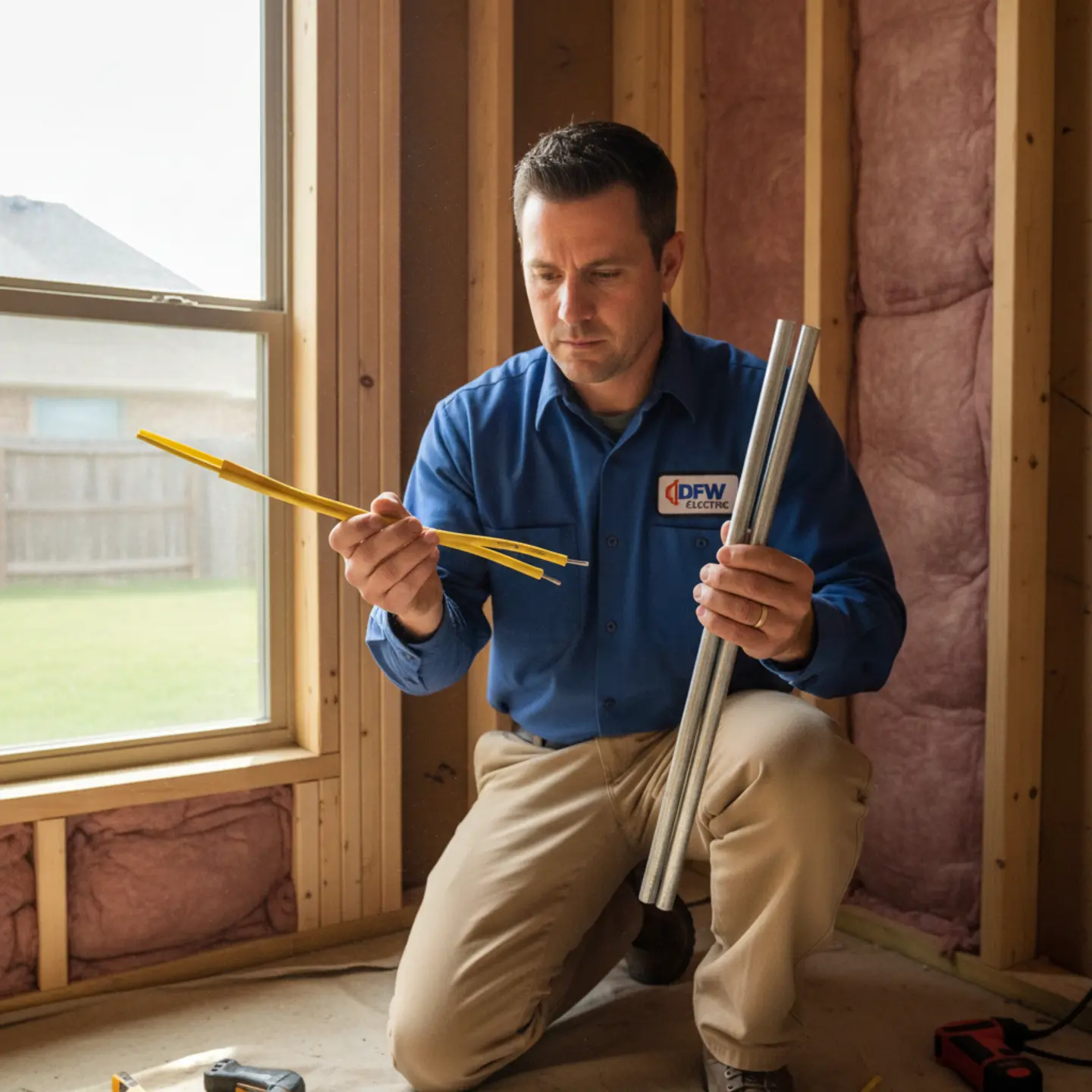
- Identifying outdated or unsafe wiring — knob-and-tube wiring (common in pre-1950 homes) and aluminum branch circuit wiring (installed in many 1960s–70s homes) both carry elevated fire risk
- Verifying outlets are properly polarized and grounded — including GFCI protection in kitchens, bathrooms, garages, and outdoor areas as required by code
- Assessing load capacity — whether your current panel can safely handle your existing circuits and any planned additions
- Documenting code violations and fire hazards with photos
- Delivering a written report with clear recommendations, prioritized by urgency
If an electrician offers to inspect your home and delivers only a verbal summary — or hands you a repair estimate without a written report — that’s not a real inspection. A legitimate inspection produces documentation you can keep, share with your insurance company, or use when selling the home.
For homeowners considering a panel installation or upgrade, an inspection is often the logical first step — it tells you whether an upgrade is actually necessary or whether a simpler fix will do the job.
Cost of an Electrical Safety Inspection in Fort Worth
Most homeowners in the DFW area pay between $150 and $300 for a standard residential electrical safety inspection. Larger homes, older homes with complex systems, or properties with detached structures (workshops, guest houses) may run $300–$500. The variables that affect price include home square footage, the age and complexity of the electrical system, and how much testing is involved.
A few things worth knowing before you schedule:
- Many reputable electricians credit the inspection fee toward any repair work you hire them to perform — so you’re not paying twice.
- Cheaper inspections often skip important testing steps. A $75 “inspection” that doesn’t include grounding tests or load assessment isn’t worth the paper the report is printed on.
- Some homeowners insurance policies and lenders partially cover inspection costs — worth a quick call to your agent before you pay out of pocket.
- The inspection fee is modest compared to the cost of addressing an electrical fire, a failed home sale, or a code violation discovered mid-renovation.
💡 Pro Tip: Ask About Fee Credits
When you call for an inspection, ask if the electrician will credit the inspection fee toward repair work if you hire them. Many reputable contractors do this, so you’re not paying twice — it’s a sign of confidence in their honest diagnosis.
If cost is a concern, Epic Electrical also offers residential project financing options for homeowners who need to address findings after an inspection.
How to Choose a Licensed Electrician for Your Inspection
Not every electrician who offers inspections is equally qualified — or equally honest. Here’s how to vet someone before you let them into your home:
- Verify their Texas electrical license — Every licensed electrical contractor in Texas has a TECL number. You can look it up on the TDLR (Texas Department of Licensing and Regulation) website. If a contractor won’t give you their TECL number, walk away.
- Confirm liability insurance and workers’ compensation coverage — This protects you if something goes wrong on the job.
- Read recent Google and Yelp reviews — Look specifically for comments about honesty, transparency, and whether the contractor recommended repairs that turned out to be unnecessary. Pattern matters more than a single review.
- Ask about inspection fee credits — A contractor who credits the inspection fee toward repair work is confident in their honest diagnosis.
- Avoid high-pressure sales tactics — If an electrician tells you your entire home needs to be rewired on the spot, without a written report or a second opinion, that’s a red flag. A trustworthy licensed electrical contractor in Fort Worth will give you a written estimate and let you make the decision on your own timeline.
- Request a written estimate and detailed inspection report before paying — No exceptions.
- Get a second opinion on major recommendations — If an inspector recommends full rewiring or a panel replacement, a second opinion is reasonable and any reputable contractor will tell you so.
Common Inspection Findings and What They Mean for Your Home
Most inspections turn up at least one or two issues. Here’s plain-language context for the findings you’re most likely to see in a DFW home inspection report:
- Outdated wiring (knob-and-tube or aluminum branch circuits) — Knob-and-tube wiring was standard before the 1950s and lacks a ground wire. Aluminum branch circuit wiring, installed in many homes built between 1965 and 1973, expands and contracts with heat in ways that can loosen connections over time. Both are fire hazards and typically require wiring repairs or replacement to bring the home up to current safety standards.
- Overloaded circuits — When too many devices share a single circuit, the wiring heats up. This is a fire risk and often means the panel needs additional circuits or a capacity upgrade.
- Missing or improper grounding — A shock hazard. In many cases, this is a relatively straightforward fix.
- Two-prong outlets in kitchens, bathrooms, or garages — These locations require GFCI protection under current code. Two-prong outlets without GFCI are a code violation and a shock hazard near water.
- Backstabbed wires in outlets or the panel — Wires pushed into the back of a device instead of secured under a screw terminal. These connections loosen over time and are a fire risk.
- Reverse polarity — Outlets wired backward. Appliances still work, but the shock risk is significantly higher. Usually a quick fix.
- Insufficient panel capacity — A 100-amp panel in a home with central AC, an electric range, and a hot tub is almost certainly undersized. A panel replacement may be needed before adding new circuits.
- Water damage or corrosion near electrical components — An immediate safety concern. Don’t delay on this one.
ℹ️ You’re Not Alone — Many Fort Worth Homes Have Outdated Wiring
If your home was built before 1980, outdated wiring is common in the DFW area. It doesn’t mean you’re in immediate danger, but it does mean an inspection is a smart investment to understand what you’re dealing with and plan for upgrades on your own terms.
Homes in older Fort Worth neighborhoods — Benbrook, Hurst, North Richland Hills, and Euless — frequently have original panels and wiring that have never been updated. If your home is in one of these areas and you’re not sure what’s inside your walls, an inspection is the most straightforward way to find out.
Why Epic Electrical Is the Right Choice for Fort Worth Homeowners
Epic Electrical is a father-and-son team of master electricians — Mike and Griffin — with more than 50 years of combined experience working on homes across the DFW Metroplex. We’ve been a Texas-licensed electrical contractor (TECL #33192) since 2009, and we’ve built our reputation one honest diagnosis at a time.
With 123+ five-star Google reviews from homeowners across Fort Worth, Arlington, Keller, and the surrounding area, our track record speaks for itself. Customers consistently mention the same things: we showed up on time, we explained what we found in plain language, we didn’t push work that wasn’t necessary, and we got the job done right.
Here’s what that looks like in practice for an electrical safety inspection:
- We inspect your panel, wiring, outlets, grounding, and load capacity — the full picture, not a quick walkthrough.
- We provide a written report with photos and clear recommendations, prioritized by urgency so you know what needs attention now and what can wait.
- We credit the inspection fee toward any repair work we perform — you’re not paying twice.
- If there’s a cheaper fix, we’ll tell you. If something doesn’t need to be replaced, we’ll say so. No upsells, no pressure.
We’re based in North Richland Hills and serve homeowners throughout Fort Worth, Arlington, North Richland Hills, Keller, Colleyville, and communities across the DFW Metroplex.
Ready to know if your home’s electrical system is safe? Get a Free Estimate from Epic Electrical and get honest answers without the sales pitch.
Electrical Safety Inspection FAQs
How often should I have my electrical system inspected?
If your home is under 40 years old and has no electrical issues, once every 10 years is a reasonable baseline. Homes over 40 years old should be inspected at least once, and again before any major renovation or when adding high-demand appliances like an EV charger or central AC. If you’re noticing warning signs — flickering lights, warm outlets, frequent breaker trips — don’t wait for a scheduled interval. Get an inspection now.
Can I do a DIY electrical inspection myself?
You can spot obvious problems — flickering lights, warm outlets, outlets that don’t hold plugs — but a professional inspection uses specialized testing equipment to detect hidden hazards that your eyes can’t see. Improper grounding, reverse polarity, overloaded circuits, and loose connections inside the panel are all invisible without the right tools. A licensed electrician’s inspection is also the only version that carries weight with insurance companies, lenders, and buyers.
What’s the difference between a home inspection and an electrical safety inspection?
A general home inspector does a broad walkthrough of the entire property and may flag obvious electrical issues — missing outlet covers, a visibly outdated panel — but they are not licensed electricians and cannot perform detailed electrical testing. A professional electrical safety inspection is conducted by a licensed electrician using specialized equipment and produces a detailed report covering code compliance, grounding, load capacity, and specific hazards. If a home inspector flags electrical concerns, the next step is always a licensed electrician’s evaluation.
If the inspection finds problems, am I required to fix them?
If you’re selling your home, the buyer’s lender may require certain code violations to be corrected before closing — this is common with FHA and VA loans in particular. If you’re keeping the home, the decision is yours, but fire hazards and shock risks should be addressed promptly for your family’s safety. A good electrician will prioritize the findings for you: what needs immediate attention, what can be scheduled, and what’s worth monitoring but not urgent right now.
What makes Epic Electrical different from other electricians in Fort Worth?
We’re a father-and-son team of master electricians with 50+ years of combined experience and 123+ five-star Google reviews from DFW homeowners. We’re honest: if there’s a cheaper fix, we’ll tell you. We don’t pressure you into unnecessary work, and we credit your inspection fee toward any repairs we perform. We’ve been serving Fort Worth since 2009 as a Texas-licensed contractor (TECL #33192), and our reputation is built on transparency and integrity. Ready to get an honest electrical safety inspection? Get a Free Estimate from Epic Electrical today.
Ready for an Honest Electrical Safety Inspection in Fort Worth?
If your home is overdue for an inspection — or you’ve been putting off a call because you’re worried about what you might find — we get it. Our job isn’t to scare you into expensive repairs. It’s to give you a clear, honest picture of your electrical system so you can make informed decisions on your own timeline.
Epic Electrical serves Fort Worth, North Richland Hills, Arlington, Keller, Colleyville, Grapevine, Southlake, Hurst, Euless, Bedford, and communities throughout the DFW Metroplex. Call us or request a free estimate online — no pressure, no upsells, just straight answers.
Serving Fort Worth, Arlington, Keller, Southlake, Colleyville, Grapevine, Lewisville, and all of DFW.
Pricing, equipment specifications, and project scope mentioned in this article are accurate as of the date of publication and are subject to change. Code requirements and permit needs vary by municipality and property. Please contact us directly for a current quote on your specific home or business.