
Whole House Surge Protector: Is It Worth It? (Honest Answer from a Local Electrician)
Key Takeaways
- Whole house surge protectors are now required by code in Texas (2023 NEC adopted September 2023)
- 60-80% of damaging surges come from inside your home—not lightning
- Average cost: $300-$600 installed—not the $1,000+ some companies charge
- They can’t stop direct lightning strikes, but they can prevent the “electronic rust” that kills appliances early
- Texas homes face higher risk due to ERCOT grid instability and severe weather patterns
You’ve probably heard it before: “You need a whole house surge protector.”
Maybe an electrician mentioned it during a panel upgrade. Maybe you saw it advertised after a big storm. And your first thought was probably, “Is this real, or are they trying to upsell me?”
That skepticism? It’s smart.
The electrical industry has a reputation for upselling unnecessary work. Surge protection has been oversold in the past—especially those “$75,000 connected equipment warranties” that are nearly impossible to claim. You’re not wrong to wonder if this is just another expensive add-on.
But here’s what’s changed: As of September 2023, whole house surge protection became required by electrical code in Texas. It’s no longer optional—it’s the law for new installations and panel upgrades.
So the real question isn’t “do I need it?” anymore. It’s “what am I actually getting, and is it worth the cost?”
Let me walk you through what surge protection actually does, when it helps, when it doesn’t, and what you should expect to pay.
It’s Not the Lightning You Should Worry About
When most people think “power surge,” they picture a dramatic lightning strike frying everything in the house.
But that’s not the real threat to your appliances.
Here’s what actually causes most of the damage: your own home.
Studies show that 60-80% of power surges are generated internally—from the everyday operation of your appliances. Every time your AC compressor kicks on, your refrigerator cycles, or your pool pump starts, it creates what’s called “inductive kickback.”
Here’s how it works: When an electric motor runs, it builds up a magnetic field. When that motor shuts off, the magnetic field collapses suddenly. That collapse creates a voltage spike that travels back through your electrical panel and spreads to other circuits in your home.
Unlike lightning—which destroys things spectacularly and instantly—these internal surges cause something engineers call “electronic rust.”
It’s cumulative damage. Repeated small voltage spikes (200V to 400V) occurring dozens of times a day gradually wear down the delicate circuit boards in modern appliances. Over time, this erodes the microscopic insulation layers inside the chips and transistors that control everything from your dishwasher to your smart thermostat.
That three-year-old dishwasher control board that just died? The refrigerator that stopped working for “no reason”? Probably not bad luck or poor manufacturing. It was electrical wear and tear that could have been prevented.
External Threats: Grid Issues
Beyond what happens inside your home, the power grid itself creates surge problems—especially here in Texas.
When ERCOT does rolling blackouts or restores power after outages, thousands of appliances across entire neighborhoods try to start simultaneously. This creates massive voltage swings and what’s called a “restoration surge.”
Ironically, the moment power comes back on after a storm is often more dangerous to your electronics than the outage itself.
Utility companies also switch large capacitor banks on and off to manage voltage stability across the grid. These switching events send transient voltage spikes down the power lines and straight into homes.
What About Lightning?
Lightning is real, and Texas gets plenty of it. But let’s be clear about what surge protectors can and can’t do.
Direct lightning strikes to your house: Nothing stops these. No residential surge protector can absorb a direct hit. The energy is simply too massive—we’re talking millions of volts and tens of thousands of amps. That kind of power will arc across open switches and vaporize standard wiring.
Near-field strikes: This is what surge protectors actually handle. When lightning hits a utility pole, a tree, or the ground near your home, it creates a massive electromagnetic pulse. That pulse induces voltage surges in nearby power lines, and those surges travel into your home through the service entrance.
Whole house surge protectors are highly effective against these induced surges—and statistically, they’re far more common than direct strikes.
Why Texas Homes Are at Higher Risk
Not every home in the country faces the same level of risk. Texas has a unique combination of factors that make surge protection more critical here than almost anywhere else.
ERCOT Grid Instability
The Texas grid operates independently from the rest of the country. While that gives Texas more control, it also means we can’t pull power from neighboring states during emergencies.
You saw what happened during Winter Storm Uri in 2021. The grid was under extreme stress, with rolling blackouts and emergency load shedding happening constantly. Every time the grid operators disconnect and reconnect large sections of the system, it generates significant voltage transients.
And it’s getting worse. As of late 2024, ERCOT is tracking over 205 gigawatts of new load requests—mostly from data centers, AI facilities, and cryptocurrency mining operations. That’s more than double the current peak capacity of the entire grid.
These massive industrial loads switching on and off rapidly create “dirty power”—voltage fluctuations and harmonic distortion that ripple through the transmission network. If your home shares a substation with one of these facilities, the quality of your power is increasingly compromised.
Weather Extremes
Beyond the grid issues, Texas weather itself is a major factor.
According to insurance data, Texas consistently leads the nation in lightning-related property damage. In 2023 alone, Texas recorded $194 million in lightning-caused homeowners insurance claims—the highest of any state.
But here’s what’s even more telling: the average cost per claim in Texas was $41,654, compared to a national average of around $17,000.
Florida might have more lightning strikes overall, but when a surge event happens in Texas, it tends to be catastrophic—wiping out entire HVAC systems, pool equipment, and networks of smart appliances all at once.
Code Requirements
Here’s the part many homeowners don’t realize: As of September 1, 2023, Texas adopted the 2023 National Electrical Code (NEC), which mandates whole house surge protection for all new electrical services and panel upgrades.
This isn’t optional. If you’re in Fort Worth, Arlington, Keller, or any other municipality enforcing the 2023 NEC, and you’re pulling a permit for electrical work, surge protection must be included.
So when an electrician quotes you for a surge protector during a panel replacement, they’re not trying to upsell you—they’re following code. Without it, your work won’t pass inspection.
How They Work (Without the Engineering Degree)
Let’s talk about what you’re actually buying.
A whole house surge protector installs inside your electrical panel. At its heart is a component called a Metal Oxide Varistor, or MOV. Think of it as a smart sacrificial component.
Under normal conditions—when your home is running at the standard 120 volts—the MOV has extremely high resistance. It’s essentially an open switch. No current flows through it, and it just sits there dormant.
But when a voltage spike occurs—say, 330 volts or higher—the MOV’s resistance drops to nearly zero in nanoseconds. This creates a temporary short circuit that diverts the excess voltage away from your circuits and sends it safely to ground.
This process generates intense heat, which is why MOVs don’t last forever. They’re designed to sacrifice themselves to protect everything else. That’s why quality surge protectors have indicator lights—when the MOV eventually fails, the light goes out to tell you it’s time for a replacement.
What They Protect
Whole house surge protectors defend:
- Your electrical panel itself
- Hardwired appliances like your HVAC system, water heater, oven, and dryer
- Your entire home’s electrical system from the cumulative damage of daily voltage spikes
What They DON’T Protect
It’s important to be realistic about the limitations:
- Direct lightning strikes to your home: The energy is too massive for any residential device to handle
- Surges coming through cable or phone lines: A whole house electrical surge protector only covers power lines. Lightning can enter through coaxial cable (internet) or copper phone lines separately
- Plug-in electronics without surge strips: Whole house units bring dangerous voltage spikes down to around 600 volts, which is safe for a water heater but still potentially damaging to sensitive electronics
The Truth About Layered Protection
Here’s something important: whole house surge protection doesn’t replace surge strips. It works with them.
Think of it like this:
- Whole house protector = your home’s immune system. It handles the big, dangerous surges before they can spread through your wiring.
- Surge strips = targeted defense for sensitive electronics. They take that 600-volt “residual” from the whole house unit and clamp it down to 330 volts—safe for your TV, computer, and gaming systems.
You need both layers working together for complete protection.
What You Should Actually Pay
Let’s talk numbers. Transparency matters, so here’s an honest breakdown of what this actually costs:
| Item | Cost Range | Notes |
|---|---|---|
| Hardware (Type 2 SPD) | $80-$160 | Quality units from Eaton, Square D, Siemens |
| Labor (Installation) | $150-$350 | Takes 30-60 minutes if your panel has space |
| Permit (if required) | $50-$150 | Varies by city |
| Total Typical Cost | $300-$600 | For a standalone installation |
| With Panel Upgrade | +$100-$200 | Incremental cost when bundling with other work |
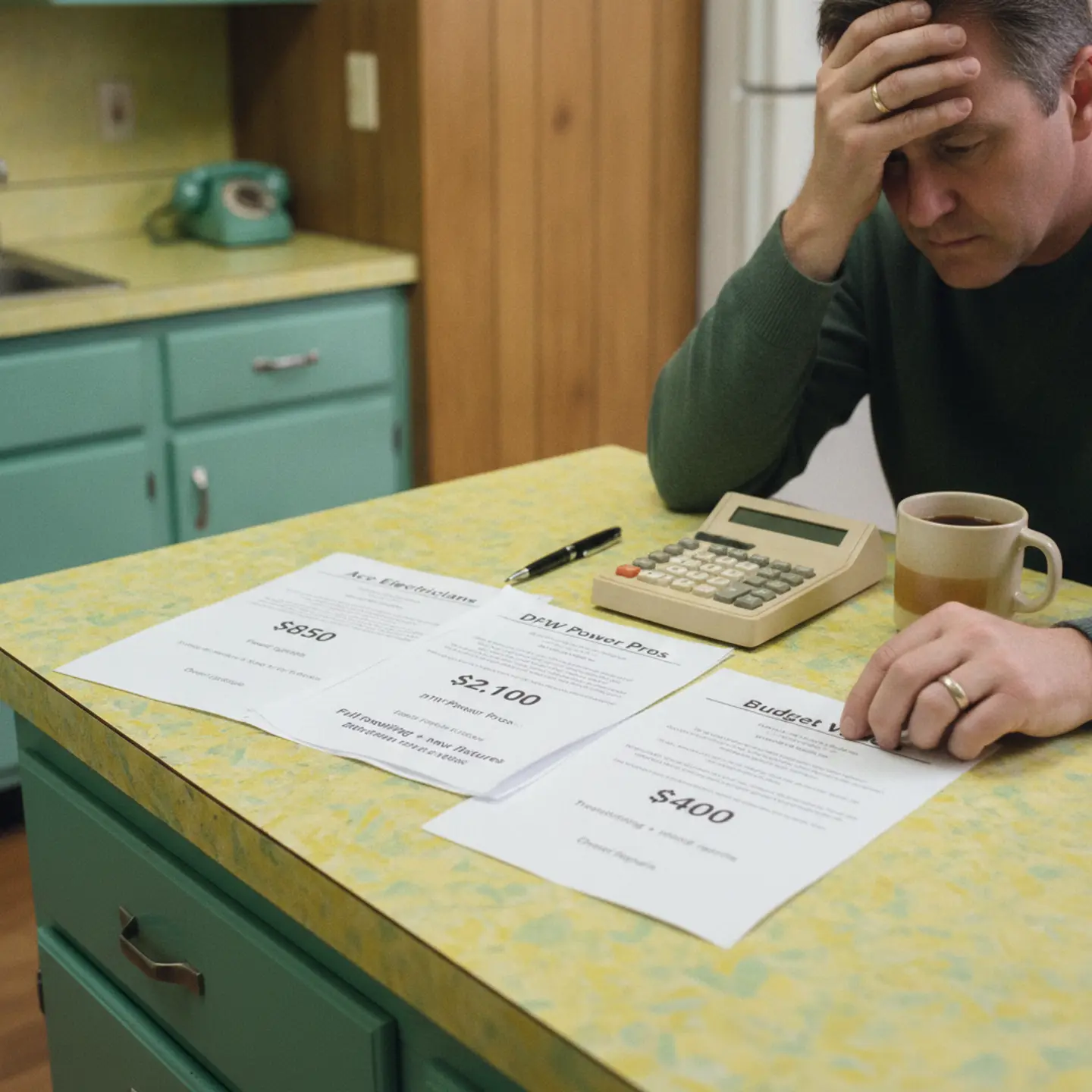
If you’re getting quotes over $800 to $1,000 for a basic surge protector installation—and there’s no major panel remediation needed—that’s a red flag.
What to Ignore: The Warranty Trap
You’ll see surge protectors advertised with impressive “Connected Equipment Warranties”—$25,000, $50,000, even $75,000 in coverage if your electronics get damaged.
Sounds great, right?
Here’s the reality: these warranties are nearly impossible to collect on. The claim process requires you to mail the damaged surge protector back to the manufacturer. Their lab analyzes it and almost always finds a reason to deny the claim—either the MOVs were still functional (so they claim the surge came from a different source), or the MOVs were destroyed (so they claim it was improper installation or an “act of God”).
The warranty sounds impressive, but it’s mostly marketing. Choose your surge protector based on the technical specifications—surge capacity, clamping voltage, and build quality—not the dollar amount of a warranty you’ll likely never be able to use.
Do You Actually Need One?
Let me give you honest scenarios.
You Definitely Need It If:
- You’re doing any electrical work that requires a permit (it’s required by code)
- You have expensive HVAC systems, smart appliances, or home automation equipment
- You live in an area with frequent power outages or severe weather
- Your home has sensitive medical equipment or critical home office setups
It’s Optional (But Smart) If:
- Your home is older with basic appliances, but you’re planning to stay long-term
- You want to extend the lifespan of your appliances by 2-3 years
- You’re looking to avoid the “electronic rust” that causes premature failures
You Probably Don’t Need It If:
- You’re renting: You can’t modify the electrical panel. Focus on quality surge strips for your electronics instead.
- The building is scheduled for demolition or complete rewiring: No point adding protection to a system that’s going away.
- Your panel is a known fire hazard brand (Federal Pacific, Zinsco): In this case, you don’t need a surge protector—you need a new panel. Adding a protector to a dangerous panel is like putting a band-aid on a broken leg.
What to Do Next
If you’ve decided surge protection makes sense for your home, here’s how to move forward.
If You’re Getting It Installed:
1. Hire a licensed electrician.
This isn’t a DIY project. Panel work involves live voltage that can kill. Even with Texas homeowner exemptions, you’ll still need a permit and inspection—and inspectors will check for proper installation.
2. Look for these technical specs:
- Surge capacity: 50kA to 80kA. Texas needs higher capacity due to severe lightning activity.
- Clamping voltage: 600V to 700V. Lower numbers mean better protection.
- NEMA 4 rating: If your panel is outside (common in parts of Texas), the enclosure needs to be weather-resistant.
3. Check the installation quality.
The wires connecting the surge protector to your panel should be short and straight. Long, coiled wires reduce effectiveness. Every extra inch of wire adds voltage “let-through” during a surge. A $500 unit installed poorly is less effective than a $100 unit installed correctly.
After It’s Installed:
- Check the indicator lights after every major storm. If the light is off, the protector has sacrificed itself and needs replacement.
- Plan to replace every 3-5 years in high-lightning areas (Houston, East Texas) or every 5-10 years in more stable regions.
- Consider units with audible alarms if your panel is in a garage or outside where you won’t see the indicator lights regularly.
If You Can’t Afford It Right Now:
Budget tight? I get it. Here’s a practical approach:
Prioritize high-quality surge strips for your most expensive electronics—TVs, computers, home office equipment. Then plan to add whole house protection during your next panel service or upgrade, when the incremental cost will be lower.
Frequently Asked Questions
Will a whole house surge protector protect against direct lightning strikes?
No. Direct strikes carry too much energy for any residential device to handle. But it will protect against near-field strikes—when lightning hits nearby poles, trees, or the ground—which are far more common and still extremely damaging.
How long do whole house surge protectors last?
Typically 3-5 years in areas with frequent lightning activity, or 5-10 years in more stable regions. They’re sacrificial devices—they die protecting your home. Check the indicator lights regularly and replace the unit when it fails.
Can I install one myself?
Texas law allows homeowners to do electrical work on their own primary residence without a license. But you still need a permit and must pass inspection. More importantly, panel work involves live voltage even when breakers are off. It’s not worth the risk. Hire a pro.
Do surge protectors reduce my insurance rates?
Rarely. Most insurance discounts focus on fire, burglary, and water leak detection. The real financial value of surge protection is avoiding your deductible—which is often $4,000 or more on Texas homeowner policies. A surge that damages $3,000 worth of electronics won’t meet your deductible, meaning you pay 100% out of pocket.
What’s the difference between Type 1 and Type 2 surge protectors?
Type 1 devices install before the main breaker (line side) and are designed to handle massive external surges from lightning or utility switching. They’re the “brute force” defenders.
Type 2 devices install inside the panel (load side) and are the most common for residential homes. They balance protection and cost, handling both external and internal surges effectively.
For most Texas homes, Type 2 is what you need.
Do I still need surge strips if I have whole house protection?
Yes. Whole house surge protectors bring voltage spikes down to around 600 volts—safe for hardwired appliances like your HVAC or water heater. But sensitive electronics like TVs, computers, and gaming systems need voltage clamped down to 330 volts. That’s what quality surge strips do. You need both layers working together.
What happens if I don’t install one during a panel upgrade?
You’ll fail inspection under the 2023 Texas electrical code. That means you’ll face permit re-filing fees, delays, and potentially issues with homeowners insurance if something goes wrong down the line. The code requires it for a reason—it’s a safety standard, not a suggestion.
Need Help Deciding What’s Right for Your Home?
I get it—electrical work can feel overwhelming, especially when you’re trying to figure out what’s actually necessary versus what’s just a sales pitch.
If you’re in the DFW area and want an honest assessment of your panel and surge protection needs, I’m happy to take a look. No pressure, no upselling—just a straightforward explanation of what your home needs and what it’ll cost.
Everything works as it should when we’re done.
Call/Text: 682-478-6088