What Is a Circuit Breaker in Your Home — And What’s It Telling You When It Trips?
⚡ Key Takeaways
- A circuit breaker is your home’s early warning system — it doesn’t just cut power, it’s reporting a condition in your electrical system every single time it trips.
- There are five things a tripping breaker can mean — overload, short circuit, ground fault, arc fault, or a line-side fault. Each one has a different cause and a different level of urgency.
- In DFW, your breakers work harder than anywhere else — attic temperatures above 140°F cause a 20-amp breaker to behave like a 16-amp breaker, which is why afternoon trips spike in summer.
- Arcing faults start 28,000 home fires per year — and a standard breaker cannot detect them. This is why AFCI breakers exist, and why that “annoying” AFCI trip may be the most important one your panel ever makes.
- Federal Pacific, Zinsco, and Sylvania panels fail to trip 1 in 3 times — if your DFW home was built between 1955 and 1985, there’s a real chance one of these panels is still in your wall.
- Repeatedly resetting a breaker that trips immediately can permanently disable your protection — the contacts can weld shut, creating a breaker that looks fine but no longer trips at all.
- Most breaker problems don’t require a panel replacement — the fix is usually faster and cheaper than people assume. The goal is an honest diagnosis, not an upsell.
Something tripped. You walk to the panel, find the breaker in the middle — not fully on, not fully off — push it back, and the lights come on. Maybe it’s the second time this week. Maybe it’s the fifth time this month.
You’ve been resetting it and moving on. But somewhere in the back of your mind there’s a question you haven’t quite gotten around to asking: what is that thing actually doing, and should I be worried?
That’s exactly the right question to be asking. Because a tripping breaker isn’t just an inconvenience — it’s a message. And once you understand what the different types of trips actually mean, you’ll know in about thirty seconds whether you’re dealing with a minor nuisance or something that genuinely needs attention before it becomes a problem.
This guide covers all of it — what a circuit breaker actually is, how it works, what it’s communicating when it trips, why DFW homes deal with this differently than most of the country, and exactly when to call someone versus when to just redistribute what’s plugged in. No jargon. No scare tactics. Just what you need to know.
The Gray Box on Your Wall — What It Actually Is
Your home’s electrical system is essentially a network of rivers. Electricity flows from the utility through your meter, into your main panel, and then out through individual branch circuits to every outlet, light, and appliance in your home.
The circuit breaker is the dam in that system. Its job is to monitor how much electricity is flowing through each circuit and shut off the flow the moment it exceeds a safe level — before the wires inside your walls get hot enough to become a fire hazard.
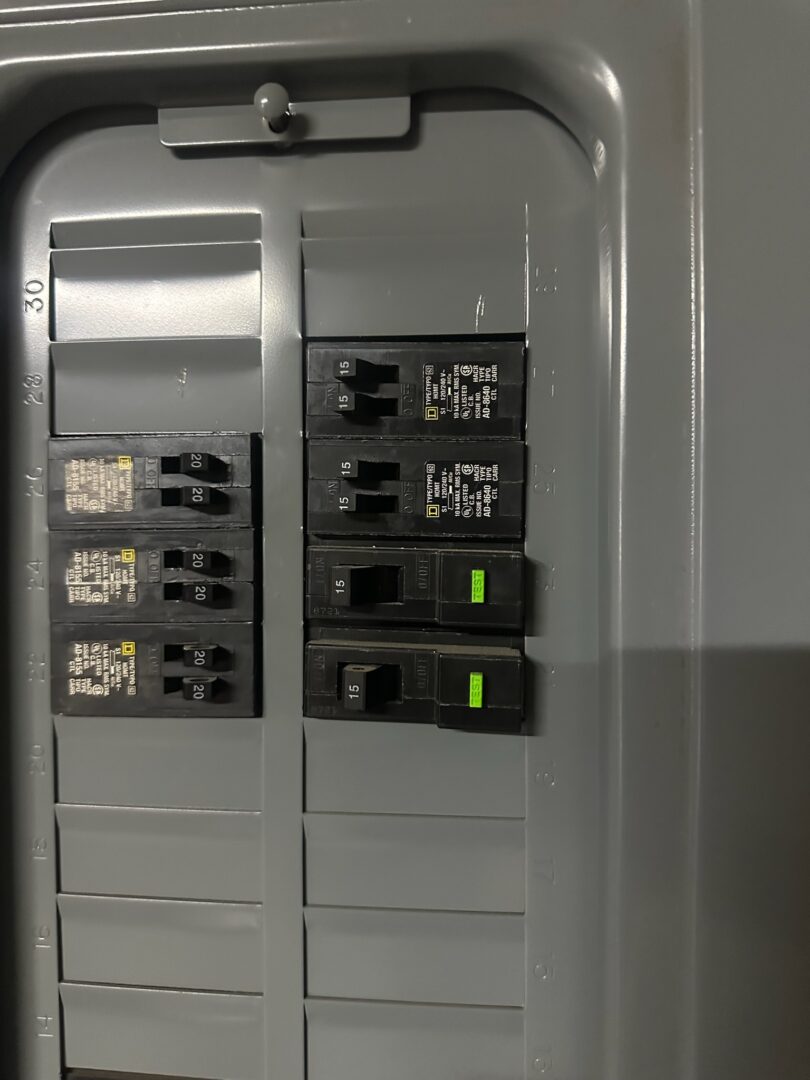
Inside that gray metal panel you’ll find two things: one large main breaker at the top that controls power to the entire panel, and a row of smaller individual branch circuit breakers — each one dedicated to a specific circuit in your home. One breaker might control the kitchen outlets. Another controls the master bedroom. A wider double breaker handles your AC unit or electric dryer.
💡 Before Breakers, There Were Fuses
Homes built before roughly 1960 used fuse boxes instead of breaker panels. Fuses worked on the same principle — too much current and the fuse element would melt, cutting the circuit. But once blown, a fuse had to be replaced entirely. Circuit breakers replaced fuses because they can be reset and reused. If your home still has a fuse box, that’s worth a conversation with an electrician — not just for safety, but because modern electrical loads have likely outgrown what it was designed to handle.
The number stamped on each breaker — 15, 20, 30, 50 — is its ampere rating. That’s the maximum continuous current that circuit can safely carry. The breaker’s entire purpose is to make sure the current never exceeds that number long enough to cause harm.
Simple concept. Remarkably sophisticated execution. And when it trips, it’s doing exactly what it was designed to do.
How a Circuit Breaker Actually Works — Without the Engineering Degree
Inside every standard residential circuit breaker are two separate trip mechanisms. They’re designed to respond to two completely different types of electrical problems — and they do it on completely different timescales.
The Slow One: Thermal Trip (Overloads)
The thermal mechanism handles overloads — situations where too much current is flowing, but not catastrophically so. At the heart of it is a bimetallic strip: two different metals bonded together that expand at different rates when heated.
As current flows through the breaker, the strip heats up. Under normal load, it stays straight. But when the circuit is overloaded — say, a space heater and a hair dryer running on the same 15-amp circuit — the strip carries more current than it should, heats up faster, bends from the uneven expansion, and eventually hits a trip lever that physically releases the breaker’s spring-loaded contacts.
This process takes time — and that’s intentional. Your refrigerator, your air conditioner, and your washing machine all draw a brief surge of current when they start up (called inrush current). If the breaker tripped every time a motor kicked on, your home would be unusable. The thermal mechanism is calibrated to ignore brief spikes and only trip when a sustained overload is present.
The Fast One: Magnetic Trip (Short Circuits)
The magnetic mechanism handles something far more serious: a short circuit. This is what happens when a hot wire directly contacts a neutral or ground wire — resistance drops to nearly zero, and current spikes to thousands of amps in an instant.
The magnetic mechanism uses an electromagnet. Under normal current levels, the electromagnet isn’t strong enough to move anything. But when a short circuit sends a massive surge through the line, the electromagnet fires instantly — tripping the breaker in as little as 4 milliseconds.
How Fast Does a Breaker Trip?
A short circuit triggers the magnetic mechanism in as little as 4 milliseconds — faster than you can blink. An overload triggers the slower thermal mechanism, which can take anywhere from a few seconds to nearly an hour depending on how much the circuit is overloaded. Both protect your home — on very different timescales.
The time-current relationship breaks down like this: at 135% of the breaker’s rating, it may carry that load for up to an hour before tripping. At 200% of its rating, it trips in 4 to 40 seconds. At 500% or more — the territory of a hard short circuit — it trips in under a tenth of a second. The higher the fault, the faster the response.
What Your Breaker Is Actually Telling You When It Trips
This is the part most homeowners never learn — and it’s the most useful thing in this entire guide. A tripping breaker isn’t a random event. It’s your electrical system reporting a specific condition. Here’s how to read what it’s saying.
“Too Much Is Running on Me” → Overloaded Circuit
This is the most common trip by a wide margin, and it’s usually the least urgent. A standard 15-amp circuit can handle approximately 1,800 watts of continuous load. When you push past that — a 1,500-watt space heater plus a 1,200-watt coffee maker on the same circuit, for example — the thermal mechanism heats up and trips.
The fix here is usually simple: unplug something, reset the breaker, and redistribute your appliances across different circuits. If your space heater keeps tripping the breaker, that’s usually an overload issue — but it’s worth understanding what’s happening before you assume the breaker is bad.
💡 The Most Common Overload Culprits in DFW Homes
Space heaters, portable air conditioners, hair dryers, and electric skillets are the top causes of overloaded circuits in North Texas homes — especially in older homes where kitchen and bathroom circuits were designed for far lighter loads than today’s appliances demand. If the same breaker trips every time you use a specific appliance, that’s not a bad breaker — that’s a circuit that has too much on it.
“Something Is Wrong in the Wiring” → Short Circuit
A short circuit is a more serious conversation. It happens when a hot wire makes direct contact with a neutral wire — inside a damaged appliance cord, inside a wall where rodents have chewed through insulation, or at a loose connection that has deteriorated over time.
The magnetic mechanism fires immediately, so the tell-tale sign of a short circuit is a breaker that trips the instant you try to reset it. If you push it back to ON and it immediately flips to the middle again — that’s almost always a short or ground fault. Stop resetting it. Leave it in the OFF position and call an electrician. Continuing to reset it pushes high-fault current into whatever is causing the problem, which can ignite wiring inside the wall or cause the breaker’s contacts to weld shut.
“Electricity Is Going Somewhere Dangerous” → Ground Fault
A ground fault is a specific type of short circuit where current escapes toward the ground — which becomes dangerous when that path runs through a person standing near water. This is precisely why GFCI protection exists and why it’s required in bathrooms, kitchens, garages, and outdoor locations.
GFCI devices monitor the balance between the hot and neutral wires. If they detect a difference of more than 4 to 6 milliamps — an amount so small you might not feel it — they trip instantly. A GFCI that won’t reset is telling you there’s a real ground fault present somewhere on that circuit. That’s not a nuisance — that’s the protection doing exactly what it was built to do.
“There’s a Spark You Can’t See” → Arc Fault
This is the one that gets homes. Arcing faults — small electrical sparks occurring at loose connections or through damaged wire insulation — are responsible for more than 28,000 home fires every year in the United States. The problem is that an arc can reach temperatures of thousands of degrees while drawing less current than it takes to trip a standard 15-amp breaker. Standard breakers are essentially blind to it.
AFCI breakers were developed specifically to detect the electrical “signature” of an arc using digital signal processing. They recognize the specific waveform of a dangerous spark and disconnect power before a fire can start. The 2023 National Electrical Code now requires AFCI protection in nearly every living area of a home.
AFCI breakers trip more than standard breakers — and homeowners often find that frustrating. But when an AFCI trips on a circuit with normal load, it’s usually detecting something real. Learn more about AFCI breaker requirements in Texas and what a trip on one of these actually means.
“Something Is Wrong You Can’t Easily See” → Nothing Plugged In
If a breaker trips when nothing is drawing load on that circuit — no appliances running, nothing plugged in — the problem is what electricians call a line-side fault. The most common causes are rodents chewing through wire insulation inside the wall, a loose connection at an outlet or the breaker itself that has developed an arc point, or moisture infiltrating an exterior outlet box and creating a leakage path.
None of these are fixable by resetting. This one needs an electrician to trace and diagnose.
⚠️ The Most Dangerous Thing You Can Do
If a breaker trips immediately every time you reset it, stop resetting it. Each reset pushes a massive surge of fault current into whatever is causing the problem. In a short circuit, that current can ignite wiring inside your walls. Even worse — it can cause the breaker’s internal contacts to weld shut, permanently disabling the protection. A breaker with welded contacts looks completely normal from the outside. It will never trip again. That is not a fixed breaker — that is a missing safety net.
If You Live in DFW, Your Breakers Work Harder Than You Think
Everything above applies to homes everywhere. But North Texas adds a layer of stress to residential electrical systems that most national content completely ignores. If your home is in DFW, these factors are not theoretical — they’re part of your daily electrical reality.
Texas Heat Changes the Math on Your Breakers
Circuit breakers are factory-calibrated at a reference temperature of 30°C (86°F). That’s the ambient temperature the manufacturer assumed when they set the trip threshold. In North Texas, residential attics — where many branch circuits and subpanels are located — routinely reach 140°F or higher during summer months.
This creates a phenomenon called thermal derating. Because the bimetallic strip is already partially heated by the surrounding air, it takes less electrical current to reach the trip threshold. In practical terms, a 20-amp breaker operating in a 140°F attic effectively becomes a 16.4-amp breaker.
How DFW Summer Heat Derate Your Breakers
A 20-amp breaker in a 140°F attic loses approximately 18% of its rated capacity — dropping to an effective 16.4 amps. This is why DFW homeowners experience more circuit trips in the afternoon when AC systems are running at full load and attic temperatures are at their daily peak. The breaker isn’t failing — it’s operating in conditions it was never rated for.
| Attic Temperature | Derating Factor | Effective Capacity of 20A Breaker |
|---|---|---|
| 86°F (Reference / Rated) | 1.00 | 20.0 Amps |
| 104°F | 0.94 | 18.8 Amps |
| 122°F | 0.88 | 17.6 Amps |
| 140°F | 0.82 | 16.4 Amps |
This derating effect explains something many DFW homeowners experience but can never quite account for: the same circuit that runs fine all winter trips repeatedly every July and August. The load hasn’t changed — the thermal environment around the breaker has. If afternoon trips are a pattern in your home, this is almost certainly a factor.
The DFW Building Boom Left a Specific Legacy
The Dallas-Fort Worth area saw an extraordinary residential building boom between 1970 and 1990. That growth was real and rapid — and the electrical infrastructure installed during that era reflects the standards, materials, and cost pressures of that time. Some of what was built then is still in those walls today.
Aluminum wiring (1965–1973): During a period of high copper prices, aluminum was widely used as a cheaper alternative for branch circuit wiring. It conducts electricity fine — but it expands and contracts more dramatically than copper with temperature changes. In the DFW climate, this repeated thermal cycling creates a phenomenon called cold creep: the aluminum wire slowly works loose from the terminals at outlets and breakers. Loose connections are one of the primary causes of arcing faults. If your home was built between 1965 and 1973, aluminum wiring deserves a professional evaluation.
Federal Pacific, Zinsco, and Sylvania panels: These manufacturers supplied millions of residential panels during the 1955–1985 period. Independent testing by the IEEE and the Consumer Product Safety Commission (CPSC) has since confirmed serious design flaws. FPE “Stab-Lok” breakers have been documented to fail to trip in as many as 1 out of every 3 overcurrent events — a 33% failure rate, compared to less than 1% for modern listed breakers. In the Texas heat, the internal components of these panels are even more prone to the contact “welding” that permanently disables the breaker. If you have one of these panels, the case for replacement is well-established.
⚠️ Texas Homeowners Insurance and Legacy Panels
The Texas Department of Insurance (TDI) has specifically flagged Federal Pacific, Zinsco, and Sylvania panels. In Texas, these panels can be grounds for automatic insurance denial or significant premium increases. If you’re planning to sell your home — or if you’ve recently purchased one — this is worth checking before your next renewal. See also: which Sylvania panels are flagged in Fort Worth.
The ERCOT Factor
Texas operates its own isolated electrical grid managed by ERCOT — separate from the rest of the country. During peak summer demand, the grid experiences power quality events that homes in other states rarely deal with: brief voltage surges, brownouts, and fluctuations that stress residential electrical equipment.
For standard breakers and wiring, this is mostly background noise. But for AFCI and GFCI breakers — which rely on sensitive electronic monitoring circuits — repeated voltage fluctuations can cause premature wear on the internal electronics. DFW homeowners may find that their AFCI and GFCI breakers fail or begin nuisance-tripping earlier than their rated lifespan suggests. It’s not a defective product — it’s a product operating in a harder electrical environment than it was designed around.
Types of Breakers in Your Home — Why It Matters Which One Trips
Not all breakers in your panel are the same, and the type that trips changes what it’s telling you. Here’s a practical breakdown — not a technical catalog, but enough to understand what you’re looking at.
Standard Single-Pole Breakers (15A / 20A)
These handle 120-volt circuits — most of your outlets, lighting, and small appliances. They protect against overloads and short circuits but cannot detect arcing or ground faults. When one trips, start with the overload explanation: too much plugged in, or an appliance with a fault.
Double-Pole Breakers (240V)
These are the wider breakers that occupy two slots in your panel. They serve high-demand appliances: central AC, electric dryer, electric range, water heater, EV charger. When one of these trips, the entire appliance it serves goes dead. If your AC unit trips its breaker, that’s worth a call — it could be the breaker, the wiring, or an issue with the unit itself drawing too much current. Understanding why half your house might lose power is related to this category of breaker.
GFCI Breakers
Required in bathrooms, kitchens, garages, outdoor locations, and anywhere near water. They monitor the balance of current between hot and neutral and trip at just 4–6 milliamps of imbalance — an amount too small to cause electrocution if caught fast enough. When a GFCI breaker trips, treat it as a real warning. There is a ground fault somewhere on that circuit. Don’t just reset and forget.
AFCI Breakers
Now required by the 2023 NEC in almost all living areas. These use digital signal processing to detect the electrical waveform of an arc — the kind of spark that can smolder inside a wall for hours before igniting. When an AFCI trips with no obvious overload, an electrician can use a specialized meter to read the waveform on the line and determine whether a real arc is occurring or whether it’s a nuisance trip from a device with a motor (vacuum cleaners and treadmills are common culprits).
💡 GFCI Breaker vs. GFCI Outlet — Which Is Better?
A GFCI outlet only protects what’s plugged into it (and sometimes downstream outlets on the same circuit). A GFCI breaker protects the entire circuit — including the wiring inside the walls leading to those outlets. For areas where the wiring itself runs near moisture (like a bathroom wall adjacent to a shower), a GFCI breaker provides broader coverage. Either is code-compliant; an electrician can advise which makes more sense for a specific circuit.
When Is a Tripping Breaker Actually Dangerous?
Here’s the honest answer to the question most people are really asking: the breaker tripping is almost never the danger. The breaker tripping is the protection working. The danger lies in three specific scenarios.
Scenario 1: A breaker that fails to trip when it should. This is the FPE/Zinsco/Sylvania problem. A breaker with a 33% failure rate doesn’t trip, current continues flowing, wiring overheats, and a fire starts inside your wall with no warning at all.
Scenario 2: A fault that doesn’t go away when you reset it. If you reset a breaker and the underlying cause — a short circuit, a ground fault, a damaged wire — is still there, you’re not fixing anything. You’re just pushing more current into the problem.
Scenario 3: The panel itself showing signs of distress. The breakers are doing their job. But the panel housing them has developed a problem that no amount of resetting will address.
✅ Warning Signs That Make It an Emergency:
- A burning smell or ozone smell near the panel — insulation is already melting or arcing is actively occurring
- The panel cover is hot or warm to the touch — a breaker is struggling to handle its load or a connection is failing
- Singe marks, scorch marks, or discoloration on any breaker or the panel interior — a significant electrical event has already occurred
- An audible sizzling, crackling, or buzzing from the panel — this is the literal sound of electricity arcing through the air; a fire could start at any moment
- A breaker that trips immediately every time you reset it — short circuit or ground fault present; stop resetting
- Your panel brand is Federal Pacific, Zinsco, or Sylvania — have it evaluated regardless of symptoms
✅ Warning Signs That Need Attention Soon:
- The same breaker trips repeatedly with no clear overload cause
- A breaker that trips under loads it used to handle without issue — a sign the breaker may be weakening
- Flickering lights or intermittent power on a specific circuit — points to a loose connection or developing arc fault
- Your panel is 20+ years old and you’ve never had it inspected
- Outlets that feel warm or have a slight burning smell at the face — loose connection at the device
And again — the most dangerous single action a homeowner can take is to repeatedly reset a breaker that trips immediately. Each reset sends a surge of fault current into the problem. In a short circuit scenario, that current can ignite material inside the wall before you ever smell smoke. And if it welds the contacts shut, you’ve turned a protection device into a permanent bypass.
If a breaker trips twice in a row without an obvious cause — leave it off. That’s not giving up; that’s making the right call. Our full guide on signs it’s time to call an electrician covers this in detail.
How Long Should a Circuit Breaker Last?
A residential electrical panel has an average lifespan of 25 to 40 years. The breakers inside it can outlast that estimate — but they can also wear out significantly sooner, especially in high-load, high-heat environments like North Texas.
Every time a breaker trips, its internal spring and bimetallic strip experience mechanical and thermal stress. A breaker that has tripped dozens of times due to repeated overloads may gradually become weak — meaning it begins to trip at lower and lower current levels than it was originally rated for. Eventually, a weak breaker can fail in the opposite direction: failing to trip at all.
In high-heat environments like DFW, electricians often recommend proactively evaluating breakers every 20 to 25 years rather than waiting for symptoms. The cost of replacing a breaker is a fraction of what it costs to deal with what happens when one fails silently.
Knowing whether it’s the breaker or the wiring matters. A failing breaker typically shows symptoms at the panel: it trips under normal loads, won’t hold its reset position, or feels warm. A wiring problem usually shows at the circuit level: flickering, intermittent power, warm outlets, or a burning smell at a specific device location. An electrician can use a multimeter and circuit testing to confirm which one is the real cause — and fix only what actually needs fixing.
| Service | Typical DFW Cost Range | Notes |
|---|---|---|
| Single standard breaker replacement | $150 – $250 | Includes diagnosis and labor |
| GFCI breaker replacement | $200 – $350 | GFCI breakers cost more than standard |
| AFCI breaker replacement | $200 – $350 | Similar to GFCI pricing |
| Double-pole breaker (240V circuits) | $200 – $400 | Depends on amperage rating |
| Basic panel swap (same amperage) | $1,500 – $2,800 | Minimal code upgrades required |
| 100A to 200A panel upgrade | $2,750 – $4,800 | Includes new service wires and meter base |
⚠️ The Wrong Breaker Size Is a Fire Hazard — Not a Fix
One of the most common DIY mistakes we see: swapping a 15-amp breaker for a 20-amp one because the 15-amp keeps tripping. It seems logical — give the circuit more capacity. But the breaker rating has to match the wire gauge on that circuit. A 15-amp circuit uses 14-gauge wire, which can only safely carry 15 amps. Putting a 20-amp breaker on it means the wire can overheat and potentially ignite before the breaker ever trips. The breaker isn’t the limit — the wire is. And the breaker’s job is to protect that wire.
Should You Replace It Yourself?
This comes up constantly, and the honest answer deserves a complete explanation — not just “call a professional” without context.
The core issue is that turning off the main breaker does not make the panel safe to work in. The service entrance wires — the thick cables that come in from the utility through your meter — remain energized at 240 volts even when the main breaker is off. Only the utility can de-energize those wires. Contacting them accidentally is fatal, and they’re located at the top of the panel, just inches from where you’d be working.
Beyond the safety issue, breakers are brand-specific. A Square D breaker installed in a Siemens panel may fit physically but the connection to the bus bar won’t be UL listed — meaning the fit is mechanically imprecise in ways that create heat and arcing over time. Using the wrong breaker voids the UL listing of the entire panel, which matters significantly for home insurance and resale.
In Texas, electrical panel work requires a licensed electrician and a permit pulled through the city or county. That permit isn’t just bureaucracy — it creates a documented inspection record that matters when you sell your home, file an insurance claim, or need to prove the work was done to code. An unpermitted breaker replacement or panel installation can complicate all three of those situations significantly.
Frequently Asked Questions
How do I find out what’s tripping my circuit breaker?
Start by unplugging everything on that circuit, resetting the breaker, and then plugging appliances back in one at a time. If the breaker holds with nothing plugged in but trips when a specific appliance is connected, that appliance likely has an internal fault. If the breaker trips with nothing plugged in, you have a line-side fault — a wiring issue that needs an electrician to trace. If it trips immediately every time you reset it regardless of load, that’s almost always a short circuit or ground fault in the wiring itself.
Can a breaker that keeps tripping cause a fire?
A functioning breaker that trips correctly is preventing a fire, not causing one. The fire risk comes from two failure modes: a breaker that fails to trip when it should (allowing the circuit to overheat), or a homeowner who repeatedly resets a breaker with an active fault, potentially igniting wiring or welding the contacts shut. The tripping is the protection. Removing the protection — by resetting repeatedly or installing a higher-rated breaker — is what creates fire risk.
Is a tripped breaker an emergency?
It depends entirely on why it tripped. A breaker that trips once with an obvious overload cause, resets cleanly, and stays on is not an emergency — it’s just feedback. A breaker that trips immediately on reset, or that trips alongside any of the warning signs listed above (burning smell, hot panel, audible sizzling, scorch marks), is an emergency that warrants turning it off and calling an electrician the same day. When in doubt, leave the breaker off and get a professional assessment.
How do I know if my circuit breaker is bad?
A failing breaker typically shows one or more of these signs: it trips under loads it previously handled without issue (weakened threshold), it won’t hold its reset position, it feels warm or hot on the face, or it has visible discoloration or a burning smell at the panel. A bad breaker can also fail in the opposite direction — no longer tripping when it should — which is harder to detect without testing. If you suspect a breaker is failing, have it tested before assuming the circuit or appliance is the problem.
Do breakers just randomly trip?
Not truly randomly — though they can feel that way. The most common explanation for trips that seem to have no pattern is the thermal derating phenomenon: in DFW homes, attic temperatures above 120–140°F effectively reduce a breaker’s capacity, so circuits that run fine in cooler months trip repeatedly in summer under the same loads. Other causes of seemingly random trips include a weakening breaker, intermittent arcing at a loose connection, or appliances with variable power draw (like older refrigerators or AC compressors with struggling motors).
What does it mean when a breaker won’t stay in the on position?
A breaker that won’t hold its reset position — that returns to the middle or trips back immediately — almost always means the fault that caused the trip is still present. The breaker is working correctly: it’s refusing to stay on because the circuit it’s protecting still has a problem. The most common causes are a short circuit in the wiring, a ground fault, a failed appliance drawing excessive current, or a badly deteriorated breaker that has lost its internal spring tension. In any of these cases, the answer is diagnosis, not more resets. See our guide on what to do when your circuit breaker keeps tripping.
Are there warning signs before an electrical fire starts?
Yes — and recognizing them is genuinely life-saving. The key warning signs are: a persistent burning or ozone smell near the panel or at outlets, a panel cover that is warm or hot to the touch, visible scorch marks anywhere on the panel interior or outlet faces, an audible sizzling or crackling from the panel or inside the wall, lights that flicker consistently on a specific circuit, and outlets or switch plates that are warm or discolored. None of these are “monitor and see” situations. Any one of them warrants an electrician visit before the end of the week — and the burning smell or audible arcing warrant a call today.
The Bottom Line — What to Do Right Now
The circuit breaker in your home isn’t just a switch. It’s a calibrated safety device that monitors 120 or 240 volts of electricity flowing through your walls around the clock — and intervenes in as little as 4 milliseconds when something goes wrong.
When it trips, it’s not failing. It’s reporting. And what it’s reporting is almost always one of five specific things: too much load, a short circuit, a ground fault, an arc fault, or a line-side problem in the wiring. Each one has a different urgency level and a different appropriate response.
We’ve sat across from homeowners who were told by other electricians that a tripping breaker meant they needed a full panel replacement — when all they actually needed was a single breaker swap and a redistribution of two appliances. That’s the kind of outcome we’re here to prevent. An honest diagnosis costs far less than unnecessary work, and it’s what you deserve every time.
If your DFW home was built before 1990, has a panel brand you don’t recognize, has breakers that trip in summer but not in winter, or has any of the warning signs listed in this guide — the right next step is a professional assessment. Not a panic, not a pressure sale. Just an honest look at what’s actually happening and a clear explanation of what, if anything, needs to be done about it.
What to Do Right Now Based on What You’re Seeing
Trip happened once, obvious cause (too many things plugged in): Unplug something, reset the breaker, redistribute your appliances. Monitor it. You’re probably fine.
Same breaker trips repeatedly with no clear cause: Leave it off after the second trip. Note which circuit it is and what was on it. Call an electrician for a diagnosis.
Breaker trips immediately every time you reset it: Stop resetting. Leave it off. Call today — there’s an active fault on that circuit.
Any of the emergency warning signs (burning smell, hot panel, audible sizzling, scorch marks): Turn off the main breaker. Leave the building if the smell is strong. Call an electrician immediately. This is not a wait-and-see situation.
Call or Text: (682) 478-6088
Serving Fort Worth, Arlington, Keller, Southlake, Colleyville, Grapevine, Lewisville, and all of DFW