Key Takeaways
- Battery backup costs more upfront — but the 30% IRA federal tax credit brings a $17,000 system down to $11,900, making the gap smaller than it looks.
- Generators win on runtime — they run as long as fuel lasts, which matters during multi-day outages like Winter Storm Uri; batteries are limited to 4–48 hours depending on capacity.
- DFW outages typically last 2–12 hours — which puts most storm events squarely within battery backup territory for essential circuits.
- True whole-home battery coverage requires 40+ kWh — that means multiple stacked batteries and a premium price tag; a single 13.5 kWh unit powers essentials, not everything.
- Generators carry ongoing costs — annual maintenance contracts run $300–$800/year, plus fuel during outages; batteries require minimal upkeep.
- Noise and HOA restrictions matter in suburban DFW — generators run at 65–75 dB; batteries are completely silent, a real advantage in neighborhoods with restrictions.
- A hybrid system (battery + generator) offers maximum resilience — but costs $25,000–$50,000+ installed; best for critical medical needs or those who lived through Uri-level events.
- Always hire a TECL-licensed contractor — verify any installer at tdlr.texas.gov before signing anything.
- The right answer depends on your specific situation — outage history, budget, home load, and HOA rules all shape which system makes sense for you.
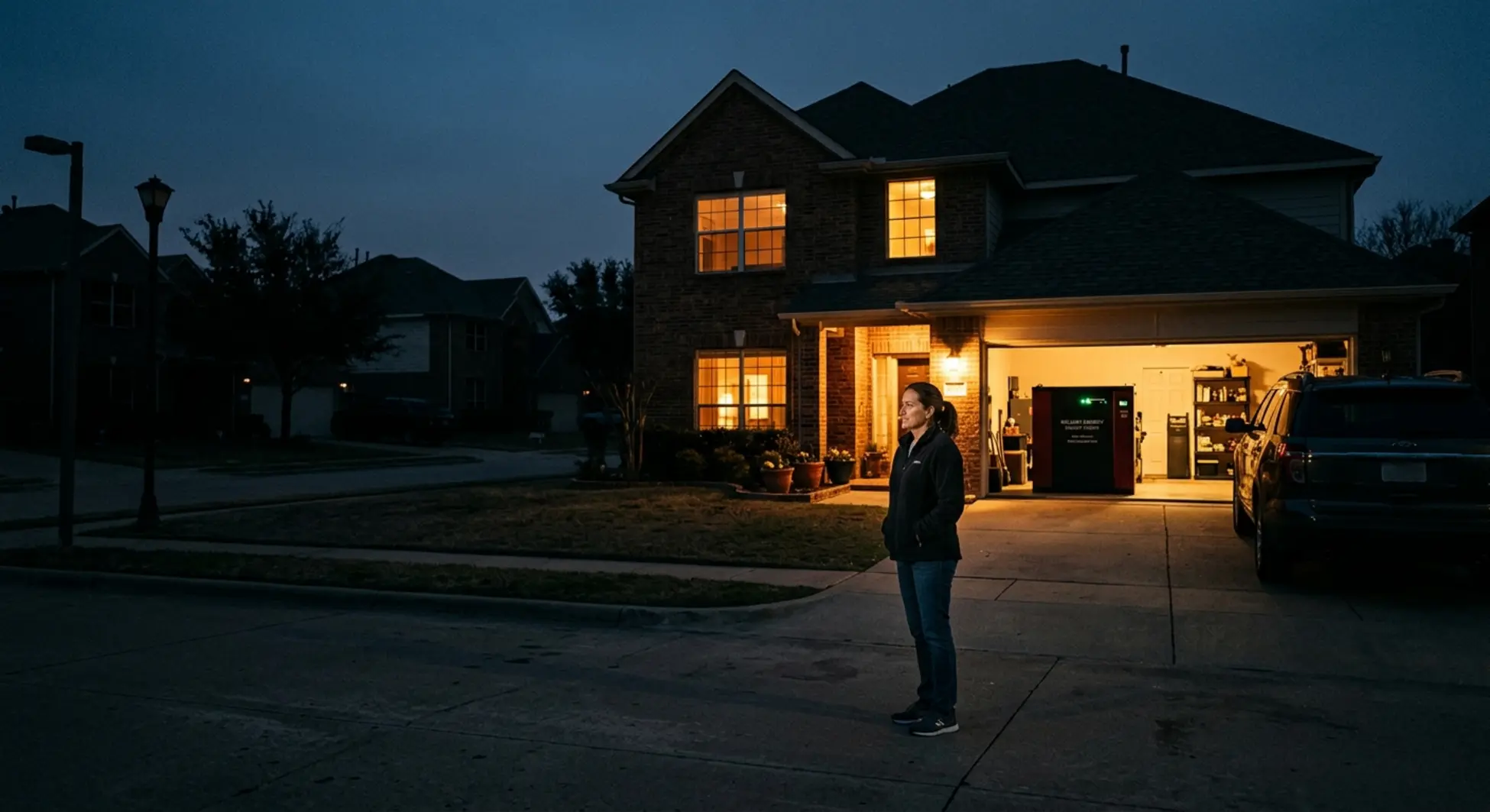
It’s 2 PM on a summer afternoon in North Richland Hills. The power goes out. Your AC shuts down. Your fridge starts warming up. Your home office goes dark. The kids are home. Your neighbor’s dog is barking. And somewhere in the back of your mind, you’re thinking: I should have done something about this by now.
You have two real options for whole-home emergency power: a battery backup system or a standby generator. Both work. Both have legitimate advantages. And both have trade-offs that most salespeople won’t volunteer upfront.
This guide is going to give you the honest version — costs, runtime, maintenance, tax credits, and the specific scenarios where each system makes more sense. No pressure, no upsell. Just the facts you need to make a confident decision for your family and your home.
Why DFW Homeowners Are Choosing Backup Power Right Now
The DFW metroplex now exceeds 8 million residents, and the grid that serves it is under more strain than ever. Fastest-growing suburbs — Celina, Anna, Prosper to the north, and closer to home, North Richland Hills, Keller, and Haltom City — are adding thousands of households every year. That growth puts real pressure on aging electrical infrastructure that wasn’t designed for today’s demand.
According to ERCOT grid reliability data, DFW experiences 5–10+ localized outages annually due to weather events — ice, wind, lightning — with storm-related outages typically lasting 2–12 hours. ERCOT also recorded 3–5 significant grid stress events annually in recent years, creating the potential for managed rotating outages that can stretch longer.
Winter Storm Uri in February 2021 changed the conversation permanently. Millions of Texans went without power for days in subfreezing temperatures. Pipes burst. People died. The grid held on by the thinnest of margins. Subsequent grid stress alerts in 2023 and 2024 — while managed without widespread rotating outages — served as reminders that the risk hasn’t gone away. For many DFW families, backup power stopped being a luxury and became a practical necessity.
The economics have also shifted. With DFW median household incomes in the $80,000–$90,000 range and homeownership rates above 70–80% across the suburbs, a growing segment of homeowners can genuinely afford whole-home backup systems — especially with federal tax credits now in play. If you’re researching this topic, you’re in good company. Permit activity for both generators and battery systems has been climbing steadily since 2021, and demand is strong enough that installer lead times in some DFW suburbs are stretching out.
If you want to understand what backup power option makes sense for your specific home before diving into the details, you can always contact Epic Electrical for a free assessment — but read through this first. The more you know going in, the better the conversation will be.
🛡️ You’re Not Alone in Worrying About Power Outages
After Winter Storm Uri and ongoing ERCOT grid stress events, DFW homeowners are rightfully concerned about backup power. This isn’t paranoia — it’s a smart response to real grid challenges in our region. The fact that you’re researching this now, before the next outage, puts you ahead of most of your neighbors.
Battery Backup Systems: How They Work and What They Cost
Battery backup systems store electricity — either from the grid or from solar panels — and release it instantly when the power goes out. The key word is instantly. Unlike generators, which take 10–30 seconds to spin up, a battery system switches to backup power in a fraction of a second. For sensitive electronics like computers, medical devices, and home servers, that sub-second response time is a real advantage.
Here’s what you’re looking at for installed costs in DFW in 2026:
| System Tier | Capacity | Installed Cost | After 30% IRA Credit |
|---|---|---|---|
| Entry-Level | 10–13 kWh | $9,000–$15,000 | $6,300–$10,500 |
| Mid-Range | 20–27 kWh | $15,000–$22,000 | $10,500–$15,400 |
| Premium / Whole-Home | 40+ kWh | $22,000–$35,000+ | $15,400–$24,500+ |
Leading brands available through licensed electrical contractors in DFW include Tesla (Powerwall+, ~$11,500 installed), Enphase (IQ Battery, ~$13,000 per 5 kWh unit), and Generac (PWRcell, ~$12,000+). Pricing varies significantly based on installation complexity, panel capacity, and the number of units required.
Recharge time from the grid runs 4–10 hours for a full cycle. If you’re pairing with solar, recharge time depends on your array size and available sunlight — typically 1–2 days for a full recharge from solar alone. Battery lifespan is generally 10–15 years, with manufacturers warranting against more than 25–30% capacity loss. In DFW’s extreme summer heat, expect capacity retention of roughly 75–85% after 10 years under heavy cycling.
What a 13.5 kWh Battery Can Actually Power
A single Tesla Powerwall (13.5 kWh) or comparable unit is genuinely useful during a typical DFW storm outage — but you need to be realistic about what it covers. Here’s an honest breakdown:
- What it handles well: Refrigerator (~1.5 kWh/day), LED lighting throughout the home (~1–2 kWh/day), Wi-Fi router, phone chargers, ceiling fans, and basic electronics. Realistically, this covers essential comfort for 1–2 days.
- What it won’t sustain: Central AC running continuously (a 3-ton unit draws 3–5 kW — it’ll drain a 13.5 kWh battery in 3–5 hours at full load), electric water heater, electric range, or multiple large appliances running simultaneously.
- The math on whole-home coverage: The average DFW home uses 20–40 kWh per day. True whole-home coverage — including AC — requires 40+ kWh of storage, meaning multiple stacked batteries at premium cost.
This isn’t a knock on battery systems — it’s just the physics. For most DFW storm outages (2–12 hours), a single battery covering essentials is genuinely effective. The question is whether your situation calls for more than that.
Hidden Battery Costs to Budget For
The sticker price is only part of the story. Before you commit, factor in these additional costs that often come up during installation:
- Electrical panel upgrades: If your current panel doesn’t have sufficient capacity for the battery system’s interconnection requirements, you’re looking at $2,000–$5,000+ for a panel upgrade before the battery even goes in.
- Inverter replacement: Battery inverters typically last 10–15 years. Replacement cost runs $1,000–$4,000 depending on the system.
- Capacity degradation: Your battery won’t perform the same in year 10 as it does in year 1. Plan for reduced backup duration over time.
- HOA approval: Some DFW HOAs require aesthetic modifications or have approval processes that can add delays and costs.
💡 Pro Tip: The 30% Tax Credit Changes the Math
The IRA Section 25D tax credit applies to battery systems even without solar panels. This means a $17,000 battery system costs you only $11,900 after the credit — and there are no income limits. Don’t skip this calculation when comparing upfront costs to a generator. It’s a significant difference.
If you’re trying to figure out whether a battery system makes sense for your home’s electrical setup, that’s exactly what a free estimate is designed to answer. Epic Electrical can assess your panel capacity, outage patterns, and budget to give you a clear recommendation — no pressure, just honest advice.
Whole-Home Standby Generators: Unlimited Runtime, Real Trade-Offs
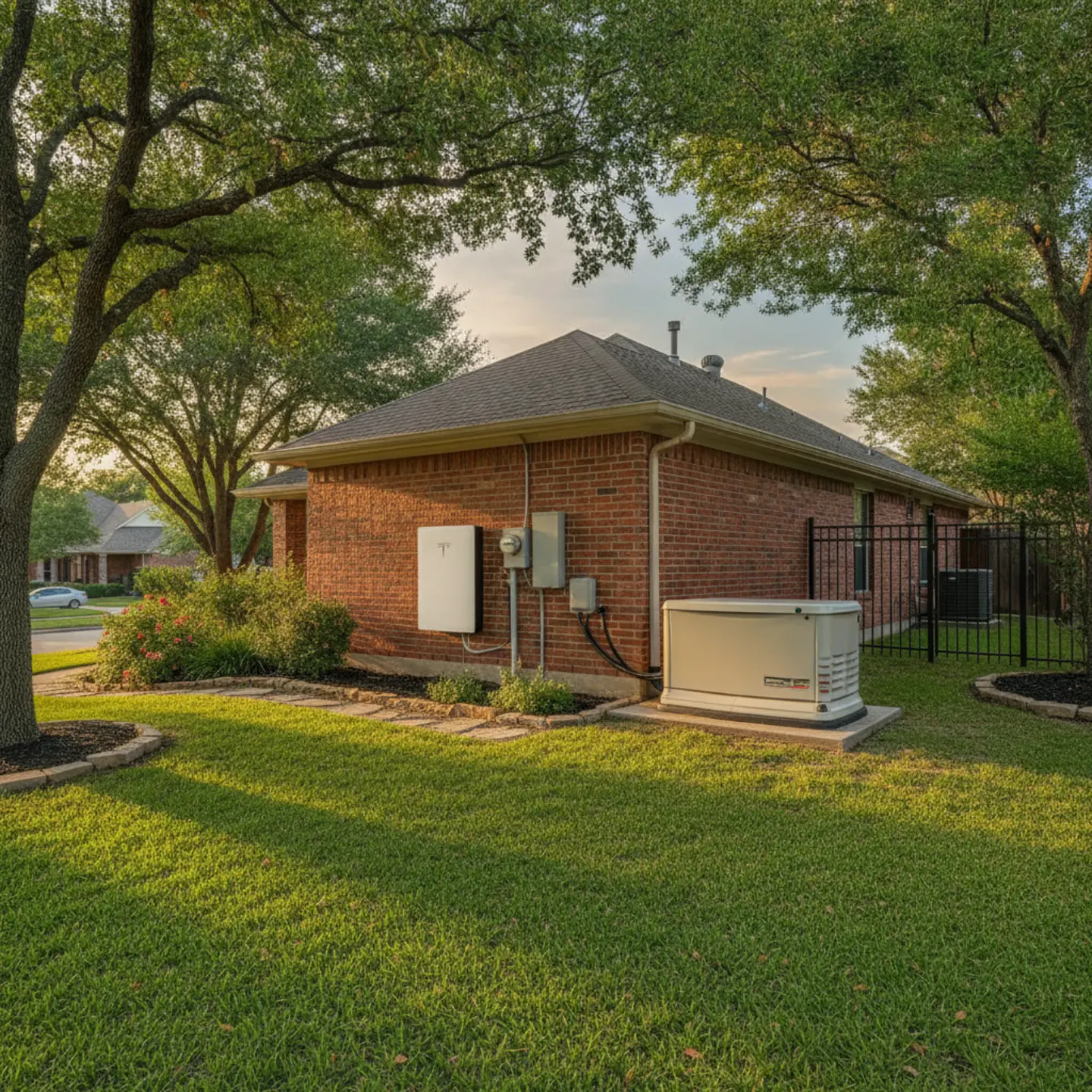
A standby generator is the proven workhorse of emergency power. It sits outside your home, connected to either natural gas or a propane tank, and when the power goes out, an Automatic Transfer Switch (ATS) detects the outage and starts the generator within 10–30 seconds. From your perspective inside the house, the lights flicker briefly and then everything comes back on.
The defining advantage of a generator is runtime. As long as you have fuel, it keeps running — for hours, for days, for as long as the outage lasts. That’s a fundamentally different proposition than a battery system with a fixed energy reserve. For our whole-home generator installation customers, that unlimited runtime is usually the deciding factor.
Here’s the installed cost breakdown for 2026:
| Output | Best For | Installed Cost |
|---|---|---|
| 10–14 kW | Essentials + some HVAC | $7,000–$12,000 |
| 16–22 kW | Most circuits + central HVAC | $10,000–$18,000 |
| 24–26 kW | Full whole-home coverage | $15,000–$25,000+ |
Leading brands in DFW include Generac (by far the most common), Kohler, Briggs & Stratton, and Cummins. Annual maintenance contracts — oil changes, filter replacements, spark plug checks, load testing — run $300–$800/year and are strongly recommended. A generator that hasn’t been serviced is a generator that might not start when you need it most.
You can read our detailed breakdown of Generac vs. Kohler whole-house generators if you want to go deeper on brand comparisons — it’s worth the read if you’re seriously considering a generator.
Natural Gas vs. Propane: Which Fuel Source Makes Sense for Your Home?
This is one of the first questions you’ll face when choosing a generator, and it’s worth thinking through carefully:
- Natural gas: Lower fuel cost (~$2.50/hr at 50% load on a 20 kW unit), no tank to maintain, and continuous supply as long as the Atmos Energy line is active. Most suburban DFW neighborhoods have natural gas service — but confirm before assuming.
- Propane: Higher fuel cost (~$4.50/hr at 50% load), requires a tank purchase or rental plus periodic delivery, but works anywhere — including rural areas without gas service. A standard 500-gallon propane tank provides roughly 4–6 days of runtime at 50% load for a 20 kW generator.
One important caveat on natural gas: during Winter Storm Uri, some natural gas supply lines were affected by the extreme cold, which impacted generator performance. This is a real consideration for DFW homeowners planning for Uri-level events.
Generator Noise and HOA Restrictions in DFW Suburbs
Standby generators typically operate at 65–75 dB at 20–25 feet — roughly the volume of a vacuum cleaner or normal conversation. That’s not deafening, but it’s noticeable, and it runs continuously during an outage.
Many DFW HOAs restrict generator placement, operating hours, or require noise abatement measures that can add $500–$2,000 to your installation cost. Local setback requirements in cities like North Richland Hills, Fort Worth, and Keller govern minimum distances from property lines, windows, and doors. Before you buy a generator, check your HOA rules and local ordinances — this is a step that gets skipped more often than it should.
Kohler generators are notably quieter than Generac units (60–65 dB vs. 65–75 dB), which can make a real difference in noise-sensitive neighborhoods. If HOA restrictions are a concern, it’s worth factoring brand selection into your decision.
Epic Electrical’s licensed team handles all permitting, setback verification, and HOA coordination as part of the installation process. We’ve worked through the permit offices in North Richland Hills, Fort Worth, and Keller enough times to know what to expect — and how to keep your project moving.
Battery Backup vs Generator: Head-to-Head Comparison for DFW Homes
Let’s put both systems side by side across the factors that actually matter for DFW homeowners. No spin — just an honest look at where each system wins and where it falls short.
| Factor | Battery Backup | Standby Generator | Edge |
|---|---|---|---|
| Upfront Cost | $9K–$35K+ | $7K–$25K+ | Generator |
| Ongoing Cost | Minimal | $300–$800/yr + fuel | Battery |
| Runtime | 4–48 hours | Unlimited (with fuel) | Generator |
| Response Time | Sub-second | 10–30 seconds | Battery |
| Noise | Silent | 65–75 dB | Battery |
| Maintenance | Minimal | Annual service required | Battery |
| Tax Incentives | 30% IRA credit | Limited rebates | Battery |
| Solar Integration | Excellent | Limited | Battery |
Battery Backup Wins When You Have Frequent, Short Outages
The typical DFW storm outage lasts 2–12 hours. A properly sized battery system handles that window comfortably for essential circuits, and it does so silently, instantly, and without requiring any fuel. If you live in a neighborhood with an active HOA, work from home and need clean power for sensitive electronics, or have medical devices that can’t tolerate even a 30-second gap, battery backup is a strong fit.
Battery systems also pair seamlessly with solar panels, which is increasingly relevant as more DFW homeowners add rooftop solar. A battery-solar combination can recharge during the day and provide true energy independence during extended outages — something a generator simply can’t replicate. For a deeper look at how surge protection fits into this picture, our guide on Type 1 vs. Type 2 whole-home surge protection is worth reading alongside this one.
Generators Win When You Need Extended Runtime and High Load Capacity
If you lived through Uri, you understand why runtime matters. When the power is out for 3 days in subfreezing temperatures, a battery system’s 24–48 hours of essential coverage isn’t enough. A generator keeps running as long as you have fuel, and for a 20 kW unit on natural gas, that’s essentially unlimited as long as the Atmos Energy line holds.
Generators also handle high-load homes better. If you’re running central AC, an electric water heater, a home office, and a refrigerator simultaneously, a generator handles that demand more easily than a battery system would without significant (and expensive) battery capacity. For homes with all-electric setups — increasingly common in newer DFW construction — a generator’s raw power output is often the more practical choice. Our post on the best whole-house generators for DFW homes goes deeper on sizing and brand selection.
Not sure which system fits your situation? The best way to know is to talk through your specific needs — outage history, budget, home size, and long-term plans. Epic Electrical offers free consultations to help you decide without any pressure to buy.
The Real Cost of Ownership: 10-Year Total Cost Comparison
Sticker price comparisons are misleading. A battery system that looks expensive upfront might look different over 10 years — and a generator that looks affordable initially can accumulate significant costs through maintenance and fuel. Here’s an honest 10-year total cost of ownership (TCO) comparison using mid-range systems:
Battery Backup System (Mid-Range, $17,000 Installed)
- Initial cost after 30% IRA credit: $11,900
- Maintenance and electricity use over 10 years: ~$5,500 ($550/yr)
- Battery replacement at year 10: ~$17,000 (resale value may offset some of this)
- 10-Year TCO: ~$34,400
Standby Generator (Mid-Range, $14,000 Installed)
- Initial cost: $14,000
- Annual maintenance over 10 years: ~$5,000 ($500/yr)
- Fuel costs (10 days/yr outage use, 50% load, natural gas): ~$7,200
- 10-Year TCO: ~$26,200
Based on these numbers, generators currently show a lower 10-year TCO — primarily because battery replacement costs are significant. However, this comparison comes with important caveats:
- Battery prices are declining year over year. The math will continue to shift in battery’s favor.
- Fuel costs are highly variable. If you experience extended outages (like Uri), generator fuel costs can spike dramatically — a 5-day propane outage at 50% load costs roughly $540 in fuel alone.
- Battery systems have grid services potential — some Texas utility programs are beginning to pay homeowners for demand response participation, which could offset operating costs.
- Generators recoup 30–60% of their cost in home resale value; battery ROI on resale is still emerging but growing as the market matures.
“The right system isn’t necessarily the cheapest one — it’s the one that matches your actual outage risk, your home’s power demands, and your budget over time. Both systems have a legitimate financial case depending on your situation.”
⚠️ Watch Out for Hidden Costs
Both systems have costs beyond the sticker price. Battery systems may need panel upgrades ($2,000–$5,000+) and inverter replacement ($1,000–$4,000 after 10–15 years). Generators require annual maintenance contracts ($300–$800/yr) and fuel costs during extended outages. A 48-hour outage with a propane generator at full load can cost $216–$432 in fuel alone. Factor all of this in when comparing total cost of ownership — not just the installation quote.
Federal Tax Credits and Financing Options for DFW Homeowners
The financial case for battery backup has changed significantly since the Inflation Reduction Act passed. Here’s what you need to know about accessing these incentives in 2026:
IRA Section 25D: The 30% Federal Tax Credit
The Residential Clean Energy Credit under IRA Section 25D covers 30% of the cost of qualifying battery storage systems — and critically, this applies even if you don’t have solar panels. The battery must have at least 3 kWh of capacity and meet performance standards, but those thresholds are easily met by all major residential systems (Tesla, Enphase, Generac PWRcell). There are no income limits on this credit, and it applies to systems installed through 2032.
To put this in concrete terms: a $17,000 battery installation becomes $11,900 out of pocket after the credit. A $22,000 system becomes $15,400. This is a real, meaningful reduction — not a small rebate.
Utility Rebates and PACE Financing
Oncor and other DFW utilities may offer additional rebates for battery systems, particularly those participating in grid services programs. These programs are evolving — check current Oncor program details before assuming what’s available, as offerings change year to year.
PACE (Property Assessed Clean Energy) financing is available in some Texas municipalities and allows you to repay the cost of clean energy improvements through your property tax bill. For homeowners with limited liquid capital but significant home equity, this can be an attractive option. You can learn more about residential electrical project financing options to understand what might work for your situation.
Manufacturer Financing and Home Equity Options
- Manufacturer financing: Tesla, Enphase, and Generac all offer financing through lending partners. Rates typically run 6–12% APR depending on creditworthiness and term length.
- HELOCs and home equity loans: Common for homeowners with significant equity. Current rates are in the 7–12%+ APR range. The advantage is flexibility and potentially lower rates than manufacturer financing.
- Generators: Limited federal incentives are available; some utility rebates may apply. Check with Oncor and local providers for current programs.
Epic Electrical can help you navigate tax credits and financing — we’ve walked through this process with enough DFW homeowners to know which questions to ask and which programs are actually worth pursuing.
Licensing, Permits, and Regulations in DFW: What You Need to Know
This section matters more than most homeowners realize. Backup power installations involve significant electrical work — and in some cases, gas line work — that requires licensed contractors, permits, and inspections. Cutting corners here doesn’t just void warranties; it creates genuine safety risks and can create problems when you sell your home.
Here’s what Texas law requires:
- Texas Electrical Contractor (TECL) license: Required for all battery and generator electrical installation work. This is non-negotiable.
- Gas line work: Requires a licensed Master Plumber or Licensed Residential Appliance Installer (LRAI). If a contractor tells you they’ll handle the gas line without a licensed plumber, that’s a red flag.
- Electrical and gas permits: Mandatory in all DFW municipalities. Permit review and inspection scheduling typically takes 2–8 weeks after application in cities like Fort Worth, North Richland Hills, and Keller.
- Insurance and bonding: Contractors must carry General Liability ($1M–$2M), Workers’ Compensation, and a Surety Bond ($10,000–$50,000). Always request proof before signing a contract.
- NEC compliance: Installations must meet current National Electrical Code standards — likely NEC 2020 or 2023 in Texas, with state-specific amendments.
Working with licensed electrical contractors who know the DFW permitting landscape isn’t just about compliance — it’s about having someone who knows the local inspectors, understands the specific requirements in your city, and can keep your project on track.
How to Verify Your Contractor’s License in 60 Seconds
Before you sign anything with any contractor, take 60 seconds to verify their license:
- Visit tdlr.texas.gov/licensesearch/
- Select “Licensed Professionals” and then “Electrical”
- Search by TECL number or business/individual name
- Verify the license status shows “Active”
- Review any listed disciplinary actions
- Request proof of insurance and bond before signing any contract
🔍 Why Licensing Matters (And How to Check)
Texas requires TECL (Electrical Contractor) licensing for all backup power installations. This ensures your system meets safety codes and warranty requirements. An unlicensed installation can void your manufacturer warranty, create issues with your homeowner’s insurance, and fail inspection when you sell your home. The 60-second license check at tdlr.texas.gov is the easiest due diligence you can do.
Navigating permits, codes, and contractor licensing can feel overwhelming. That’s why working with a licensed, local contractor like Epic Electrical takes the guesswork out of the process. We handle the paperwork and ensure your system meets all DFW requirements — from North Richland Hills to Fort Worth to Keller.
The Hybrid Approach: Battery + Generator for Maximum Resilience
There’s a third option that’s gaining real traction in DFW, particularly among homeowners who lived through Uri or who have critical medical equipment that can’t afford any interruption: combining a battery system with a standby generator.
Here’s how a hybrid configuration typically works: a smaller battery (around 10 kWh) handles the immediate outage response — providing instant, silent power for the first few hours. If the outage extends beyond the battery’s capacity, the generator kicks in for extended runtime and high-load needs. The battery can even recharge from the running generator, creating a more efficient overall system.
The cost is significant: $25,000–$50,000+ installed, depending on system sizes and integration complexity. This isn’t a solution for every homeowner. But for families with medical equipment that requires uninterrupted power, for homes with high electrical loads, or for anyone who wants maximum resilience against Uri-level events, the hybrid approach offers something neither system can provide alone.
Generac’s PWRcell battery is specifically designed to integrate with Generac standby generators, making it a natural choice for hybrid configurations. If you’re interested in exploring this option, our team at Epic Electrical has experience designing and installing these systems — it’s more complex than a single-system install, but the resilience it provides is genuinely different.
You might also want to consider whole-home surge protection as part of any backup power installation — when power is restored after an outage, voltage surges can damage appliances and electronics. It’s a relatively small addition that protects a significant investment.
💡 The Hybrid Approach Is Gaining Traction in DFW
More homeowners are combining a small battery (10 kWh) for instant power with a mid-size generator (16–20 kW) for extended runtime. It’s a significant investment ($25,000–$50,000+), but it offers maximum resilience for those who experienced Uri-like events or have critical power needs. If you’re seriously considering this route, talk through the specifics with a licensed contractor before committing to either system independently.
Top Backup Power Solutions in DFW: Real Providers Compared
Understanding the technology is one thing — knowing which brands and installers are worth considering is another. Here’s an honest look at the leading options available to DFW homeowners in 2026.
Tesla Powerwall+ (Battery Backup)
- Product: 13.5 kWh with integrated inverter and gateway
- Installed cost: ~$11,500 (hardware + installation)
- Service area: Nationwide; DFW certified Tesla partners available
- Strengths: Integrated inverter reduces complexity; strong solar pairing; app-based monitoring; 10-year warranty; qualifies for 30% IRA credit
- Ratings: 4.5/5 stars (Tesla forums, Reddit); praised for reliability and solar integration; some complaints about customer service response times and app glitches
- Best for: Solar-integrated homes; homeowners who want a clean, single-unit solution
Enphase IQ Battery (Battery Backup)
- Product: 5 kWh per unit (stackable to 40+ kWh); 3.84 kW continuous per unit
- Installed cost: ~$13,000 per 5 kWh unit; scales with capacity
- Service area: Nationwide; strong DFW installer network
- Strengths: Modular design allows incremental expansion; 15-year warranty (longest in class); advanced monitoring; qualifies for 30% IRA credit
- Ratings: 4.6/5 stars (Enphase forums, contractor reviews); praised for flexibility and monitoring; some reports of firmware update issues
- Best for: Homeowners who want to start small and expand; solar-integrated systems
Generac PWRcell (Battery Backup)
- Product: 9–18.2 kWh usable; 4.8–7.6 kW continuous output
- Installed cost: ~$12,000+ (varies by capacity and installation complexity)
- Service area: Nationwide; extensive DFW contractor network
- Strengths: Seamless integration with Generac generators for hybrid systems; 10-year warranty; qualifies for 30% IRA credit
- Ratings: 4.4/5 stars; praised for reliability and generator integration; some concerns about inverter longevity
- Best for: Homeowners planning a hybrid battery + generator system
Generac Standby Generator (Whole-Home Generator)
- Product: 10–26 kW output; natural gas or propane; ATS included
- Installed cost: $7,000–$25,000+ depending on output and fuel source
- Service area: Nationwide; most common generator in DFW with strong local installer base
- Strengths: Market leader with 20+ years of proven performance; extensive parts availability; integrates with PWRcell battery systems; extensive warranty options
- Ratings: 4.3/5 stars; praised for reliability and performance; complaints about noise and maintenance costs
- Best for: Whole-home coverage; extended outage resilience; hybrid system integration
Kohler Standby Generator (Whole-Home Generator)
- Product: 10–26 kW output; natural gas or propane; ATS included
- Installed cost: $7,000–$22,000+ depending on output and fuel source
- Service area: Nationwide; growing DFW installer network
- Strengths: Quieter than Generac (60–65 dB vs. 65–75 dB); premium build quality; advanced controls; excellent for HOA-restricted neighborhoods
- Ratings: 4.5/5 stars; praised for quiet operation and reliability; higher price point noted
- Best for: HOA communities; noise-sensitive neighborhoods; homeowners who prioritize build quality
Epic Electrical — Local DFW Installation Partner
Epic Electrical is a 3rd-generation family business based at 7304 Hialeah Cir W, North Richland Hills, TX 76182. We serve the Dallas-Fort Worth metroplex — North Richland Hills, Keller, Fort Worth, and surrounding suburbs — with battery backup systems, whole-home generators, hybrid installations, solar integration, and electrical panel upgrades.
- Licensing: TECL-licensed electrical contractor; fully insured and bonded
- Approach: Honest, no-pressure consultations. If there’s a cheaper fix, we’ll tell you. Free estimates. Transparent pricing.
- Local expertise: We understand DFW grid reliability and outage patterns. We know Oncor interconnection requirements. We’ve navigated the permit offices in North Richland Hills, Fort Worth, and Keller enough times to know what to expect.
- Why local matters: Faster response times, ongoing support and maintenance relationships, and a team that’s genuinely invested in the community. This isn’t a national franchise — it’s a father-son team that’s been doing this work for decades.
You can read what our customers say about working with us on our testimonials page — and if you want to understand more about who we are and how we operate, our about us page tells the full story.
Frequently Asked Questions About Backup Power in DFW
Can a battery backup system really power my whole house during an outage?
Yes — but capacity is the key variable. A standard 13.5 kWh battery (like the Tesla Powerwall) powers essential circuits comfortably for 1–2 days: refrigerator, lights, fans, Wi-Fi, phone chargers, and basic electronics. What it won’t sustain is continuous central AC, an electric water heater, or multiple large appliances running simultaneously. The average DFW home uses 20–40 kWh per day, so true whole-home coverage — including AC — requires 40+ kWh of storage, meaning multiple stacked batteries at premium cost. For most DFW storm outages (2–12 hours), a single battery covering essentials is genuinely effective and worth the investment.
How long does a whole-home generator run on a full tank of propane?
Runtime depends on the generator’s output and the load you’re running. A typical 20 kW generator running at 50% load consumes approximately 1.5 gallons of propane per hour. A standard 500-gallon propane tank provides roughly 100–150 hours of continuous operation at that load — that’s 4–6 days. At full load, consumption roughly doubles, cutting runtime in half. Natural gas generators have effectively unlimited runtime as long as the Atmos Energy line remains active, which is one of the reasons natural gas is preferred in suburban DFW where service is available.
Does a battery backup system qualify for the 30% tax credit even if I don’t have solar panels?
Yes — this is one of the most important things to understand about the current incentive landscape. Under the Inflation Reduction Act (IRA) Section 25D, the 30% federal tax credit applies to battery storage systems regardless of whether they’re paired with solar. The system must have at least 3 kWh of capacity and meet performance standards, but those thresholds are easily met by all major residential systems. There are no income limits on this credit, and it applies to installations through 2032. On a $17,000 system, that’s $5,100 back — a significant reduction that changes the financial comparison with generators.
What happens to my generator if we have another extended ice storm like Winter Storm Uri?
Generators continue running as long as they have fuel — that’s their defining advantage during multi-day outages. However, extreme cold can affect propane fuel vaporization at very low temperatures, and starting reliability depends heavily on whether the generator has been properly maintained. Battery systems would be depleted once their stored energy is used, unless they can recharge via solar or a running generator. The lesson from Uri is that regular maintenance isn’t optional — a generator that hasn’t been serviced is a generator that might not start when temperatures are in the single digits and you need it most.
How loud are whole-home standby generators in a suburban neighborhood?
Standby generators typically operate at 65–75 decibels at 20–25 feet — roughly comparable to a vacuum cleaner or a conversation at normal volume. That’s not deafening, but it’s noticeable and it runs continuously during an outage. Many DFW HOAs restrict generator placement, operating hours, or require noise abatement measures that can add $500–$2,000 to installation costs. Kohler generators are notably quieter (60–65 dB) than most Generac models, which can matter in noise-sensitive neighborhoods. Battery systems offer completely silent operation — a genuine advantage if you live in an HOA community or have neighbors in close proximity.
Is battery backup worth it if I only need power for essentials?
Absolutely. If your goal is powering essentials — refrigerator, lights, Wi-Fi, medical devices, phone chargers — during typical DFW storm outages of 2–12 hours, a smaller battery system is very effective and well-matched to that use case. Its instant power restoration protects sensitive electronics, its silent operation avoids noise complaints, and the 30% IRA tax credit makes the upfront cost significantly more competitive than the sticker price suggests. You don’t need 40+ kWh to get real, meaningful value from a battery system. An entry-level 10–13 kWh system in the $6,300–$10,500 range after credits is a legitimate option for many DFW homeowners.
Ready to Choose the Right Backup Power System for Your DFW Home?
Making this decision doesn’t have to be overwhelming. Whether you’re leaning toward battery backup, a standby generator, or a hybrid approach, the right answer depends on your specific home, your outage history, and your budget — not a one-size-fits-all recommendation.
Epic Electrical is a licensed, family-owned team based in North Richland Hills. We’ve helped DFW homeowners navigate this decision honestly — and if there’s a cheaper or simpler solution for your situation, we’ll tell you that too. No pressure, just straight answers.
Get a free, no-obligation estimate and let’s figure out what actually makes sense for your family.
Serving: Fort Worth · North Richland Hills · Keller · Arlington · Southlake · Colleyville · Grapevine · Lewisville · Irving · Denton · and all of DFW