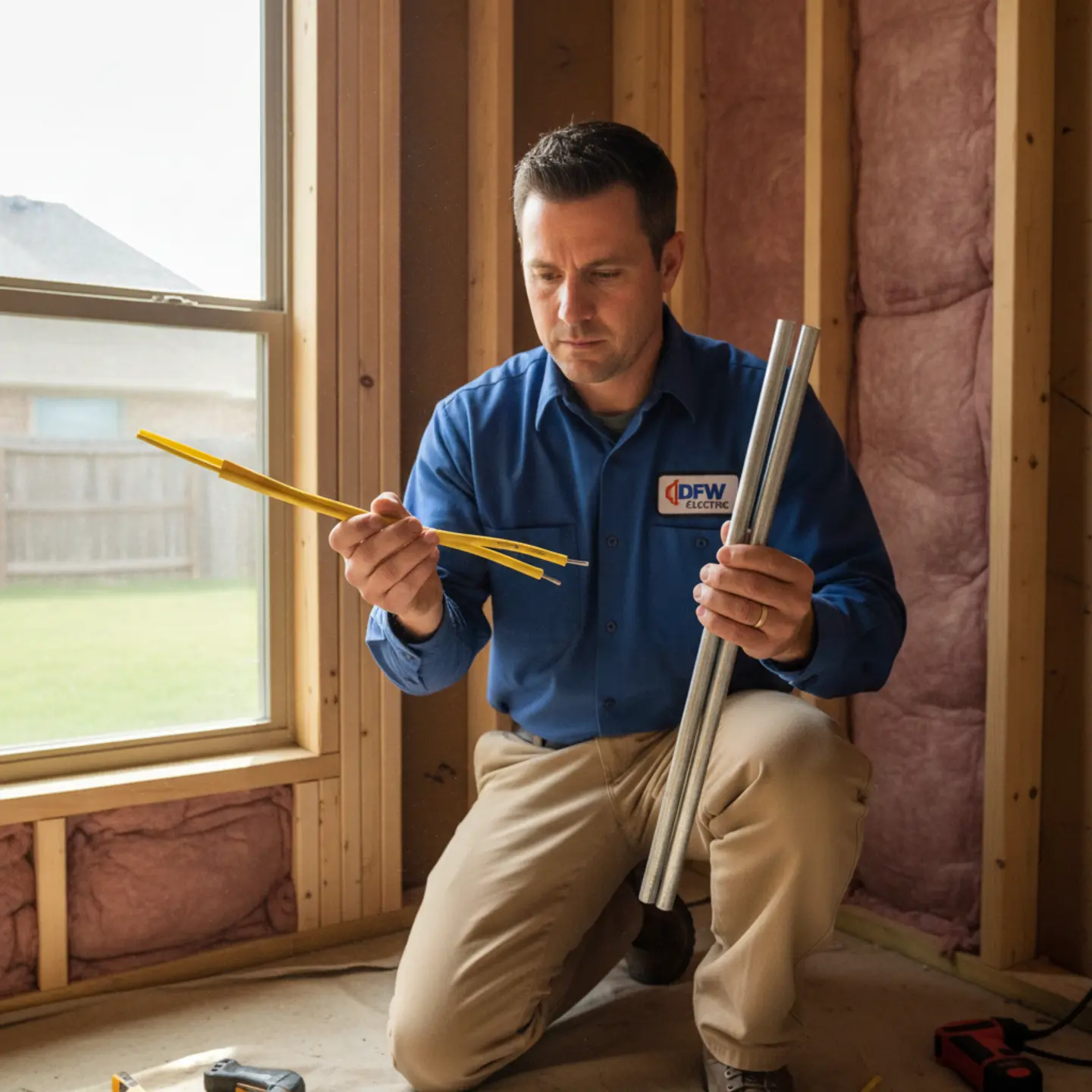
Key Takeaways
- Romex (NM-B) is the residential standard — cost-effective at $0.50–$1.50/ft in materials and $3–$8/ft in labor, it’s the correct choice for concealed interior wiring in DFW homes.
- Conduit is required by code for exposed applications — garages with surface-mounted wiring, commercial spaces, wet/damp locations, and anywhere wiring is subject to physical damage must use conduit, not Romex.
- The cost gap is significant — a full Romex rewire of a 1,800 sq ft DFW home runs $22,800–$35,800 all-in; the same project in EMT conduit can reach $39,800–$85,800+.
- All electrical work in Texas requires a TECL-licensed electrician — verify any contractor at tdlr.texas.gov before work begins; unpermitted wiring can void insurance and kill a real estate deal.
- Trust Epic Electrical for honest wiring recommendations, transparent pricing, and 50+ years of combined master electrician experience — visit Epic Electrical to get the right answer for your DFW project.
Conduit vs. Romex: Which Wiring Method Is Right for Your DFW Project?
Romex (NM-B cable) is the standard, cost-effective choice for concealed residential wiring in DFW homes, while conduit is required by code for exposed applications, commercial spaces, and areas subject to physical damage. The choice depends on your specific project type, location, and local code requirements. Understanding the differences—cost, durability, code compliance, and future flexibility—ensures you make the right decision for safety and long-term value.
Let’s break down when each method applies, what it costs, and how to avoid costly mistakes in the DFW market.
Epic Electrical
Free Quote & Honest Diagnosis — No Upsells
Core Service Programs:
- Electrical Repairs, Wiring & Lighting for tripping breakers, faulty wiring, GFCI issues, and indoor/outdoor lighting
- EV Chargers, Generators & Panel Upgrades for Level 2 EV charging, whole-home generator installs, panel replacements, and surge protection
- Commercial, Warehouse & Industrial Electrical for restaurants, offices, industrial buildouts, LED retrofits, and dedicated circuits
Why Choose Epic Electrical:
- ✓ Trusted by customers with 140+ five-star Google reviews
- ✓ Father-and-son master electricians — a third-generation electrical family
- ✓ Serving North Richland Hills and the DFW Metroplex since 2009
- ✓ 50+ years of combined electrical experience on every job
- ✓ No upsells, no jargon, no pressure — we fix what’s actually broken
- ✓ Small repairs fixed same-visit; big jobs get a written quote with no hidden costs
- ✓ Texas-licensed electrical contractor (TECL #33192)
Romex (NM-B Cable): The Residential Standard
Romex is the brand name most electricians and homeowners use interchangeably with NM-B cable — a flexible, insulated cable that bundles multiple conductors (typically a hot, neutral, and ground) inside a single plastic sheath. It’s designed specifically for concealed interior wiring in residential buildings and certain commercial construction types. If you’ve ever watched a new home go up in DFW, the wiring stapled to the studs before drywall goes on is almost certainly Romex.
The appeal is straightforward: it’s fast to install and affordable. Material costs run $0.50–$1.50 per linear foot, with labor adding $3–$8 per linear foot. For a new residential build or an interior renovation in North Richland Hills, Keller, or Southlake, Romex is the code-compliant, cost-effective default. Installation is significantly less labor-intensive than conduit — no bending, threading, or securing rigid pipe — which keeps project timelines and costs manageable.
Where Romex is not permitted matters just as much. It cannot be used in exposed applications where it’s subject to physical damage, in wet or damp locations, in most commercial occupancies, or in buildings that require non-combustible construction. Running Romex on the surface of a garage wall or through an unfinished basement without protection is a code violation — and a real safety risk. For wiring repairs and rewiring projects in older DFW homes, understanding these boundaries is the first step to avoiding expensive remediation later.
⚠️ Exposed Romex Is a Code Violation—Don’t Risk It
Many DFW homeowners mistakenly run Romex on the surface of garage or basement walls to save money. This violates code and creates a fire and safety hazard. Exposed wiring must use conduit or be protected — cutting corners here can lead to insurance claim denials and costly remediation.
Conduit: Protection, Durability, and Code Compliance
Conduit is a rigid or flexible tube — metal or plastic — that houses electrical wires and protects them from physical damage, moisture, pests, and fire spread. Where Romex relies on its sheath and careful installation location for protection, conduit provides an additional layer of mechanical defense. That’s why code requires it anywhere wiring is exposed or vulnerable.
There are three main types you’ll encounter in DFW projects. EMT (Electrical Metallic Tubing) is the most common — lightweight, relatively easy to bend, and used in garages, commercial spaces, and exposed interior runs. RMC (Rigid Metal Conduit) is the heavy-duty option for high-protection applications like outdoor installations or industrial environments. FMC/LFMC (Flexible Metal Conduit) is used for motor connections, tight spaces, or anywhere a rigid run isn’t practical.
The cost premium is real. EMT runs $1.50–$4 per linear foot in materials and $8–$20+ per linear foot in labor — roughly two to four times the cost of Romex. That labor premium exists because conduit work requires skill: precise bending, proper support intervals, correct fittings, and code-compliant layout. It’s not a job for a generalist who bends pipe once a year. For commercial electrical projects in DFW — restaurant buildouts, warehouse retrofits, office tenant improvements — conduit isn’t optional, it’s the baseline.
The long-term case for conduit, even where it’s not strictly required, comes down to future flexibility. New wires can be pulled through existing conduit without opening walls. If you’re planning to add an EV charger, upgrade to a smart home panel, or run additional circuits in the next decade, conduit on those specific runs can save you $5,000–$15,000 in future wall-opening labor.
💡 Plan for Future Upgrades — Conduit Pays for Itself
If you’re planning to add an EV charger, smart home panel, or additional circuits in the next 5–10 years, conduit’s upfront cost premium often pays for itself by avoiding expensive wall-opening labor. A licensed electrician can help you identify which runs should use conduit for future-proofing. See our EV charger installation page for more on planning ahead.
Conduit vs. Romex: Feature and Cost Comparison
| Factor | Romex (NM-B Cable) | Conduit (EMT) |
|---|---|---|
| Material Cost | $0.50–$1.50 / linear ft | $1.50–$4.00 / linear ft |
| Labor Cost | $3–$8 / linear ft | $8–$20+ / linear ft |
| Installation Speed | Fast — staple and run | Slower — bend, thread, secure |
| Where Permitted | Concealed residential wiring, certain commercial types | Exposed wiring, commercial, wet/damp, industrial |
| Where Required | N/A (it’s permitted, not required) | Exposed applications, commercial occupancies, outdoor |
| Physical Protection | Minimal — relies on concealment | Superior — mechanical protection from damage |
| Future Flexibility | Low — wall must be opened to add wires | High — pull new wires without opening walls |
| Full Rewire Cost (1,800 sq ft DFW home) | $22,800–$35,800 all-in | $39,800–$85,800+ all-in |
| Best For | New residential construction, interior renovations | Garages, commercial, exposed runs, future-proof installs |
Texas Code Requirements and When Each Method Is Required
Texas municipalities generally adopt the National Electrical Code (NEC 2020 or 2023) with local amendments, and the TDLR provides overarching licensing and enforcement. The NEC governs which wiring method is permitted or required based on the application, occupancy type, and exposure conditions — not on contractor preference or cost savings.
Under NEC Article 334, Romex (NM-B) is permitted for concealed work in residential buildings and certain commercial construction types — specifically wood-frame buildings where the cable isn’t exposed to physical damage. It is explicitly not permitted in exposed applications, wet or damp locations, above suspended ceilings in fire-rated assemblies, or in most commercial occupancies.
Conduit (covered under NEC Articles 358, 344, and 348/350 depending on type) is required for most commercial and industrial applications, exposed wiring subject to physical damage, wet and damp locations, and anywhere fire ratings mandate additional protection. In DFW garages, Romex is generally acceptable if it’s concealed within walls or ceilings — but surface-mounted wiring for outlets and lighting requires conduit or equivalent physical protection. In unfinished basements, Romex is permitted if properly secured through bored holes in joists and protected from damage; exposed Romex stapled to the face of framing in a high-traffic area is a violation.
DFW municipalities — including North Richland Hills, Fort Worth, Keller, Southlake, Colleyville, and Arlington — have active permitting and inspection enforcement. Some cities adopt local amendments that go beyond NEC minimums, particularly around AFCI and GFCI protection zones. What’s acceptable in one city may require additional protection in another, which is why a contractor with deep local knowledge matters.
Every electrical wiring project in Texas requires a TDLR-licensed electrician holding a TECL (Texas Electrical Contractor License). Rough-in inspections happen before walls close; final inspections confirm the completed system. You can verify any contractor’s license at tdlr.texas.gov using the “Search for a License” tool. Epic Electrical’s license number is TECL #33192. For guidance on what to look for when hiring, our electrician hiring checklist walks through the key questions to ask before signing anything.
ℹ️ Confused About Your Project’s Wiring Requirements? You’re Not Alone.
DFW homeowners often struggle to understand whether their specific project requires conduit or if Romex is acceptable. Electrical code is genuinely complex, and local amendments add another layer. Consulting a licensed electrician for a free estimate and honest assessment is the most reliable way to avoid costly mistakes and ensure your project passes inspection the first time.
Cost Breakdown: What You’ll Actually Pay in DFW
Let’s put real numbers to both options for a typical 1,800 sq ft, three-bedroom DFW home — the kind of project where homeowners most often face a conduit vs. Romex decision.
A full Romex rewire breaks down like this: wiring materials and labor run $15,000–$25,000 depending on home complexity and accessibility. Add a panel upgrade (Epic’s base price is $5,800 for an exterior panel, inclusive of permit and whole-home surge protection — competitive in a DFW market where most contractors quote $4,000–$8,000 and exclude those line items). Drywall and paint repair after the rough-in adds $2,000–$5,000. Realistic all-in total: $22,800–$35,800.
The same project in EMT conduit tells a different story. Wiring materials and labor jump to $30,000–$70,000+ — the two-to-four times premium is driven almost entirely by the skilled labor required to bend, thread, and secure conduit correctly. The panel upgrade stays at $5,800. But drywall repair increases to $4,000–$10,000+ because conduit runs require larger penetrations and more wall disruption. Realistic all-in total: $39,800–$85,800+. If you’re financing a project of this scale, our residential electrical financing guide covers options worth knowing before you commit.
The hidden costs of conduit that rarely show up in initial quotes: longer project timelines (which means more days without finished walls), potentially higher permit fees for complex commercial installations, and re-inspection costs if work doesn’t pass the first time. On the flip side, conduit’s long-term savings are real — future circuit additions or wire replacements that would require opening walls in a Romex home can often be done in hours through existing conduit, potentially saving $5,000–$15,000 over a 10-year horizon.
DFW’s construction boom has pushed electrician labor rates higher across the board. The labor intensity of conduit work is amplified by those increased hourly rates — which is why the cost gap between conduit and Romex has widened in recent years. Getting a detailed, itemized quote that separates materials from labor is essential for any project over $5,000.
Top Electrical Contractors in DFW: Expertise and Wiring Method Knowledge
The DFW electrical market is large and competitive. Choosing the wrong contractor for a wiring project — particularly one involving conduit — can mean failed inspections, code violations, and remediation costs that dwarf the original job. Here’s how the provider landscape breaks down, and what to look for.
| Provider Type | Typical Strengths | Potential Limitations | Best For |
|---|---|---|---|
| Solo Master Electricians | Deep expertise, personalized service | Limited capacity for large rewires | Small residential jobs, troubleshooting |
| Small Independent Shops (e.g., Epic Electrical) | Local knowledge, transparent pricing, both Romex and conduit expertise | Smaller crews for very large commercial projects | Residential rewires, commercial buildouts, complex conduit work |
| Mid-Size Contractors | Broader team capacity, mix of residential and commercial | Variable expertise in specialized wiring methods | Mixed residential/commercial volume |
| National Franchise Chains | Brand recognition, standardized processes | Higher overhead, rigid pricing, variable conduit expertise | Basic residential service calls |
Epic Electrical (TECL #33192, 7304 Hialeah Cir W, North Richland Hills, TX 76182) is a father-and-son master electrician team with 50+ years of combined experience across both residential Romex work and complex commercial conduit installations. Conduit work in particular requires significant skill in bending, layout, and code compliance — it’s a meaningful differentiator between highly skilled teams and generalists who handle it occasionally.
When evaluating any DFW electrician for a wiring project, ask for their TECL number and verify it at tdlr.texas.gov. Ask specifically whether they’ll pull the permit, and what their experience is with your project type. Red flags include vague code justifications, reluctance to discuss permits, or pushing conduit for residential concealed applications where Romex is perfectly appropriate — and cheaper. Our post on what to look for when choosing an electrician covers these red flags in detail.
Why Epic Electrical Is the Right Choice for DFW Homeowners and Businesses
When you’re deciding between conduit and Romex, the honest answer is: it depends on your specific project, location, and code requirements. What you need is an electrician who will tell you that — not one who defaults to the more expensive option to pad the invoice. That’s exactly how Epic Electrical operates.
With 140+ five-star Google reviews and 50+ years of combined master electrician experience, Epic has built its reputation in DFW by being straight with customers. If Romex is the right call for your concealed residential wiring, we’ll say so. If your garage outlet circuit needs conduit because the wiring is surface-mounted, we’ll explain why — and show you the code section. No upsells. No vague justifications. Just the right answer for your project.
As a TDLR-licensed contractor (TECL #33192) serving DFW since 2009, Epic handles every permit, schedules every inspection, and stands behind the work. Whether your project is a straightforward residential rewire in North Richland Hills or a complex conduit installation for a commercial kitchen in Fort Worth, the same standard applies: code-compliant, properly inspected, and priced transparently from the start.
Get a free estimate from Epic Electrical — talk to a licensed master electrician who will give you an honest recommendation and a written quote with no hidden costs.
Frequently Asked Questions: Conduit vs. Romex in DFW
When is conduit legally required by the NEC in Texas versus when can I use Romex (NM-B cable)?
Conduit is legally required by the NEC and DFW local codes for most commercial and industrial applications, exposed wiring subject to physical damage (such as surface-mounted runs in garages, workshops, or unfinished basements), wet and damp locations, and where specific fire ratings mandate additional protection. Romex (NM-B) is primarily permitted for concealed interior wiring in residential buildings and certain commercial construction types where the cable is not exposed to physical damage. The distinction is almost always about exposure and occupancy type — not about which is cheaper or easier. Always consult a licensed electrician and check your local city’s specific ordinances before starting any wiring project.
Can I run Romex in my DFW garage, or do I need conduit for outlets and lighting?
In DFW, you can typically run Romex in your residential garage if it is concealed within walls or ceilings — for example, wired through framing before drywall is installed. However, if the wiring for outlets and lighting is exposed (surface-mounted on the face of studs or walls) and subject to physical damage, conduit or equivalent physical protection is required by code. This is one of the most common code violations we see in DFW garages — homeowners or handymen surface-running Romex to save time, not realizing it’s a violation. Check with a licensed electrician and your local city’s building department before proceeding.
What happens if a home inspector flags my wiring because the wrong material was used or it’s not up to code?
If a home inspector flags incorrect wiring material or non-code-compliant installations — such as exposed Romex where conduit is required — it typically becomes a significant issue during a real estate transaction. Buyers will often demand remediation as a condition of sale or request a price reduction to cover the repair cost. For existing homeowners not in a transaction, flagged wiring is a safety hazard and can lead to insurance claim denials if a wiring-related incident occurs. Remediation costs for incorrect wiring can run 20–50% higher than doing it right initially, because the previous work has to be removed before the correct installation can begin. A licensed electrician will assess the scope and bring it up to current code.
Beyond cost, what are the main long-term benefits of installing conduit over Romex for a DFW business or commercial project?
For DFW businesses and commercial projects, conduit’s long-term advantages are substantial. It provides superior physical protection for wiring against machinery impacts, pest damage, and the general wear of daily commercial operations — reducing the risk of costly outages or fire hazards. More practically, conduit offers future flexibility: when you need to add circuits for new equipment, technology upgrades, or expanded operations, new wires can be pulled through existing conduit without demolition. In a commercial environment where downtime costs money, that flexibility has real dollar value. It also simplifies compliance with evolving code requirements, since the infrastructure is already in place to accommodate wire upgrades.
What makes Epic Electrical different from other DFW electrical contractors for wiring decisions?
Epic Electrical brings 50+ years of combined master electrician experience and 140+ five-star Google reviews to every wiring decision — and the approach is the same every time: honest assessment, no upsells, and a written quote with no hidden costs. As a TDLR-licensed contractor (TECL #33192) serving DFW since 2009, Epic handles all permits and inspections, and if Romex is the right and cheaper answer for your project, that’s exactly what we’ll recommend. Whether your project needs cost-effective concealed Romex or robust conduit for a commercial buildout or exposed application, you’ll get the right method for your safety and budget — not the most expensive option. Request a free estimate today and get a straight answer from a licensed master electrician.
Ready to Get the Right Wiring Method for Your DFW Project?
Whether your project calls for cost-effective Romex or code-required conduit, Epic Electrical will give you a straight answer, a transparent quote, and work that passes inspection the first time. No upsells. No guessing. Just honest electrical work from a father-and-son team that’s served DFW since 2009.
Serving Fort Worth · Arlington · North Richland Hills · Keller · Southlake · Colleyville · Grapevine · Lewisville · and all of DFW
Pricing, equipment specifications, and project scope mentioned in this article are accurate as of the date of publication and are subject to change. Code requirements and permit needs vary by municipality and property. Please contact us directly for a current quote on your specific home or business.