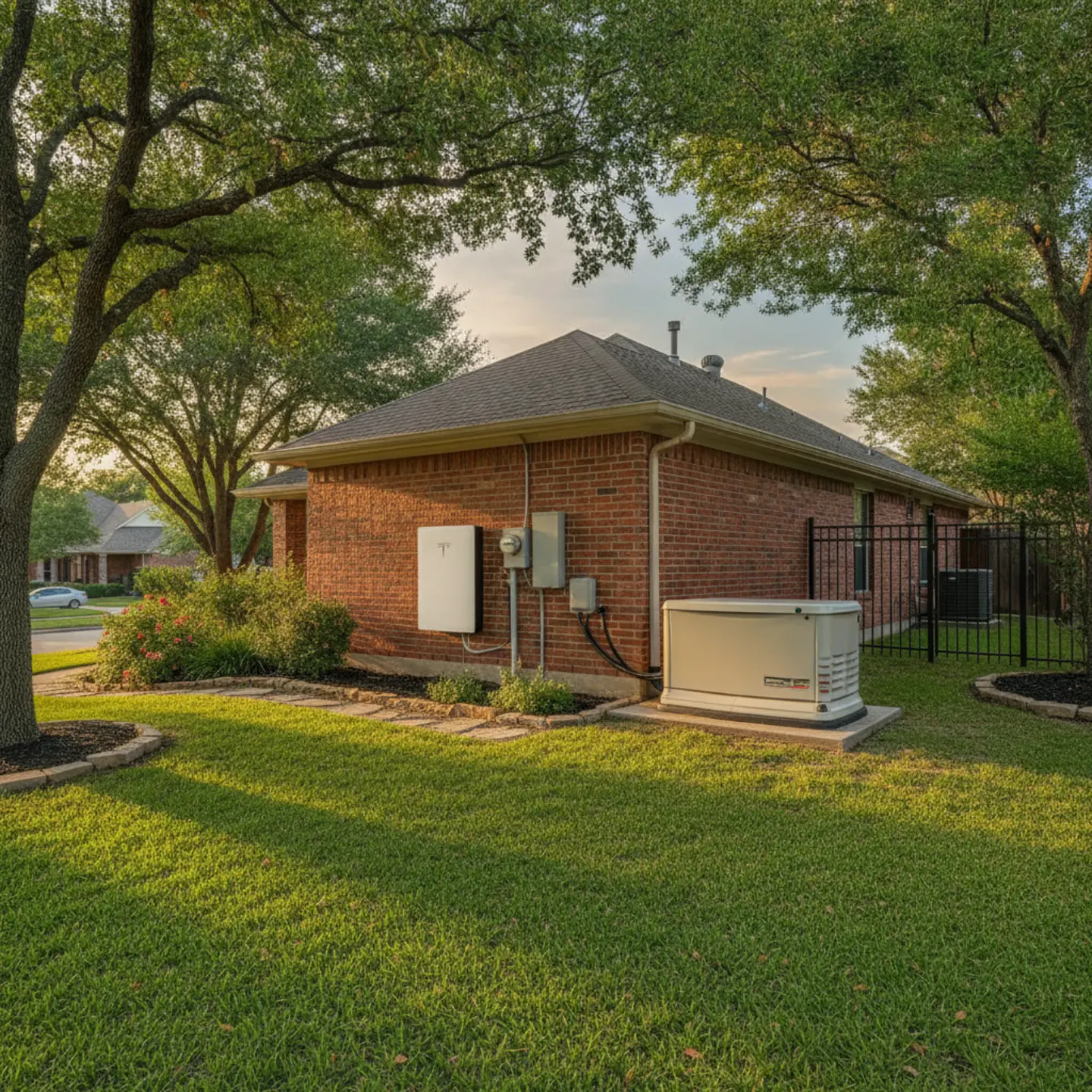

Best Whole House Generators for DFW Homes in 2026 — Ranked by Real-World Performance
⚡ Key Takeaways
- Our #1 Pick: Kohler 26RCA. Delivers 24kW on natural gas (vs. 22.5kW for Generac), has hydraulic lifters that never need adjustment, and handles Texas heat better than any competitor.
- Generac dominates on dealer support. More service techs in DFW than anyone else, which matters when everyone’s generator fails at once during a storm.
- Cummins is the quietest and best cold-starter. 65 decibels vs. 70+ for most air-cooled units. Starts reliably down to 0°F standard, -40°F with the cold weather kit.
- Temperature derating is real. At 110°F, your generator can lose 5-10% of its rated power — right when you need it most for AC.
- Gas meter upgrades are common. Most DFW homes have a 250-class meter. A 26kW generator needs a 425-class or larger to avoid fuel starvation.
- Maintenance matters more than brand. A well-maintained Generac will outlast a neglected Kohler. Battery replacement every 3 years is the #1 thing people skip.
- Budget doesn’t mean “give up.” Champion’s 14kW standby unit offers permanent whole-house backup at a fraction of the cost of premium 26kW models.
If You Live in DFW, You Already Know Why This Matters
You’ve sat in the dark before. The power went out during a storm — or during a heat wave when the grid couldn’t keep up — and it stayed out. For hours. Maybe days. You know exactly what it feels like when the AC stops running in July, or when the heat cuts out during a freeze in February.
That’s not a hypothetical in North Texas. It’s a pattern.
The Texas grid is isolated. ERCOT can’t pull power from neighboring states the way most of the country can. When extreme weather hits the entire state at once — and it does, regularly — there’s no backup plan. Rolling blackouts, extended outages, and power quality issues are part of living here now.
DFW Power Outage Reality (2024 Data)
That’s the national average for total outage time in 2024 — nearly double the previous decade. For DFW, non-storm reliability is solid at ~75 minutes per year. But when storms hit, outages stretch into multi-day events.
May 2024’s derecho moved through the Dallas-Houston corridor with hurricane-force winds, flattening power infrastructure across hundreds of miles. Hundreds of thousands of customers were without power for over 24 hours. Winter Storm Uri in 2021 left 4.5 million Texans in the dark — not because of downed lines, but because the generation plants themselves froze.
If you’re in Fort Worth, Arlington, Southlake, Colleyville, or anywhere in the Metroplex, you’re sitting on one of the most weather-exposed grids in the country. Derechos in spring, heat strain in summer, ice storms in winter — DFW gets hit from every direction.
📌 This Isn’t Going Away
ERCOT is adding new demand faster than transmission infrastructure can keep up — data centers, population growth in the suburbs, electric vehicles. Even if Texas builds enough power plants, getting that power to your specific neighborhood during peak demand is becoming a bottleneck. A standby generator isn’t paranoia. It’s a practical response to a grid that’s under constant stress.
So the question isn’t whether you need backup power. The question is: which generator is actually the right one for a DFW home?
We dug into the specs, the dealer networks, the real-world performance data from Texas summers and winters, and the customer satisfaction reports from 2025 and 2026. Here’s what we found.
Our Top 5 Whole House Generators for DFW — The Rankings
These aren’t just “good” generators. These are the five that perform best under the specific conditions of North Texas — extreme heat, occasional hard freezes, natural gas fuel, and the reality of DFW’s dealer service network.
| Rank | Model | Power (NG) | Why It Wins | Approx. Installed Cost |
|---|---|---|---|---|
| 🥇 #1 | Kohler 26RCA | 24kW | Best heat performance, hydraulic lifters, superior build quality | $16,000–$18,500 |
| 🥈 #2 | Generac Guardian 26kW | 22.5kW | Massive dealer network, proven platform, Mobile Link app | $13,500–$15,800 |
| 🥉 #3 | Cummins RS20A QuietConnect | 18kW | Quietest (65 dB), best cold-start, premium reliability | $14,000–$16,500 |
| #4 | Briggs & Stratton 26kW NGMax | 26kW | Full 26kW even on natural gas (if claims hold), 10-year warranty | $13,000–$15,500 |
| #5 | Champion 14kW | 13kW | Budget-friendly standby, 10-year warranty, solid for smaller homes | $8,500–$11,000 |
Now let’s break down exactly why each one earned its spot — and who it’s actually right for.
🥇 #1: Kohler 26RCA — The DFW Heat Champion
Power Output: 26kW on propane, 24kW on natural gas
Engine: Kohler Command PRO, hydraulic lifters, pressure lubrication
Noise Level: ~68 dB
Warranty: 5 years parts, 2 years labor and travel
Best For: Homeowners who plan to stay long-term and want the best-engineered unit on the market
Why It’s Our Top Pick
The Kohler 26RCA wins on engineering. While other brands race to hit 26kW on the spec sheet, Kohler is the only one that delivers 24kW on natural gas — a full 1.5kW more than the Generac Guardian 26kW’s 22.5kW NG rating. In a DFW summer when it’s 108°F outside and your AC is struggling to keep up, that extra power matters.
Here’s the technical advantage: air-cooled engines lose power as ambient temperature climbs. At 110°F, a generator can lose 5–10% of its rated capacity due to thinner air and thermal stress. The Kohler’s higher baseline NG output gives you thermal headroom. You’re not maxing out the unit just to start your AC compressor.
Hydraulic Lifters = Zero Valve Adjustments
This is the feature that separates Kohler from Generac and Briggs & Stratton. Those brands use mechanical valve lifters, which require a technician to disassemble the engine and manually adjust the valve clearances after the first 25 hours of use — and then every 400 hours after that.
Kohler uses hydraulic lifters. They self-adjust automatically using oil pressure. You will never need a valve adjustment for the life of the unit. For a DFW homeowner who might run this thing for 100+ hours straight during a weeklong outage, that’s one less thing that can go wrong when you can’t get a tech to your house.
Build Quality You Can See
The enclosure is heavy-duty aluminum with a corrosion-resistant coating that exceeds standard salt-spray testing. DFW isn’t coastal, but the UV intensity, hail storms, and temperature swings still beat up outdoor equipment. The Kohler enclosure holds up.
Voltage regulation is rated at ±1%, making it one of the cleanest power sources in the residential class — safe for sensitive electronics, variable-speed HVAC systems, and anything with a microprocessor.
The Trade-Off: Cost
A fully installed Kohler 26RCA in DFW typically runs $16,000 to $18,500 — about $1,500 to $2,500 more than a comparable Generac setup. You’re paying for the better engineering, the maintenance-free valve train, and the superior warranty (2 years of labor coverage vs. most competitors’ parts-only warranties after year one).
If you’re planning to stay in your home for 15+ years and you want a generator that’s built to last the entire time with minimal intervention, the Kohler is worth it.
✅ Bottom Line on the Kohler 26RCA
This is the generator for people who want to buy once and be done. It’s over-engineered for residential use in the best possible way. In the punishing DFW climate — where summers hit 110°F and winters occasionally drop to 10°F — the Kohler’s thermal performance and zero-maintenance valve system make it the most reliable choice.
Want to compare Kohler to Generac side-by-side? Check out our Generac vs. Kohler detailed comparison.
🥈 #2: Generac Guardian 26kW — The Everywhere Standard
Power Output: 26kW on propane, 22.5kW on natural gas
Engine: G-Force 1000 Series, mechanical lifters, pressure lubrication
Noise Level: ~70 dB
Warranty: 5 years limited (parts), labor varies by dealer
Best For: Homeowners who value proven performance and unmatched dealer support across DFW
Why It’s a Strong #2
Generac holds 75–80% of the DFW market for a reason: they’re everywhere. If something goes wrong with your generator at 2am during a storm, finding a Generac-certified technician is easier than for any other brand. Companies like Premier Generators of Texas, Generator Supercenter, North Texas Generators, and hundreds of independent electricians all service Generac units.
That service network density is a real advantage. If your primary dealer is slammed during a mass outage, you can call someone else. You’re not locked into a single service provider.
The Mobile Link App Actually Works
Generac’s Mobile Link Wi-Fi monitoring system comes standard on the Guardian 26kW. You get real-time status updates on your phone, maintenance reminders, and alerts if the unit detects a fault. In 2026, this integrates with the PWRview energy management ecosystem, which helps you track exactly what’s running during an outage so you can manage your load intelligently.
Is it necessary? No. But it’s genuinely useful — especially if you’re away from home when the power goes out and you want to know your house is being protected.
The Valve Adjustment Reality
Unlike the Kohler, the Generac uses mechanical valve lifters. After the first 25 hours of runtime (usually just 2–3 days of actual outage use), you need a technician to adjust the valve clearances. Then it’s every 400 hours after that.
This isn’t a dealbreaker, but it is a recurring cost and maintenance appointment. If you’re diligent about it, it’s fine. If you’re not, it can lead to hard starting and reduced power output over time.
The Lawsuit You Should Know About
Generac has faced legal challenges in recent years. A class-action lawsuit (Dawson v. Generac) alleged defects in the slip rings and carbon brushes in 22kW and 24kW models manufactured between 2021 and 2024, claiming these components are prone to premature wear during extended outages.
Generac disputes these claims and maintains that failures are due to improper maintenance. That said, if you’re buying a used Generac from that era, it’s worth asking about service history. For new units purchased in 2026, the issue appears to have been addressed through design updates.
Natural Gas Derating
The Guardian 26kW produces 22.5kW on natural gas — 1.5kW less than the Kohler 26RCA. In most cases, that’s not a problem. But in extreme DFW heat, when you’re asking the generator to start a 5-ton AC compressor while also running the fridge, lights, and everything else, you might bump up against that limit.
The solution: proper load management or a soft starter on your AC unit (which can reduce startup draw by 60–70%).
💡 Why Generac Still Wins for Many People
If you’re budget-conscious, want a proven platform with a massive support network, and don’t mind scheduling valve adjustments, the Generac Guardian 26kW is an excellent choice. It’s the “Toyota Camry” of generators — ubiquitous, reliable when maintained, and supported everywhere. You’re paying less upfront and betting on the service network to keep you running.
🥉 #3: Cummins RS20A QuietConnect — The Silent Cold-Start Specialist
Power Output: 20kW on propane, 18kW on natural gas
Engine: 993cc Cummins, liquid-cooled
Noise Level: 65 dB (quietest in class)
Warranty: 5 years full coverage
Best For: Homes under 3,000 sq ft in dense neighborhoods, or anyone prioritizing silence and extreme cold-weather reliability
Why It Earns Bronze
The Cummins RS20A QuietConnect is a specialist. It does two things better than anyone else: it’s the quietest residential generator on the market, and it’s the most reliable cold-starter.
Noise: 65 Decibels vs. 70+
Most air-cooled generators run at 70+ decibels at 25 feet. The Cummins RS20A hits 65 dB. That 5-decibel difference is significant — it’s roughly half as loud to the human ear.
Why does this matter in DFW? If you live in Southlake, Colleyville, Plano, or any zero-lot-line neighborhood with strict HOA noise rules, the Cummins can be the difference between a compliant installation and a violation notice. It’s also just more pleasant for you and your neighbors during a multi-day outage.
Cold Weather: Starts Down to 0°F Standard
Winter Storm Uri changed the calculation for DFW generators. A unit that works great in July can fail completely in February if it’s not designed for cold starts.
The Cummins RS20A is engineered to start reliably down to 0°F without any add-ons. With the integrated cold weather kit, it’s rated to -40°F. That’s overkill for DFW, but it means you have absolute confidence that this thing will fire up during an ice storm when other units are cranking and failing.
The Power Limitation
Here’s the trade-off: the RS20A tops out at 18kW on natural gas. For a typical DFW home in the 2,000–3,000 sq ft range with a single 4-ton or 5-ton AC unit, that’s enough. But if you have a larger home, multiple AC zones, or high-draw appliances like an electric furnace or well pump, you’ll need to use aggressive load management — or step up to a larger unit.
Cummins does make larger liquid-cooled models, but they jump to the 30kW+ range and the price doubles. The RS20A sits in an awkward middle ground: too powerful (and expensive) for small homes, not quite powerful enough for large ones.
📌 Who Should Buy the Cummins
If you live in a dense suburban neighborhood where noise is a primary concern, or if you’re in a more exposed area north of Denton where deep freezes are a real risk, the Cummins RS20A is the superior choice. Its cold-start capability is unmatched, and the 65 dB noise level makes it the most neighbor-friendly option on the market.
#4: Briggs & Stratton 26kW NGMax — The Natural Gas Powerhouse
Power Output: 26kW on propane, 26kW on natural gas (claimed)
Engine: Vanguard Commercial Power, mechanical lifters
Noise Level: ~70 dB
Warranty: 10 years comprehensive (often included as standard or promo)
Best For: Homeowners who want maximum natural gas performance and the longest warranty in the industry
The NGMax Advantage
Briggs & Stratton’s big claim with the 26kW NGMax model is that it delivers the full 26kW even on natural gas — no derating. If that holds up in real-world testing, it gives Briggs the highest power density in the air-cooled class for NG operation.
Most generators lose 10–15% of their rated power when running on natural gas vs. propane. The Kohler 26RCA drops from 26kW to 24kW. The Generac Guardian 26kW drops to 22.5kW. If Briggs can actually deliver all 26kW on NG, that’s a legitimate engineering win.
The 10-Year Warranty
Briggs & Stratton offers the longest comprehensive warranty in the industry — 10 years on parts and labor, often included as a standard feature or promotional offer. That’s double what most competitors provide.
For DFW homeowners concerned about long-term cost of ownership, that decade of coverage is a significant value proposition. Even if the unit costs the same as a Generac upfront, you’re protected for twice as long.
The Unknowns
Here’s the caveat: Briggs & Stratton doesn’t have the same dealer density in DFW as Generac or Kohler. Finding a certified service tech can be harder, especially during a mass outage when everyone needs help at once.
The NGMax technology is also relatively new to the market. While the Vanguard engine platform is proven, the specific NG optimization hasn’t been tested through years of DFW summers and winters the way Generac and Kohler units have.
⚠️ The Service Network Question
Before buying a Briggs & Stratton unit, ask your installer who services them locally. If the answer is vague or they say “we send them to a central depot for repairs,” that’s a red flag. You want a dealer who can dispatch a tech to your house during an outage, not one who has to ship the controller board to Ohio for diagnostics.
If you can find a solid local dealer with Briggs certification, and the NGMax claims hold up, this could be the sweet spot for natural gas performance. Just make sure you’re not sacrificing service access for a spec-sheet advantage.
#5: Champion 14kW — Best Budget Standby
Power Output: 14kW on propane, 13kW on natural gas
Engine: Champion dual-fuel capable, mechanical lifters
Noise Level: ~72 dB
Warranty: 10 years (often included as standard)
Best For: Smaller homes under 2,000 sq ft, or homeowners who want permanent backup at half the cost of premium units
Why It Makes the List
Not everyone can justify $15,000 for a standby generator. The Champion 14kW offers a legitimate whole-house backup solution for $8,500 to $11,000 installed — roughly half the cost of a 26kW premium unit.
For a home under 2,000 sq ft with a single AC unit, the 13kW NG output is enough to run the essentials: AC, fridge, lights, internet, a few outlets. You won’t run everything at once, but you’ll be comfortable and safe during an outage.
The 24-Volt Starting System
Champion uses a dual-battery 24-volt starting system (two 12V batteries in series). This gives the unit significantly more cranking amps than a standard 12V setup, which is a real advantage during cold weather starts.
The trade-off: if one battery dies, the whole system fails. You’re dependent on both batteries staying healthy. Replace them together every 3 years, and it’s not an issue.
Dealer Support Is Thin
This is the biggest weakness. Champion doesn’t have the dealer network in DFW that Generac or Kohler has. If something breaks, finding a certified tech can be a challenge.
That said, for a homeowner who’s budget-conscious and mechanically inclined enough to handle basic troubleshooting, the Champion 14kW is a solid entry point into whole-house backup. The 10-year warranty helps offset the service network gap.
✅ When the Champion Makes Sense
If you have a smaller home, a tight budget, and you’re willing to trade some dealer support for significant cost savings, the Champion 14kW is a legitimate option. It’s still a permanent standby unit with an automatic transfer switch — not a portable generator you have to wheel out and plug in. You get whole-house backup at a price point most people can actually afford.
Comparing Champion to other budget-friendly options? See our Champion vs. Predator generator comparison.
How to Actually Size a Generator for Your DFW Home
Now that you know the top-rated models, here’s the part most people get wrong: figuring out what size you actually need.
Square Footage Is a Lie
You’ll see charts online that say “2,000 sq ft = 20kW generator.” Ignore them. Generator sizing has nothing to do with how big your house is. It has everything to do with what’s plugged in — and more specifically, what has a motor.
A 1,500 sq ft home with a Level 2 EV charger, an induction cooktop, and an electric heat pump can pull significantly more power than a 4,000 sq ft home that runs on natural gas for heat, water, and cooking.
Starting Watts vs. Running Watts
Every appliance has two numbers: how much power it uses while running, and how much it needs for that first split-second to get going.
For resistive loads (lights, toasters, space heaters), those two numbers are the same. But for anything with a motor — AC units, well pumps, refrigerators — the starting number can be three times higher than the running number.
Your central AC is the big one. A 4-ton unit might run on 4,000 watts all day long. But the instant it kicks on, it can pull 10,000 to 12,000 watts. If your generator can’t handle that surge, the voltage drops, the compressor stalls, and you’re back to square one.
⚡ Temperature Derating Is Real
Here’s what most people don’t know: at 110°F, your generator loses 5–10% of its rated capacity. The air is thinner, the engine runs hotter, and the alternator is less efficient. A 22kW generator in a DFW July might only produce 20kW when you actually need it. That’s why “over-sizing” by one step (going from 22kW to 26kW) is smart for Texas.
| Appliance | Running Watts | Starting Watts |
|---|---|---|
| Central AC (4-Ton) | 3,500–4,000 | 10,000–12,000 |
| Central AC (5-Ton) | 4,500–5,000 | 12,000–15,000 |
| Electric Furnace | 10,000–20,000 | 10,000–20,000 |
| Well Pump (1 HP) | 1,000–2,000 | 3,000–5,000 |
| EV Charger (Level 2) | 7,200–11,500 | 7,200–11,500 |
| Refrigerator | 200–400 | 1,200–1,600 |
| Microwave | 1,500 | 1,500 |
| Garage Door Opener | 350–600 | 1,000–1,500 |
Soft Starters Can Save You Thousands
There’s a device called a soft starter (brands like MicroAir EasyStart) that plugs into your AC unit and ramps up the power gradually instead of dumping it all at once. It can cut the startup requirement by 60–70%.
A 5-ton AC without a soft starter might need 80 amps to start, pointing you toward a 24kW generator. With a soft starter, that drops to around 30 amps. Suddenly a 20kW unit can handle it. That’s $2,000+ saved on the generator itself.
💡 Get a Load Calculation Before You Buy
Have a licensed electrician do a proper load calculation on your home before you commit to a generator size. It’s the single best thing you can do to avoid overpaying — or undersizing and risking damage to your appliances during an outage. If you’re in DFW, our team does whole-home generator assessments and can tell you exactly what you need.
What Does Installation Actually Cost in DFW?
The generator unit is only about half the total project cost. Here’s the full breakdown for a typical DFW installation in 2026.
| What You’re Paying For | 2026 Cost Range | What to Know |
|---|---|---|
| Generator Unit (20–26kW) | $4,500–$7,500 | Price varies by brand. Kohler and Cummins cost more than Generac. |
| Automatic Transfer Switch | $600–$1,200 | Often bundled, but service-rated upgrades cost extra. |
| Concrete Pad & Site Prep | $500–$1,000 | Prefab pads are cheaper. Poured concrete holds up better. |
| Electrical Labor | $3,000–$5,000 | Panel work, conduit runs, grounding. |
| Gas Line Work | $1,500–$3,000 | The biggest variable. Long runs or meter upgrades add cost fast. |
| Cold Weather Kit | $300–$600 | Mandatory for DFW. Battery warmer + oil heater. |
| Permits & Inspections | $300–$800 | Varies by city — Fort Worth and Southlake are stricter. |
Total Installed Cost Range (DFW)
That’s the typical range for a 22–26kW unit, fully installed and permitted. Champion 14kW units run $8.5K–$11K. Liquid-cooled Cummins units can hit $25K+.
Here’s a gotcha a lot of DFW homeowners don’t find out until installation day: your existing gas meter probably can’t handle a generator. Most homes have a 250-class meter (250 cubic feet per hour). A 26kW generator at full load can demand 330+ cubic feet per hour. Add in your furnace and water heater, and you’re over capacity. Upgrading to a 425-class meter through Atmos Energy or CoServ Gas can add 4–8 weeks to your timeline — so plan ahead.
⚠️ Watch Out for Incomplete Quotes
If someone quotes you just the generator unit price, ask what’s missing. Electrical labor, gas work, the transfer switch, and permits add up fast. A trustworthy installer gives you a full project quote upfront — not just the hardware cost.
Financing is standard for these projects. Most authorized dealers offer 18 months same-as-cash or low-interest loans over 5–7 years through partners like Synchrony or EnerBank. A home equity line of credit is another option. We cover financing in detail in our residential electrical financing guide.
Transfer Switches — The Part Most People Skip (But Shouldn’t)
The transfer switch is what connects your generator to your home’s electrical panel — and keeps your generator from sending power back out to the street. Getting this wrong has serious consequences.
Automatic vs. Manual vs. Interlock Kit
An automatic transfer switch (ATS) detects the outage, starts the generator, and switches your panel over — all without you touching anything. When utility power comes back, it switches back automatically. This is the standard for whole-house standby systems.
A manual transfer switch requires you to physically flip a switch. It’s cheaper, but you have to be home and awake. It works, but it defeats the purpose of a standby generator.
An interlock kit is a budget option — a sliding metal plate on your breaker panel that prevents the main breaker and generator breaker from both being on at the same time. It’s legitimate for use with portable generators, but it comes with a safety caveat.
For a detailed comparison, see our manual vs. automatic transfer switch guide.
The Backfeeding Risk
If an interlock kit is removed, modified, or installed incorrectly, your generator can send power back up the utility lines. That 240 volts steps up to over 7,200 volts at the transformer. A lineman working on those lines — even miles from your home — can be electrocuted.
Some DFW utilities have specific rules. Tri-County Electric Cooperative (TCEC) prohibits interlock kits entirely and requires a UL 1008-listed transfer switch for interconnection. If you’re in TCEC territory and you install an interlock kit, you could face service disconnection.
For more on interlock kits and when they make sense, see our generator interlock kit guide. And if you’re deciding between a 30 amp or 50 amp inlet for a portable setup, we cover that in our 30 amp vs. 50 amp generator inlet comparison.
Natural Gas or Propane? (Spoiler: Gas Wins for Most DFW Homes)
Natural gas wins for most suburban and urban DFW homes. It’s cheap to run (a 22kW unit for 24 hours costs around $65 on NG vs. $250+ on propane). The lines are underground and protected from wind and ice. And there’s no tank to refill or run out of.
Propane is the right call if you don’t have natural gas service — typically rural properties outside city limits. It gives you full rated power from the generator (a Generac 26kW puts out all 26kW on propane vs. 22.5kW on gas). But it costs more to run, and if the roads are iced over, the delivery truck can’t get to you.
For most people in Fort Worth, Arlington, Southlake, Keller, Colleyville, or Grapevine, natural gas is the obvious choice.
Permits — What Your City Requires
Every DFW city has its own rules. Skipping the permit voids your homeowner’s insurance and causes problems when you sell.
Fort Worth: Separate electrical, mechanical, plumbing, and building permits required. 2023 NEC strictly enforced.
Arlington: Permits processed through ArlingtonPermits.com. Gas and electrical work needs validation.
Southlake: Rigorous enforcement. Generator Submittal Checklist required. Setback and impervious coverage limits strictly enforced.
Grapevine: Generator must be screened from public view. No Sunday test cycles. 3-foot minimum setback from property lines.
Keller: Residential units must meet 2021 IFC amendments for fuel storage. Commercial units need Fire Marshal approval.
⚠️ Don’t Skip the Permit
An unpermitted generator can void your insurance when you actually need it. It’ll also get flagged during a home sale. The permit process ensures the installation is safe and code-compliant. It’s worth the fee and the wait.
Do Generators Qualify for Tax Credits?
Short answer: no. Standalone fossil-fuel generators don’t qualify for federal clean energy tax credits.
The Inflation Reduction Act offers a 30% Residential Clean Energy Credit — but that’s for solar panels and battery storage. A natural gas or propane generator is excluded.
The workaround: if your generator is part of a microgrid system that also includes solar and batteries, the solar and battery portions can qualify for the 30% credit. The generator cost has to be separated out.
There’s also a medical necessity angle. If a doctor prescribes a generator to power life-support equipment, the cost can be itemized as a medical expense on federal taxes.
As for local incentives: Oncor offers rebates for solar and battery storage (up to $9,000), but nothing for standalone generators. CoServ and TCEC don’t offer generator rebates either.
For financing options, see our residential electrical financing guide.
Maintenance — What It Actually Takes to Keep It Running
A generator is an engine. Engines need care. The #1 reason generators fail during emergencies is neglected maintenance.
✅ Your Generator Maintenance Checklist
- Replace the battery every 3 years. A dead battery is the most common reason a generator won’t start. Don’t wait for it to fail.
- Change the break-in oil after the first 25 hours. New generators ship with special oil that must be changed after 2–3 days of actual use. Skip this and you risk engine damage during a long outage.
- Run a weekly exercise cycle. 5–10 minutes a week keeps the seals from drying out and verifies the battery and ignition are working.
- Schedule valve adjustments if you own a Generac or Briggs & Stratton. Mechanical lifter engines need it after the first 25 hours and every 400 hours after that.
- Use 5W-30 full synthetic oil year-round. DFW’s temperature swings (10°F to 110°F) demand oil that flows in both extremes.
- Verify your gas meter capacity. Make sure it can handle the generator + furnace + water heater running simultaneously.
✅ A Maintained Generator Is a Reliable Generator
The best setup in the world is useless if it won’t start at 2am during a storm. Stick to a simple maintenance schedule, and yours will be ready when you actually need it.
Frequently Asked Questions
What is the best whole house generator for DFW homes?
For most DFW homeowners, the Kohler 26RCA is the best overall choice. It delivers 24kW on natural gas (more than any air-cooled competitor), uses hydraulic lifters that never need adjustment, and handles Texas heat better than any other residential generator. If budget is the main concern, the Generac Guardian 26kW offers proven performance and unmatched dealer support across the Metroplex.
How much does a whole house generator cost installed in DFW?
A fully installed 22–26kW standby generator in DFW typically runs $13,000 to $18,500. That includes the unit, automatic transfer switch, concrete pad, electrical and gas work, cold weather kit, and permits. Budget-friendly options like the Champion 14kW run $8,500 to $11,000 installed. Premium liquid-cooled units can exceed $25,000.
What size generator do I need for a 2,500 sq ft house in Texas?
Square footage doesn’t determine generator size — your appliances do. A typical 2,500 sq ft DFW home with a single 4-ton or 5-ton AC unit usually needs a 20–22kW generator. But if you have an electric furnace, well pump, or Level 2 EV charger, you may need 24–26kW. A licensed electrician should do a load calculation that accounts for startup surges, not just running watts.
Is Generac or Kohler better for Texas?
Kohler 26RCA is the better machine for Texas heat — it delivers 24kW on natural gas vs. Generac’s 22.5kW, and it uses hydraulic lifters that never need adjustment. But Generac has a much larger dealer network in DFW, which matters when everyone’s generator fails during a mass outage. If you value engineering and longevity, buy Kohler. If you value service availability and upfront cost, buy Generac.
Do whole house generators work in extreme heat?
Yes, but they lose power. At 110°F, an air-cooled generator can lose 5–10% of its rated capacity due to thinner air and thermal stress on the engine. This is called “derating.” That’s why oversizing by one step (going from 22kW to 26kW) is smart for DFW — it gives you thermal headroom so the generator doesn’t max out right when your AC needs it most.
Are whole house generators worth it in Texas?
For most DFW homeowners, yes. Texas runs on an isolated grid that can’t pull power from other states during emergencies. Multi-day outages from derechos, ice storms, and extreme heat are a real and growing risk. A properly sized standby generator keeps your home running — and your family safe — when the grid goes down. It’s not a luxury anymore. It’s a practical hedge against grid instability.
What generator brands should I avoid?
Avoid any brand without local dealer support in DFW. A generator is only as good as the service network behind it. Generac, Kohler, and Cummins all have established dealer networks across the Metroplex. Briggs & Stratton and Champion have fewer authorized service providers, which can be a problem during mass outages. Also avoid used Generac 22kW and 24kW models from 2021–2024 without verifying service history due to the class-action lawsuit over slip ring and carbon brush failures.
Ready to Stop Guessing? Let’s Figure Out What You Actually Need.
You’ve got the data now. You know which generators perform best in DFW’s climate, what installation actually costs, and what to watch out for along the way.
If you want someone to look at your specific home — your appliances, your panel, your gas situation — and tell you exactly what size and brand makes sense, that’s what we do. No upselling. No pressure. Just an honest assessment and a straight answer.
Call or Text: (682) 478-6088
Serving Fort Worth, Arlington, Keller, Southlake, Colleyville, Grapevine, Lewisville, and all of DFW