Best Portable Generators for Your Inlet Outlet
⚡ Key Takeaways
- Tri-fuel is critical for DFW – Natural gas capability means infinite runtime during outages when gas stations can’t pump
- Size for reality, not theory – You’ll run what matters at that moment, then switch loads around with your interlock
- Power quality matters – Modern furnaces and appliances can be picky about “dirty” power from cheap generators
- Most need a simple mod – Floating neutral configuration is required for safe interlock use (10-minute fix on most units)
- Sweet spot is $1,200-$1,500 – Best balance of power, features, and reliability for DFW whole-home backup
- Soft start changes everything – A $350 device lets you run your AC on a smaller generator (huge in Texas summers)
- Noise ordinances are real – Fort Worth has a 60 dBA nighttime limit that many generators violate
You just called – your interlock kit and inlet outlet are installed. First question you asked: “Which generator should I actually buy?”
Yesterday, a customer texted me from the Lowe’s parking lot. He was standing between a $799 unit and a $1,499 one, completely confused by the spec sheets and sales pitches. Let me save you that headache.
Here’s the thing: we don’t sell generators. We just install the inlet boxes and interlocks, then connect whatever generator you buy. That means we can be completely honest about what we’ve seen work in real DFW homes – and what hasn’t.
We’ve connected hundreds of these systems across Fort Worth, Arlington, Keller, and all of DFW. We’ve seen generators purr through August heat domes and survive February ice storms. We’ve also seen homeowners make expensive mistakes.
This is the honest conversation we have after every interlock installation. Here’s what you actually need to know – based on real North Texas homes, not marketing hype.
Why This Decision Actually Matters in DFW
You’re Not Running Extension Cords Anymore
With your interlock kit installed, you’re playing a completely different game than the neighbor dragging extension cords through their kitchen window.
Your generator connects to your inlet outlet, which feeds directly into your main electrical panel. That means you have access to any circuit in your house – lights, outlets, hardwired appliances, everything.
But here’s the catch: you still can’t run everything simultaneously. Your 10,000-watt generator can’t power your 5-ton AC, electric water heater, electric dryer, and oven all at once. That would need about 25,000 watts.
Instead, you become the energy manager. You manually turn breakers on and off, prioritizing what matters at that moment. Run the AC for two hours to cool the house down, then flip over to the water heater. It’s dynamic load shedding, and your interlock setup makes this possible.
💡 The Interlock Advantage
This flexibility is why we recommend interlocks over automatic transfer switches. In winter, you prioritize your gas furnace. In summer, it’s all about the AC. One system handles both without any rewiring.
DFW Reality: It’s About the AC in Summer
Let’s be real about North Texas weather. We get both February freezes and August heat domes. But when the power goes out in summer, your AC is the make-or-break appliance.
A 3-5 ton central air conditioner is the single biggest load in your home. It’s also the hardest to start because of the massive surge needed to get the compressor spinning. Your generator selection essentially comes down to this: can it reliably start and run your AC unit?
Everything else is manageable. Your gas furnace only uses 600-900 watts. Your fridge is 700 watts. Lights and devices are negligible. But that AC compressor? That’s the beast you’re sizing for.
AC Starting vs Running Power
Your AC compressor needs 5-7 times more power to START than it does to run. A unit that runs on 4,500 watts might need 25,000+ watts for those first milliseconds of startup. This is why generator sizing matters.
ERCOT is ERCOT (You Know What I Mean)
I don’t need to lecture you about the Texas grid. You lived through 2021. You’ve seen the “conservation notices” become a summer ritual. You understand why thousands of DFW homeowners have installed interlock systems.
But here’s what matters for generator selection: when the power goes out here, it’s not for two hours. It’s often multi-day events when demand outstrips supply. That changes your fuel strategy completely.
⚠️ What We’ve Seen Fail
Too small: Generator stalls every time the AC tries to start. Family suffers through August heat with no cooling.
Gas-only: Customer runs out of fuel during 2021 freeze because gas stations couldn’t pump without power. Generator sat useless.
Wrong neutral configuration: GFCI trips instantly on connection. Generator won’t work with interlock until modified.
These aren’t hypotheticals. These are calls we got during actual outages.
The Three Things That Actually Matter
1. Fuel Type: Why Tri-Fuel Wins in Texas
This is the most important decision you’ll make, and it’s not even close.
✅ Natural Gas = Infinite Runtime
Your home’s natural gas line doesn’t care if the electric grid is down. Atmos Energy and CoServ keep the gas flowing. Connect your generator to your gas supply, and you have unlimited runtime without storing dangerous fuel or hunting for open gas stations during a storm.
During the 2021 freeze, do you know what didn’t fail? The natural gas infrastructure. While people were desperately searching for gasoline (and gas stations couldn’t pump without electricity), homes with natural gas connections had power as long as their generator kept running.
DFW has robust residential gas infrastructure. Most homes in Fort Worth, Arlington, Keller, Southlake, and Colleyville have natural gas service. If you have a gas line, using it for your generator is a no-brainer.
The Power Trade-Off:
Natural gas has lower energy density than gasoline. Physics doesn’t care about your convenience. You’ll lose about 20% of your generator’s power output when running on natural gas versus gasoline.
- A 13,000-watt generator on gasoline becomes ~10,000 watts on natural gas
- A 10,000-watt generator on gasoline becomes ~8,000 watts on natural gas
This matters for sizing calculations, especially for starting AC units. But here’s the thing: 10,000 watts on natural gas with unlimited runtime beats 13,000 watts on gasoline that runs out in 12 hours.
Propane as Your Backup Fuel:
For homes in all-electric neighborhoods without natural gas lines, propane is your next best option. Unlike gasoline, propane doesn’t degrade. It can sit in a tank for 10-20 years and still work perfectly.
Standard 20-pound BBQ tanks last 5-7 hours on a large generator. That’s not great. But larger 100-pound or 250-pound tanks? Now you’re talking about multi-day runtime. Services like Suburban Propane in Fort Worth and Propane Doctor in Dallas deliver to residential customers.
Fuel Runtime Comparison
Gasoline: Limited by storage (10-25 gallons max per fire code) = 24-48 hours
Propane: 100lb tank = ~24 hours | 250lb tank = ~60 hours
Natural Gas: Unlimited as long as gas service remains active
Bottom Line: Spend the extra $100-200 for tri-fuel capability. Even if you plan to use gasoline primarily, having natural gas or propane as a backup option gives you flexibility when it matters most.
2. Power Quality: Why Your Furnace Computer Cares
Here’s something most generator guides skip: not all electricity is created equal.
Utility power from the grid is a smooth, perfect sine wave. It’s “clean” power. Cheap generators produce “dirty” power – a distorted waveform with high Total Harmonic Distortion (THD).
Twenty years ago, this didn’t matter. Incandescent bulbs, old motors, and simple appliances didn’t care. But your modern home is filled with sensitive electronics.
What’s at Risk:
- High-efficiency furnaces: Trane, American Standard, and Carrier units have computer boards that monitor power quality. High THD triggers error codes and lockouts. We’ve seen furnaces refuse to run even though the generator is producing power.
- Inverter refrigerators: Samsung and LG models with inverter compressors can be damaged by voltage spikes and harmonic distortion.
- Smart home devices: LED dimmers, UPS backups, and smart appliances often malfunction on dirty power.
You don’t want to discover your $8,000 Trane furnace won’t work with your generator during a February freeze.
💡 The Clean Power Solution
Inverter generators produce pristine power (THD less than 3%) that’s safe for everything in your home. They’re more expensive but eliminate all power quality concerns.
Good conventional generators with low-THD engineering (THD less than 5-6%) are the middle ground – clean enough for most equipment at a lower price point.
Cheap construction generators (THD 15-25%) are risky for whole-home backup and modern appliances.
Real example: A customer bought a cheap 12,000-watt generator from Harbor Freight (not the Predator inverter model – a different cheaper unit). His Trane furnace threw error codes constantly. The generator produced power, but the power quality was so poor that the furnace’s safety system refused to operate. His $300 savings became a $1,200 mistake when he had to buy a different generator.
3. Proper Interlock Compatibility: The Floating Neutral Issue
This is technical, but it’s critical for safety. Most homeowners have never heard of this, and it causes problems on first connection.
The Problem: Most portable generators ship with a “bonded neutral” configuration. This is required for job site safety but creates a code violation when connected to your home through an interlock.
Your home’s electrical panel already has the neutral bonded to ground at the service entrance. When you connect a bonded generator to a bonded panel, you create a parallel path for current through the ground wire. This violates National Electrical Code Article 250 and causes:
- Instant GFCI tripping when you try to use the generator
- Potential shock hazards on metal surfaces
- Inspection failures if your city requires generator connection permits
The Solution: Floating Neutral Configuration
For interlock use, your generator must have a “floating neutral” – where the neutral wire is NOT connected to the generator frame or ground.
- Ships ready to use (Floating Neutral): Honda EU7000is, DuroMax XP13000HXT
- Requires simple modification: Westinghouse WGen series, Harbor Freight Predator 9500
The modification takes about 10 minutes. You remove the alternator cover, locate a specific jumper wire (usually green or green/yellow), and disconnect it from the frame. YouTube has dozens of tutorials. We can also walk you through it over the phone or do it when we come out to test your first connection.
Don’t skip this step. We’ve had customers call us frustrated because “the generator won’t work” with their new interlock kit. Nine times out of ten, it’s because they didn’t unbond the neutral.
Sizing for YOUR Home (Not the Internet’s Opinion)
Let’s cut through the confusion. You’ve probably seen online calculators that add up every appliance in your house and tell you that you need a 20,000-watt generator. That’s nonsense for an interlock setup.
🎯 Real DFW Scenario Planning
Here’s what actually happens: You won’t run everything at once. You’ll run what matters at that moment, then manually switch breakers to different loads. This is how interlocks work – you’re the energy manager.
Scenario 1: Summer Outage (AC is Critical)
It’s August in Fort Worth. Temperature outside is 102°F. Power goes out at 2 PM. Here’s your priority:
What You Need Running:
- Central AC (3-5 ton): 3,500-5,500 watts running (but 15,000-35,000 watts to START)
- Refrigerator/freezer: 700 watts
- Lights, phone chargers, TV: 500 watts
- Maybe a fan or two: 200 watts
Total running load: About 5,000-7,000 watts. Very manageable.
The problem: Starting that AC compressor. This is where most generators fail.
✅ The Soft Start Game-Changer
A soft start device (like Micro-Air EasyStart) is a small electronic module installed in your AC condenser. It reduces the starting surge by 65-75%.
Without soft start: 5-ton AC needs ~30,000 watts to start (impossible on portable generator)
With soft start: Same unit needs ~9,000 watts to start (totally doable)
Cost: About $350-400 installed. We work with HVAC companies who install these. It’s the difference between needing a $4,000 generator and a $1,400 generator.
Scenario 2: Winter Outage (Heating is Critical)
It’s February. Temperature outside is 18°F. Ice storm knocked out power. Your priorities shift:
What You Need Running:
- Gas furnace blower: 600-900 watts
- Refrigerator/freezer: 700 watts
- Lights and devices: 500 watts
- Space heater for bathroom: 1,500 watts
Total load: About 3,000-4,000 watts. Much easier than summer.
Winter outages are actually less demanding on your generator. Gas furnaces use minimal electricity (just the blower and control board). The hard part is starting the generator in freezing temperatures, which is why tri-fuel capability and electric start matter.
Real-World Home Sizing
1,500-2,000 sq ft home: 9,500-10,500W generator (with soft start on AC)
2,500-3,500 sq ft home: 10,500-13,000W generator (with soft start on AC)
Any size home: Consider soft start device to maximize your investment
We install generators and soft start devices across Fort Worth, Arlington, Keller, Southlake, and Colleyville. Most DFW homes fall into that 9,500-13,000 watt range for comfortable backup power.
The Generators We Actually Recommend
Alright, let’s get to it. Here are the four generators we connect most often in DFW homes. Remember: we don’t sell these, we just install the connections. This is completely unbiased advice based on what we’ve seen perform.
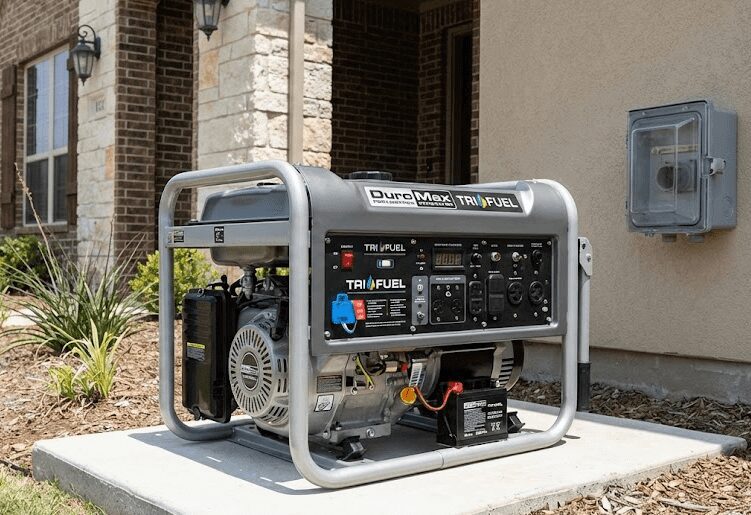
1. BEST OVERALL VALUE: DuroMax XP13000HXT
Price: ~$1,399
Power: 13,000W peak / 10,500W running (gas) | ~10,000W peak on natural gas
Fuel: Tri-fuel (Gas/Propane/Natural Gas) – Built-in
Power Quality: ~12% THD (acceptable for most equipment)
Noise: 74 dBA
Interlock Ready: Yes (ships with floating neutral)
✅ Why We Recommend It
This is the generator we connect most often. It’s tri-fuel ready out of the box (no conversion needed), ships with floating neutral (plug and play for interlocks), and has enough power to start most AC units even on natural gas. Best watts-per-dollar in the market with a solid 5-year warranty.
The Trade-Off: It’s louder than inverter units and produces “dirtier” power (12% THD). For most homes, this is fine – lights, motors, and basic appliances handle it without issues. If you have a super-sensitive high-efficiency furnace, you might need a power conditioner or different generator.
Who It’s For: The DFW homeowner who wants natural gas capability, maximum power, and doesn’t want to spend $4,000. This is the workhorse generator for North Texas backup power.
Where to Buy: Home Depot, Amazon, direct from DuroMax
2. BEST FOR QUIET & CLEAN POWER: Honda EU7000is
Price: ~$4,499
Power: 7,000W peak / 5,500W running (gas only, can add tri-fuel conversion)
Fuel: Gasoline (EFI), propane/NG kits available aftermarket
Power Quality: <3% THD (pristine)
Noise: 52-60 dBA (whisper-quiet)
Interlock Ready: Yes (ships with floating neutral)
🏆 The Premium Choice
This is the Lexus of portable generators. It produces the cleanest power available (safer than grid power), runs incredibly quiet, and has Honda’s legendary reliability. If you have picky HVAC equipment or value quiet operation, this is worth the investment.
The Trade-Off: Expensive. The lower wattage means you MUST use a soft start device for any AC use. It’s gasoline-only unless you add an aftermarket tri-fuel conversion kit (which can void warranty).
Who It’s For: The homeowner who values quiet operation, has picky electronics, and budget isn’t the primary concern. Also great for HOA neighborhoods with strict noise rules.
Features: Bluetooth monitoring app (Honda My Generator), CO-MINDER carbon monoxide detection, electric fuel injection for easy starting
Where to Buy: Home Depot, authorized Honda dealers (DFW Honda in Grapevine), Amazon
3. BEST FEATURES: Westinghouse WGen10500TFc
Price: ~$1,299
Power: 13,500W peak / 10,500W running (gas) | ~10,000W peak on natural gas
Fuel: Tri-fuel (Gas/Propane/Natural Gas) – Built-in
Power Quality: Varies (some <6% THD, some >20% – quality control inconsistency)
Noise: 74 dBA
Interlock Ready: No (requires neutral unbonding modification)
💡 The Remote Start Advantage
This generator’s killer feature: remote start from a key fob. Start it from inside your house during an ice storm instead of trudging outside. For DFW weather, this is legitimately useful. Similar power and price to DuroMax but adds this convenience feature.
The Trade-Off: Ships with bonded neutral (requires the modification we talked about – takes 10 minutes). Power quality is inconsistent between units based on customer reviews – some report excellent clean power, others report issues with sensitive equipment.
Who It’s For: The tech-savvy homeowner who wants remote start convenience and doesn’t mind doing a simple modification. Great for people who don’t want to go outside in severe weather.
Where to Buy: Home Depot, Lowe’s, Amazon
4. BEST BUDGET INVERTER: Harbor Freight Predator 9500
Price: ~$1,999
Power: 9,500W peak / 7,600W running (gas only)
Fuel: Gasoline (tri-fuel kits available aftermarket)
Power Quality: <3% THD (excellent)
Noise: 67 dBA
Interlock Ready: No (requires neutral unbonding modification)
🎯 The “Honda Clone” That Works
This is clean inverter power at half the Honda price. It produces the same quality electricity as the EU7000is and actually has MORE wattage. The Harbor Freight brand scares some people, but we’ve connected dozens of these and they perform well.
The Trade-Off: Ships bonded neutral (requires modification). Gas-only unless you add an aftermarket tri-fuel kit. Shorter warranty (90 days standard, extendable to 2 years). Harbor Freight’s service network is less robust than Honda.
Who It’s For: The homeowner who wants clean inverter power but can’t justify $4,500. Perfect for sensitive equipment at a reasonable price.
Where to Buy: Harbor Freight stores (several in DFW), online
Quick Comparison Table
| Generator | Price | Tri-Fuel? | Clean Power? | Interlock Ready? | Best For |
|---|---|---|---|---|---|
| DuroMax XP13000HXT | $1,399 | ✅ Yes | ⚠️ OK (12%) | ✅ Yes | Most DFW homes |
| Honda EU7000is | $4,499 | ➕ Add kit | ✅ Excellent (<3%) | ✅ Yes | Premium/Quiet |
| Westinghouse WGen10500TFc | $1,299 | ✅ Yes | ⚠️ Varies | ❌ Mod needed | Remote start fans |
| Predator 9500 | $1,999 | ➕ Add kit | ✅ Excellent (<3%) | ❌ Mod needed | Budget inverter |
What About Champion, Generac, and Others?
You’ve probably seen other brands while shopping. Here’s our quick take on the other common options:
Champion 100416 (14,000W Tri-Fuel)
Price: ~$1,399 | Tri-Fuel: Yes | Interlock Ready: Requires modification
Good power output, good price point, similar specs to DuroMax. The issue: we’ve seen more warranty claims and reliability problems with Champion than DuroMax. They’re not bad, but we connect DuroMax more often because of fewer service calls.
Generac GP Series
Price: ~$1,699-$2,199 | Tri-Fuel: Varies by model | Interlock Ready: Varies
You’re paying for the Generac name – which means a great dealer network in DFW (Generator Supercenter of Dallas/Fort Worth, Premier Generators). If local service and parts availability matter most to you, Generac delivers. But you’re not necessarily getting better hardware for the price premium.
Generac XT8500EFI
Price: ~$1,899 | Tri-Fuel: No (gas only) | Interlock Ready: Requires modification
Electronic fuel injection (EFI) engine starts reliably in extreme weather – no choke adjustments in freezing cold or blazing heat. Lower THD (<5%) without being a full inverter - good middle ground for power quality. The downside: gas-only, no tri-fuel capability.
The Mistakes We See (And How to Avoid Them)
✅ Common Generator Mistakes Checklist
❌ Mistake #1: Buying Based on Peak Watts Only
Marketing loves big numbers. That 13,000W rating? That’s the “surge” or “peak” wattage for a few seconds. The “running watts” (usually 10,500W) is what actually matters for sustained operation. And if you’re using natural gas, drop another 20% from that.
✅ Fix: Focus on running watts on your preferred fuel type.
❌ Mistake #2: Skipping the Floating Neutral Modification
We get calls all the time: “The generator won’t work, the GFCI keeps tripping!” Then we ask: “Did you unbond the neutral?” Blank stare. It takes 10 minutes and prevents all this frustration.
✅ Fix: Watch a YouTube tutorial or call us for guidance before first connection.
❌ Mistake #3: Forgetting About Noise Ordinances
Fort Worth has a 60 dBA nighttime limit. Arlington and other cities have similar rules. That 74 dBA generator violates these limits. In short-term emergencies, enforcement is usually lenient. But after day 2 of continuous operation, your neighbors WILL call code enforcement.
✅ Fix: Consider inverter units (quieter) or acoustic baffles if you go with open-frame generators.
❌ Mistake #4: Undersizing for AC
“The internet calculator said 7,000W is enough.” Maybe for running your AC, but not for STARTING it. Without a soft start device, you need massive surge capacity.
✅ Fix: Either budget for 10,500W+ generator OR add soft start device to your AC.
❌ Mistake #5: Gas-Only in DFW
2021 taught us that gas stations need electricity to pump fuel. Natural gas infrastructure kept working while people desperately searched for gasoline. Don’t make this mistake again.
✅ Fix: Spend the extra $100-200 for tri-fuel capability even if you primarily plan to use gas.
❌ Mistake #6: Not Testing Before You Need It
The worst time to discover your generator doesn’t work properly is during an actual outage. Test your setup at least once before winter and once before summer.
✅ Fix: Call us for help with your first connection and test run: (682) 478-6088
Your Practical Next Steps
Alright, let’s make this actionable. Here’s your step-by-step plan:
🎯 Your Generator Buying Action Plan
Step 1: Decide on Fuel Strategy
- Do you have natural gas at your home? → Tri-fuel is a no-brainer (DuroMax or Westinghouse)
- All-electric home? → Tri-fuel with propane tank setup
- Budget-focused? → Predator 9500 inverter (add tri-fuel kit later if needed)
- Want ultimate quiet? → Honda EU7000is (accept gasoline limitation or add conversion kit)
Step 2: Check Your Inlet Size
- L14-30 (30-amp) inlet? → Limits you to 7,200W max transfer (even if generator is bigger)
- 14-50 (50-amp) inlet? → Can handle up to 12,000W transfer
- Not sure which you have? Call us: (682) 478-6088
Step 3: Consider the Soft Start Addition
- If you have a 4-5 ton AC and want to run it reliably on a mid-sized generator
- Cost: ~$350-400 professionally installed by HVAC tech
- Makes a 9,500W generator feel like a 13,000W generator for AC starting
- We work with local HVAC companies who install these
Step 4: Order Your Generator
- Home Depot and Lowe’s stock most of these models (can see in person)
- Amazon often has better prices and faster shipping
- Check for seasonal sales (Black Friday, Memorial Day, July 4th)
- Don’t wait until the week before a predicted ice storm (everyone else will be buying too)
Step 5: First Connection and Testing
- Verify floating neutral configuration before connecting
- Test with small loads first, then gradually increase
- Practice your load management (which breakers to turn on/off)
- Run it for 30 minutes under load to break it in properly
We’re available for first-time connections and testing across Fort Worth, Arlington, Keller, Southlake, Colleyville, Grapevine, and all of DFW. If you need help verifying your setup works correctly, that’s what we do.
Frequently Asked Questions
Do I need to unbond the neutral on my generator?
If your generator ships “bonded neutral” and you’re connecting to an interlock kit, yes – you need to convert it to floating neutral. Honda EU7000is and DuroMax XP13000HXT ship floating neutral (ready to go). Westinghouse WGen series and Predator 9500 ship bonded and need the modification. It takes about 10 minutes – you remove the alternator cover and disconnect one jumper wire. We can walk you through it or do it when we come test your connection.
Can I just use gasoline and skip the tri-fuel?
You can, but we strongly advise against it in DFW. During the 2021 freeze, gas stations couldn’t pump without electricity. People with gasoline-only generators had useless equipment because they couldn’t get fuel. Natural gas lines kept working throughout the crisis. For an extra $100-200, tri-fuel capability gives you options when it matters most.
Will a 9,500W generator run my whole house?
Define “whole house.” You can’t run EVERYTHING simultaneously, but with proper load management through your interlock kit, yes – you can power everything that matters. With a soft start device on your AC, a 9,500W generator can run your AC, refrigerator, lights, devices, and most essential loads. You just manually switch between heavy loads (run AC for 2 hours, then switch to water heater, etc.).
How loud is too loud for my neighborhood?
Fort Worth has a 60 dBA nighttime residential limit. Open-frame conventional generators (DuroMax, Westinghouse) hit 74 dBA and technically violate this. During actual emergencies, code enforcement is usually lenient. But prolonged outages (day 3+) can lead to neighbor complaints. Inverter generators (Honda, Predator 9500) are quieter and come closer to compliance at 52-67 dBA.
Is the Honda worth twice the price of the DuroMax?
It depends on your priorities. If you value whisper-quiet operation and have ultra-sensitive electronics (high-efficiency furnace with picky control boards), the Honda’s clean inverter power justifies the cost. If you need maximum power output, natural gas capability, and want the best value for whole-home backup, the DuroMax offers better bang for your buck. For most DFW homes, the DuroMax is the smarter choice.
Can I connect the generator myself or do I need an electrician?
You need a licensed electrician (like us) to install the inlet outlet and interlock kit – that’s permitted electrical work. Once those are installed, you CAN plug in the generator yourself. However, we strongly recommend having us there for the first connection to verify everything is configured correctly (floating neutral, proper grounding, load testing). After that initial verification, you’re good to go on your own.
What maintenance does a generator need?
Run it for 15 minutes every month under load (not just idling). Change oil after the first 5 hours of use (break-in period), then every 50 hours or annually. Use synthetic 5W-30 oil for Texas temperature extremes (works in both summer heat and winter freezes). If storing with gasoline, either drain the carburetor or use fuel stabilizer. Check air filter, spark plug, and battery annually. For natural gas/propane operation, maintenance is minimal since these fuels don’t gum up carburetors.
Do I need a permit to connect a portable generator?
In most DFW cities, yes – you need a permit for the inlet and interlock installation. That’s the electrical work we handle. The generator itself doesn’t require a permit since it’s portable equipment. We pull all necessary permits and handle inspections for generator installations in Fort Worth, Arlington, and surrounding areas.
The Honest Bottom Line
Most DFW homeowners with an interlock kit should be looking at either the DuroMax XP13000HXT or Westinghouse WGen10500TFc. Both offer tri-fuel capability (critical for North Texas), enough power for real-world needs including AC with a soft start, and reasonable prices around $1,300-$1,400.
If budget allows and quiet operation matters (or you have ultra-sensitive electronics), the Honda EU7000is is worth every penny – just plan to add a soft start device for your AC and potentially a tri-fuel conversion kit for fuel flexibility.
For those wanting clean inverter power at a budget price, the Predator 9500 hits a sweet spot at $1,999, though you’ll need to handle the neutral modification and potentially add a tri-fuel kit later.
We genuinely don’t care which one you buy – we don’t sell generators. We just want you to get one that actually works when you need it during the next ERCOT event or ice storm.
Already purchased your generator? Give us a call and we’ll help you test the connection, verify the neutral configuration, and make sure everything is set up correctly. The first connection is the most important – let’s get it right together.
We’re Epic Electrical, serving Fort Worth, Arlington, Keller, Southlake, Colleyville, Grapevine, Lewisville, and all of Dallas-Fort Worth. We’ve installed hundreds of interlock kits and connected every brand of generator you can imagine. When you’re ready to test your new generator connection, we’re here to help.
Call or Text: (682) 478-6088
Serving Fort Worth, Arlington, Keller, Southlake, Colleyville, Grapevine, Lewisville, and all of DFW