Key Takeaways:
- Solar batteries offer silent, instant backup — systems like the Tesla Powerwall 3 (13.5 kWh) can power essential loads for 10–12 hours and recharge indefinitely when paired with solar panels.
- Standby generators provide unlimited runtime — whole-home units (20–26 kW) run on natural gas or propane as long as fuel is available, making them ideal for extended multi-day outages like Winter Storm Uri.
- Costs are comparable upfront, but diverge over time — batteries run $10,000–$50,000+ installed (depending on capacity) with minimal ongoing costs; generators run $13,000–$18,500 installed but add $300–$500/year in maintenance plus fuel during outages.
- DFW homeowners have access to significant incentives for battery storage — including the Oncor rebate (up to $9,000 for solar + battery) and a 100% Texas property tax exemption on added home value; generators qualify for neither.
- Trust Epic Electrical for honest, licensed backup power installation across DFW — visit Epic Electrical’s homepage to learn more about whole-home generators, battery storage, and panel upgrades from a father-son team with 60+ combined years of experience.
Solar Battery Storage vs. Home Generator: Which Is Better for Texas Backup Power?
Both solar batteries and home generators provide reliable backup power in Texas, but they work differently and suit different needs. Solar batteries (like Tesla Powerwall or Enphase) offer silent, instant backup powered by stored solar energy, while standby generators provide unlimited runtime on fuel but require ongoing maintenance and produce noise. The best choice depends on your budget, outage patterns, and whether you want to reduce energy bills alongside backup protection.
Understanding the key differences—cost, runtime, maintenance, and how they integrate with your home—will help you make the right decision for your DFW household.
Epic Electrical
Free Quote & Honest Diagnosis — No Upsells
Core Service Programs:
- Electrical Repairs, Wiring & Lighting for tripping breakers, faulty wiring, GFCI issues, and indoor/outdoor lighting
- EV Chargers, Generators & Panel Upgrades for Level 2 EV charging, whole-home generator installs, panel replacements, and surge protection
- Commercial, Warehouse & Industrial Electrical for restaurants, offices, industrial buildouts, LED retrofits, and dedicated circuits
Why Choose Epic Electrical:
- ✓ Trusted by customers with 140+ five-star Google reviews
- ✓ Father-and-son master electricians — a third-generation electrical family
- ✓ Serving North Richland Hills and the DFW Metroplex since 2009
- ✓ 50+ years of combined electrical experience on every job
- ✓ No upsells, no jargon, no pressure — we fix what’s actually broken
- ✓ Small repairs fixed same-visit; big jobs get a written quote with no hidden costs
- ✓ Texas-licensed electrical contractor (TECL #33192)
How Solar Battery Storage Works as Backup Power
A home battery system stores electricity — either from solar panels during the day or from the grid during off-peak hours — and discharges that stored energy when the grid goes down. The switchover is automatic and nearly instantaneous, so your lights, refrigerator, and internet stay on without you touching a thing.
System capacity ranges widely. Entry-level setups (around 5 kWh) cover only essential loads, while whole-home configurations can exceed 40 kWh. The Tesla Powerwall 3 (13.5 kWh, 11.5 kW continuous output) is one of the most popular options in DFW right now — a single unit can run essential loads for 10–12 hours and can even start a 5-ton AC unit. Stack two or three Powerwalls and you’re looking at 20–40+ kWh of storage, enough for whole-home coverage with room to spare. The Enphase IQ Battery 5P (5 kWh per module) lets you scale incrementally, and the Generac PWRcell offers modular capacity from 9 kWh up to 36 kWh per cabinet.
One detail that matters specifically for Texas: battery chemistry. The Tesla Powerwall 3 uses LFP (Lithium Iron Phosphate) chemistry, which is more thermally stable in extreme heat than NMC batteries. When DFW summers regularly push past 100°F, that stability translates to longer battery life and lower fire risk. Battery systems also operate silently — no moving parts, no exhaust, no weekly self-tests that wake up the neighborhood.
📋 Why DFW Homeowners Are Choosing Backup Power Now
Texas has experienced multiple grid emergencies in recent years — Winter Storm Uri caused four days of rotating outages, May 2024 DFW storms left hundreds of thousands without power for days, and summer heat waves continue to stress ERCOT reserves. Texas averages approximately 48 hours of grid downtime per year. You’re not alone in wanting peace of mind — and you’re not overreacting by investing in a solution.
How Standby Generators Work as Backup Power
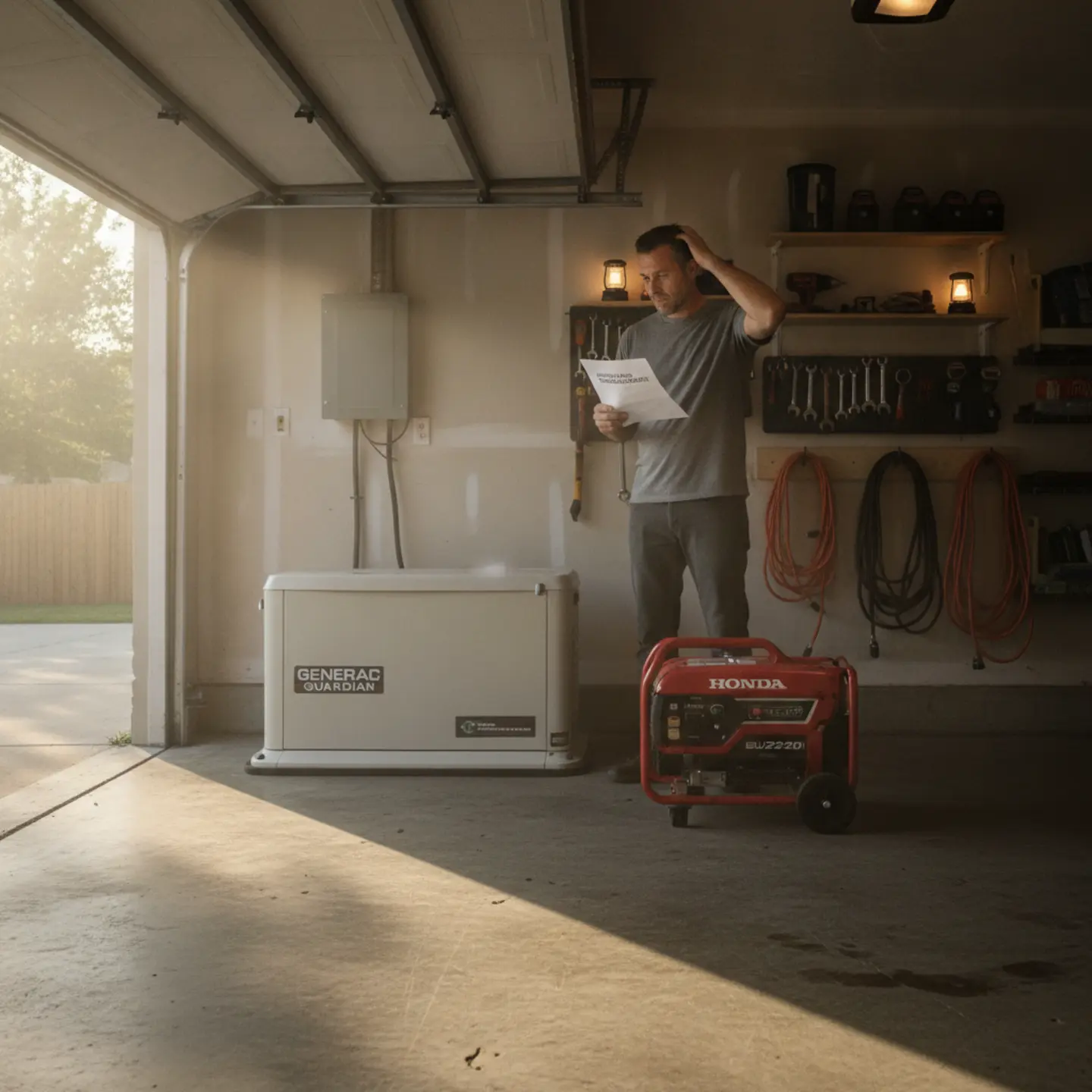
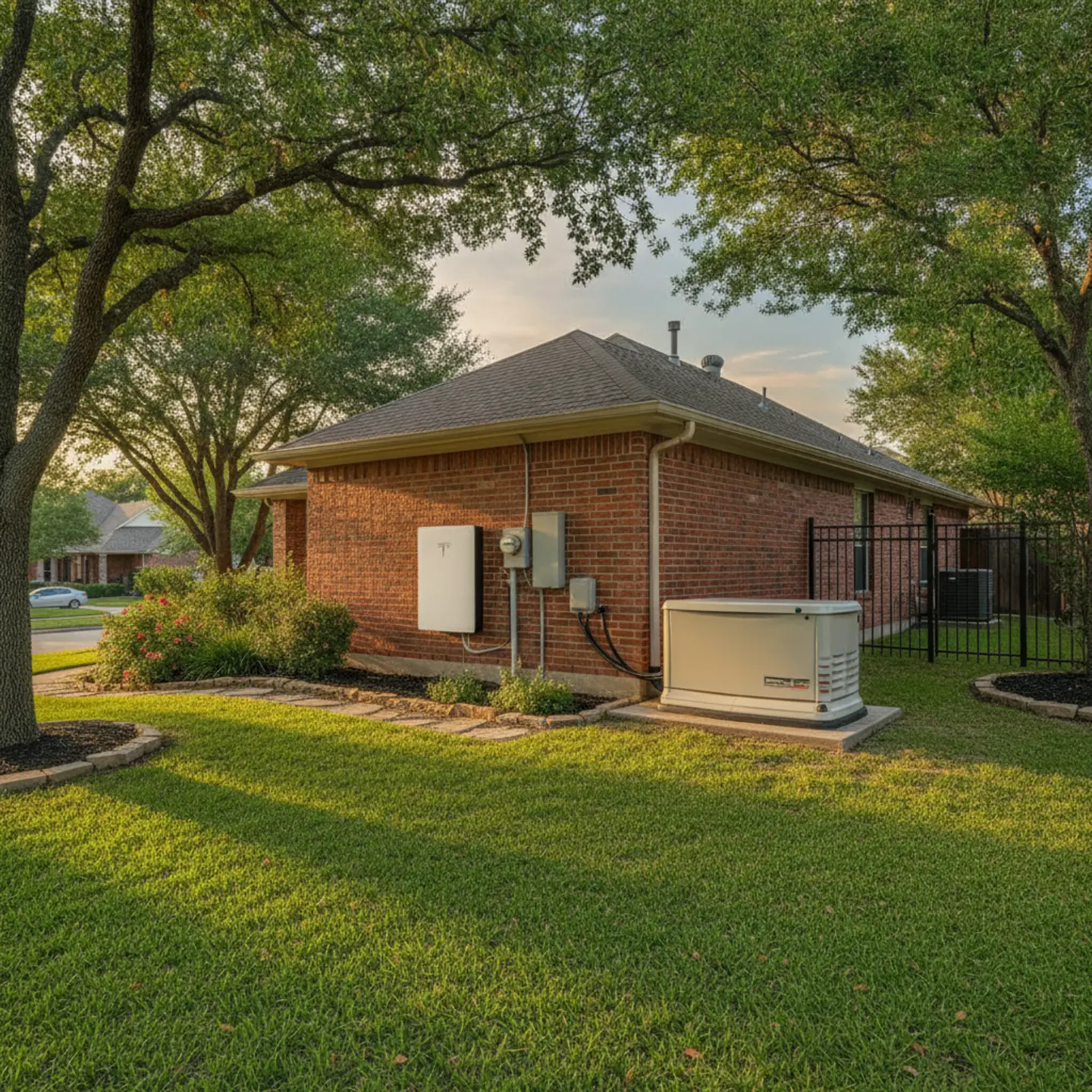
A whole-home standby generator sits outside your house on a concrete pad, connected to your natural gas or propane supply. When grid power fails, an automatic transfer switch (ATS) detects the outage within milliseconds and starts the generator — no manual intervention needed. The whole process takes about 10–30 seconds, and then your home runs normally: AC, heating, appliances, everything.
Typical whole-home units range from 20 kW to 26 kW, which is enough to cover all loads simultaneously. The biggest practical advantage of a generator over batteries is unlimited runtime. As long as your fuel supply continues, the generator keeps running — no recharge time, no capacity ceiling. That’s a meaningful difference when you’re staring down a four-day outage like Winter Storm Uri or a multi-day storm recovery like the May 2024 DFW events that left around 70,000 Oncor customers without power for days.
The trade-offs are real, though. Generators produce 55–65 decibels during operation — comparable to a running dishwasher — and they run weekly self-tests that you’ll hear. They require annual maintenance contracts ($300–$500/year) to stay reliable, and fuel costs accumulate fast during extended use: a 22 kW unit running on natural gas burns roughly $65 per day of continuous operation. For whole-home standby generator installation in DFW, Epic Electrical installs both Generac and Kohler units and handles all electrical permits and code compliance.
Cost Comparison: Installation, Maintenance, and Long-Term Expenses
Both systems have comparable upfront costs for whole-home coverage, but their long-term cost profiles diverge significantly. Batteries have almost no ongoing operational costs when paired with solar; generators have mandatory maintenance and fuel expenses that add up over years.
⚠️ Beware of Unlicensed Installers and Lowball Generator Quotes
In Texas, all electrical work — including battery storage and generator installation — requires a TECL (Texas Electrical Contractor License), verifiable at tdlr.texas.gov. Unlicensed work can void your homeowner’s insurance, fail city inspections, and create serious safety hazards. Generator quotes under $7,000 for a whole-home system are a red flag: reputable DFW installers explicitly warn that complete, permitted whole-home installations simply don’t happen at that price point. If the quote seems too good to be true, ask what it excludes.
The incentive picture strongly favors battery storage in DFW. The Oncor “Take a Load Off Texas” rebate offers up to $9,000 for qualifying solar + battery systems (minimum 5 kWh battery required — solar-only systems don’t qualify). Texas also exempts 100% of the home value added by solar and battery systems from property taxes, which can save $10,500–$14,500 over 25 years. Generators qualify for neither. On the federal side, the 30% Residential Clean Energy Credit (ITC) applied to homeowner-owned battery systems installed by December 31, 2025 — but that credit expires for cash or loan purchases after that date. If you’re considering a battery system and haven’t installed yet, the financing timeline matters. If budget is a concern, Epic offers residential project financing options worth reviewing before you decide.
| Cost Factor | Solar Battery Storage | Standby Generator |
|---|---|---|
| Installed Cost (entry) | $10,000–$18,000 (single unit) | $13,000–$18,500 (22–26 kW whole-home) |
| Installed Cost (whole-home) | $25,000–$50,000+ | $14,000 base (Epic); up to $20,000+ with add-ons |
| Annual Maintenance | Minimal — no service contract required | $300–$500/year mandatory contract |
| Fuel Cost During Outage | $0 (solar recharge) | ~$65/day (22 kW on natural gas) |
| Federal Tax Credit (2025) | 30% ITC (expires for homeowners after Dec 31, 2025) | None |
| Oncor Rebate (DFW) | Up to $9,000 (solar + battery, min. 5 kWh) | Not eligible |
| TX Property Tax Exemption | 100% on added home value | Not eligible |
| Panel Upgrade (if needed) | $5,800+ (Epic Electrical) | $5,800+ (Epic Electrical) |
Runtime and Capacity: How Long Will Each System Keep Your Home Running?
Runtime is where the two technologies diverge most sharply — and where your specific outage scenario matters most. A battery system’s runtime is finite unless it’s recharging from solar. A generator’s runtime is theoretically unlimited as long as fuel flows.
Here’s how real-world runtime breaks down for common configurations:
- Single Tesla Powerwall 3 (13.5 kWh): ~10–12 hours for essential loads (lights, refrigerator, internet, AC startup). 11.5 kW continuous power.
- Two Powerwalls (27 kWh): ~20–24 hours for essential loads; can handle whole-home backup including AC for shorter periods.
- Three Powerwalls (40.5 kWh) + solar: Indefinite runtime during daylight as batteries recharge; extended coverage into evening.
- Enphase IQ Battery 5P (10 kWh, two units): ~8–10 hours for essential loads.
- Generac PWRcell (9 kWh): ~6–8 hours for essential loads; scales to 36 kWh for longer coverage.
- Standby generator (22–26 kW): Unlimited runtime on fuel; ~$65/day in natural gas costs for continuous operation.
Texas context matters here. The state averages about 48 hours of grid downtime per year — a single Powerwall handles that comfortably with solar recharging. But Winter Storm Uri lasted four days, and the May 2024 DFW storms left some neighborhoods dark for nearly a week. For those scenarios, either a multi-battery system with solar or a standby generator is the honest answer.
💡 Combine Batteries and Generators for Ultimate Resilience
The most comprehensive backup power solution pairs a battery system with a standby generator. Batteries handle frequent, short outages silently and instantly — often using stored solar power — while the generator activates for longer outages, recharging the batteries and powering your home indefinitely. This hybrid approach offers seamless transitions and extended runtime for any duration of grid disruption, making it the go-to choice for homeowners who want true energy independence regardless of what Texas weather throws at them.
Top Battery Storage and Generator Providers in DFW: Compared and Reviewed
The DFW backup power market has grown significantly since Winter Storm Uri. Here’s an honest look at the licensed providers actively serving the area — what they specialize in, what they charge, and what sets them apart.
Epic Electrical (Battery Storage & Generators)
Epic Electrical (TECL #33192, verified at tdlr.texas.gov) is a father-and-son electrical contracting firm based in North Richland Hills at 7304 Hialeah Cir W, North Richland Hills, TX 76182, serving all of DFW since 2009. The team brings 60+ combined years of master electrician experience to every backup power project. Epic installs both Generac and Kohler whole-home standby generators, with a base price of $14,000 that includes the unit, electrical hookup, and up to 15 feet of fuel line. They also handle battery storage integration and electrical panel installations when existing panels need upgrading ($5,800 floor for a 200-amp panel change with permit and whole-home surge protection). Epic pulls and manages all electrical permits — a critical detail for inspections and insurance coverage. With 140+ five-star Google reviews, the business has built its reputation on honest diagnosis and transparent pricing, not upsells.
Destined Energy (Battery Storage)
Destined Energy specializes in Tesla Powerwall 3 installation and solar + battery integration across DFW and surrounding Texas regions. They’re known for transparent pricing (single Powerwall 3 runs $11,500–$16,500 installed in DFW), detailed runtime calculations, and a strong emphasis on LFP battery chemistry for Texas heat performance.
North Texas Solar (Battery Storage & Solar)
North Texas Solar focuses on solar + battery storage bundles using Enphase and Tesla products. Battery-only systems run $12,000–$20,000 installed; solar + battery bundles start around $25,000 and can exceed $50,000 for whole-home configurations. They have strong expertise in navigating the Oncor rebate process and modular system design for scalable capacity.
Grasten Power (Generators)
Grasten Power is a Fort Worth-area generator specialist and factory-authorized dealer for Generac and Kohler. Whole-home units range from $7,000 to $20,000+ depending on size and complexity. They offer service and maintenance contracts and have an established reputation in the area for generator reliability.
UTS ElectricPros (Generators)
UTS ElectricPros focuses on whole-home standby generator installation across the DFW region, with typical installations running $13,500–$17,000. They’re notably transparent about hidden costs — explicitly cautioning customers that $4,000 whole-home generator quotes are unrealistic — and detail fuel line pricing at $15–$20 per foot beyond the base run.
| Provider | Specialty | Price Range | Key Differentiator |
|---|---|---|---|
| Epic Electrical | Generators & Battery Storage | Generator from $14,000; Panel from $5,800 | TECL #33192, 60+ yrs experience, pulls all permits, 140+ five-star reviews |
| Destined Energy | Battery Storage (Tesla) | $11,500–$16,500 (single Powerwall 3) | Transparent pricing, LFP chemistry focus, runtime detail |
| North Texas Solar | Solar + Battery Storage | $12,000–$50,000+ | Oncor rebate expertise, modular design, Enphase & Tesla |
| Grasten Power | Generators | $7,000–$20,000+ | Factory-authorized dealer, maintenance contracts |
| UTS ElectricPros | Generators | $13,500–$17,000 | Transparent about hidden costs, detailed fuel line pricing |
Why Epic Electrical Is the Right Choice for DFW Backup Power
Epic Electrical holds TECL #33192 and brings 60+ combined years of master electrician expertise to every backup power project — whether that’s a whole-home standby generator, a battery storage system, or a hybrid setup that combines both. This isn’t a solar company that subcontracts the electrical work. Epic is a licensed electrical contractor that owns every aspect of the electrical installation, from panel assessment through final inspection.
With 140+ five-star Google reviews, Epic has earned trust across DFW by doing something simple: telling homeowners the truth. If there’s a cheaper fix, they’ll say so. If your existing panel can handle the load, they won’t push a replacement. Honest diagnosis, transparent pricing, no hidden costs — that’s the standard on every job.
Permit compliance is another area where Epic’s approach protects you. Epic pulls and manages all electrical permits for battery storage and generator installations, ensuring your system passes inspection and your homeowner’s insurance stays intact. For generators, Epic coordinates the electrical side while working alongside licensed gas contractors for fuel line work — a trade-coordination nuance that matters for code compliance in every DFW municipality.
As a father-and-son family business serving North Richland Hills, Keller, Southlake, Arlington, Fort Worth, and all of DFW since 2009, Epic combines old-school reliability with hands-on expertise in the technologies that matter today: Tesla Powerwall, Enphase, Generac PWRcell, and Kohler generators. When you call Epic, you’re talking to the people who will actually do the work — not a call center.
Contact Epic Electrical today for a free estimate and an honest consultation on whether battery storage, a standby generator, or a hybrid system is the right fit for your DFW home.
Frequently Asked Questions: Solar Battery Storage vs. Home Generator
Can a battery system really run my entire Texas home through a summer outage, including my AC?
Yes — a properly sized battery system can power your entire home, including AC, during a Texas summer outage. A single Tesla Powerwall 3 (13.5 kWh) delivers 11.5 kW of continuous power and can start a 5-ton AC unit. For extended whole-home coverage with multiple AC units during prolonged summer outages, two or three stacked Powerwalls (up to 40.5 kWh total) are recommended. When integrated with solar panels, the batteries recharge during daylight hours, offering indefinite backup as long as the sun is shining — which, in a Texas summer, is most of the day.
How does the federal Investment Tax Credit (ITC) apply to a standalone battery versus a solar-paired battery in Texas for 2025 and 2026?
For installations completed by December 31, 2025, both standalone battery storage systems (3 kWh or larger) and solar-paired battery systems qualify for the 30% federal Residential Clean Energy Credit (ITC) — as long as the homeowner owns the system outright (cash or loan purchase). However, for homeowner-owned systems installed after December 31, 2025, this residential ITC expires entirely, meaning no federal tax credit is available for cash or loan purchases in 2026. If the system is acquired through a solar lease or Power Purchase Agreement (PPA), the third-party system owner can claim the 30% commercial ITC (which continues through 2032) and typically passes those savings along through lower monthly payments. If you’re weighing timing, this distinction matters significantly to your total cost.
Are there any DFW-specific utility rebates or local incentives for battery storage systems beyond federal tax credits?
Yes. DFW homeowners in Oncor Electric Delivery’s service territory can access the Oncor Residential Solar + Battery Storage Rebate (part of the “Take a Load Off Texas” program), which offers up to $9,000 for qualifying solar + battery systems — up to $5,000 for solar and up to $4,000 for battery storage. A critical requirement: the installation must include a battery storage system of at least 5 kWh. Solar-only systems do not qualify. Texas also provides a 100% property tax exemption on home value added by solar and battery systems, and solar equipment is exempt from state sales tax. Some Retail Electric Providers in the deregulated DFW market, including TXU Energy, also offer solar buyback plans that make battery storage financially attractive for managing energy costs year-round.
What happens during an extended, multi-day grid outage in Texas if I only have batteries and no solar or generator?
A battery-only system without an external charging source will provide power until its stored energy runs out — and then your home goes dark until the grid comes back. A single 13.5 kWh battery typically lasts about 10–12 hours for essential loads. For the kind of extended outages Texas has experienced — Winter Storm Uri (four days), May 2024 DFW storms (some neighborhoods out for nearly a week) — a standalone battery without solar or generator backup isn’t enough on its own. True resilience for multi-day outages requires either solar integration (so the batteries recharge daily) or a standby generator that can power the home and recharge the batteries simultaneously. This is exactly why the hybrid approach — batteries plus a generator — is increasingly popular among DFW homeowners who’ve lived through Uri and don’t want a repeat.
What makes Epic Electrical different from other backup power providers in DFW?
Epic Electrical stands out with TECL #33192 and 60+ combined years of master electrician expertise — this is a licensed electrical contractor, not a solar company that subcontracts the electrical work. With 140+ five-star Google reviews, Epic has built its reputation on honest diagnosis, transparent pricing, and zero hidden costs or upsells. If there’s a cheaper solution for your situation, they’ll tell you. Epic handles all electrical permits and code compliance for both battery storage and standby generator installations, so your system passes inspection and your homeowner’s insurance stays protected. As a father-and-son family business serving DFW since 2009, Epic brings the kind of accountability you get when the people answering the phone are the same people doing the work. Get a free estimate from Epic Electrical and find out which backup power solution is right for your home.
Ready to Protect Your DFW Home with Reliable Backup Power?
Whether you’re leaning toward a solar battery system, a whole-home standby generator, or a hybrid setup that combines both, the right answer starts with an honest assessment of your home’s electrical system and your real-world outage needs. Epic Electrical’s father-son team has been helping DFW homeowners make that call — without pressure, without upsells — since 2009.
Get a straight answer and a transparent quote from a licensed master electrician who’s seen every type of Texas grid outage and knows exactly what it takes to keep your family comfortable through the next one.
Serving North Richland Hills, Fort Worth, Arlington, Keller, Southlake, Colleyville, Grapevine, Lewisville, Irving, Grand Prairie, and all of DFW.
Call us: (682) 478-6088 | TECL #33192
Pricing, equipment specifications, and project scope mentioned in this article are accurate as of the date of publication and are subject to change. Code requirements and permit needs vary by municipality and property. Please contact us directly for a current quote on your specific home or business.