Circuit Breaker Won’t Reset: Common Causes & DIY Solutions for Homeowners
Key Takeaways
- Circuit breakers are safety devices — a tripped breaker is your home protecting itself, not a random malfunction.
- Overloaded circuits are the most common cause and often the easiest to fix yourself by redistributing devices.
- Short circuits and ground faults are more serious and require a licensed electrician to diagnose and repair safely.
- A faulty appliance can cause your breaker to trip — testing devices one at a time is a safe DIY diagnostic step.
- A breaker that trips with nothing plugged in signals a circuit or breaker box problem — stop resetting it and call a professional.
- DFW heat and humidity add extra stress to electrical systems, especially in homes built before 2000.
- A free estimate from a licensed electrician costs you nothing and gives you a clear picture of what’s actually going on.
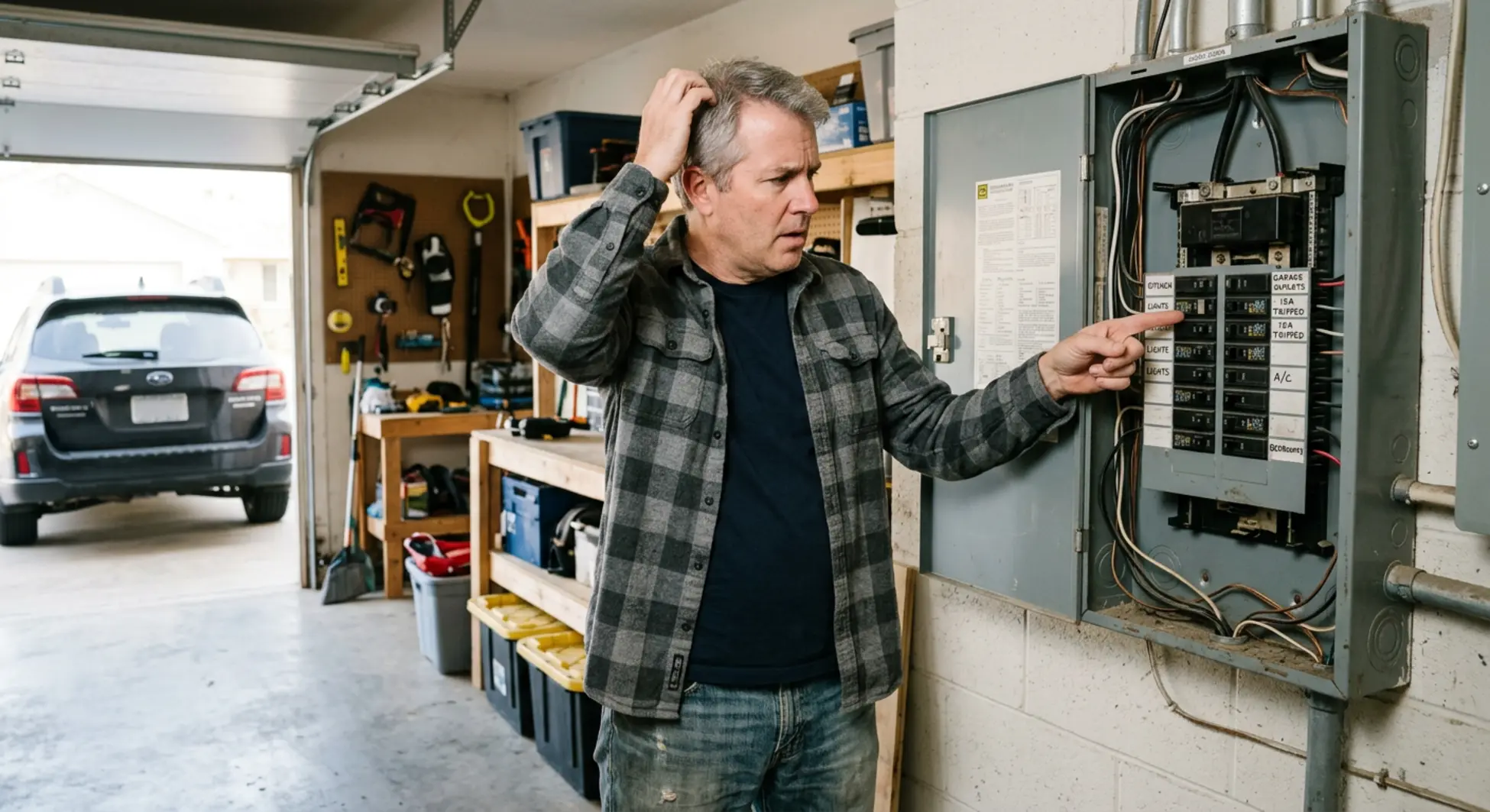
You flip the switch. Nothing. You walk to the breaker box, push the switch back to ON, and it immediately flips back to OFF. Again. Your stomach tightens a little — is this expensive? Is it dangerous? Can you fix it yourself, or do you need to call someone?
That moment — standing in front of your breaker box, half-frustrated and half-worried — is one of the most common electrical experiences homeowners have. And the anxiety that comes with it is completely understandable. Most of us weren’t taught how our home’s electrical system works, and electrical problems carry a weight that a leaky faucet just doesn’t.
Here’s the good news: a circuit breaker that won’t reset is almost always diagnosable. Some causes are simple enough to fix in five minutes. Others are a clear sign that it’s time to call a professional. The key is knowing the difference — and that’s exactly what this guide is for. We’re going to walk through every common reason a breaker won’t reset, what you can safely check yourself, and when to hand it off to someone with the right tools and training.
No fear-mongering. No jargon. Just honest, practical information from a team that’s been doing this in DFW for three generations.
Why Circuit Breakers Trip (And Why They Won’t Reset)
Before we get into specific causes, it helps to understand what a circuit breaker actually does — because once you understand its job, you’ll realize that a tripped breaker isn’t a failure. It’s a success. Your breaker did exactly what it was designed to do.
The Basic Function: What Your Breaker Is Doing Right
Every circuit in your home has a breaker assigned to it — usually rated for 15 or 20 amps for standard household circuits, and higher for large appliances like your dryer or air conditioner. The breaker’s job is simple: monitor the amount of electrical current flowing through that circuit at all times. The moment that current exceeds the breaker’s rating, the breaker trips automatically and cuts the power.
Why? Because too much current flowing through a wire generates heat. And heat in your walls — especially in older wiring — is how electrical fires start. The breaker is stopping that process before it begins. When you think about it that way, a tripped breaker is your home’s electrical system working exactly as intended. It’s not a malfunction. It’s a warning.
Understanding electrical safety for homeowners starts with respecting this basic principle: the breaker is always on your side. It’s not tripping to inconvenience you — it’s tripping because something on that circuit is drawing more power than the wiring can safely handle, or because there’s a fault somewhere in the circuit that needs attention.
The Difference Between a Trip and a Stuck Breaker
Not all breaker problems look the same, and the distinction matters a lot for figuring out what to do next.
A normal trip looks like this: the breaker flips to the OFF position (or sometimes to a middle “tripped” position), you identify and address the cause, you reset the breaker, and it stays ON. Done. That’s the system working perfectly.
A stuck breaker is different. You flip it back to ON and it immediately flips back to OFF. Or it won’t flip at all — it feels stiff or stuck in the middle position. Or it resets fine but keeps tripping again and again under normal conditions. These behaviors signal that there’s an underlying electrical problem that hasn’t been resolved — and resetting the breaker repeatedly without addressing the root cause isn’t just ineffective, it can be dangerous.
The goal of this guide is to help you figure out which category you’re in, and what to do about it.
🏠 You’re Not Alone — This Happens to Thousands of DFW Homeowners
Circuit breaker problems are one of the most common electrical issues homeowners face. The fact that you’re researching it before doing anything means you’re already being smart about your home’s safety. Not knowing the technical details of your electrical system isn’t something to be embarrassed about — it’s just not something most of us were ever taught.
Common Reason #1: Circuit Overload (The Most Common Fix)
If you had to bet on the most likely reason your breaker tripped, overload is the smart bet. It’s by far the most common cause, and it’s also the most straightforward to diagnose and fix on your own. No tools required.
An overload happens when too many devices on the same circuit are drawing more power than that circuit is rated to handle. A standard 15-amp circuit can handle about 1,800 watts of continuous load. A 20-amp circuit handles around 2,400 watts. That sounds like a lot — until you realize that a space heater alone can draw 1,500 watts, a hair dryer can pull 1,800 watts, and a microwave can hit 1,000 watts or more. Combine two of those on the same circuit and you’ve just asked your 15-amp breaker to handle a 3,300-watt load. It’s going to trip. Every time.
How to Identify an Overload Problem
Overloads have a very recognizable pattern. The breaker trips when you use a specific appliance or combination of appliances — and it happens consistently. You run the space heater and the hair dryer in the master bedroom at the same time, and the breaker trips. You plug in the microwave while the coffee maker is running, and the kitchen circuit goes out. The pattern is repeatable and predictable.
The other tell-tale sign of a simple overload: when you reset the breaker without changing anything about the load on the circuit, it trips again quickly. But when you unplug the offending device first and then reset it, the breaker stays ON without any issues. That’s your confirmation. It’s an overload, not a deeper electrical problem.
The DIY Fix: Load Balancing
The good news is that fixing an overload usually costs nothing and takes about ten minutes. Here’s the process:
- Identify which devices are on the tripping circuit. Check the label on your breaker box to see what’s on that circuit, then walk through the space and note every device plugged in — including things you might not think of, like phone chargers, lamps, and TVs.
- Move high-power devices to different circuits. Space heaters, hair dryers, and microwaves are the usual suspects. Plug them into outlets that are on different circuits — ideally circuits that aren’t already heavily loaded.
- Use power strips strategically, but never daisy-chain them. Plugging one power strip into another is a fire hazard and can mask overload problems. Each power strip should plug directly into a wall outlet.
- Test by plugging devices back in one at a time. This helps you confirm the fix and identify which combination of devices was causing the problem.
If you find yourself constantly shuffling devices around to avoid tripping the same circuit, that’s a sign your home’s electrical capacity may not match your modern power needs. Home electrical upgrades — like adding a dedicated circuit for high-draw appliances — are a professional service, but they’re often more affordable than homeowners expect and eliminate the problem permanently. That said, redistributing your devices is always worth trying first.
Common Reason #2: Short Circuits (When to Call a Pro)
A short circuit is a different animal from an overload, and it’s important to understand why. Where an overload is about too many devices drawing too much power, a short circuit is about the wiring itself — specifically, about electricity taking a path it’s not supposed to take.
In a properly functioning circuit, electricity flows from the breaker box through the “hot” wire to your outlet or device, and returns through the “neutral” wire. A short circuit happens when the hot wire makes contact with a neutral wire or a ground wire — creating a sudden, massive surge of current that trips the breaker almost instantly. The breaker doesn’t hesitate. It trips immediately, because the surge is dramatic and unmistakable.
What Causes a Short Circuit
Short circuits can happen for several reasons, and some of them are more obvious than others:
- Damaged appliance cords or outlets. A frayed cord where the insulation has worn away can allow wires to touch. An outlet where the internal components have loosened or corroded can cause the same problem.
- Water damage or moisture in walls. Water is conductive. If moisture has gotten into your walls — from a roof leak, a plumbing issue, or even just years of humidity — it can create a path for current to flow where it shouldn’t.
- Loose connections in the breaker box or outlets. Over time, connections can loosen due to the natural expansion and contraction of materials from heat cycles. A loose connection can allow wires to touch intermittently.
- Rodent damage to wiring. This one surprises a lot of homeowners, but it’s more common than you’d think — especially in older DFW homes with attic access. Rodents chew through wire insulation, exposing bare conductors that can short against each other or against the metal of junction boxes.
The warning signs of a short circuit are more alarming than those of an overload: you may notice a burning smell near an outlet or the breaker box, you might see scorch marks around an outlet, or the breaker may trip the instant you flip it back to ON — even with nothing plugged in on that circuit.
Why You Shouldn’t DIY a Short Circuit
We’re going to be straight with you here: short circuits are not a DIY fix. Not because you’re not capable, but because diagnosing one safely requires specialized testing equipment — a multimeter at minimum, and often more advanced tools to trace the fault through your walls. And working inside walls or inside the breaker box with live electricity present is genuinely dangerous without proper training.
More importantly, a short circuit that’s left unaddressed — or that’s temporarily “fixed” by resetting the breaker repeatedly — is a fire hazard. The wiring in your walls can overheat before the breaker trips, and that heat can ignite insulation or framing material. This is the kind of problem where getting a professional electrical inspection isn’t just a good idea — it’s the responsible choice for your family’s safety.
⚠️ Never Ignore a Breaker That Won’t Reset
If your breaker trips repeatedly or won’t stay in the ON position, it’s your home’s electrical system telling you something is wrong. Ignoring it — or repeatedly forcing the reset — doesn’t fix the underlying problem. It increases the risk of electrical fire or shock. When a breaker keeps tripping, treat it as a message, not an inconvenience.
If you’re seeing signs of a short circuit — a burning smell, immediate tripping with nothing plugged in, or scorch marks near outlets — that’s exactly what a professional electrical inspection is designed to diagnose safely. We’ll find the problem and explain it in plain language.
Common Reason #3: Ground Faults (The Silent Safety Issue)
Ground faults are closely related to short circuits, but they have their own specific characteristics — and their own specific dangers. Understanding the difference helps you identify what’s happening in your home and why it matters.
A ground fault occurs when electrical current escapes the intended circuit path and flows to the ground — either through a grounded surface, through water, or through a person. Unlike a short circuit (where current surges dramatically between wires), a ground fault can be a smaller, more subtle leak of current. That doesn’t make it less dangerous. In fact, ground faults are one of the leading causes of electrocution in residential settings, precisely because the current levels involved can be enough to cause cardiac arrest without being high enough to immediately trip a standard breaker.
Where Ground Faults Happen Most Often
Ground faults are almost always associated with moisture, which is why they’re most common in specific areas of your home:
- Bathrooms — moisture from showers and sinks creates the perfect conditions for ground faults near outlets, light switches, and fixtures.
- Kitchens — water splashes near countertop outlets are a common source, especially in older homes where GFCI protection wasn’t required.
- Laundry rooms and basements — washing machines, utility sinks, and damp concrete floors are all ground fault risk factors.
- Outdoor outlets and garage circuits — rain, irrigation, and general outdoor moisture exposure make these high-risk zones.
If your breaker trips in one of these wet areas, especially if it happens when someone is using water nearby, a ground fault is a very real possibility. Getting bathroom and kitchen electrical safety evaluated by a professional is the right call in this situation.
The GFCI Solution
GFCI stands for Ground Fault Circuit Interrupter — and it’s the single most effective protection against ground faults in wet areas. A GFCI outlet (or GFCI breaker) monitors the current flowing through a circuit and detects even tiny imbalances — as small as 4-6 milliamps — that indicate current is leaking to ground. When it detects that leak, it cuts power in about 1/40th of a second. That’s fast enough to prevent electrocution in most cases.
GFCI protection has been required by the National Electrical Code in bathrooms since 1975, kitchens since 1987, and outdoor outlets since 1978. But if your home was built before those dates, or if it’s been through renovations that didn’t bring those circuits up to code, you may not have GFCI protection where you need it. This is an affordable upgrade — a GFCI outlet typically costs $15-30 in materials, and installation is quick — but it’s a professional installation to ensure it’s wired correctly and actually protecting the right outlets.
Faulty Appliances: The Hidden Culprit
Here’s a scenario we see often: a homeowner resets their breaker, it trips again almost immediately, and they assume they have a serious wiring problem. They’re already mentally calculating the cost of rewiring their house. But when we show up, we plug in a single appliance — and the breaker trips. We unplug it, reset the breaker, and everything works fine. The problem wasn’t the circuit at all. It was a faulty appliance causing an internal short circuit.
This is more common than most people realize. Appliances can develop internal faults over time — damaged heating elements, frayed internal wiring, failed motors — that cause them to draw far more current than they should, or to create a short circuit within the device itself. The breaker does its job and trips. But because the appliance looks fine on the outside, homeowners often don’t think to check it.
The good news: testing for a faulty appliance is one of the safest and simplest diagnostic steps you can take. No tools required, and you can do it in a few minutes.
How to Test for a Faulty Appliance
This process is methodical and safe when done correctly:
- Reset the breaker and leave the circuit completely empty. Unplug every single device on that circuit — everything. If the breaker trips immediately with nothing plugged in, you have a circuit or breaker box issue (not an appliance problem), and it’s time to call a professional.
- Plug in one appliance at a time. Start with the device you suspect most, or just go one by one. After each one, wait a minute or two to see if the breaker holds.
- If the breaker trips with a specific appliance, that’s your culprit. Unplug it, reset the breaker, and confirm the circuit works fine without it.
- Stop using that appliance and replace it. A device that’s causing a short circuit is a fire hazard, even if it seems to “work” most of the time. Don’t try to repair it yourself unless you have specific appliance repair training.
This simple process can save you the cost of an unnecessary service call — or it can confirm that you do need professional help. Either way, you’ll have useful information. If you’ve isolated the problem to a specific appliance but you’re still not confident about the circuit’s overall health, a professional electrical safety inspection can give you peace of mind that nothing else is lurking.
💡 Pro Tip: Label Your Breaker Box
Spend 15 minutes testing each breaker and labeling what’s on each circuit. Have someone walk through the house while you flip breakers one at a time, calling out what turns off. This makes future troubleshooting dramatically faster — and it helps any electrician you call understand your system quickly. It’s one of the best 15-minute investments you can make as a homeowner.
Breaker Box Issues: When the Problem Is the Breaker Itself
We’ve talked about problems that originate in your circuits — overloads, short circuits, ground faults, faulty appliances. But sometimes the problem is the breaker itself. Breakers are mechanical devices with a finite lifespan, and they can and do fail over time. When the breaker is the problem, no amount of device-shuffling or appliance-testing is going to solve it.
Breakers are designed to last 30-40 years under normal conditions, but “normal conditions” in DFW is a relative term. Texas heat is hard on electrical components. Summers regularly push 100°F+ for weeks at a time, and that heat cycles through your breaker box every day. Add in the humidity that comes with DFW weather patterns, and you have conditions that accelerate corrosion and wear on electrical components faster than manufacturers’ ratings assume.
Signs Your Breaker Itself Is Faulty
How do you know if the breaker is the problem, rather than something on the circuit? There are a few clear indicators:
- The breaker won’t stay in the ON position even with nothing plugged in. You’ve unplugged everything on the circuit, reset the breaker, and it still trips. That’s a strong sign the breaker itself has failed.
- The breaker feels loose or wiggly when you touch it. Breakers should feel solid and secure in the panel. A loose breaker may have a poor connection to the bus bar, which can cause erratic tripping and create heat.
- You notice a burning smell near the breaker box. This is a serious warning sign that should prompt an immediate call to a professional. Don’t investigate further on your own.
- The breaker trips repeatedly without any meaningful load on the circuit. If a circuit with just a lamp and a phone charger keeps tripping, the breaker’s internal trip mechanism may have worn out or become hypersensitive.
Why This Requires Professional Help
Here’s where we need to be direct with you: the inside of your breaker box is not a safe DIY workspace. Even when individual breakers are turned off, the main bus bars in the panel remain energized at all times — the only way to de-energize them is to have the utility company disconnect power at the meter. That’s not something you do yourself.
Replacing a breaker requires working inside the panel, removing the panel cover, and handling components that are inches away from live bus bars carrying enough current to be lethal. One slip, one wrong contact, and the consequences are severe. This isn’t about doubting your capabilities — it’s about the reality that this particular task has a very unforgiving margin for error.
A breaker box inspection and repair from a licensed electrician is the right call here. The electrician has the training, the proper PPE, and the tools to do this safely. And in most cases, replacing a faulty breaker is a relatively quick fix — often completed in a single visit.
🔍 Why Your Breaker Box Matters More in DFW
Texas heat and humidity can stress electrical systems in ways that homeowners in milder climates don’t deal with. Older breaker boxes in DFW homes are especially prone to corrosion on bus bars and connections, which can cause intermittent tripping and reset failures that look like circuit problems but are actually panel problems. If your home was built before 2000, a professional inspection of your panel is a genuinely smart investment — not a sales pitch, just honest advice from people who’ve seen what years of Texas summers do to electrical components.
The DIY Diagnostic Checklist: What You Can Safely Do
Now that you understand the main causes of a breaker that won’t reset, let’s put it all together into a practical, step-by-step process you can follow right now. This checklist is designed to help you safely identify your specific problem — and to give you clear guidance on when to stop and call a professional. Most homeowners can complete this entire process in 10-15 minutes.
A few important notes before you start: this checklist assumes your breaker box is in normal condition — no visible damage, no water intrusion, no burning smell. If any of those conditions exist, skip the checklist and call a professional immediately.
Step 1: Safety First
Before you touch anything, do a quick safety check:
- Is the area around your breaker box dry? Never interact with your electrical panel if there’s any moisture present — on the floor, on the panel itself, or on your hands.
- Do you see any visible damage to the panel — scorch marks, melted plastic, corrosion, or physical damage? If yes, don’t touch it. Call a professional.
- Do you smell burning? If you smell anything that resembles burning plastic, hot metal, or smoke near the panel or anywhere in the affected area, turn off the main breaker and call a professional immediately. Don’t investigate further.
- Are there sparks visible anywhere? Same answer: main breaker off, call a professional.
If everything looks and smells normal, proceed to Step 2.
Step 2: Identify the Tripping Circuit
Open your breaker box and look at the breakers. A tripped breaker will typically be in one of three positions: fully OFF, fully ON, or in a middle “tripped” position that’s between ON and OFF. Most modern breakers have a small indicator window that turns red when tripped.
Check the label on the tripped breaker. If your panel is labeled (and if it’s not, see the Pro Tip callout above about labeling your box), you’ll know which area of your home or which appliances are on that circuit. Note this information — it’s useful for the next steps and for any electrician you might call.
Step 3: Test for Overload
Before you reset the breaker, unplug everything on that circuit. Everything — not just the big appliances, but lamps, chargers, small electronics, all of it. Then reset the breaker by flipping it fully to OFF first (even if it’s already in the tripped position), then back to ON.
Watch what happens:
- If the breaker stays ON with nothing plugged in — you almost certainly had an overload. Start plugging devices back in one at a time and redistribute high-draw appliances to different circuits.
- If the breaker trips again immediately with nothing plugged in — you have a circuit or breaker box issue, not an overload. Move to Step 4.
Step 4: Test Appliances One by One
If the breaker stayed ON with nothing plugged in, you’re now testing to see if a specific appliance is the culprit. Plug in one device at a time, wait a minute or two, and see if the breaker holds. If it trips when you plug in a specific device, that device is faulty. Unplug it, reset the breaker, and confirm the circuit works normally without it. That appliance needs to be replaced — don’t continue using it.
If the breaker trips with nothing plugged in (from Step 3), skip this step. You’re past the appliance-testing phase and into territory that requires professional diagnosis.
Step 5: Know When to Stop and Call a Pro
This is the most important step in the checklist. The following situations are clear signals that you’ve reached the limit of safe DIY diagnosis:
- The breaker trips with nothing plugged in on the circuit.
- You smell burning at any point during the process.
- You see any discoloration, scorch marks, or physical damage near outlets, the panel, or along baseboards.
- The breaker feels loose, sticky, or won’t flip properly.
- You’re uncomfortable or unsure at any point.
There’s no shame in calling a professional. Electrical safety is serious, and the professionals exist precisely for situations like this. If your checklist pointed to a circuit or breaker box issue, a free electrical estimate takes the guesswork out of what comes next — you’ll know exactly what’s wrong and what it costs to fix it before you commit to anything.
💡 The Safest Way to Reset Your Breaker
Always reset a tripped breaker by flipping it fully to OFF first — even if it looks like it’s already in the OFF position. Many breakers have a middle “tripped” position that’s not the same as fully OFF. Flipping to OFF first ensures a complete reset of the internal mechanism. Then flip it firmly to ON. If it won’t flip, or if it feels stuck, stop and call a professional — never force it.
If your diagnostic checklist pointed to a circuit or breaker box issue — not a simple overload — getting a professional opinion takes the guesswork out of what comes next. We’ll test your system, tell you what’s causing the problem, and give you a straight estimate. No pressure, just answers.
When to Call a Professional (And Why It’s Worth It)
We’ve mentioned calling a professional several times throughout this guide, and we want to take a moment to talk about why — not to sell you on a service call, but because we genuinely believe that understanding the value of professional help makes you a better, safer homeowner.
Here’s the reality: electrical work in Texas requires a licensed electrician for most repairs beyond basic device replacement. That’s not bureaucratic red tape — it’s a safety standard that exists because electrical mistakes can kill people and burn down houses. A licensed electrician has passed exams, completed supervised training hours, and carries insurance that protects you if something goes wrong. When you hire a licensed pro, you’re not just paying for labor — you’re paying for accountability and expertise.
Beyond the licensing issue, there’s a practical argument for professional help: a trained electrician can diagnose in 30 minutes what might take you hours of trial and error — and they can do it safely, with the right equipment. We’ve seen homeowners spend an entire weekend troubleshooting a problem that turned out to be a loose connection in the panel — something we can spot in minutes with the right testing equipment.
Red Flags That Require Professional Help
To be clear and specific, here are the situations where you should call a licensed electrician rather than continuing to troubleshoot on your own:
- The breaker won’t reset or trips immediately after resetting — even with nothing plugged in on the circuit.
- Burning smell or visible damage near outlets, switches, or the breaker box.
- Multiple breakers tripping at once — this can indicate a problem with the main panel or the utility connection.
- Flickering lights throughout the house — especially if it’s not isolated to one circuit.
- Outlets that don’t work even when the breaker is ON — this can indicate a wiring fault or a failed outlet that needs replacement.
- Any situation where you feel unsafe or uncertain. Trust that instinct.
What to Expect from a Professional Inspection
If you’ve never had an electrician out for a diagnostic visit, here’s what the process actually looks like — because knowing what to expect makes it less intimidating.
A licensed electrician will start by asking you to describe what’s happening — when it started, what the breaker does when you reset it, whether you noticed anything unusual before it started tripping. This context helps narrow down the likely causes before any testing begins. Then they’ll use testing equipment — typically a multimeter and sometimes a circuit tracer — to measure voltage, check for continuity, and identify where the fault is occurring.
A good electrician will explain what they’re finding as they go, in plain language. You should understand what’s wrong and why before they ever mention a repair. Then you’ll get a clear estimate for any work needed — and you decide whether to proceed. A professional who pressures you to commit on the spot before you’ve had a chance to think it over is a red flag.
Most circuit-level issues can be diagnosed and repaired in a single visit. If you’re ready to stop guessing and get a straight answer, get a free electrical estimate and we’ll walk you through exactly what’s going on.
A professional electrician can pinpoint the exact problem and explain your options in plain language — no pressure, no high-pressure sales pitch. Just honest advice from people who’ve been doing this in DFW for three generations.
Preventing Future Breaker Problems: Maintenance Tips for DFW Homeowners
Once you’ve resolved your current breaker issue — whether through a DIY fix or a professional repair — the next question is how to prevent it from happening again. The good news is that most breaker problems are preventable with some simple habits and occasional professional maintenance. This is especially true in DFW, where the climate adds some specific challenges that homeowners in other parts of the country don’t face.
North Texas summers are brutal on electrical systems. When temperatures stay above 100°F for weeks at a time, your air conditioning runs almost constantly — and that sustained load, combined with the heat inside walls and attic spaces, accelerates wear on wiring insulation, connections, and breaker components. Homes built in the 1980s and 1990s — a huge portion of DFW’s housing stock — are now at the age where electrical maintenance becomes genuinely important, not optional.
Load Management Best Practices
The simplest prevention strategy is also the most effective: be intentional about what you plug in where.
- Avoid plugging multiple high-power devices into the same outlet or circuit. Space heaters, hair dryers, air fryers, and microwaves are the biggest culprits. These devices should ideally be on dedicated circuits or at least spread across different circuits.
- Use different circuits for major appliances. Your window AC unit, space heater, and portable dehumidifier should not all be on the same circuit. In DFW summers, these devices run for hours at a time — that sustained load is much harder on a circuit than brief spikes.
- Don’t daisy-chain power strips. Plugging one power strip into another is a common way to accidentally overload a circuit — and it’s a fire hazard regardless of the load. Each strip should plug directly into a wall outlet.
- Unplug devices you’re not using. Many modern electronics draw “standby” power even when they appear to be off. Unplugging unused devices reduces your overall circuit load and extends the life of your wiring.
Visual Inspection Habits
You don’t need any electrical knowledge to do a basic visual inspection of your home’s electrical system. These are things any homeowner can check regularly:
- Check outlet covers and cords regularly for damage or discoloration. Yellowing or brown discoloration around an outlet is a sign of heat damage. Frayed cords need to be replaced immediately.
- Look for outlets that wiggle when you plug things in. A loose outlet means the internal connections are loose — and loose connections create heat and potential arc faults.
- Keep the area around your breaker box clear and dry. The panel needs adequate airflow, and moisture near the panel is a serious hazard. Don’t store items in front of the panel or use the area as a utility shelf.
- Notice if the same breaker trips repeatedly. One trip is a warning. Repeated trips on the same circuit is a pattern that deserves professional attention, even if you’ve been managing it by redistributing devices.
When to Schedule Professional Maintenance
Some electrical maintenance is genuinely DIY-friendly. But some of it requires a professional — not because homeowners aren’t capable, but because the inspection requires tools and access that aren’t practical for most people to have.
Consider scheduling a professional home electrical maintenance visit in these situations:
- Annual inspection for older homes (pre-1990s). Wiring from this era — including aluminum wiring used in many 1960s-70s homes — has specific maintenance needs that aren’t obvious from a visual inspection.
- After major storms or weather events. DFW gets severe thunderstorms, hail, and occasional tornadoes. After any significant weather event, it’s worth having your electrical system checked for damage, especially if you noticed flickering lights or tripped breakers during the storm.
- Before adding new circuits or upgrading appliances. If you’re adding an EV charger, upgrading to a larger HVAC system, or adding a hot tub or pool, your existing electrical system may need to be assessed and possibly upgraded to handle the new load.
- If you notice any unusual behavior. Buzzing sounds from outlets, warm outlet covers, lights that dim when you run the microwave, or any burning smell — these are all reasons to schedule a professional inspection sooner rather than later.
In Fort Worth, Arlington, Keller, Southlake, and the surrounding DFW communities, we see a lot of homes from the 1970s-1990s that have never had a professional electrical inspection. These homes often have outdated panels, insufficient GFCI protection, and wiring that’s reached the end of its practical lifespan. A one-time inspection gives you a clear picture of where your home stands — and most of the time, the news is better than homeowners expect.
Circuit Breaker Won’t Reset: Your Next Steps
Let’s bring this all together. If you’ve read through this guide, you now have a solid understanding of why circuit breakers trip, what the different causes look like, what you can safely diagnose yourself, and when to hand it off to a professional. That’s genuinely useful knowledge — and it puts you in a much better position than most homeowners who face this problem.
Here’s a quick summary of where you likely stand based on what you’ve found:
- If the breaker stayed ON after you unplugged everything and redistributed devices — you had an overload. Manage your circuit loads going forward, and consider adding a dedicated circuit if the problem is chronic.
- If the breaker tripped with a specific appliance — that appliance is faulty. Stop using it, replace it, and your circuit should be fine.
- If the breaker trips with nothing plugged in — you have a circuit or breaker box issue. This is a professional job. Don’t keep resetting it.
- If you noticed a burning smell, visible damage, or sparks — turn off the main breaker if it’s safe to do so, and call a licensed electrician immediately.
- If you’re not sure — that’s a completely valid place to be. Getting a professional opinion costs nothing upfront and gives you certainty about what’s actually happening.
The most important thing to take away from this guide is that a circuit breaker that won’t reset is always telling you something. Sometimes it’s a simple message — “you’ve got too many things plugged in here.” Sometimes it’s a more serious one — “there’s a fault in this circuit that needs attention.” Either way, the breaker is doing its job. Your job is to listen to it.
If you’re in the DFW area and you’ve worked through the diagnostic checklist without a clear answer, or if you’ve identified a problem that’s beyond safe DIY territory, contact Epic Electrical for a free estimate. We’ll come out, test your system, and tell you exactly what’s going on — in plain language, with no pressure to commit to anything on the spot.
Frequently Asked Questions: Circuit Breaker Won’t Reset
Can I reset a circuit breaker myself, or is it dangerous?
Resetting a breaker is safe — you’re flipping a switch on a device that’s specifically designed to be reset by homeowners. The danger comes not from the reset itself, but from ignoring what the reset is telling you. If the breaker trips immediately after you reset it, or if it keeps tripping under normal conditions, that’s a signal that something on the circuit needs attention. Resetting a breaker once to see if it holds is fine. Resetting it repeatedly because it keeps tripping — without addressing the underlying cause — is where the risk comes in. If you smell burning or see any damage near the panel, don’t touch it at all.
Why does my circuit breaker keep tripping even when nothing is plugged in?
This is one of the clearest signs that the problem isn’t an overload — it’s the circuit itself or the breaker. When a breaker trips with no load on the circuit, the most likely causes are a short circuit somewhere in the wiring, a ground fault, or a faulty breaker that has worn out and is tripping on its own. All three of these require professional diagnosis. Don’t keep resetting a breaker that trips with nothing plugged in — each reset without addressing the cause puts unnecessary stress on the breaker and can mask a worsening problem.
Is it normal for a breaker to trip occasionally?
An occasional trip — especially one that’s clearly connected to running too many high-draw devices at the same time — is completely normal and actually means your breaker is doing its job correctly. The circuit is protected from overheating, and you just need to redistribute your load. What’s not normal is a breaker that trips repeatedly on the same circuit, trips with nothing plugged in, or trips under conditions that shouldn’t be stressing the circuit. If you’re resetting the same breaker more than once every few months, that pattern deserves a professional look.
What’s the difference between a breaker trip and a breaker that won’t reset?
A trip is the normal function of a breaker — it detects an unsafe condition (usually an overload), flips to OFF, and waits for you to address the cause and reset it. Once you fix the underlying issue, the breaker resets and stays ON. A breaker that won’t reset is different: you flip it back to ON and it immediately flips back to OFF, or it won’t flip at all. This indicates that the condition causing the trip hasn’t been resolved — or that the breaker itself has failed. The latter is always a sign that professional diagnosis is needed.
How much does it cost to fix a circuit breaker problem?
The cost depends entirely on the cause. If it’s a simple overload that you resolve by redistributing devices, the fix costs nothing. If a faulty appliance is the culprit, you’re looking at the cost of replacing that appliance — not an electrical repair at all. Professional repairs range from around $150-$300 for replacing a faulty breaker, to $300-$600+ for diagnosing and repairing a short circuit or ground fault, depending on where the fault is located and how much access is required. A free estimate gives you the exact number for your specific situation before you commit to anything.
Should I replace my old breaker box, or can it be repaired?
Many breaker box issues — a faulty individual breaker, a loose connection, surface corrosion — can be repaired without replacing the entire panel. Repair is almost always less expensive than replacement and is often the right call. However, some situations do call for panel replacement: if the panel is a known problematic brand (like Federal Pacific or Zinsco, which have documented safety issues), if the panel is severely corroded or damaged, or if your home’s electrical needs have grown beyond what the existing panel can safely support. A professional inspection will tell you honestly which situation you’re in — and a good electrician will recommend repair when repair is sufficient.
Need Help Diagnosing Your Circuit Breaker Problem?
If you’ve worked through the diagnostic checklist and you’re still not sure what’s causing your breaker to trip or won’t reset, that’s exactly what we’re here for. We’ll inspect your system, explain what’s happening in plain language, and give you an honest estimate for any work needed — no pressure, no high-pressure sales. Just a family business that’s been helping DFW homeowners with electrical problems for three generations. Fort Worth, Arlington, Keller, Southlake, Colleyville, Grapevine, Lewisville, and all of DFW.
Or call us directly: (682) 478-6088