What Is Base Power? A DFW Homeowner’s Honest Breakdown (And the One Thing Most People Miss)
Key Takeaways
- Base Power is a new kind of energy company — they install a battery at your home, become your electricity provider, and use that battery to trade power on the wholesale grid to lower your rates.
- The pricing is genuinely compelling — approximately 13.8¢/kWh all-in vs. the Texas average of ~15.83¢/kWh, plus backup power for a fraction of what a Tesla Powerwall costs.
- Base Power is live in DFW right now — serving Oncor, CoServ, and Farmers Electric territories across the metroplex.
- There’s a catch most people don’t read about — Base Power can legally drain your battery to 20% charge to sell power back to the grid. That means your “backup” may not be full when you need it most.
- A supplemental generator + interlock kit closes the gap — for $300–$700, you can recharge the Base Power battery during extended outages and never be caught short again.
- This isn’t a knock on Base Power — it’s a genuinely innovative product. But understanding how it actually works helps you protect yourself completely, not just partially.
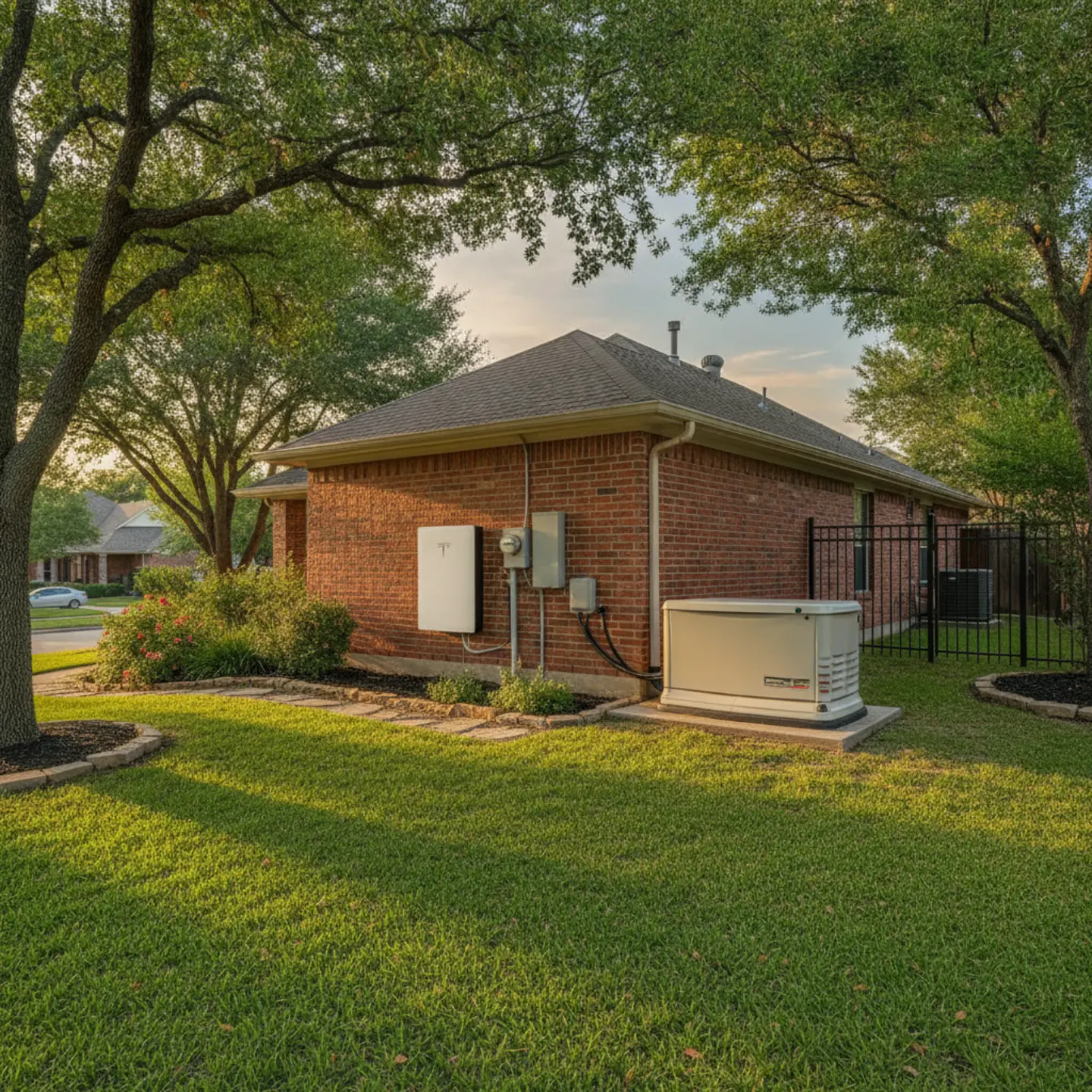
Something new has quietly arrived in Dallas-Fort Worth, and if you haven’t heard about it yet, you will soon. Your neighbors are talking about it. Signs are going up in Frisco and Denton County. And if you’ve seen a big, gray battery box sitting next to someone’s AC unit and wondered what it was — that’s Base Power.
Base Power Company is one of the most interesting things to happen to Texas electricity since deregulation. The concept is genuinely novel: they install a large battery backup system at your home, become your retail electricity provider, and use that battery to trade energy on the ERCOT wholesale market. The savings they generate from that trading subsidize your energy bill and cover the cost of the hardware. You get backup power for a fraction of what a traditional battery system costs. They get a distributed grid asset they can monetize.
It’s a compelling product, and the growth numbers back that up — they just closed a $1 billion funding round in October 2025 at a $4 billion valuation. This isn’t a startup experiment anymore. It’s real, it’s in DFW, and DFW homeowners deserve a straight explanation of how it works, what it costs, and — critically — where the gaps are.
We’re electricians. We’re not here to sell you Base Power or talk you out of it. We’re here to make sure you understand the full picture, because there’s one piece of the Base Power story that most homeowners miss entirely — and it matters a lot if your goal is true whole-home protection during a grid outage.
Let’s get into it.
What Is Base Power, Exactly?
Base Power Company was founded in August 2023 in Austin, Texas. The co-founders — Zach Dell (formerly of Blackstone and Thrive Capital) and Justin Lopas (formerly Head of Manufacturing at Anduril and a manufacturing engineer at SpaceX) — built the company around a specific observation: the bottleneck to energy reliability in the 21st century isn’t power generation. It’s the storage and distribution infrastructure needed to manage an increasingly volatile grid.
Their answer was to build what the energy industry calls a “gentailer” — a company that acts as both a generator and a retail electricity provider simultaneously. The mechanism is a fleet of residential batteries spread across thousands of homes, all coordinated by software built by their Head of Software, Jared Greene, a veteran of the SpaceX Starlink team.
In plain English: Base Power installs a battery at your house. They become your electric company. They charge and discharge that battery based on wholesale grid prices — buying cheap, selling high — and they use the profit from that trading to give you lower electricity rates and a backup power system you didn’t have to pay $10,000–$15,000 to own outright.
⚡ The “Gentailer” Model in One Sentence
Base Power makes money by trading your home’s battery on the wholesale electricity market. They share the profits with you in the form of lower energy rates and cheap backup power. You benefit. They benefit. ERCOT benefits because the grid gets more stable. It’s a genuinely clever model — with one important caveat we’ll cover shortly.
How Base Power Works: The Three-Layer Revenue Model
Understanding what you’re actually signing up for requires understanding how Base Power makes money. There are three revenue streams stacked on top of each other, and this structure is what makes the economics work.
Layer 1 — Your installation and membership fees. You pay a one-time installation fee ($345–$995 depending on your territory and plan) and a monthly membership fee ($19–$29/month). These fees are far below the actual cost of the hardware — which is significant, as you’ll see. They provide Base Power with steady recurring cash flow.
Layer 2 — Your electricity bill. Base Power becomes your Retail Electric Provider (REP), replacing TXU, Reliant, Gexa, or whoever you’re currently with. They charge you approximately 8.0¢/kWh for energy, plus a pass-through of Oncor’s delivery charge (roughly 5.8¢/kWh in most of DFW). Your all-in rate works out to around 13.8¢/kWh at typical usage — compared to the current Texas average of approximately 15.83¢/kWh.
Layer 3 — Wholesale grid arbitrage. This is the real engine. Base Power’s software monitors the ERCOT wholesale market in real time. When grid prices are low — or even negative, which happens during certain overnight hours — Base Power charges your battery from the grid. When prices spike during peak demand (think: a DFW summer afternoon with every AC unit in North Texas running simultaneously), they discharge your battery back into the grid and collect the difference. That spread is where the company makes most of its money, and it’s what allows them to give you hardware at a 90–95% discount versus buying a comparable system yourself.
The participation in ERCOT’s wholesale market is formalized through what’s called the Aggregate Distributed Energy Resource (ADER) pilot program — a framework that allows Base Power’s distributed fleet to bid as a single virtual power plant. By late 2025, Base Power was deploying at a pace of 20 MW per month across Texas. In March 2026, they announced a 100 MW partnership with CoServ specifically for Denton County — one of the largest distributed storage programs in the country.
The Hardware: What’s Actually Sitting Next to Your AC Unit
Base Power manufactures its own battery systems at “Factory One” — the former Austin American-Statesman newspaper building. The vertical integration (designing, building, and operating the hardware themselves) is a key part of how they keep costs low.
The units are ground-mounted, industrial in aesthetic, and notably larger than most consumer battery products on the market. They use Lithium Iron Phosphate (LFP) chemistry, which was specifically chosen because it handles frequent charge/discharge cycles far better than other battery chemistries. That matters a lot in the gentailer model, where the battery isn’t just sitting idle waiting for an outage — it’s being actively cycled for grid trading on a daily basis.
| Specification | Single Battery (25 kWh) | Dual Battery (50 kWh) |
|---|---|---|
| Total Energy Capacity | 25 kWh | 50 kWh |
| Usable Energy | 22.5 kWh | 44 kWh |
| Peak Continuous Power | 11.4 kW | 11.4 kW |
| Battery Chemistry | Lithium Iron Phosphate (LFP) | Lithium Iron Phosphate (LFP) |
| Switchover Time During Outage | < 0.5 Seconds | < 0.5 Seconds |
| Noise Level | 40 dB (refrigerator hum) | 40 dB |
| Temperature Range | 14°F – 122°F | 14°F – 122°F |
The switchover speed — under half a second — is one of the most impressive technical specs. During a real outage, you will not know the power went out unless you happen to be watching your neighbors’ lights. The system responds faster than your eyes can process the change.
For HVAC compatibility: the system handles up to 88–100 Locked Rotor Amps (LRA), which covers most standard residential air conditioning units. If your AC unit is above that threshold, a “soft start” modification is available. Worth checking before installation if you have a larger system.
What It Costs: The Real Numbers for DFW Homeowners
Base Power’s pricing structure has three components. All three matter, and the total picture is more competitive than most people expect.
| Pricing Component | 1 Battery (25 kWh) | 2 Batteries (50 kWh) |
|---|---|---|
| One-Time Installation Fee | $695 | $995 |
| Monthly Membership Fee | $19/month | $29/month |
| Energy Charge | 8.0¢/kWh | 8.0¢/kWh |
| TDU Delivery Fee (Oncor) | ~5.8¢/kWh (pass-through) | ~5.8¢/kWh (pass-through) |
| All-In Effective Rate | ~13.8¢/kWh | ~13.8¢/kWh |
| Texas Average for Comparison | ~15.83¢/kWh | ~15.83¢/kWh |
The comparison to a traditional battery purchase is even more striking. A Tesla Powerwall 3 — which has 13.5 kWh of usable capacity, less than two-thirds of Base Power’s single-unit system — runs $10,000–$15,000 installed before any electrical work. Base Power’s 22.5 kWh usable system costs under $700 to get in the door. That’s not a rounding error. That’s a fundamentally different business model.
The contractual terms are worth knowing upfront: the energy agreement is a 36-month term, and the battery services agreement is a 10-year term. Base Power retains ownership of the hardware. If you move, the agreement transfers to the new homeowner. If you cancel without moving, there’s a $500 de-installation fee (waived after 5 years or if they raise rates above the market average). They also reimburse up to $250 in early termination fees from your current provider to make switching easier.
In CoServ territory (Denton County, Frisco, McKinney), founding member pricing has been as low as $345 for installation. If you’re in that footprint, it’s worth checking current availability.
How Long Will It Actually Back Up Your Home?
Base Power’s backup duration specs are frequently cited at 15–24 hours for a single battery system at low usage. That’s technically accurate — but it requires a closer look at what “low usage” actually means.
| Usage Scenario | What’s Running | Single Battery (25 kWh) | Dual Battery (50 kWh) |
|---|---|---|---|
| Low | Internet, lights, fridge, freezer | 15–24 Hours | 30–48 Hours |
| Average | Above + intermittent AC | 8–12 Hours | 15–24 Hours |
| High | Constant heavy AC, laundry | 3–4 Hours | 5–8 Hours |
| Very High | Dual AC, electric heating | 1–2 Hours | 3–4 Hours |
A DFW summer outage scenario — the one everyone is actually worried about after Uri — is not a “low usage” situation. Your AC is going to run. The temperature outside is 102°F. You’re looking at 3–12 hours on a single battery if you’re being realistic about real-world usage. And if you’re also running an EV charger, that draw adds up fast — worth reading our breakdown of what it actually costs to charge an EV at home in Texas to understand the load impact.
For most short outages — the kind that last 2–6 hours due to a storm or localized equipment failure — that’s probably fine. But for a multi-day event, you’re going to need more than the battery alone.
⚠️ The Number You Need to Know: 20%
Under Base Power’s service agreement, the company has the right to discharge your battery to as low as 20% state of charge to fulfill its wholesale grid trading obligations. That’s not a rumor — it’s a structural feature of how the business model works. When ERCOT wholesale prices spike, Base Power sells power from your battery back to the grid. That’s exactly how they subsidize your rates. But it also means that when the lights go out, your battery may not be at 100%. It might be at 20%, which cuts the rated backup duration by 80%. That’s the gap most Base Power customers don’t fully account for — and it’s the gap worth closing.
The Gap in the Plan: Why Base Power Alone May Not Be Enough
We want to be clear about something: we think Base Power is a well-engineered product with a legitimate value proposition. The people who built it are serious, the hardware is industrial quality, and the pricing model is genuinely disruptive. This section isn’t a criticism of Base Power. It’s an honest look at a structural reality that comes with any system that serves two masters simultaneously.
Base Power’s battery has one job when the grid is healthy: trade energy to subsidize your electricity rate. That’s the deal. It works in your favor month after month on your bill. But that same job means the battery’s state of charge is actively managed by Base Power’s software — not by you — and its primary obligation in normal operating conditions is the arbitrage cycle, not sitting at 100% in anticipation of the next storm.
Base Power does guarantee a minimum backup buffer. But “minimum buffer” and “full charge” are not the same thing. And in a region where outages can last days — not hours — that difference matters enormously.
Here’s the real-world math: a 25 kWh battery at 20% charge has 5 kWh of usable energy. At a moderate household load during a Texas summer, that might give you 1–2 hours of backup before the system shuts down. That’s not what most people picture when they sign up for “backup power.”
⚡ Base Power Does Offer a Generator Recharge Port
To their credit, Base Power is currently testing a generator recharge port add-on (approximately $1,000, currently in beta) that allows a portable generator to recharge the battery during an extended outage. That’s the right instinct — but it’s a beta product, it’s an additional cost, and it requires a generator you may or may not already own. A properly installed interlock kit achieves the same goal more directly, works with generators you already own or plan to buy, and doesn’t depend on a product that’s still in testing. We’ve written a full side-by-side comparison: Base Power’s generator port vs. a generator inlet — worth reading before you decide which route to take.
The Fix: A Generator Interlock Kit as Supplemental Backup
An interlock kit is a mechanical device installed at your main electrical panel that allows a portable generator to safely power your home through your existing wiring. It works by interlocking the main breaker and the generator breaker so that they can never be on at the same time — which is the critical safety requirement for any generator connection to a home’s electrical system. We’ve covered the full details in our guide to generator interlock kits as an affordable backup connection.
For Base Power customers, an interlock kit serves a specific and important function: it gives you the ability to recharge or supplement the Base Power battery during an extended outage using a portable generator. When the battery runs low, you connect your generator, start it up, and restore power to your critical circuits — and in many configurations, the generator can simultaneously recharge the battery, essentially buying back the runtime that the grid trading may have cost you.
This is not a complicated or expensive addition. It’s a sensible insurance policy against the one scenario where Base Power’s model has structural limitations: a multi-day outage during peak demand, when the battery was actively being traded before the lights went out.
| Component | Typical Cost | Notes |
|---|---|---|
| Interlock Kit (hardware) | $30–$150 | Panel-specific; must match your panel model |
| Generator Inlet (exterior) | $30–$80 | Weatherproof exterior connection point for your generator |
| Licensed Electrician Labor | $200–$450 | Permit required in most DFW municipalities |
| Permit and Inspection | $75–$150 | We handle all paperwork |
| Total Installed (Typical) | $300–$700 | Does not include cost of the generator itself |
Compare that to Base Power’s own beta generator recharge port at approximately $1,000 — and the interlock kit approach gets you there for less, works with any generator you already own or choose to buy, and doesn’t require waiting on a beta product rollout. If you’re still deciding on a generator, our guide to the best portable generators for inlet connections covers the options that work best with an interlock setup.
✅ What This Setup Actually Gives You
Base Power handles the short outages — the ones that last 2–12 hours after a storm — automatically, seamlessly, without you doing anything. The interlock kit + generator handles the scenarios Base Power can’t fully cover on its own: multi-day grid events, deep-winter freezes, or situations where the battery was at partial charge when the grid went down. Together, it’s a genuine whole-home backup solution. Separately, each one has limits. That’s the honest answer.
Already have Base Power installed — or planning to sign up? We can add an interlock kit to your panel in a single visit. It’s a small job with a big impact on your real-world outage protection.
Is Base Power Available in Your Part of DFW?
Base Power is currently serving homeowners across the DFW metroplex through three utility territories. Service and pricing vary slightly by territory, with cooperative territories sometimes offering lower founding member installation pricing.
| Utility Partner | Geographic Coverage | Service Type |
|---|---|---|
| Oncor | Dallas, Fort Worth, Arlington, Plano, Irving | Energy + Backup (Full REP Model) |
| CoServ | Denton County, Frisco, McKinney | Backup + Grid Support (100 MW Co-op Deal) |
| Farmers Electric | Northeast DFW suburbs (Wylie, Hunt Co.) | Energy + Backup (Full REP Model) |
If you’re not sure which utility serves your home, check your current electricity bill — the TDU name is listed in the delivery charges section. Oncor covers the overwhelming majority of the DFW urban core.
Note that Base Power does operate a waitlist. Due to high demand following their 2025 funding round, some homeowners report waiting several months before being contacted for installation scheduling. If you’re interested, the earlier you get on the list, the better.
How Base Power Compares to the Alternatives
If you’re trying to decide whether Base Power makes sense, the comparison that matters most isn’t Base Power vs. your current electricity provider. It’s Base Power vs. the other options for getting backup power and better rates simultaneously.
| Feature | Base Power | Tesla Powerwall 3 | Traditional REP (No Battery) |
|---|---|---|---|
| Upfront Cost | $695–$995 | $10,000–$15,000+ | $0 |
| Usable Backup Capacity | 22.5–44 kWh | 13.5 kWh | None |
| You Own the Hardware? | No (Base Power owns it) | Yes | N/A |
| Effective Energy Rate | ~13.8¢/kWh | Depends on REP (avg ~15.83¢) | ~15.83¢/kWh average |
| Battery Under Your Control? | Partially (grid arbitrage managed by Base Power) | Yes (if not enrolled in VPP) | N/A |
| Commitment Term | 36-month REP / 10-year battery | No ongoing commitment | Typically 12–24 months |
The honest assessment: Base Power wins on accessibility and value for most DFW homeowners who don’t want to spend $10,000+ on a battery. It loses on full control of the battery state of charge — which is the tradeoff at the heart of the business model. If having 100% control over your backup is non-negotiable, a purchased battery system like Tesla Powerwall is the right answer — or see our comparison of Generac whole-home generators vs. Base Power in DFW if a standby generator is on your radar. If you’re comfortable with the tradeoff in exchange for dramatically lower upfront cost and better monthly rates, Base Power is a genuinely strong product — made stronger with a supplemental interlock kit setup for extended outage scenarios.
FAQs About Base Power in Dallas-Fort Worth
Does Base Power replace my current electric company completely?
Yes. When you sign up with Base Power, they become your Retail Electric Provider, replacing whoever you currently use (TXU, Reliant, Gexa, etc.). Oncor or your local TDU still maintains the physical power lines — that relationship doesn’t change. Base Power handles your billing, your rate, and your battery. You’ll still pay a delivery charge to your TDU, but it passes through your Base Power bill rather than appearing as a separate account.
What happens to my backup power when Base Power draws down the battery for grid trading?
This is the most important question Base Power customers should be asking. Base Power guarantees a minimum backup buffer — they will not drain the battery to zero. However, they can draw it down to approximately 20% state of charge during peak grid demand periods. At 20%, a 25 kWh system has roughly 5 kWh of usable energy remaining. During a real summer outage with your AC running, that may translate to 1–3 hours of backup time rather than the 15–24 hours cited in best-case scenarios. For short outages, this is usually fine. For extended multi-day events, it’s a gap worth addressing with a supplemental generator and interlock kit.
How fast does the Base Power system switch on during an outage?
Under half a second — faster than the human eye can register. For most homeowners, the experience is: the power goes out, and nothing in their house changes. Lights stay on. The AC keeps running. Clocks don’t reset. The switchover is instantaneous in practical terms. This is one of the genuine advantages of a battery-based backup system over a traditional generator, which requires 10–30 seconds to start and transfer.
What’s an interlock kit and why would I need one with Base Power?
An interlock kit is a mechanical device installed at your main electrical panel that allows you to safely connect a portable generator to your home’s wiring. It physically prevents the main breaker and generator breaker from being on simultaneously, which is the critical safety requirement that prevents back-feeding electricity onto the utility line. For Base Power customers, an interlock kit lets you connect a portable generator to recharge or supplement the battery during an extended outage — addressing the gap created when the battery has been partially depleted by grid trading activity. It’s the most cost-effective way to extend your backup coverage beyond what the battery alone can provide. We install these throughout the DFW area and can confirm compatibility with your specific panel before the job starts.
What if I move while under a Base Power agreement?
The agreement is transferable to the new homeowner at no cost to you — which can actually be a selling point for your home. Battery backup is increasingly valued by buyers in Texas, and a transferable service agreement with no hardware cost to the buyer is a genuine amenity. If you’re moving to a home that’s also in Base Power’s service territory, you can start a new agreement at your new address. If neither option works and you cancel outright, there’s a $500 de-installation fee (waived after 5 years or if renewal rates exceed the market average).
Does my home need any electrical upgrades to support a Base Power installation?
Base Power’s current system is compatible with main electrical panels up to 200 amps. Most homes built in the last 30–40 years in DFW already have 200-amp service, so this is typically not a barrier. The installation also requires a level ground-mounted surface for the battery unit and a reliable internet connection for Base Power’s monitoring software. If your panel is older or undersized, that’s worth knowing before you sign up — and it’s something we can assess quickly during a free inspection. See our guide on how to tell if you need a panel upgrade for a quick self-check before calling. Base Power handles all permitting and municipal paperwork for the battery installation itself.
Epic Electrical serves homeowners throughout Dallas-Fort Worth, including Fort Worth, Arlington, Keller, Southlake, Colleyville, Grapevine, Lewisville, and surrounding communities. We install interlock kits, generator inlet connections, and panel upgrades — and we can confirm compatibility with your Base Power system before the job starts. We’re a third-generation family business and your neighbors.
Already Have Base Power? Make Sure Your Backup Is Complete.
Base Power is a smart product that solves a real problem for DFW homeowners. But any system that splits its battery between your backup needs and the wholesale grid has a structural gap — and a properly installed interlock kit closes it. We’ll assess your panel, confirm compatibility, pull the permits, and have the job done in a single visit. Whether you already have Base Power installed or you’re planning to sign up, we’ll make sure you’re covered for the outage scenario that actually matters: the one that lasts longer than a few hours.
Get a Free Estimate for Your Interlock Kit
Call us at (682) 478-6088 · Serving Fort Worth, Arlington, Keller, Southlake, Colleyville, Grapevine, Lewisville & all of DFW