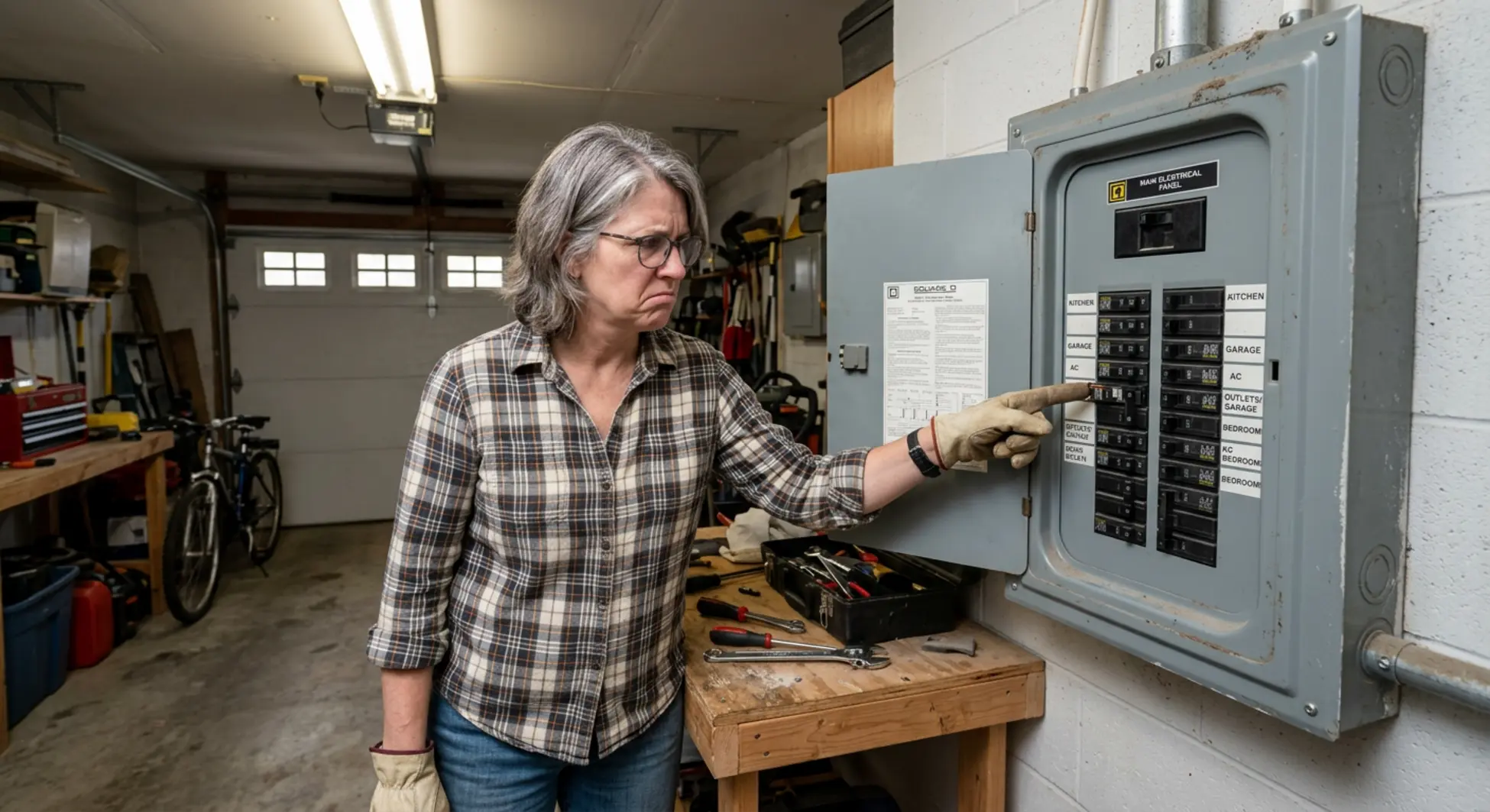
Circuit Breaker Tripping Frequently: Troubleshooting Guide & Replacement Solutions
Key Takeaways
- Breakers trip for a reason — frequent tripping is always a symptom of something: overload, short circuit, ground fault, or a failing breaker.
- Circuit overload is the most common cause — and often the easiest to fix without calling anyone.
- Short circuits and ground faults are serious — burning smells, scorch marks, or a breaker that won’t stay ON are fire hazards that need professional attention immediately.
- Failing breakers are a hidden danger — a breaker that doesn’t trip when it should is more dangerous than one that trips too often.
- Safe troubleshooting doesn’t require opening the panel — you can diagnose most issues by observation, pattern tracking, and simple appliance testing.
- Breaker replacement costs $150–$300 — a full panel upgrade runs $1,500–$3,000, but either is far cheaper than fire damage.
- Some situations require immediate professional help — know the red flags so you don’t wait too long.
You’re in the middle of doing laundry, running the dishwasher, and charging your phone when—click—the lights go out. Again. You trudge to the breaker box, flip the switch back on, and wonder: Is this normal? Am I about to burn my house down? Or am I just overloading circuits like an idiot?
Here’s the honest answer: it’s probably not an emergency. But it’s also not something you should keep ignoring. Your circuit breaker is one of the few parts of your home that literally exists to protect you from electrical fires—and when it keeps tripping, it’s trying to tell you something. The frustrating part is figuring out what.
This guide walks you through exactly that. We’ll explain why breakers trip, how to tell the difference between a simple overload and something more serious, what you can safely check yourself, and when it’s time to call a licensed electrician. By the end, you’ll have a clear picture of what’s going on in your home’s electrical system—and what to do about it.
Why Your Circuit Breaker Keeps Tripping: The Real Reasons
Let’s start with the basics, because understanding why breakers trip changes how you think about the whole problem. A tripping breaker isn’t a malfunction—it’s the system doing exactly what it was designed to do. The question isn’t “why does my breaker keep tripping?” so much as “what is my breaker trying to protect me from?”
Your home’s electrical system is built around the principle of electrical safety—every wire, outlet, and breaker is sized and rated to handle a specific amount of current. When that limit gets exceeded, things get hot. Hot wires inside your walls can ignite insulation, framing, and everything else they touch. A breaker trip is what stands between you and that outcome.
What a Circuit Breaker Actually Does
Think of a circuit breaker as an automatic switch that monitors the flow of electricity through a circuit. Every circuit in your home has a rated capacity—usually 15 or 20 amps for standard household circuits, more for appliances like dryers and ranges. When the current flowing through the circuit exceeds that rating, the breaker detects the excess heat or current and trips, cutting power to that circuit instantly.
This is not a failure. This is the breaker working perfectly. The problem isn’t that it tripped—the problem is whatever caused it to trip. And that cause is almost always one of three things.
The Three Main Culprits Behind Frequent Tripping
Circuit overload is the most common reason a breaker trips. It happens when you’re drawing more power than the circuit can handle—too many appliances running at once, or one high-draw appliance pushing the circuit past its limit. This is annoying, but it’s not inherently dangerous if the breaker is functioning correctly.
Short circuits are more serious. A short circuit happens when a hot wire and a neutral wire make unintended contact, creating a sudden surge of current that trips the breaker almost instantly. Short circuits are often caused by damaged wiring, faulty appliances, or moisture getting into outlets. They’re fire hazards and should never be ignored.
Ground faults are the most dangerous type. A ground fault occurs when electricity finds an unintended path to the ground—sometimes through water, sometimes through a metal surface, and sometimes through a person. Ground faults are why GFCI outlets exist, and why they’re required by code in bathrooms, kitchens, and outdoor areas.
Not all tripping is an emergency, but all tripping deserves investigation. The difference between a simple overload and a short circuit can mean the difference between a minor inconvenience and a house fire. Let’s break each one down.
💡 You’re Not Overreacting—Frequent Tripping Is Worth Investigating
It’s easy to dismiss a tripping breaker as “just an inconvenience,” but your breaker is trying to tell you something. Whether it’s a simple overload or a serious electrical fault, understanding the cause is the first step to fixing it safely. You’re not being paranoid—you’re being a responsible homeowner.
Circuit Overload: The Most Common Reason Your Breaker Trips
If your breaker trips predictably—always when you’re running the microwave and the toaster at the same time, or when you plug in the hair dryer while the bathroom heater is running—there’s a good chance you’re dealing with a simple circuit overload. This is by far the most common reason breakers trip, and it’s also the most straightforward to diagnose and fix.
Here’s the math: a standard 15-amp circuit can handle about 1,800 watts of continuous load (80% of its rated capacity, per electrical code). A 20-amp circuit handles about 2,400 watts. A hair dryer alone can draw 1,200–1,875 watts. A microwave pulls 600–1,200 watts. A space heater? Up to 1,500 watts. Run two or three of these on the same circuit and you’ve exceeded its capacity before you’ve even thought about it.
Modern homes have more high-draw appliances than older electrical systems were ever designed to handle. If your home was built in the 1960s or 70s, its electrical system was designed for a fraction of today’s appliance loads. That’s why home electrical upgrades are so common in older DFW neighborhoods—the wiring and panel capacity simply weren’t built for today’s demands.
How to Spot an Overload Situation
Overload is the easiest of the three causes to identify because it’s predictable. Here’s what it typically looks like:
- The breaker trips when you use multiple high-draw appliances at the same time
- It always happens in the same room or on the same circuit
- The tripping is consistent and repeatable—you can almost predict when it’s going to happen
- There’s no burning smell, no visible damage to outlets or switches, and no scorch marks
- The breaker resets normally and stays on once you’ve reduced the load
If all of those boxes are checked, you’re almost certainly dealing with overload. The good news: this is often fixable without spending a dime on an electrician.
Quick Fixes for Circuit Overload
Before you call anyone, try these simple adjustments:
- Spread high-draw appliances across different circuits. Outlets in different rooms are usually on different circuits. Plug your hair dryer into the bedroom outlet instead of the bathroom if both are running at the same time.
- Stagger your appliance use. Run the dishwasher after the laundry is done, not simultaneously. Your home’s electrical system isn’t designed for everything to run at once during peak hours.
- Identify what’s actually on that circuit. You might be surprised—sometimes a bedroom, a hallway, and part of a bathroom share the same 15-amp circuit. Knowing what’s connected helps you manage the load.
- Avoid daisy-chaining power strips. Plugging one power strip into another multiplies the number of devices on a single outlet but doesn’t increase the circuit’s capacity. It’s a fire hazard, not a solution.
If load-shifting doesn’t solve the problem, or if your home simply doesn’t have enough circuits to spread the load, that’s a sign you may need additional circuits added—which brings us to a conversation with a licensed electrician. But often, simple behavioral changes make the tripping stop entirely.
Short Circuits: When Wiring Goes Wrong
Short circuits are a different animal entirely. Where overload is a capacity problem, a short circuit is a wiring problem—and it’s significantly more serious. If you’re seeing any of the red flags we’re about to describe, stop using that circuit and call a licensed electrician. This isn’t the kind of thing you troubleshoot by trial and error.
A short circuit happens when a hot wire (the wire carrying current) comes into contact with a neutral wire, creating a direct path of very low resistance. Electricity always takes the path of least resistance, so when that path opens up, a massive surge of current flows through it instantly. Your breaker trips almost immediately—but not before that surge generates significant heat.
Short circuits are one of the leading causes of residential electrical fires. The wiring inside your walls can reach temperatures that ignite surrounding materials before the breaker even trips. That’s why a professional electrical inspection is the right call when you suspect a short circuit—not because electricians want your money, but because diagnosing wiring problems safely requires the right tools and training.
Common Causes of Short Circuits
Short circuits don’t just happen randomly. They’re usually the result of one of these underlying issues:
- Damaged wire insulation. Wiring insulation degrades over time from age, heat exposure, and physical damage. In older homes, insulation can become brittle and crack, allowing wires to contact each other inside walls or junction boxes.
- Rodent damage. Rats and mice chew through wire insulation with alarming efficiency. If you’ve had rodent activity in your home, your wiring may be compromised in places you can’t see.
- Faulty appliances. Internal wiring problems in appliances—especially older ones—can cause short circuits that trip your breaker the moment you plug in or turn on the device.
- Water damage or moisture. Water and electricity are a dangerous combination. Moisture in outlets, switches, or junction boxes can create conductive paths between wires that shouldn’t be touching.
- Improper DIY electrical work. Wiring that was installed incorrectly—even years ago—can eventually cause short circuits as connections loosen or insulation wears.
Red Flags That Indicate a Short Circuit
Unlike overload, short circuits often come with warning signs that are hard to miss:
- A burning smell near outlets, switches, or the breaker box
- Visible scorch marks, discoloration, or melting around outlets or switch plates
- The breaker trips immediately when you try to reset it—before you’ve even turned anything on
- Tripping that seems random and isn’t tied to any specific appliance or usage pattern
- A popping or crackling sound when the breaker trips
⚠️ Never Ignore These Red Flags
Burning smells, scorch marks, or a breaker that won’t stay ON are not normal. These are signs of serious electrical problems that can cause fires. If you notice any of these, stop using that circuit immediately and call a licensed electrician. Don’t wait to see if it gets worse—it will.
If you’re seeing burning smells, scorch marks, or a breaker that trips the moment you reset it, that’s not an overload problem—it’s a wiring problem. A licensed electrician can pinpoint the issue safely and give you an honest assessment of what it’ll take to fix it.
Ground Faults: The Silent Safety Threat
Ground faults are the type of electrical fault most homeowners know the least about—and the most dangerous. A ground fault occurs when electricity finds an unintended path to the ground. That path might be through a puddle of water, through a metal appliance housing, or—most terrifyingly—through a person who touches the wrong thing at the wrong time.
The reason ground faults are so dangerous is that the current involved doesn’t have to be large to be lethal. As little as 30 milliamps of current passing through the human body can cause cardiac arrest. Your standard 15-amp breaker won’t trip until it detects a much larger current imbalance—which is why GFCI (Ground Fault Circuit Interrupter) protection exists. GFCI devices detect imbalances as small as 4–6 milliamps and trip in as little as 1/40th of a second.
If your home doesn’t have GFCI protection for bathrooms and kitchens, that’s a gap in your home’s safety net worth addressing—regardless of whether you’re experiencing tripping issues.
Where Ground Faults Happen Most Often
Ground faults follow moisture. Anywhere water and electricity are in close proximity, ground fault risk is elevated:
- Bathrooms: Wet hands, steam, and water splashes near outlets and switches create ideal conditions for ground faults. This is why GFCI outlets are required by code in all bathroom locations.
- Kitchens: Countertop outlets near sinks are a common ground fault location. Wet hands reaching for appliances plugged into non-GFCI outlets is a genuine electrocution risk.
- Laundry rooms: Washing machines and utility sinks create high-moisture environments where ground faults can occur, especially with older appliances.
- Outdoor outlets and garages: Rain, irrigation, and humidity make outdoor and garage outlets particularly vulnerable. GFCI protection is required by code for all outdoor and garage outlets.
- Wet basements: Water intrusion in basements can compromise outlets and wiring in ways that aren’t immediately obvious.
GFCI Protection: Your First Line of Defense
GFCI outlets and breakers are specifically engineered to detect ground faults and cut power before the current reaches dangerous levels. Here’s what you need to know:
- A GFCI outlet monitors the current flowing out through the hot wire and returning through the neutral wire. If there’s an imbalance—even a tiny one—it trips instantly.
- GFCI outlets can be installed as individual outlets (the ones with the TEST and RESET buttons you see in bathrooms) or as a GFCI breaker that protects an entire circuit.
- Current electrical code requires GFCI protection in bathrooms, kitchens, garages, outdoor areas, crawl spaces, and unfinished basements.
- If your home was built before the mid-1970s, it may not have GFCI protection in any of these areas—and that’s a safety gap worth closing.
If a GFCI outlet is tripping repeatedly, treat it the same way you’d treat a standard breaker that keeps tripping: investigate the cause. A GFCI that trips once because of a wet appliance is doing its job. One that trips every day is telling you something is wrong.
Failing Breakers: When the Switch Itself Is the Problem
Here’s a scenario that doesn’t get talked about enough: sometimes the breaker itself is the problem. Circuit breakers are mechanical devices, and like all mechanical devices, they wear out. Most breakers are rated for 20,000–30,000 operations, which sounds like a lot until you consider how often a frequently tripping breaker gets cycled. After 20–30 years of service, a breaker can start to fail in ways that are both annoying and genuinely dangerous.
A failing breaker might trip too easily—triggering under normal loads that shouldn’t cause any issue. But the more dangerous failure mode is a breaker that doesn’t trip when it should. A breaker that fails to trip during an overload or short circuit is no longer protecting your home. It’s just a switch that happens to be in the panel.
If you suspect a failing breaker, breaker replacement and panel upgrades are exactly the kind of work that requires a licensed electrician—not because it’s complicated, but because the main panel contains live current even when breakers are in the OFF position. This is not a DIY situation.
Signs Your Breaker Is Failing
- Trips repeatedly even after you’ve significantly reduced the load on that circuit
- Won’t stay in the ON position—flips back to OFF on its own within seconds or minutes
- Trips without any appliances running on that circuit at all
- The breaker feels warm or hot to the touch (if you notice this, don’t touch it again—call a pro)
- The breaker handle feels loose or doesn’t snap firmly into position
- Visible signs of damage, corrosion, or burning on or around the breaker
Why You Can’t DIY a Breaker Replacement
We get it—replacing a breaker looks simple on YouTube. But here’s what those videos don’t show you: the main lugs in your electrical panel remain energized even when the main breaker is turned off. The only way to fully de-energize a residential panel is to have the utility company pull the meter—something a licensed electrician can arrange and work around safely.
⚠️ Why You Can’t DIY a Breaker Replacement
The main electrical panel contains live current even when breakers are off. Working inside requires specialized training, insulated tools, and knowledge of what’s still energized. A licensed electrician can do it safely in 1–2 hours—it’s genuinely not worth the risk of electrocution or starting a fire. This is one of those jobs where the cost of professional help is far less than the cost of getting it wrong.
Beyond the safety issue, breaker replacement also needs to be done correctly to meet electrical code. The replacement breaker must be the right type and amperage for your specific panel, properly installed, and tested before the panel is closed. Improper installation can create fire hazards that aren’t immediately obvious—and can void your homeowner’s insurance if something goes wrong.
Step-by-Step Troubleshooting: What to Check Before Calling an Electrician
Now that you understand the three main causes of breaker tripping, let’s talk about what you can safely do yourself before picking up the phone. Safe troubleshooting doesn’t require opening the breaker box or touching live wires—it’s mostly about observation, pattern recognition, and simple testing. And the information you gather will make any electrician’s job faster and cheaper.
Step 1: Document the Pattern
This sounds tedious, but it’s genuinely the most valuable thing you can do. Before you change anything, write down:
- When the breaker trips (time of day, day of week)
- What appliances were running at the time
- Whether it’s always the same breaker or different ones
- Any smells, sounds (popping, buzzing), or visible signs before the trip
- How long after resetting before it trips again
Three or four data points like this can tell an electrician almost everything they need to know before they even open the panel. It’s the difference between a 30-minute service call and a 2-hour diagnostic.
Step 2: Check for Obvious Overloads
If you suspect overload, test it systematically:
- Unplug everything from the outlets on the affected circuit
- Reset the breaker
- Plug devices back in one at a time, waiting a minute between each
- Note which combination causes the trip
- If a specific combination consistently trips the breaker, you’ve found your overload threshold
If unplugging everything and resetting the breaker still results in an immediate trip, overload is not your problem. Move on to the next steps.
Step 3: Inspect Outlets and Switches for Damage
Do a visual inspection of every outlet and switch on the affected circuit. You’re looking for:
- Scorch marks, discoloration, or melting on outlet faces or switch plates
- Any burning or acrid smell near outlets or the breaker box
- Outlets that feel warm to the touch on the outside of the cover plate
- Evidence of water damage, moisture, or rust near outlets in bathrooms, kitchens, or laundry areas
If you find any of these, stop. Don’t try to troubleshoot further. This is a short circuit or ground fault situation that needs professional diagnosis.
Step 4: Test Individual Appliances
If your outlets look clean and the breaker doesn’t trip with no load, try isolating the problem to a specific appliance:
- Plug each suspect appliance into an outlet on a different circuit (a different room)
- If the breaker on the new circuit trips with that appliance, the appliance is faulty—not the original circuit
- A faulty appliance should be unplugged and not used until repaired or replaced
- If the breaker trips with multiple different appliances on that circuit, the circuit itself is the problem
💡 Pro Tip: Document Your Breaker’s Behavior
Keep a simple log of when your breaker trips—what time, what appliances were running, any smells or sounds. This information helps an electrician diagnose the problem faster and saves you money on service calls. Even a few notes on your phone can make a real difference when the tech arrives.
If you’ve worked through these troubleshooting steps and the breaker still trips—or if you’re seeing any red flags like burning smells or scorch marks—that’s exactly what a professional electrical inspection is designed to answer. We’ll pinpoint the problem and give you a straight answer on the safest, most cost-effective fix.
When to Call a Licensed Electrician (Don’t Wait on These)
We want to be straight with you: not every tripping breaker requires a service call. If you’ve identified a clear overload situation and load-shifting fixes it, you’re done. But there are situations where waiting—or trying to troubleshoot further yourself—creates real risk. Here’s how to tell the difference.
If you’re ever unsure whether your situation is urgent, a quick call to a licensed electrician can give you peace of mind. For genuine emergencies, emergency electrical service in DFW is available when you need it fast. Most of the time, a quick conversation can tell you whether you need someone out today or whether it can wait for a scheduled appointment.
Call Immediately If You Notice:
- Burning smell near outlets, switches, or the breaker box. This is not a “wait and see” situation. A burning smell means something is overheating right now.
- Visible scorch marks, melting, or discoloration on outlets or wiring. This indicates a short circuit has already occurred and may recur.
- A breaker that won’t stay in the ON position. If it flips back to OFF immediately after resetting, there’s an active fault on that circuit.
- Frequent tripping on multiple different circuits. This suggests a panel-level problem, not a circuit-level one.
- A breaker box that feels hot or has visible damage. The panel itself may be failing.
- Any sparks or flashes from outlets or the panel. Stop using that circuit immediately.
Schedule Service Soon If:
- Your breaker trips regularly even with what seems like normal use—no high-draw appliances running simultaneously
- You have an older home (pre-1980s) with original electrical service and frequent tripping across multiple circuits
- You’ve recently added new high-draw appliances (electric vehicle charger, new HVAC system, electric range) and the tripping started afterward
- You’ve done the troubleshooting steps above and can’t identify a clear cause
- Your home has Federal Pacific or Zinsco panels—these brands have documented safety issues and should be evaluated by a professional regardless of tripping frequency
“The cost of a professional diagnosis is almost always less than the cost of ignoring the problem. A breaker that fails to trip when it should doesn’t give you a warning—it just lets the fire start.”
Breaker Replacement: What to Expect and How Much It Costs
If you’ve determined that a breaker needs to be replaced—either because it’s failing or because you’re upgrading to a higher-capacity or different type—here’s what the process actually looks like and what you can expect to pay. We believe in being upfront about costs, because surprises on an invoice are never a good experience.
For most homeowners, a single breaker replacement is a straightforward job that takes 1–2 hours and costs between $150 and $300, depending on the breaker type and your panel’s accessibility. Specialty breakers—GFCI breakers, AFCI breakers, tandem breakers—cost more than standard single-pole breakers, but the labor is similar. You can learn more about what’s involved in electrical panel service and upgrades to understand what the work entails before committing to anything.
Typical cost for a single circuit breaker replacement by a licensed electrician in DFW. Full panel upgrades range from $1,500–$3,000 depending on capacity and complexity.
The Breaker Replacement Process
Here’s what a licensed electrician actually does when replacing a breaker, so you know what you’re paying for:
- Turn off the main breaker to de-energize as much of the panel as safely possible (note: the main lugs may still be live)
- Remove the panel cover and identify the failing breaker
- Disconnect the circuit wire from the old breaker and remove it from the panel
- Install the new breaker of the correct type and amperage rating for your panel
- Reconnect the circuit wire and verify proper torque on connections
- Restore power and test the circuit to confirm proper operation before closing the panel
Why Professional Installation Matters
Beyond the safety issue of working in a live panel, professional installation matters for several practical reasons:
- Code compliance. Breaker replacement must meet current electrical code, which affects insurance coverage and home resale value.
- Correct breaker selection. Not all breakers are interchangeable. Using the wrong brand or type in a panel can create connection problems that cause heat buildup over time.
- Warranty protection. Professional installation typically comes with a warranty on both the work and the breaker itself.
- Liability protection. If a DIY breaker replacement causes a fire, your homeowner’s insurance may deny the claim. Licensed work protects you.
Ready to fix this once and for all? Whether you need a simple breaker replacement or a full panel upgrade, we’ll walk you through your options and give you an honest estimate—no pressure, no surprise charges.
Upgrading Your Electrical Panel: When Frequent Tripping Means You Need More Capacity
Sometimes the problem isn’t a single failing breaker or a specific circuit overload—it’s that your home’s entire electrical system is undersized for what you’re asking it to do. This is especially common in DFW homes built before 1980, where the original electrical service was designed for a world without electric vehicles, smart home systems, large-screen TVs, and modern HVAC equipment.
Homes from the 1950s through 1970s were often wired with 60–100 amp service. That was adequate for the appliance loads of that era. Today, a typical family home comfortably uses 150–200 amps, and homes with electric vehicle chargers, electric ranges, and heat pumps may need even more. If you’re constantly fighting breaker trips across multiple circuits—not just one—the problem may be that you’ve simply outgrown your panel.
The honest truth about electrical panel upgrades for modern homes is that they cost more upfront than replacing a single breaker, but they eliminate the problem permanently instead of just moving it around. If you’ve replaced breakers, redistributed loads, and the tripping continues, a panel upgrade is worth a serious conversation.
💡 The Honest Truth About Panel Upgrades
If your home is older and you’re constantly fighting breaker trips, a panel upgrade might be the cheapest long-term solution. Yes, it costs more upfront—typically $1,500–$3,000—but it eliminates the problem permanently instead of just moving it around. And it adds real value to your home.
Signs Your Home Needs a Panel Upgrade
- Frequent breaker tripping on different circuits throughout the house, not just one
- Home built before 1980 with original electrical service that’s never been upgraded
- Adding new high-draw appliances (EV charger, heat pump, electric range) causes problems across multiple circuits
- Your panel has no room to add new circuits—every slot is full
- Your utility company has recommended a service upgrade for new equipment
- Your panel is a known problem brand (Federal Pacific Stab-Lok, Zinsco/Sylvania) that has documented failure issues
What a Panel Upgrade Involves
A full panel upgrade is a bigger job than a breaker replacement, but it’s also a one-time investment that solves the problem at the root:
- The existing main breaker panel is replaced with a new, higher-capacity panel (typically 200 amps for modern homes)
- If the service line from the utility to your home is undersized, that may need to be upgraded as well—which involves coordination with your utility company
- Circuits are redistributed and balanced across the new panel
- The job typically takes 1–2 days and requires a permit and inspection in most DFW municipalities
- Total cost typically runs $1,500–$3,000, depending on the complexity of the job and whether service line work is needed
In the Dallas-Fort Worth area, many homes in established neighborhoods like Arlington, Keller, and Colleyville were built in the 1960s and 70s with electrical systems that are now 50+ years old. If your home is in that era and you’ve never had the panel evaluated, it’s worth a conversation—not because something is necessarily wrong, but because you deserve to know where you stand.
Prevention: How to Avoid Frequent Breaker Tripping Going Forward
Once you’ve addressed the immediate problem—whether that’s redistributing loads, replacing a breaker, or upgrading your panel—the goal is to not end up back in the same situation six months from now. The good news is that most frequent tripping is preventable with a combination of smart daily habits and targeted upgrades.
Staying ahead of electrical issues is part of what electrical maintenance and safety inspections are designed to help with. A periodic check of your panel and wiring can catch failing breakers, loose connections, and capacity issues before they become emergencies. Think of it the same way you think about getting your HVAC serviced—proactive care is cheaper than reactive repair.
Daily Habits That Reduce Tripping
- Stagger high-draw appliances. Run the dishwasher after the laundry cycle finishes, not simultaneously. Use the electric oven and the microwave at different times when possible.
- Unplug devices when not in use. Devices in standby mode still draw small amounts of current. Over a full circuit, this adds up.
- Don’t overload power strips. A power strip doesn’t add capacity—it just adds outlets. The circuit is still limited to 15 or 20 amps regardless of how many things are plugged in.
- Keep moisture away from outlets. In bathrooms and kitchens, be mindful of water splashes near outlets and appliances. If an outlet gets wet, don’t use it until it’s dried out completely.
- Know your circuit layout. Understanding which outlets are on which circuits helps you make smarter decisions about where to plug in high-draw appliances.
Upgrades That Prevent Future Problems
- Install GFCI outlets in all required locations. Bathrooms, kitchens, garages, outdoor areas, and unfinished basements should all have GFCI protection. If yours don’t, this is a straightforward upgrade that significantly improves safety.
- Add AFCI breakers to bedroom circuits. Arc Fault Circuit Interrupters detect dangerous electrical arcing (a common cause of house fires) and are now required by code in bedrooms. Older homes often lack them.
- Upgrade to a higher-capacity panel if your home is older. If you’re in a pre-1980 home with a 100-amp or smaller panel, proactive upgrading before you have problems is smarter than waiting for a crisis.
- Have an electrician inspect your panel every 5–10 years. Breakers wear out, connections loosen, and panels can develop issues that aren’t visible from the outside. Periodic inspection catches these before they become emergencies.
DFW summers put real strain on home electrical systems. Running central AC while cooking, charging devices, and using entertainment systems simultaneously is standard summer behavior—and it’s exactly the kind of sustained high load that stresses older panels and wiring. If you’ve noticed more tripping in summer months, that’s not a coincidence.
Frequently Asked Questions About Circuit Breaker Tripping
Is it dangerous if my circuit breaker keeps tripping?
It depends on the cause. If it’s simple overload—too many appliances on one circuit—it’s annoying but not dangerous. Your breaker is doing exactly what it’s supposed to do. But if the tripping is caused by a short circuit or ground fault, you’re dealing with a genuine fire hazard that needs professional attention. The key is to pay attention to the warning signs: if you’re seeing burning smells, scorch marks, or a breaker that won’t stay ON, stop using that circuit immediately and call a licensed electrician. Don’t wait to see if it gets worse.
Can I just keep resetting my breaker, or do I need to fix it?
Occasional tripping—especially if you can identify a clear overload cause—is usually fine to reset and move on from. But frequent tripping is a sign something needs attention, and repeatedly resetting the breaker doesn’t fix the underlying problem—it just masks it. There’s also a more serious concern: a breaker that gets cycled too many times can wear out faster, and a worn-out breaker may eventually fail to trip when it should. That’s the scenario you really want to avoid, because a breaker that doesn’t trip during a fault is no longer protecting your home.
How much does it cost to replace a circuit breaker?
A single breaker replacement typically costs $150–$300, depending on the breaker type (standard, GFCI, AFCI) and how accessible your panel is. If you need a full panel upgrade—replacing the entire main panel with a higher-capacity unit—expect to pay $1,500–$3,000, depending on your home’s age, current service capacity, and whether the utility service line needs to be upgraded as well. Either way, these costs are far less than the cost of dealing with fire damage or electrical injury. We always give you an honest estimate before any work begins.
Why does my breaker trip when I use my hair dryer and dishwasher at the same time?
Both appliances draw a significant amount of power—a hair dryer can pull 1,200–1,875 watts, and a dishwasher uses 1,200–2,400 watts during the heating cycle. If they happen to be on the same 15 or 20-amp circuit, running them simultaneously exceeds the circuit’s capacity. This is textbook circuit overload, and it’s the most common reason breakers trip. The fix is simple: use them at different times, or plug one into an outlet in a different room that’s on a different circuit. No electrician needed for this one.
Can I replace my own circuit breaker?
No—and this is one of those cases where we’re not just being cautious for liability reasons. The main electrical panel contains live current even when breakers are in the OFF position. The main lugs (where the utility power enters the panel) remain energized regardless of what you do with the main breaker. Working around live conductors in a confined metal box requires specialized training, insulated tools, and knowledge of exactly what’s still energized. A licensed electrician can do it safely in 1–2 hours, and the work comes with a warranty. The risk of electrocution or starting a fire simply isn’t worth the savings.
What’s the difference between a circuit breaker and a GFCI outlet?
A circuit breaker protects the entire circuit from overload and short circuits—it trips when current exceeds the circuit’s rated capacity. A GFCI (Ground Fault Circuit Interrupter) outlet serves a different purpose: it detects tiny imbalances in current flow that indicate electricity is finding an unintended path to ground, often through water or a person. GFCI outlets trip in as little as 1/40th of a second when they detect a ground fault—fast enough to prevent electrocution in most cases. Both protections are important and serve different functions. GFCI outlets are required by code in bathrooms, kitchens, garages, and outdoor areas, and they can be installed as individual outlets or as GFCI breakers that protect an entire circuit.
Stop Fighting Your Circuit Breaker — Let’s Find the Real Fix
Frequent breaker tripping is frustrating, but it’s fixable — and you don’t have to figure it out alone. Whether it’s a simple overload, a failing breaker, or a sign that your home needs more electrical capacity, we’ll diagnose the problem honestly and recommend the right solution for your situation. No pressure, no overselling — just a straight answer and a fair estimate from a DFW family electrical team that’s been doing this for three generations.
Serving Fort Worth, Arlington, Keller, Southlake, Colleyville, Grapevine, Lewisville, and all of DFW.
(682) 478-6088