Key Takeaways
- CPSC Recognition Is the Deciding Factor — AlumiConn connectors are officially recognized by the CPSC as a permanent aluminum wiring repair; purple AL-rated wire nuts are explicitly warned against and will fail city inspection in Texas.
- Insurance Acceptance Depends on Method — Nearly 100% of major Texas insurers (State Farm, Allstate, Farmers, USAA, Nationwide) require CPSC-approved remediation documentation; purple wire nut jobs are routinely rejected, leaving homeowners surcharged or uninsurable.
- Whole-Home Remediation Costs $5,000–$8,500 for a Typical DFW Home — AlumiConn installation runs $90–$110 per outlet, switch, and fixture; the higher upfront cost is offset by insurance savings of $500–$2,000+ annually and zero re-remediation risk.
- Texas Law Requires a TECL-Licensed Contractor and a City Permit — Under the 2023 NEC adopted in Texas, all aluminum wiring remediation must be performed by a TECL-licensed electrical contractor, pulled with a permit, and pass municipal inspection before it’s legally complete.
- Trust Epic Electrical for honest, CPSC-approved aluminum wiring remediation in DFW — father-and-son master electricians, TECL #33192, 123+ five-star Google reviews, and no upsells — visit Epic Electrical to get started.
AlumiConn vs. Purple Wire Nuts: Which Aluminum Wiring Remediation Method Is Safer and More Permanent?
AlumiConn connectors are the CPSC-recognized permanent solution for aluminum wiring remediation, while purple AL-rated wire nuts are explicitly warned against by the CPSC and rejected by most Texas insurers. AlumiConn uses individual set screws to create a robust mechanical connection that resists cold creep and oxidation, whereas purple wire nuts are prone to loosening over time and have a documented history of failure. For DFW homeowners, the choice is clear: AlumiConn is the only method that will satisfy insurance requirements, pass city inspection, and provide lasting safety.
Understanding the technical and regulatory differences between these two methods is essential before making a remediation decision that affects your home’s safety and insurability.
Epic Electrical
Free Quote & Honest Diagnosis — No Upsells
Core Service Programs:
- Electrical Repairs, Wiring & Lighting for tripping breakers, faulty wiring, GFCI issues, and indoor/outdoor lighting
- EV Chargers, Generators & Panel Upgrades for Level 2 EV charging, whole-home generator installs, panel replacements, and surge protection
- Commercial, Warehouse & Industrial Electrical for restaurants, offices, industrial buildouts, LED retrofits, and dedicated circuits
Why Choose Epic Electrical:
- ✓ Trusted by customers with 123+ five-star Google reviews
- ✓ Father-and-son master electricians — a third-generation electrical family
- ✓ Serving North Richland Hills and the DFW Metroplex since 2009
- ✓ 50+ years of combined electrical experience on every job
- ✓ No upsells, no jargon, no pressure — we fix what’s actually broken
- ✓ Small repairs fixed same-visit; big jobs get a written quote with no hidden costs
- ✓ Texas-licensed electrical contractor (TECL #33192)
Local Market Context: Aluminum Wiring in DFW Homes
If your home was built between 1965 and 1973 in North Richland Hills, Bedford, Haltom City, Hurst, Euless, or anywhere else in the Mid-Cities corridor, there’s a real chance it has aluminum branch circuit wiring. Estimates put the concentration at 30–50% of homes built during that era in these Tarrant County suburbs — and the vast majority have never been properly remediated.
Aluminum wiring is a standard checkbox on every Texas home inspection report. Under Texas real estate law, it’s classified as a material defect, which means sellers must disclose it and buyers have every right to negotiate over it. In the current DFW market — where active listings are up 7.28% year-over-year and buyers have more leverage — un-remediated aluminum wiring is increasingly a deal-killer or a significant price concession.
The insurance picture has gotten even tighter. As of 2026, nearly 100% of major Texas carriers — State Farm, Allstate, Farmers, USAA, Nationwide — will either surcharge premiums 10–50% or decline policies outright for homes with unmitigated aluminum wiring. That’s not a future risk. It’s happening at renewal cycles right now across DFW. If you’ve received a non-renewal notice or a premium spike and your home was built in this era, aluminum wiring is the first thing worth checking. You can read more about why home insurance companies flag aluminum wiring and what documentation they require.
✅ You’re Not Alone — Aluminum Wiring Is a Common DFW Issue
Thousands of DFW homeowners face this same decision every year, especially during real estate transactions or insurance renewals. The good news: CPSC-approved remediation is a proven, permanent solution that restores your home’s safety and insurability.
Pricing and Costs: What Aluminum Wiring Remediation Actually Costs in DFW
The most common question we hear is: “How much is this going to cost me?” Here’s a straight answer based on what we actually charge and what the DFW market looks like in 2026.
AlumiConn installation runs $90–$110 per outlet, switch, and fixture. For a typical 1,800 sq ft DFW home, whole-home remediation falls between $5,000–$8,500. Smaller homes around 1,200 sq ft typically run $3,500–$6,000; larger homes over 2,500 sq ft can reach $7,500–$15,000 or more depending on the electrical layout.
Those numbers include tamper-resistant outlet upgrades and GFCI additions where required by current code — those aren’t add-ons we tack on at the end. What can push costs higher is an electrical panel replacement. If your panel is outdated, undersized, or flagged during the remediation inspection, a 200-amp panel change starts at $5,800 at Epic Electrical. That’s a flat base price that covers the permit and whole-home surge protection when the panel is on an exterior wall. If you’re budgeting for this work, factor in permit fees of $75–$250 depending on your municipality.
The long-term math on purple wire nuts looks different than the upfront price suggests. Yes, the materials are cheaper — roughly $0.50–$1.50 per connector versus $2.70–$5.00+ for AlumiConn. But purple wire nut jobs routinely fail city inspection, get rejected by insurers, and require full re-remediation with an approved method anyway. You end up paying twice. If you want to understand financing options for remediation work, our residential project financing guide walks through what’s available.
💡 Pro Tip: Get Everything in Writing Before Work Begins
Request a detailed written estimate that specifies the CPSC-approved method (AlumiConn), the number of connection points, the total cost, and a timeline. After completion, ensure you receive a formal “Certification of Remediation” letter documenting the work and confirming city inspection approval — this is what insurers require.
Regulatory and Licensing Requirements in Texas
Aluminum wiring remediation isn’t a job for an unlicensed handyman or a general contractor who “does some electrical.” In Texas, this work must be performed by a contractor holding a Texas Electrical Contractor License (TECL), issued by the Texas Department of Licensing and Regulation (TDLR). The TECL requires the contractor to employ at least one Master Electrician — someone with 12,000+ hours of on-the-job training and a rigorous state exam. That’s the baseline for legally performing this work.
Texas adopted the 2023 National Electrical Code (NEC), effective September 1, 2023. Under this code, aluminum wiring remediation must use CPSC-recognized methods — specifically COPALUM crimp connectors or AlumiConn connectors. Standard wire nuts, AL-rated or otherwise, do not meet this standard. Every major DFW municipality enforces this: Fort Worth, North Richland Hills, Hurst, Euless, Bedford, Arlington — all require an electrical permit and a city inspection for aluminum wiring work. If it doesn’t get inspected, it doesn’t count.
The CPSC has been clear on this since their 1974 guidance and reaffirmed it in Publication No. 516 (2011): only COPALUM and AlumiConn are recognized as permanent, complete repairs. You can verify any contractor’s TECL license and check for disciplinary actions at tdlr.texas.gov using the License Search tool. Look for an active license, check the expiration date, and scan for any enforcement actions before you sign anything. For more on what aluminum wiring means for your home’s safety, see our overview of whether aluminum wiring is safe in DFW homes.
AlumiConn Connectors: Technical Specifications and Performance
AlumiConn connectors are manufactured by King Innovation and are UL-listed to UL 486C for aluminum-to-copper connections in branch circuit applications. The CPSC specifically names AlumiConn in Publication No. 516 (2011) as one of the “long-term, effective solutions” for aluminum wiring remediation — that’s not marketing language, that’s the federal agency responsible for consumer product safety putting their name behind it.
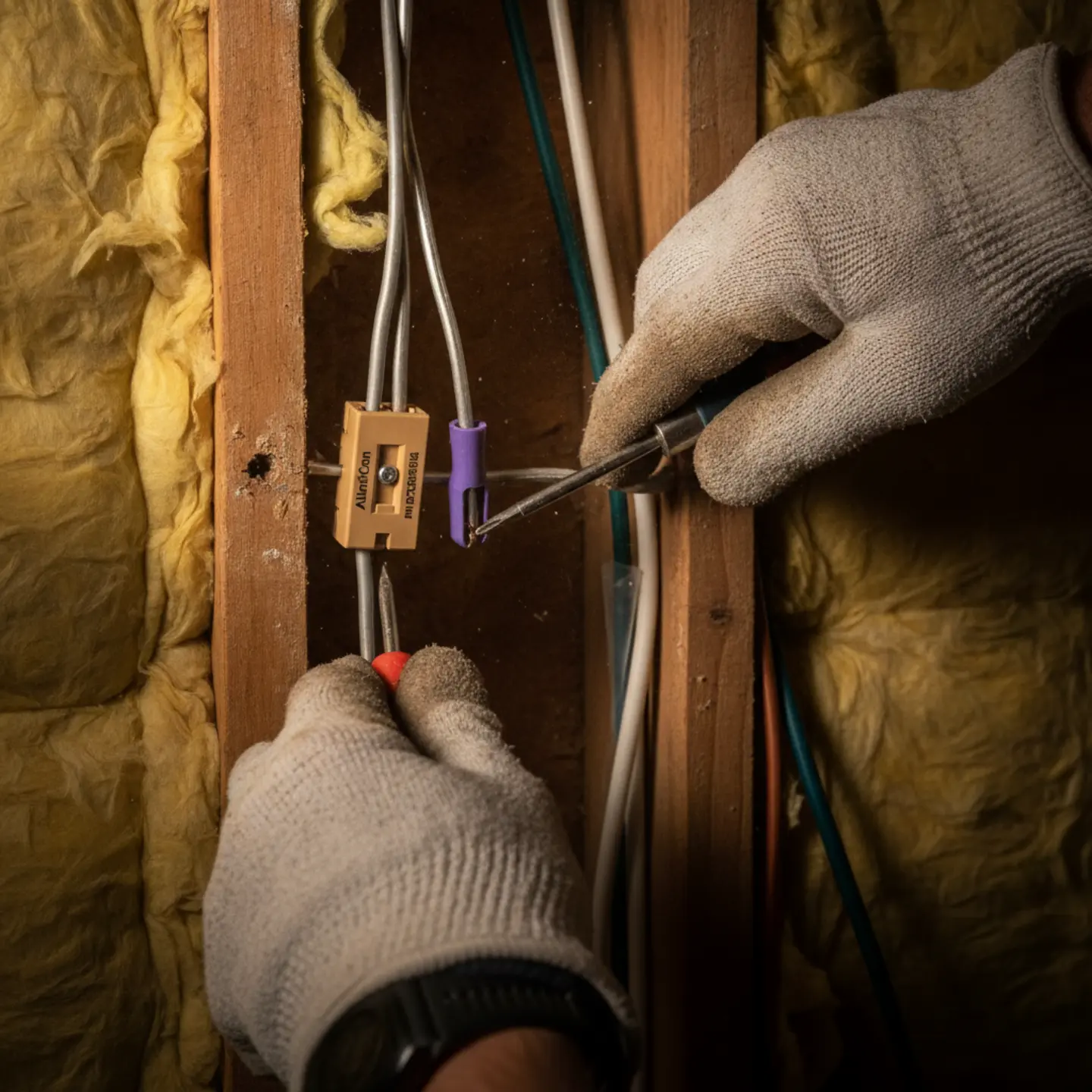
The design is straightforward: individual set screws compress each wire independently inside the connector body. This matters because it eliminates the differential expansion problem that causes twist-on connectors to loosen. Aluminum expands and contracts at a different rate than copper — a phenomenon called cold creep — and over years of thermal cycling, a twist-on connection loses its grip. AlumiConn’s mechanical compression doesn’t rely on friction. It holds.
Proper installation requires a torque screwdriver set to the manufacturer’s specification, exact wire stripping length, and anti-oxidant compound applied to the aluminum wire. When these steps are followed correctly, AlumiConn connectors have a very low documented failure rate. A typical whole-home remediation on a 1960s-era DFW home requires 150–300+ connectors depending on the electrical layout. For a deeper look at how AlumiConn compares to other connector options, see our AlumiConn vs. other connectors comparison.
Purple Wire Nuts (AL-Rated Twist-On Connectors): Why the CPSC Warns Against Them
Purple wire nuts — the most common being the Ideal Industries Twister® Al/Cu Model 65 — are UL-listed for aluminum-to-copper connections. That’s the fact some contractors use to justify recommending them. Here’s what they leave out: the CPSC explicitly warns against relying on them for comprehensive remediation. UL listing and CPSC recognition are not the same thing, and for aluminum wiring, that distinction is the entire ballgame.
The failure mechanism is well-documented. Aluminum’s cold creep properties cause the wire to slowly deform under the pressure of the twist-on connector’s spring mechanism. Over years of heating and cooling cycles, the connection loosens. Increased resistance follows. Then overheating. Then arcing. Electrician forums and fire investigation reports contain consistent accounts of melted purple wire nuts and charring at connection points — not rare edge cases, but a documented pattern that’s exactly why the CPSC drew the line where they did.
The practical consequences in Texas are immediate: purple wire nut remediation jobs fail city inspection, get rejected by insurers, and often require full re-remediation before a home sale can close. FHA and VA loans frequently require CPSC-approved documentation before funding. If you’re in the middle of a real estate transaction in DFW, this is not a theoretical concern — it’s a closing condition. Our aluminum wiring guide for real estate agents in Bedford covers exactly how this plays out at the negotiating table.
⚠️ Beware of Contractors Pushing Purple Wire Nuts as a ‘Quick Fix’
Some contractors may recommend purple wire nuts because they’re cheaper and faster to install. Don’t fall for it — they will fail city inspection, be rejected by insurers, and leave your home at fire risk. Insist on CPSC-approved AlumiConn remediation from a TECL-licensed contractor.
AlumiConn vs. Purple Wire Nuts: Head-to-Head Comparison
The CPSC’s research established that homes with aluminum branch circuit wiring from the 1965–1973 era are 55 times more likely to have fire-hazard conditions at connections than copper-wired homes. AlumiConn addresses that risk permanently. Purple wire nuts do not. Here’s how the two methods compare across every criterion that matters to a DFW homeowner.
| Criteria | AlumiConn Connectors | Purple Wire Nuts (AL-Rated) |
|---|---|---|
| CPSC Recognition | ✅ Officially recognized as a permanent repair (CPSC Pub. No. 516) | ❌ Explicitly warned against for permanent remediation |
| UL Listing | UL 486C — AL/CU branch circuit connections | UL 486C — AL/CU connections, but listing ≠ CPSC approval |
| Connection Stability | High — set-screw compression resists cold creep and thermal cycling | Low — twist-on spring mechanism loosens over time |
| Long-Term Failure Rate | Very low when installed per manufacturer specs | Documented pattern of overheating, arcing, and failure |
| Texas City Inspection | ✅ Accepted — passes under 2023 NEC requirements | ❌ Routinely rejected by DFW municipal inspectors |
| Texas Insurance Acceptance | ✅ Accepted by State Farm, Allstate, Farmers, USAA, Nationwide | ❌ Rejected by major Texas carriers; surcharges continue |
| Material Cost per Connector | ~$2.70–$5.00+ (2025 retail) | ~$0.50–$1.50 (2025 retail) |
| True Long-Term Cost | Lowest — permanent fix, no re-remediation, insurance savings | Highest — re-remediation required, ongoing insurance issues |
| FHA/VA Loan Compliance | ✅ Satisfies lender requirements with proper documentation | ❌ Does not satisfy FHA/VA remediation requirements |
“The CPSC found homes with aluminum wiring are 55 times more likely to have fire-hazard conditions at connections than copper-wired homes. AlumiConn addresses this permanently. Purple wire nuts do not.”
Why Epic Electrical Is the Right Choice for DFW Aluminum Wiring Remediation
Epic Electrical (TECL #33192) has been serving DFW since 2009. The team is a father-and-son operation — third-generation electricians with two master electricians and over 60 combined years of hands-on experience. Aluminum wiring diagnostics and CPSC-approved remediation aren’t a side service here; it’s work that requires exactly the kind of deep code knowledge and field experience that comes from decades of doing it right.
With 123+ five-star Google reviews, the track record speaks for itself. DFW homeowners consistently cite honest diagnosis and no surprise costs as the reason they call back and refer their neighbors. If there’s a cheaper fix for your situation, we’ll tell you — that’s not a marketing line, it’s how a family business that depends on referrals actually operates. You can read what customers say on our testimonials page.
Every aluminum wiring remediation job Epic handles includes permit management from start to finish. We pull the permit, schedule the city inspection, and make sure the work passes on the first visit — no re-work, no scrambling before a closing date. The remediation meets the 2023 NEC and you receive a formal Certification of Remediation letter that satisfies insurer documentation requirements. Financing is available for homeowners facing insurance deadlines or real estate transaction timelines where the investment needs to be spread out.
Get a free estimate from Epic Electrical — honest diagnosis, CPSC-approved remediation, and no upsells from a DFW electrical team that’s been doing this right since 2009.
Frequently Asked Questions: Aluminum Wiring Remediation in DFW
Is AlumiConn truly safer and more permanent than purple wire nuts?
Yes — unequivocally. AlumiConn connectors use individual set screws to compress each wire independently, creating a robust mechanical connection that resists cold creep and prevents oxidation at the joint. The CPSC officially recognizes AlumiConn as a permanent repair in Publication No. 516, while explicitly warning against purple AL-rated wire nuts due to their documented history of loosening, overheating, and failure. When installed correctly to manufacturer torque specifications, AlumiConn has a very low documented failure rate. Purple wire nuts do not offer the same long-term reliability under the thermal cycling conditions present in a live home.
Will aluminum wiring remediation satisfy my Texas homeowners insurance requirements?
Yes, if it’s done correctly using a CPSC-approved method and properly documented. Most major Texas insurers require a formal Certification of Remediation from a TECL-licensed electrician confirming that AlumiConn or COPALUM connectors were used, all identified connections were addressed, and the work passed city inspection. Standard purple wire nut remediation will not satisfy these requirements — carriers are specifically looking for CPSC-approved methods. Once you have that documentation in hand, most carriers will remove surcharges or reinstate standard coverage.
Can I still sell my house with aluminum wiring in DFW, or do I have to get it completely rewired?
You can legally sell a home with aluminum wiring in Texas, but you must disclose it — it’s a material defect under Texas real estate law. A full rewire is rarely necessary and is typically only warranted when the aluminum wiring itself is severely damaged throughout the home. CPSC-approved remediation with AlumiConn connectors is a permanent, insurance-accepted solution that makes your home electrically safe and significantly easier to sell. FHA and VA loans often require documented CPSC-approved remediation before they’ll fund, so if your buyer is using government-backed financing, this needs to be resolved before closing.
How much should I expect to pay for CPSC-approved aluminum wiring remediation in a typical DFW home?
For whole-house remediation using AlumiConn connectors in DFW, budget $3,000–$12,000, with a typical 1,800 sq ft home falling between $5,000–$8,500. Epic Electrical charges $90–$110 per outlet, switch, and fixture, which includes tamper-resistant upgrades and GFCI additions where required. If your panel also needs replacement — which is common in homes from this era — that’s a separate cost starting at $5,800 for a 200-amp panel change. For a more detailed breakdown by home size, see our aluminum wiring remediation cost guide for the Euless area.
What makes Epic Electrical different from other DFW electrical contractors for aluminum wiring remediation?
Epic Electrical (TECL #33192) brings two master electricians with over 60 combined years of experience to every aluminum wiring job — not journeymen supervised remotely, but licensed masters who understand the full scope of CPSC-approved remediation and current NEC requirements. With 123+ five-star Google reviews, the team has built a reputation on honest diagnosis and no upsells: if there’s a cheaper fix, we’ll tell you. We pull and manage all permits, ensuring your remediation passes city inspection on the first attempt and produces the Certification of Remediation your insurer requires. Epic has been serving DFW since 2009, and that kind of track record doesn’t come from cutting corners. Get a free estimate and discover the permanent, insurance-backed solution your home needs.
Ready for CPSC-Approved Aluminum Wiring Remediation in DFW?
Aluminum wiring isn’t something to defer — not when insurance carriers are declining policies and real estate transactions are on the line. Epic Electrical’s master electricians have been performing CPSC-approved AlumiConn remediation across North Richland Hills, Bedford, Hurst, Euless, Fort Worth, and the broader DFW metro since 2009. You’ll get a straight diagnosis, a written estimate with no hidden costs, and work that passes city inspection the first time.
Financing is available. Permits are handled. The Certification of Remediation your insurer requires is included.
Serving North Richland Hills, Fort Worth, Arlington, Hurst, Euless, Bedford, Keller, Southlake, Colleyville, Grapevine, Lewisville, Carrollton, Irving, Grand Prairie, and all of DFW.
Epic Electrical — TECL #33192 | (682) 478-6088
Pricing, equipment specifications, and project scope mentioned in this article are accurate as of the date of publication and are subject to change. Code requirements and permit needs vary by municipality and property. Please contact us directly for a current quote on your specific home or business.