Key Takeaways
- Most Common Issues — Tripping circuit breakers, flickering lights, outdated panels (Federal Pacific, Zinsco, Pushmatic), aluminum branch circuit wiring, and insufficient capacity for modern appliances and EV chargers are the top residential electrical problems DFW homeowners face in 2026.
- Real Cost Ranges — Repairs in the Dallas-Fort Worth market span from $75–$250 for outlet and breaker replacements to $2,500–$6,500 for panel upgrades and $8,000–$25,000+ for whole-home rewires — knowing these numbers protects you from overpaying.
- Fire Risk Is Real — NFPA data shows 34,000 home electrical fires occur annually in the U.S., causing 500 deaths and $1.5 billion in property damage; wiring failures account for 29% of those fires.
- License Verification Matters — Texas law requires a TECL license to perform residential electrical work; hiring an unlicensed contractor can void your homeowner’s insurance and leave you financially exposed if something goes wrong.
- Trust Epic Electrical for honest diagnosis, no-upsell repairs, and 50+ years of combined master electrician experience — visit Epic Electrical’s homepage to learn how a family-owned DFW team keeps your home safe.
What Are the Most Common Residential Electrical Issues Homeowners Face in 2026?
The most common residential electrical issues in 2026 include tripping circuit breakers, flickering lights, outdated or hazardous electrical panels, aluminum wiring, and insufficient capacity for modern appliances and EV chargers. These problems range from minor annoyances to serious fire hazards, with repair costs spanning from under $200 for a single breaker replacement to $25,000+ for a complete home rewire. Understanding what causes these issues, how much they typically cost in the DFW area, and when professional help is essential can save you money, prevent dangerous situations, and help you make smart decisions about your home’s electrical health.
Let’s break down the most prevalent electrical issues homeowners encounter, what drives them, the real costs involved in the Dallas-Fort Worth market, and the regulatory landscape that protects you.
Epic Electrical
Free Quote & Honest Diagnosis — No Upsells
Core Service Programs:
- Electrical Repairs, Wiring & Lighting for tripping breakers, faulty wiring, GFCI issues, and indoor/outdoor lighting
- EV Chargers, Generators & Panel Upgrades for Level 2 EV charging, whole-home generator installs, panel replacements, and surge protection
- Commercial, Warehouse & Industrial Electrical for restaurants, offices, industrial buildouts, LED retrofits, and dedicated circuits
Why Choose Epic Electrical:
- ✓ Trusted by customers with 123+ five-star Google reviews
- ✓ Father-and-son master electricians — a third-generation electrical family
- ✓ Serving North Richland Hills and the DFW Metroplex since 2009
- ✓ 50+ years of combined electrical experience on every job
- ✓ No upsells, no jargon, no pressure — we fix what’s actually broken
- ✓ Small repairs fixed same-visit; big jobs get a written quote with no hidden costs
- ✓ Texas-licensed electrical contractor (TECL #33192)
Local Market Context: Why DFW Homeowners Face Unique Electrical Challenges
Dallas-Fort Worth isn’t just big — it’s growing faster than almost any metro in the country. The region’s population was estimated at 8.1 million in 2023 and is projected to exceed 8.7 million by 2026, according to U.S. Census Bureau data. That pace of growth means constant demand for electrical upgrades, new installations, and repairs across a housing stock that ranges from brand-new construction to homes built in the 1950s.
A significant portion of DFW’s housing stock predates 1980. That matters because homes built before that era commonly feature outdated wiring systems — knob-and-tube, aluminum branch circuit wiring — and hazardous panels from brands like Federal Pacific Electric, Zinsco, and Pushmatic. These systems were never designed to handle the electrical loads of a modern household, let alone an EV charger or a whole-home smart system.
North Texas adds its own complications on top of aging infrastructure. Triple-digit summer temperatures put enormous strain on HVAC systems, which in turn overload electrical panels and trigger frequent breaker trips. Clay soil movement — common throughout Tarrant County — stresses underground conduits and can damage buried wiring over time, leading to ground faults that are difficult to diagnose without professional equipment.
EV adoption is accelerating the problem. Texas had over 150,000 registered electric vehicles by late 2024, and that number is climbing. A standard home outlet won’t cut it for daily EV charging — most owners need a dedicated 240V circuit, and many older DFW homes simply don’t have the panel capacity to support one without an upgrade. Add induction cooktops, tankless water heaters, and smart home hubs to the mix, and you can see why so many homeowners are hitting the limits of their existing electrical systems.
The 7 Most Common Residential Electrical Issues Explained
These are the problems that licensed electricians across DFW diagnose most often. Some are straightforward fixes. Others are serious fire hazards that require immediate professional attention. Knowing the difference is the first step toward making a smart, informed decision.
⚠️ Don’t Ignore Persistent Breaker Trips
Repeatedly resetting a tripped breaker without professional diagnosis is a fire hazard. Persistent tripping signals an overload or short circuit that requires immediate attention from a licensed electrician.
Issue #1: Tripping Circuit Breakers
A breaker that trips once when you plug in too many devices is doing its job. A breaker that trips repeatedly — especially when you haven’t changed anything — is telling you something is wrong. The cause is usually one of three things: an overloaded circuit (too many high-draw devices on one line), a short circuit (a fault in the wiring or an appliance), or a faulty breaker that’s worn out and trips prematurely. If the breaker feels hot to the touch or you smell burning near the panel, stop resetting it and call a licensed electrician. For persistent tripping issues, professional circuit breaker diagnosis and repair is the right next step.
Issue #2: Flickering or Dimming Lights
A flickering light is sometimes as simple as a loose bulb. But when multiple lights flicker simultaneously, or lights dim noticeably every time your AC kicks on, the problem runs deeper. Loose service neutral connections and faulty wiring inside the panel are common culprits — and both are serious. If flickering is accompanied by buzzing sounds or a burning smell anywhere in the house, treat it as an emergency. Don’t wait on this one.
Issue #3: Outdated or Hazardous Electrical Panels
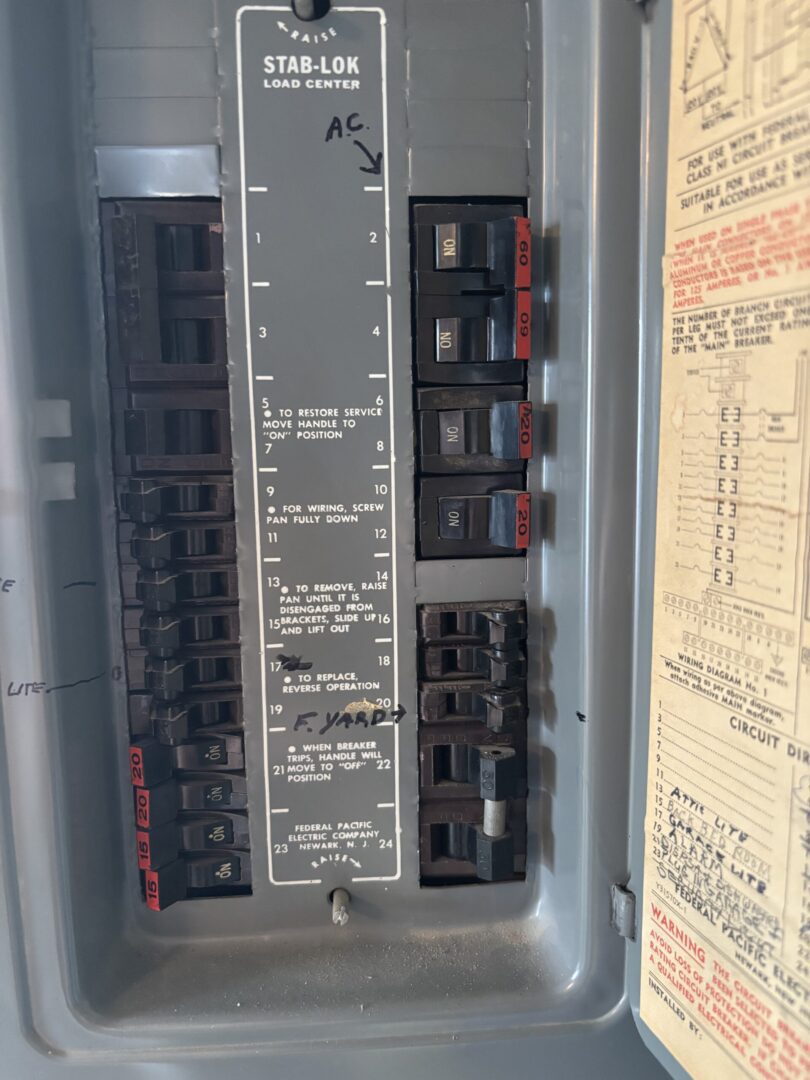
Federal Pacific Electric Stab-Lok, Zinsco, and Pushmatic panels share a dangerous design flaw: their breakers can fail to trip under overcurrent conditions. That means when a circuit is overloaded, the protection mechanism doesn’t activate — and the wiring overheats. The CPSC and NFPA both recommend replacement of these panels. If your home was built before 1985 and you’ve never had the panel inspected, it’s worth finding out what you have. A residential panel replacement eliminates this risk entirely.
Issue #4: Aluminum Branch Circuit Wiring
Homes built between 1965 and 1975 frequently have aluminum wiring running to outlets and switches. The problem is that aluminum oxidizes over time and expands and contracts with temperature changes more than copper does. This causes connections to loosen, which leads to arcing and overheating at outlets and junction boxes. The CPSC classifies unrepaired aluminum wiring as a significant fire hazard. Full rewiring is the safest long-term fix, but approved repair methods using COPALUM or AlumiConn connectors can mitigate the risk when a full rewire isn’t immediately feasible. Either way, this is work for a licensed electrician — electrical wiring repairs and maintenance should be handled by someone who knows aluminum wiring’s specific failure modes.
Issue #5: Insufficient Electrical Capacity
Older homes were designed for a fraction of today’s electrical load. A 100-amp panel that served a 1970s family just fine can’t safely support an EV charger, a tankless water heater, an induction range, and a smart home system running simultaneously. When you’re constantly tripping breakers or your electrician tells you the panel is at capacity, a panel upgrade is the answer — not more power strips. DFW panel upgrades from 100A to 200A typically run $2,500–$6,500 depending on the existing panel condition and service entry requirements. Use the panel upgrade cost calculator to get a ballpark before you call.
Issue #6: Faulty Outlets and Switches
Outlets that don’t hold plugs firmly, switches that control nothing, or receptacles that feel warm to the touch are all signs of wear or underlying wiring problems. Replacing a worn outlet is a minor repair. But if the outlet feels warm or sparks when you plug something in, the issue may be a loose connection or damaged wiring behind the wall — which is a different conversation. General electrical services cover outlet and switch replacement, but a good electrician will also check for wiring issues before calling the job done.
Issue #7: Grounding and Bonding Defects
Proper grounding gives fault current a safe path to earth, protecting you from shock and reducing fire risk. Older homes often have two-prong outlets with no ground wire at all. Post-renovation homes sometimes have grounding errors introduced during remodeling. GFCI outlets that trip constantly, outlets without ground holes, or a home inspection that flags grounding issues are all signals worth taking seriously. A licensed electrician can assess the grounding system and recommend the right fix — whether that’s adding ground wires, installing GFCI protection, or panel-level corrections.
Pricing and Costs for Common Electrical Repairs in DFW (2025–2026)
💡 Older Homes, Newer Demands
If you’re adding an EV charger, installing a tankless water heater, or expanding your smart home setup, your 1970s electrical panel probably wasn’t designed for that load. You’re not alone — thousands of DFW homeowners face the same capacity challenge. Financing options are available for larger projects.
| Repair / Service | DFW Cost Range (2026) | Notes |
|---|---|---|
| Single circuit breaker replacement | $100 – $250 | Excludes service call fee |
| Main breaker replacement | $200 – $400 | Excludes service call fee |
| Standard outlet or switch replacement | $75 – $150 per unit | Excludes service call fee |
| Smart / dimmer switch installation | $100 – $250 | Per unit, including materials |
| GFCI outlet installation | $120 – $250 | Per outlet, including materials |
| Panel upgrade (100A to 200A) | $2,500 – $6,500 | Varies by panel condition and service entry work |
| Whole-home rewire (1,500 sq ft) | $8,000 – $25,000+ | Highly variable; depends on home size and accessibility |
| EV charger installation (Level 2) | $800 – $2,500 | May require panel upgrade; permit required |
| Emergency / after-hours service call | $200 – $450 | Separate from repair costs; 50–100% premium over standard rates |
| Permit fees | $50 – $200+ | Varies by municipality and project scope |
DFW labor rates run at or slightly above the Texas state average, driven by high demand and a competitive market for skilled electricians. One cost homeowners frequently overlook: drywall repair after wire fishing. Electricians don’t typically include patching walls in their quotes, so budget for that separately on rewiring or new-circuit projects. If the cost of a panel upgrade or rewire is a concern, residential electrical project financing can spread the expense over manageable payments.
One more thing worth knowing: deferred repairs almost always cost more in the long run. Homeowners with known hazardous wiring — unaddressed aluminum wiring, Federal Pacific panels — can face insurance premium surcharges of 10–25% or even policy non-renewal. If an electrical fire occurs and the insurer can demonstrate you knew about the hazard and didn’t act, your claim may be denied entirely. The upfront cost of a repair is almost always less than the downstream consequences of ignoring it.
Regulatory Requirements and Licensing in Texas
Texas law is clear: electrical contracting work on residential properties must be performed by a business holding a Texas Electrical Contractor (TECL) license issued by the Texas Department of Licensing and Regulation (TDLR). To obtain that license, the company must employ at least one Master Electrician and carry a minimum of $300,000 in commercial general liability insurance. This protects you — if something goes wrong, there’s a licensed professional accountable for the work and insurance to cover damages.
💡 Verify Your Contractor’s License in 60 Seconds
Before hiring, visit https://www.tdlr.texas.gov/licensing.htm and search the contractor’s name or TECL license number. Check that the license is Active, verify the license class, and review any disciplinary history. This simple step protects you from unlicensed operators.
The current electrical code in most DFW municipalities is the 2023 National Electrical Code (NEC), though local jurisdictions can adopt it with amendments. Fort Worth, Arlington, and North Richland Hills each have their own permitting departments with specific requirements — what’s standard in one city may require additional steps in another. Always ask your contractor which code version applies to your project and confirm permits will be pulled before work begins.
Hiring an unlicensed contractor isn’t just a legal risk — it’s a financial one. If an unlicensed individual performs work that causes a fire or other damage, your homeowner’s insurance policy can deny the claim on the grounds that the work wasn’t performed by a licensed professional. The Texas Deceptive Trade Practices Act (DTPA) gives you legal recourse against contractors who misrepresent their credentials or breach their contracts, but recovering damages after the fact is far harder than verifying a license number before you hire. If you want to understand what a qualified electrician looks like and what questions to ask, the electrician hiring checklist is a practical starting point.
Safety Statistics and Why Proactive Electrical Maintenance Matters
Home electrical fires occur annually in the U.S., according to NFPA data — causing 500 deaths, 1,100 injuries, and $1.5 billion in property damage each year.
Wiring and related equipment account for 29% of residential electrical fires. Lighting equipment adds another 11%. Cords and plugs contribute 9%. These aren’t abstract statistics — they represent real homes where known hazards went unaddressed long enough to cause a fire.
Homes with Federal Pacific, Zinsco, or Pushmatic panels are at measurably higher risk. So are homes with unrepaired aluminum branch circuit wiring from the 1965–1975 era. The CPSC and NFPA have both issued guidance recommending repair or replacement for aluminum wiring — not because it always fails, but because the failure mode (arcing at connections) is unpredictable and the consequences are severe.
Beyond fire risk, there’s a financial case for proactive maintenance. Electrical fires typically result in total or near-total losses — claims that run into hundreds of thousands of dollars. Insurers are increasingly scrutinizing homes with known hazards. A panel upgrade that costs $4,000 today is a very different proposition when weighed against a denied insurance claim on a $400,000 home. Proactive electrical upgrades also increase buyer confidence and resale value, particularly in older DFW neighborhoods where buyers and their inspectors know what to look for.
For a deeper look at how overheating wiring develops and what warning signs to watch for, the guide to overheating home wiring in Fort Worth covers the topic in detail.
Questions to Ask Before Hiring an Electrical Contractor
The right contractor will answer every one of these questions without hesitation. The wrong one will hedge, deflect, or give you reasons why permits “aren’t really necessary” for your project.
- Ask for the TECL license number and proof of insurance before any work begins — then verify both at TDLR’s online lookup.
- Confirm the contractor will pull all required permits and clarify whether permit fees are included in the estimate.
- Ask about the warranty on parts and labor; reputable contractors typically offer one to five years.
- Request a detailed written estimate that breaks down labor, materials, and any additional fees — avoid vague lump-sum quotes.
- Ask how the contractor handles unforeseen code upgrade requirements that arise mid-project.
- Get a realistic project timeline and ask for references from recent clients.
Red flags to watch for: reluctance to provide a license number, claims that permits aren’t necessary, cash-only pricing, large upfront payments without a signed contract, and inability to explain the scope of work in plain language. After major storms, unlicensed “storm chasers” often appear offering quick repairs at low prices — always verify credentials before letting anyone work on your home’s electrical system. Be equally cautious of contractors offering “free” panel inspections who then push unnecessary replacements using scare tactics.
If you want to understand what the inspection process looks like and when a panel replacement is genuinely warranted versus oversold, the panel change decision guide walks through the real criteria.
Why Epic Electrical is the Right Choice for DFW Homeowners
Epic Electrical has been serving the Dallas-Fort Worth area since 2009 — not as a franchise, not as a private equity roll-up, but as a family business built by father-and-son master electricians with more than 50 years of combined experience. That combination of depth and accountability is hard to find in a market where skilled labor is in short supply and some contractors are more interested in upselling than actually diagnosing the problem.
The 123+ five-star Google reviews Epic Electrical has earned reflect something specific: homeowners who felt heard, got honest answers, and weren’t pushed toward repairs they didn’t need. When there’s a cheaper fix, the team says so. When a panel genuinely needs replacement, they explain exactly why — not with scare tactics, but with facts. That’s what it means to give options, not pressure.
As a Texas-licensed electrical contractor (TECL #33192) with full insurance coverage, Epic Electrical meets every legal and financial protection standard the state requires. Permits are pulled. Inspections are passed. Work is done to code — because that’s what protects you, not just during the repair, but when you sell the home or file an insurance claim years down the road. Whether you’re dealing with a tripping breaker in Fort Worth, a panel that’s maxed out in Arlington, or aluminum wiring flagged by a home inspector anywhere across the metroplex, the same team shows up with the same standard of work.
Get a free estimate from Epic Electrical today — honest diagnosis, no hidden costs, and a contractor you can actually trust with your home.
Frequently Asked Questions About Residential Electrical Issues
When do flickering lights indicate a serious electrical problem, and when is it just a minor annoyance?
Occasional, momentary flickers are often minor — usually a loose bulb or a high-draw appliance temporarily pulling power on a shared circuit. However, persistent flickering, dimming in multiple rooms simultaneously, or flickering accompanied by buzzing sounds or a burning smell can signal a serious issue like a loose service neutral connection, an overloaded circuit, or faulty wiring inside the electrical panel. These situations warrant immediate investigation by a licensed electrician. A loose service neutral in particular can cause dangerous voltage fluctuations throughout your home and should never be left unaddressed.
Is aluminum wiring in older homes really dangerous, and do I have to replace it?
Unrepaired aluminum branch circuit wiring — common in homes built between 1965 and 1975 — is considered a significant fire hazard by both the CPSC and NFPA. The core problem is that aluminum oxidizes, expands, and contracts differently than copper, causing connections to loosen over time and creating arcing and overheating at outlets and junction boxes. Full replacement (rewiring) is the safest long-term solution, but specialized repairs using CPSC-approved connectors like COPALUM or AlumiConn can meaningfully reduce the risk when a full rewire isn’t immediately feasible. Either way, this is not a DIY situation — have a licensed electrician inspect the wiring and advise on the appropriate repair method for your specific home.
How can I tell if my electrical panel needs to be replaced or just repaired?
Your panel likely needs full replacement if it’s a Federal Pacific Electric Stab-Lok, Zinsco, or Pushmatic — brands known for breakers that fail to trip under overcurrent conditions. Other replacement indicators include breakers that frequently trip and feel hot, rust or water damage inside the panel, or a panel that simply can’t support the electrical loads you need (like adding an EV charger or new high-draw appliances). A repair may be sufficient for a single faulty breaker or a minor wiring issue within an otherwise safe, up-to-code panel. A licensed electrician can perform a thorough inspection and give you a straight answer — not a sales pitch.
My circuit breaker keeps tripping. How can I identify the cause, and is it safe to just reset it?
A tripping breaker usually points to an overloaded circuit or a short circuit. Start by unplugging devices on that circuit — if it resets and holds, plug items back in one at a time to identify what’s drawing too much power. If the breaker trips immediately upon reset, or won’t reset at all, you likely have a short circuit, which is a more serious problem. Resetting a breaker once or twice is generally safe, but repeatedly resetting a breaker that keeps tripping is not — it bypasses the protection the breaker is designed to provide. If the problem persists, or if you notice a burning smell or the breaker feels hot, call a licensed electrician before resetting it again. For more detail on this specific issue, the circuit breaker won’t reset guide covers causes and solutions in depth.
What makes Epic Electrical different from other electrical contractors in DFW?
Epic Electrical stands out with 123+ five-star Google reviews, father-and-son master electricians with 50+ years of combined experience, and a track record of serving DFW homeowners since 2009. As a Texas-licensed electrical contractor (TECL #33192) with full insurance coverage, the team provides honest diagnosis with no upsells or hidden costs — if there’s a cheaper fix, they’ll tell you. Small repairs get handled same-visit. Larger jobs come with a written quote and no surprises. That commitment to transparency, local expertise, and accountability is why homeowners across the metroplex keep coming back and referring their neighbors. Request a free estimate from Epic Electrical today and experience the difference firsthand.
Ready to Resolve Your Home’s Electrical Issues in DFW?
Whether you’re dealing with a breaker that won’t stop tripping, an outdated panel flagged on a home inspection, or aluminum wiring you’ve been putting off addressing — you deserve straight answers and honest pricing. Epic Electrical’s father-and-son master electricians have been diagnosing and fixing exactly these problems across the Dallas-Fort Worth area since 2009. No upsells, no pressure, no hidden costs — just reliable work done right.
Get a free estimate and find out exactly what your home needs — and what it doesn’t.
Serving Fort Worth, Arlington, North Richland Hills, Keller, Southlake, Colleyville, Grapevine, Lewisville, and all of DFW.
Call us: (682) 478-6088
Pricing, equipment specifications, and project scope mentioned in this article are accurate as of the date of publication and are subject to change. Code requirements and permit needs vary by municipality and property. Please contact us directly for a current quote on your specific home or business.