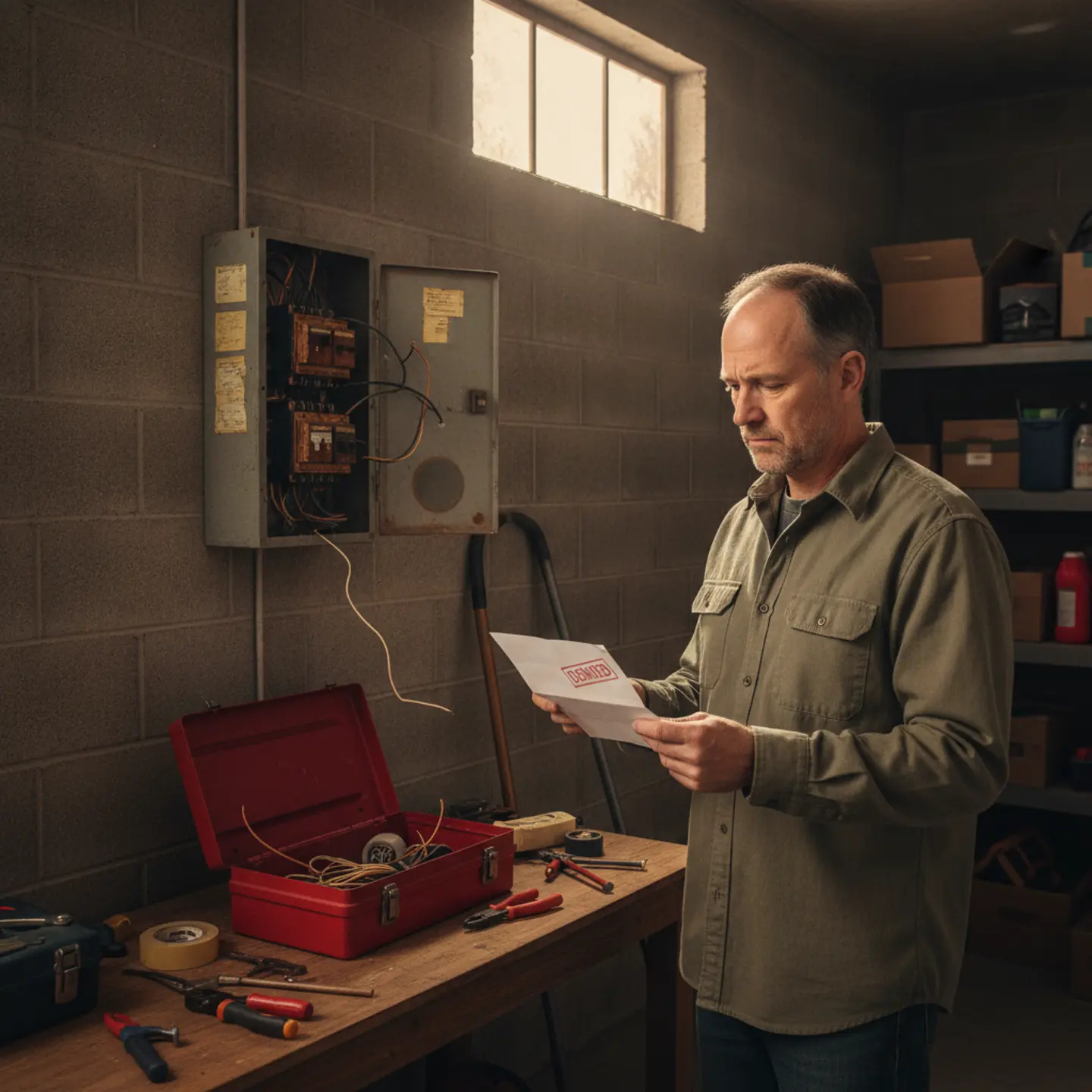
Key Takeaways
- Panel denial is a safety call, not an arbitrary rejection — Battery installers like Base Power deny panels when your home’s electrical service doesn’t meet minimum safety or capacity requirements, most commonly due to undersized amperage (60A or 100A), hazardous legacy brands like Federal Pacific or Zinsco, or insufficient bus bar space.
- Panel upgrades cost $2,500–$6,500 in DFW — That’s on top of Base Power’s $695 battery fee and $19/month membership, which do not cover electrical infrastructure upgrades. Budget for permits ($50–$500+) and any ancillary work as well.
- Delays can range from weeks to months — The full timeline from denial to resolved installation includes quotes, permit processing, the upgrade itself, and city inspection. Summer scheduling pressure in DFW makes this worse; winter upgrades move faster.
- Always verify TECL licensing before hiring anyone — Texas requires a Texas Electrical Contractor License (TECL) for panel work. Confirm any electrician’s active status at tdlr.texas.gov/LicenseSearch/ before signing a contract or letting work begin.
- Trust Epic Electrical for honest panel evaluations, licensed upgrades, and no-pressure guidance — father-and-son master electricians with 50+ years of combined experience and 123+ five-star Google reviews — visit Epic Electrical to get started.
What Does It Mean When Base Power Denies Your Panel for Battery Installation?
When Base Power (or any battery installer) denies your panel, it means your home’s existing electrical service panel doesn’t meet the safety or capacity requirements to safely integrate a backup battery system. This is a common issue in older DFW homes with undersized panels (60A or 100A), outdated brands like Federal Pacific or Zinsco, or insufficient space for new connections. The good news: it’s fixable with a licensed electrician’s panel upgrade, though it will delay your installation and add costs you need to understand upfront.
Understanding exactly why your panel was denied—and what your options are—is the first step to getting your backup power system installed and protecting your home against Texas grid stress.
Epic Electrical
Free Quote & Honest Diagnosis — No Upsells
Core Service Programs:
- Electrical Repairs, Wiring & Lighting for tripping breakers, faulty wiring, GFCI issues, and indoor/outdoor lighting
- EV Chargers, Generators & Panel Upgrades for Level 2 EV charging, whole-home generator installs, panel replacements, and surge protection
- Commercial, Warehouse & Industrial Electrical for restaurants, offices, industrial buildouts, LED retrofits, and dedicated circuits
Why Choose Epic Electrical:
- ✓ Trusted by customers with 123+ five-star Google reviews
- ✓ Father-and-son master electricians — a third-generation electrical family
- ✓ Serving North Richland Hills and the DFW Metroplex since 2009
- ✓ 50+ years of combined electrical experience on every job
- ✓ No upsells, no jargon, no pressure — we fix what’s actually broken
- ✓ Small repairs fixed same-visit; big jobs get a written quote with no hidden costs
- ✓ Texas-licensed electrical contractor (TECL #33192)
Why Battery Installers Deny Panels: The Most Common Technical Reasons
A panel denial isn’t a bureaucratic technicality. It’s a real safety call, and understanding the specific reason your panel was flagged helps you know exactly what needs to be fixed—and what it will take to get there.
The most common culprit is undersized service amperage. Homes built before 1980 frequently have 60-amp or 100-amp panels that were designed for a world of incandescent bulbs and window AC units. Today’s homes run high-capacity HVAC systems, large appliances, and increasingly, EV chargers. Adding a battery inverter’s charging and discharging load on top of all that is simply more than an older panel can safely handle.
Beyond raw amperage, installers look at bus bar capacity—the internal rail that distributes power to all your breakers. Battery systems back-feed power into the panel through a dedicated breaker, and the NEC’s 120% rule limits how much back-fed current a bus bar can safely accept. Even if your main breaker is adequately sized, an older or marginal bus bar can fail this test.
Then there are the hazardous legacy panel brands. Federal Pacific Electric (Stab-Lok), Zinsco, and Pushmatic panels have well-documented safety defects—breakers that fail to trip under overload conditions, creating serious fire hazards. No responsible installer will connect a battery system to one of these panels. If you have one, the panel needs to go before anything else happens. Our residential electric panel replacement service handles exactly this situation.
Other common denial triggers include double-tapped breakers (multiple wires sharing a single breaker terminal—a code violation and fire risk), lack of dedicated circuit space for the battery’s connection, clearance violations around the panel that make safe installation or future service impossible, and aluminum branch circuit wiring in the walls, which expands and contracts at connection points and creates overheating risks that compound when you add a battery load.
ℹ️ You’re Not Alone—Panel Denials Are Common in Older DFW Homes
A significant portion of DFW’s housing stock predates 1980, and many homes built in the 1960s–1970s have 60A or 100A panels that simply weren’t designed for modern electrical demands. If your panel was denied, you’re experiencing a widespread issue, not a unique problem.
What Panel Denial Costs You: The Real Price of Upgrades and Delays
Let’s talk numbers honestly, because this is where a lot of homeowners get blindsided.
A residential electrical panel upgrade in the DFW area runs $2,500 to $6,500 depending on amperage, scope of work, and whether ancillary work like new conduit, subpanel additions, or dedicated circuit runs are required. Most battery-compatible upgrades land in the $3,000–$5,000 range for a standard 200-amp service replacement. You can get a rough sense of what your situation might cost using our panel upgrade cost calculator.
On top of that, add permit fees. Every city in DFW has its own fee schedule—Dallas, Fort Worth, Plano, Frisco, and North Richland Hills all differ. Expect $50 to $500+ depending on your municipality and the scope of the permitted work. Inspections are typically bundled into the permitting process but add time to the overall timeline.
Here’s what Base Power’s pricing does and doesn’t cover. Their $695 one-time battery cost and $19/month membership cover the battery hardware, installation of the battery system itself, and lifetime maintenance of that system. What they do not cover is upgrading your home’s existing electrical infrastructure. That’s your responsibility, and it’s a separate project requiring a separate contractor.
For context on value: a traditional standalone battery system—Tesla Powerwall, Enphase, Franklin WH—runs $10,000 to $20,000+ installed in DFW. Even after a $4,000 panel upgrade, Base Power’s model can represent significant savings over a 5-year period. The math still works in Base Power’s favor for most homeowners; you just need to factor in the full picture from the start.
The other cost is time. From the day of denial to the day your battery goes live, you’re looking at several weeks to several months. That includes getting quotes, scheduling the upgrade, pulling permits, completing the work, passing inspection, and then re-scheduling with Base Power. If you’re in this for grid resilience after a close call with an ERCOT emergency, that delay matters.
If financing the panel upgrade is a concern, it’s worth knowing that options exist. Our residential electrical project financing guide walks through what’s available for homeowners in the DFW area.
The DFW Housing Stock Problem: Why Panel Denials Are So Common Here
If you’re frustrated by your denial, here’s some context that might help: you’re not in a unique situation. You’re in a very DFW situation.
A significant portion of DFW’s housing stock predates 1980. The average Dallas home was built in 1990—and that average is pulled upward by the massive wave of new construction in the suburbs. In established neighborhoods across Hurst, Arlington, Bedford, Euless, and North Richland Hills, 1960s and 1970s construction is the norm. Those homes came with 60-amp or early 100-amp panels that were adequate for the electrical demands of their era: a few lights, a window unit, a refrigerator, and a television.
Those panels were never designed to handle today’s loads—high-efficiency HVAC systems, tankless water heaters, EV chargers, smart home systems, and now battery backup. The gap between what those panels were built for and what modern life demands is exactly why panel denials happen so frequently in this market.
Winter Storm Uri in 2021 changed how a lot of DFW homeowners think about grid reliability. When millions of Texans lost power for days in subfreezing temperatures, the idea of backup power moved from “nice to have” to “necessary.” Then came the 2023 heat wave grid emergency, the January 2024 conservation notice, and the January 2026 winter storm that pushed outages past 90,000 homes. Each event drives another wave of homeowners toward battery systems—and into the panel compatibility problem that’s been sitting in their walls for decades.
Over 5,000 licensed electricians work in the DFW metro, but peak summer demand—when heat-stressed panels are failing across the region—can stretch scheduling significantly. If you’re dealing with a panel denial, the sooner you start the upgrade process, the better.
Licensing, Permits, and Regulations: What You Need to Know Before Hiring
This is the part of the process where homeowners sometimes get taken advantage of, so pay attention.
In Texas, any electrical panel upgrade must be performed by a contractor holding an active Texas Electrical Contractor License (TECL) from the Texas Department of Licensing and Regulation (TDLR). The company holds the TECL; the individual electricians hold Master or Journeyman licenses. The contractor must have a designated Master Electrician as their “master-in-charge” for the TECL to be valid. You can verify any contractor’s license status at tdlr.texas.gov/LicenseSearch/—look for “Active” status and “Electrical Contractor” license type.
Permits are not optional. Panel work in Tarrant County, Dallas County, and North Richland Hills all require permits, and the licensed contractor is responsible for pulling them. The permit process triggers a mandatory city or county inspection after the work is complete. Your panel cannot be legally energized and your battery cannot be installed until that inspection passes.
As of September 1, 2023, Texas enforces the 2023 National Electrical Code (NEC) statewide. For battery energy storage systems, the key articles are NEC Article 706 (Energy Storage Systems), which governs safety, disconnecting means, and overcurrent protection, and Article 480 (Storage Batteries). These aren’t technicalities—they’re the standards that ensure your battery system doesn’t become a fire hazard.
Base Power and any installation partners they use must also hold active TECL licenses for any electrical work they perform. Don’t assume—verify before work begins.
If something goes wrong, you have recourse. The TDLR handles complaints against licensed electricians. The Public Utility Commission of Texas (PUCT) handles complaints about retail electric providers like Base Power. And the Texas Deceptive Trade Practices Act (DTPA) provides additional consumer protections against misrepresented services or warranties.
How to Find the Right Electrician and Avoid Predatory Quotes
A panel denial puts you in a vulnerable position: you need work done, you need it done correctly, and you need it done before your battery installation can proceed. Some contractors know this and price accordingly. Here’s how to protect yourself.
Start with license verification. Before you call anyone, pull up tdlr.texas.gov/LicenseSearch/ and confirm the contractor holds an active TECL with a Master Electrician on staff. This takes two minutes and filters out a significant portion of unqualified operators immediately.
Ask specifically about battery-ready upgrades. Not every electrician has experience integrating panels with battery systems. Ask for references from previous battery or solar-ready panel upgrades. Ask what minimum amperage and specific panel requirements your battery system needs—a good electrician will have a direct, specific answer.
For energy storage expertise, look for NABCEP (North American Board of Certified Energy Practitioners) certification. It’s not required for panel work, but it signals the contractor understands how battery systems interact with your electrical infrastructure—which is exactly the knowledge you need here.
Get itemized quotes. Every quote should break out labor, materials, permit fees, and inspection costs separately. A quote that bundles everything into one number without explanation is a red flag. So is a contractor who minimizes your panel’s age or safety concerns, suggests they can “work around” issues without a proper upgrade, or offers to skip permits to save money.
⚠️ Red Flags: Avoid Unqualified Contractors and Unlicensed Work
Some contractors may offer cheap panel upgrades without proper TDLR licensing or city permits. This is dangerous—it voids warranties, creates code violations, and can cause serious safety issues. Always verify TECL licenses at tdlr.texas.gov/LicenseSearch/ before hiring.
The physical panel upgrade itself typically takes one day of work. The total timeline from first quote to passed inspection can be several weeks to a couple of months. If you’re scheduling during summer—June through September—expect longer lead times across the board. DFW electricians are stretched thin during peak heat season when older panels are failing across the region. If you have flexibility, a winter upgrade moves faster.
Homeowners in Hurst, Bedford, and Euless deal with this more than most—the 1960s and 1970s construction in those communities means undersized panels are the rule, not the exception. If you’re in one of these areas, budget for a full 200-amp upgrade from the start rather than hoping a smaller fix will suffice.
Your Next Steps: What to Do After a Panel Denial
Getting a denial feels like a dead end. It isn’t. Here’s the clear path forward.
- Contact Base Power immediately to clarify their specific process. Is your installation spot held while you complete the upgrade? Do you need to re-apply or re-schedule? Get this in writing.
- Request detailed documentation from Base Power explaining the specific technical reasons for the denial—panel brand, amperage, bus bar capacity, or other issues. You’ll need this when talking to electricians.
- Get quotes from at least 2–3 TECL-licensed electricians. Use the denial documentation to get apples-to-apples quotes. Ask each one: “What is the minimum amperage and specific configuration required to be compatible with my battery system?”
- Confirm permit and inspection handling. Every quote you accept should include the contractor pulling all necessary permits and coordinating city inspections. If a contractor says you don’t need permits, walk away.
- Budget the full cost: panel upgrade ($2,500–$6,500) + permits ($50–$500+) + any ancillary work. Don’t get caught by a low initial quote that balloons when conduit or subpanel work is added.
- Schedule strategically. If your timeline allows, a winter upgrade (December–February) typically means shorter wait times and less scheduling pressure than a summer job.
- Once the upgrade passes inspection, contact Base Power to re-schedule your battery installation. Confirm what documentation they need from your electrician or the city inspector.
💡 Pro Tip: Schedule Your Panel Upgrade During Winter for Faster Service
Winter (December–February) is the slowest season for electrical work in DFW, meaning shorter wait times and potentially faster scheduling. If you can delay your battery installation until winter, you’ll likely get your panel upgrade completed faster and with less scheduling pressure.
The panel installation process doesn’t have to be overwhelming. With the right contractor, clear documentation, and a realistic timeline, most homeowners move from denial to battery-ready panel in a matter of weeks.
Why Epic Electrical Is the Right Choice for DFW Panel Upgrades and Battery Compatibility
We’re a father-and-son master electrician team based in North Richland Hills, and we’ve been doing this work in DFW since 2009. Between us, we have over 50 years of combined electrical experience—and a significant portion of that has been spent upgrading exactly the kind of older panels that get denied for battery installations.
We hold Texas Electrical Contractor License TECL #33192. We pull every permit, coordinate every inspection, and handle all code compliance so you don’t have to navigate that process alone. When the inspector comes out, we’re there. When the city has questions, we answer them. You get a panel that passes, period.
Our 123+ five-star Google reviews from DFW homeowners reflect something we’re genuinely proud of: we tell people the truth. If a cheaper fix exists—if your panel doesn’t actually need a full replacement to become battery-compatible—we’ll tell you that. If your panel is a Federal Pacific that needs to go regardless of the battery, we’ll explain exactly why and what it takes to replace it safely. No upsells, no manufactured urgency, no hidden costs in the final invoice.
We know the DFW housing stock. The 1960s ranch homes in Hurst and Bedford. The 1970s brick houses in Arlington and Euless. The 1980s builds across Fort Worth and Arlington that are right on the edge of needing an upgrade. We’ve upgraded hundreds of these panels for battery readiness and modern electrical demands, and we know how to do it right the first time.
Contact Epic Electrical for a free estimate and honest assessment — no pressure, no hidden costs, just a straight answer about what your panel needs and what it will take to get your battery installation back on track.
Frequently Asked Questions About Panel Denial and Battery Installation
What exactly does “panel denied” mean when a battery installer rejects my home?
Panel denial means your home’s existing electrical service panel doesn’t meet the safety or capacity requirements for a battery system installation. Common reasons include undersized amperage (60A or 100A panels), outdated panel brands like Federal Pacific or Zinsco with known safety defects, insufficient bus bar capacity to accept back-fed power from the battery inverter, or lack of physical space for new dedicated connections. It’s a real safety issue, not an arbitrary rejection—and it’s fixable with a licensed electrician’s panel upgrade.
Do I have to pay for the electrical panel upgrade if Base Power denies my installation?
Yes, the homeowner is typically responsible for the cost of any required electrical panel upgrade. Base Power’s $695 battery cost and $19/month membership cover their battery system, its installation, and lifetime maintenance of the battery—but they generally do not include major upgrades to your home’s existing electrical infrastructure. You’ll need to hire a separate TECL-licensed electrical contractor to perform this foundational work, and you should budget $2,500–$6,500 for the upgrade plus permit fees on top of that.
How long will a panel upgrade delay my battery installation?
A panel upgrade can introduce delays ranging from several weeks to several months. This timeline includes obtaining quotes from multiple contractors, scheduling the electrician (which can be extended during peak summer demand in DFW), navigating city permits and approvals, the actual physical upgrade work (typically one day), and mandatory municipal inspections before the panel can be energized. Once the panel passes inspection, you’ll need to re-schedule with Base Power for the battery installation. Planning ahead and choosing an experienced contractor can meaningfully reduce this timeline.
What should I look for when hiring an electrician to upgrade my panel for a battery system?
Verify the contractor holds an active Texas Electrical Contractor License (TECL) at tdlr.texas.gov/LicenseSearch/ and has a designated Master Electrician on staff. Look for NABCEP certification in energy storage, which indicates specialized knowledge in battery and solar integration. Request references for similar battery-ready panel upgrades, and ask specifically what amperage and configuration your battery system requires. Get itemized quotes that separate labor, materials, permits, and inspections—and avoid any contractor who suggests skipping permits or minimizes concerns about your panel’s age or brand.
Why should I choose Epic Electrical over other electricians for my panel upgrade?
Epic Electrical brings 50+ years of combined master electrician experience, 123+ five-star Google reviews from DFW homeowners, and deep hands-on expertise in upgrading older DFW homes for battery compatibility. As a TECL-licensed contractor (TECL #33192) serving DFW since 2009, we handle all permits, inspections, and code compliance—you don’t have to navigate any of that alone. We provide honest diagnosis with no upsells: if your panel needs upgrading, we explain exactly why and what it takes; if a less expensive fix exists, we’ll tell you that instead. Contact Epic Electrical for a free estimate and honest assessment of your panel’s battery compatibility.
Ready to Get Your DFW Panel Upgraded for Battery Compatibility?
A panel denial doesn’t have to derail your backup power plans. With the right licensed electrician, a clear timeline, and honest pricing, most DFW homeowners move from denial to battery-ready in a matter of weeks. We’ve done this hundreds of times across North Richland Hills, Fort Worth, Arlington, Hurst, Bedford, and the surrounding communities—and we’ll give you a straight answer about exactly what your panel needs.
No pressure. No upsells. Just an honest evaluation from master electricians who know DFW’s housing stock inside and out.
Serving Fort Worth, Arlington, North Richland Hills, Hurst, Bedford, Euless, Keller, Colleyville, Southlake, Grapevine, Lewisville, and all of DFW
Pricing, equipment specifications, and project scope mentioned in this article are accurate as of the date of publication and are subject to change. Code requirements and permit needs vary by municipality and property. Please contact us directly for a current quote on your specific home or business.