Inspector Flagged Your Gas Pipe Bonding? Here’s What It Means — and What It Costs to Fix in DFW
⚡ Key Takeaways
- Gas pipe bonding is an electrical repair — even though it’s about your gas line, a licensed electrician is who fixes it.
- CSST is the most flagged type — that flexible yellow gas tubing in newer homes requires specific bonding and is the #1 reason inspectors write up gas piping.
- It’s a real safety issue — unbonded gas piping can become electrically energized during a lightning strike or from stray current, creating fire and explosion risk.
- The fix is usually straightforward — adding a bonding conductor from the gas piping back to the electrical panel or grounding system.
- Texas inspectors know this code cold — if it gets flagged on an inspection report, it will need to be corrected before closing or before a certificate of occupancy is issued.
- Cost is typically modest — most bonding repairs in DFW homes run between $150–$400 depending on access and what’s already in place.
- Don’t let it delay your closing — this is a same-day repair for a qualified electrician. It’s not a big job when done right the first time.
The inspector handed you a report. You’re scanning through it and you see something about “gas piping not bonded” or “CSST bonding required.” Maybe they even wrote something like “gas system bonding conductor missing.”
And now you’re wondering — is this serious? Is this expensive? Why is an electrician involved with my gas line?
You’re not alone. Gas pipe bonding is one of the most commonly flagged items on home inspection reports in DFW — and it’s also one of the most misunderstood. Most homeowners have never heard of it until an inspector writes it up days before closing.
Here’s the good news: it’s a real safety issue that deserves to be fixed, but it’s not a disaster. It’s usually a straightforward repair. And once you understand what it is, the fix makes total sense.
Let’s break it down in plain language.
What Is Gas Pipe Bonding — and Why Does It Involve an Electrician?
Gas piping is metal. Metal conducts electricity. And in your home, electricity and gas pipes are closer together than most people realize — they share the same walls, run through the same utility spaces, and are both connected to your home’s infrastructure.
Here’s the problem: if your gas piping isn’t electrically connected to your home’s grounding system, it can become energized. That means stray electrical current — from a lightning strike, a wiring fault, or a utility surge — can put voltage on your gas pipes without any warning.
Energized metal + natural gas = an ignition hazard. That’s why bonding exists.
“Bonding” means connecting your gas piping to the electrical grounding system with a copper wire (called a bonding conductor). When everything is bonded together, all those metal components are at the same electrical potential. There’s no voltage difference between them, and no opportunity for an arc or spark.
⚡ Bonding vs. Grounding — What’s the Difference?
Grounding provides a safe path for fault current to return to the earth — like a ground rod driven into the soil. Bonding connects metal components together so they’re all at the same electrical potential and can’t develop a dangerous voltage difference between them. Gas pipe bonding is about bonding. The ground rod provides the earth reference. They work together — but they’re not the same thing. If you want to understand more about grounding infrastructure, see our guide on what a ground rod actually does in your home’s electrical system.
What Is CSST — and Why Is It Always the One Getting Flagged?
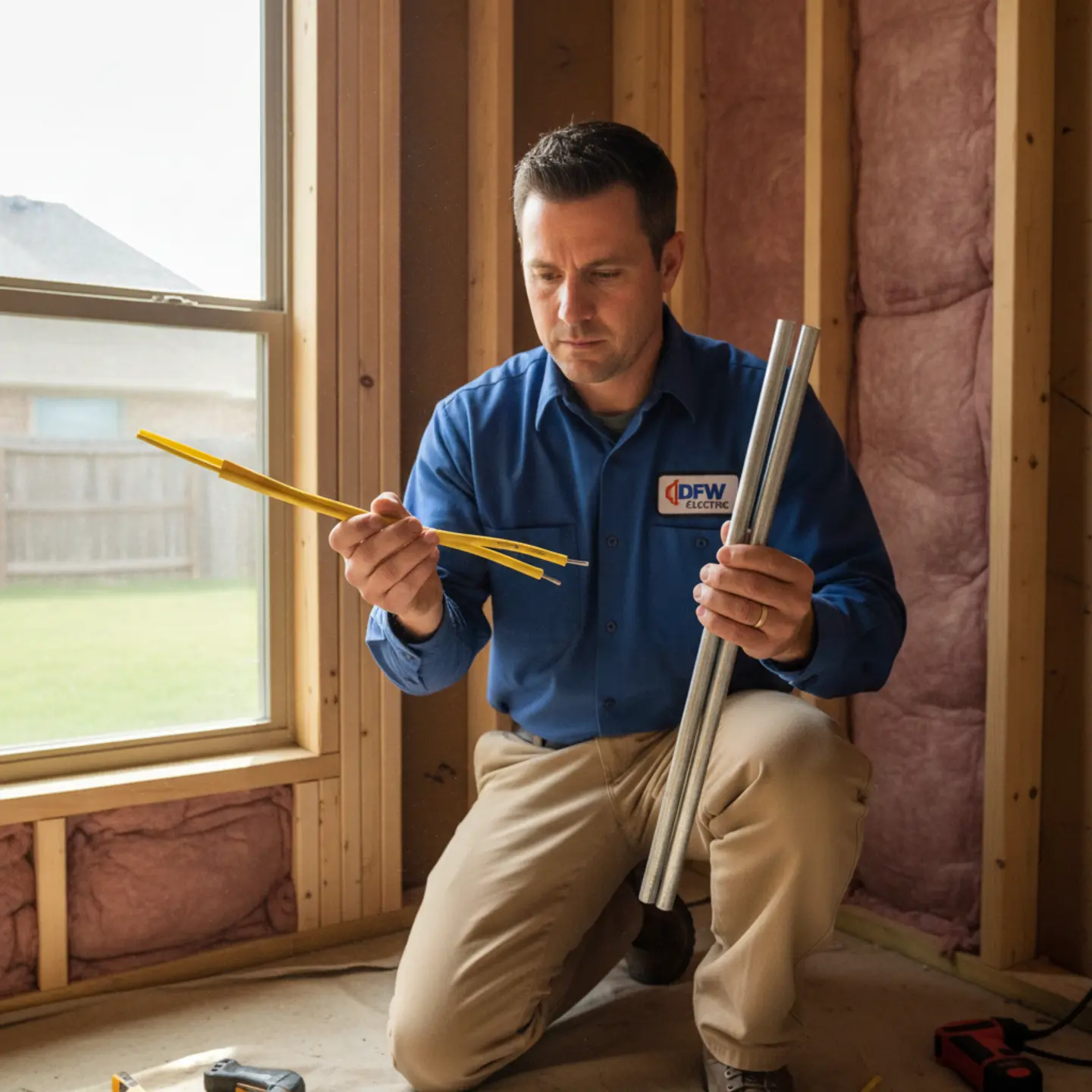
If you’ve had your home built or remodeled in the last 30 years, there’s a good chance you have CSST — Corrugated Stainless Steel Tubing — somewhere in your gas system.
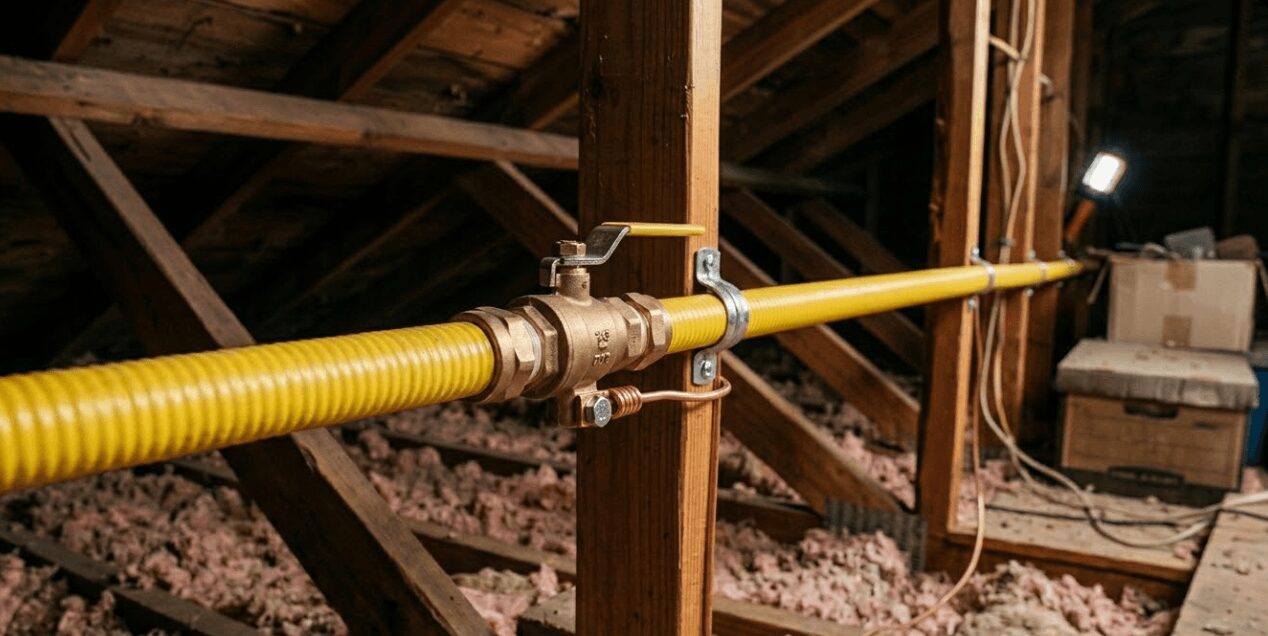
CSST is that flexible, accordion-style tubing with a bright yellow jacket. It replaced a lot of the traditional black iron pipe in residential construction because it’s faster and easier to install, more flexible around structural elements, and better at surviving seismic movement.
But CSST has one important weakness: it has a thinner wall than rigid iron pipe. And that thin wall is more susceptible to puncture from an electrical arc caused by a nearby lightning strike.
In the early 2000s, several house fires were traced back to CSST that had been perforated by lightning-induced arc events. The gas that escaped ignited. Codes were updated nationally. CSST manufacturers issued new installation requirements. And bonding became mandatory for all CSST installations.
Today, when a home inspector or code inspector sees CSST in a home and doesn’t see proper bonding, they flag it. Every time. It’s not optional, and it’s not something they can overlook on a report.
🔴 Common Inspector Write-Up Language You Might See
Here are exact phrases inspectors use on reports — all of them mean the same thing: your gas piping needs an electrician.
- “CSST gas piping not bonded per manufacturer requirements”
- “Gas system bonding conductor missing or improper”
- “Flexible gas tubing requires bonding — refer to licensed electrician”
- “Gas piping bonding not in compliance with NEC 250.104(B)”
- “CSST requires equipotential bonding — correction required”
- “Corrugated stainless steel tubing — bonding conductor not observed”
What Code Actually Requires — Without the Jargon
Here’s the short version of what the code says:
The National Electrical Code (NEC) Section 250.104(B) requires that gas piping systems be bonded to the electrical service grounding system. The bonding conductor has to be sized correctly based on the size of your electrical service — usually a #6 AWG copper wire for most residential services.
On top of the NEC, CSST manufacturers each publish their own installation requirements that specify exactly where and how bonding connections must be made. These manufacturer requirements have the force of code once the product is installed. Inspectors check both.
In Texas, both the NEC and the International Fuel Gas Code (IFGC) apply to residential construction. The IFGC also addresses gas piping bonding. When a Texas home inspector or city inspector flags gas bonding, they’re referencing one or both of these.
💡 The Two-Part Rule for CSST
For most CSST installations, bonding is required at two points: (1) a connection to the electrical grounding system at or near where the gas enters the home, and (2) bonding of the CSST system itself at a fitting or connection point. The exact requirements depend on the CSST manufacturer — TracPipe, Gastite, OmegaFlex, and CounterStrike all have slightly different specs. A licensed electrician familiar with CSST will know which applies.
If you want to understand how permits factor into all of this, our post on electrical work that requires a permit in Texas covers when a bonding repair needs a permit and when it doesn’t.
What a Proper Gas Pipe Bonding Installation Looks Like
When an electrician comes out to bond your gas system, here’s what actually happens:
Step 1: Identify the Gas Entry Point
The electrician locates where the gas service enters the home — usually near the meter on the exterior and then through the wall to the interior gas distribution. This is almost always where the main bonding connection is made.
Step 2: Find the Grounding Electrode Conductor or Panel Ground
The bonding wire has to connect back to the electrical grounding system. This is typically the main electrical panel’s grounding busbar, the grounding electrode conductor that runs to the ground rod, or the cold water pipe (which is itself bonded). Your electrician will determine the correct and most accessible bonding point.
Step 3: Install the Bonding Conductor
A properly sized copper wire (usually #6 AWG) is run from a listed bonding clamp on the gas piping to the grounding system. The clamp has to make a solid, metallic connection to the gas pipe — not to a painted surface or a fitting that could create a high-resistance joint.
Step 4: Verify Continuity
A good electrician will verify the bond with a meter — confirming that the gas piping system and the electrical grounding system are now at the same potential. This is the test that actually confirms the work is done correctly, not just cosmetically.
✅ What a Completed Bonding Job Looks Like
After a proper gas pipe bonding repair, you’ll see a bare or green copper wire — typically #6 AWG — securely clamped to the gas piping near the meter or at a fitting close to the entry point, running to the grounding system. The clamp will be a listed, corrosion-resistant fitting designed for this purpose. It should look intentional and professional, not like an afterthought. If someone uses a random screw clamp and a piece of leftover wire, that’s not the right way to do this.
What About Rigid Black Iron Gas Pipe?
If your home has traditional black iron (rigid steel) gas pipe instead of CSST, the same bonding rules apply — but there’s one key difference: black iron is less susceptible to lightning-induced arc perforation because of its thicker walls.
That doesn’t mean it gets a pass. Black iron gas piping still needs to be bonded per NEC 250.104(B). If an inspector flags your rigid pipe system for bonding, the fix is the same as for CSST — a bonding conductor run from the piping to the grounding system.
In North Texas, most homes built before 1990 used black iron pipe throughout. Homes built from the mid-1990s onward increasingly used CSST for at least part of the system — and many older homes had CSST added during remodels or appliance upgrades. DFW inspectors look for both, especially during real estate transactions where the home has had multiple owners and remodel work over the years.
Signs This Might Be an Issue in Your Home
Even if you’re not in the middle of a home sale, it’s worth knowing whether your gas piping is properly bonded. Here’s what to look for:
✅ Signs Your Gas Piping May Not Be Bonded:
- You have CSST (flexible yellow-jacketed gas tubing) anywhere in the home and don’t recall an electrician ever working on the gas system
- Your home was built between 1990 and 2010 — the period when CSST was widely installed but bonding requirements were still evolving
- You’ve had remodel work done where gas lines were added or extended and the electrical permit wasn’t pulled
- You can trace your gas piping from the meter and don’t see any copper wire clamped to it running toward the electrical system
- A previous inspection flagged it — even if you didn’t address it at the time
- You’ve had unexplained electrical issues like flickering lights or breakers tripping that were never fully explained
For more on what grounding problems can look like from an electrical standpoint, our post on signs of bad grounding in DFW homes covers symptoms you can actually observe without being an electrician.
How Much Does Gas Pipe Bonding Cost in DFW?
This is the question everyone wants answered before they call anyone. Here’s an honest breakdown:
Typical Gas Pipe Bonding Cost in DFW
For most single-family homes with accessible gas entry points and an existing grounding system in good condition. This covers labor, materials, and the bonding conductor installation.
| Scenario | Estimated Cost | Why |
|---|---|---|
| Simple bonding — accessible pipe, panel nearby | $150–$250 | Short wire run, easy access, straightforward clamp installation |
| Standard bonding — typical DFW single-family home | $200–$350 | Average wire run, panel is reasonable distance from gas entry |
| Complex bonding — long wire run, attic/crawl access required | $300–$450 | More labor for wire routing, harder access points |
| Bonding + grounding deficiencies (ground rod issues) | $350–$600+ | If the grounding system itself needs repair before bonding can be added |
⚠️ Watch Out for This
If you get a quote that includes a full “electrical inspection” and a list of $2,000+ in work just to bond a gas line — that’s a red flag. Gas pipe bonding is a focused repair. An honest electrician will look at your specific situation, quote you the bonding work, and tell you separately if they notice anything else that needs attention. They won’t use a bonding call as a backdoor into a high-pressure upsell. That’s not how we operate, and it’s not how good electrical contractors operate.
Gas Pipe Bonding and Home Inspections in Texas: What You Need to Know
If you’re selling a home, buying a home, or dealing with a failed inspection, here’s what matters:
If You’re Selling
Get this fixed before it shows up on the buyer’s inspection report. A bonding flag on an inspection report creates negotiating leverage for the buyer, can delay closing, and always looks worse than it actually is. A $200 repair that was done proactively is infinitely better than a $200 repair that shows up as a deficiency.
If You’re Buying
If the seller’s disclosure didn’t mention gas piping and the inspector flagged it, this is a legitimate repair request. It’s not a massive negotiating point, but you are entitled to have it corrected. Make sure whoever fixes it is a licensed electrician — not a handyman, not a plumber, not the seller’s cousin who “knows electrical.”
If You Had a Failed Re-Inspection
If a city inspector flagged this during a permit inspection or a certificate of occupancy process, the fix needs to be documented and verified by re-inspection. Make sure your electrician knows this upfront so they can provide the right documentation.
DFW home inspectors are well-trained on CSST bonding. The Dallas-Fort Worth area has a large concentration of homes built during the CSST era (1990s–2010s), and bonding issues are extremely common. This is not an obscure code violation that inspectors are reaching for — it’s something they specifically look for every time they see yellow flexible gas tubing.
Can a Plumber Do This? What About a Gas Company?
No, and no. Bonding gas piping is an electrical repair. A plumber can install or move gas lines, but they cannot legally perform the electrical bonding connection. A gas company can check for gas leaks and service their meter — but the bonding conductor connects the piping to the electrical grounding system, which is entirely outside their scope.
You need a licensed electrician for this. And in Texas, that means someone holding a valid TECL license (Texas Electrical Contractor License). If a non-electrician does this work and it’s discovered during a future inspection or after a fire, the insurance implications can be significant.
💡 Ask This When You Call
When you call an electrician about gas pipe bonding, ask: “Do you have experience with CSST bonding requirements and can you provide documentation of the repair?” A qualified electrician will answer that confidently. If they sound uncertain about what CSST is or what bonding entails, move on. This is a code-specific repair and it needs to be done by someone who knows the specs.
Does Gas Pipe Bonding Require a Permit in Texas?
This depends on the municipality. In most DFW cities, adding a bonding conductor to an existing gas system is classified as a minor electrical repair and may not require a permit. However, some jurisdictions do require one — especially if the work is being done in connection with a real estate transaction or a code compliance repair order.
The honest answer is: ask your electrician, and let them look up the local requirements. A good contractor will know whether your city requires a permit for this specific repair and will handle it correctly. If you’re in a situation where you need documentation of the repair for a real estate closing, your electrician should provide a written statement of work regardless of permit status.
For a broader look at what types of electrical work require permits in Texas, our guide on Texas electrical permit requirements is a good resource.
What About Arc-Resistant CSST?
Some newer homes have a type of CSST called arc-resistant CSST — the most common brand is TracPipe CounterStrike, which has a special polymer jacket that provides additional protection against lightning-induced arcing. This product has different bonding requirements than standard CSST.
Arc-resistant CSST still requires bonding at the system level (connecting the gas piping to the electrical grounding system), but the manufacturer’s requirements about bonding at individual fittings may be different. This is where it’s critical to have an electrician who actually knows CSST products — because applying the wrong bonding spec to the wrong product doesn’t actually fix the problem.
⚡ How to Tell What Type of CSST You Have
Standard CSST typically has a bright yellow jacket. Arc-resistant TracPipe CounterStrike has a black outer jacket over the yellow. If you see black-jacketed flexible gas tubing in your home, that’s likely CounterStrike. Gastite FlashShield is another arc-resistant option with a similar appearance. The bonding requirements differ between products, which is another reason to use an electrician who knows gas piping systems — not just someone who “bonds things.”
Frequently Asked Questions About Gas Pipe Bonding
Is unbonded gas piping immediately dangerous?
It’s a safety risk, not necessarily an emergency that means you can’t be in your home tonight. The risk becomes significant during a lightning strike or major electrical fault — those are the events that can cause enough current to arc through or perforate an unbonded gas pipe. That said, “not immediately dangerous” doesn’t mean it’s acceptable to leave it. Get it fixed promptly, especially in North Texas where thunderstorm season is real.
My home passed inspection when it was built — why is it flagged now?
Codes change. CSST bonding requirements have been updated multiple times since CSST became widely used in the 1990s. A home that passed inspection in 1998 or 2005 may not meet today’s requirements. Inspectors in real estate transactions check current code, not the code that was in effect when the home was built. This is extremely common in DFW for homes from that era.
Can I just remove the CSST and replace it with black iron pipe?
Theoretically yes, but that’s almost certainly more expensive, more disruptive, and unnecessary. Replacing working CSST with black iron just to avoid bonding it is like replacing your kitchen faucet because it has a small drip — when tightening a connection costs $80. Bond the CSST. It works. It’s code-compliant. It’s fast.
What if my home has a mix of CSST and black iron pipe?
Both systems need to be bonded, and if they’re connected to each other (which they likely are), a properly installed bonding conductor at the right point will bond both. Your electrician needs to trace the system to confirm continuity throughout. This is actually a very common situation in DFW homes — original black iron with CSST added for a new appliance or during a remodel.
How long does the repair take?
For most homes, this is a 1–2 hour repair. If the gas meter, electrical panel, and access points are all reasonably close and accessible, some jobs take under an hour. It’s genuinely not a big job when done by someone who’s done it before.
Do I need to turn off the gas for this repair?
No. The bonding conductor connects to the outside of the gas pipe — nothing is opened, cut, or penetrated. The gas line stays fully operational during the repair. This is an electrical connection to the exterior surface of the pipe, not a gas line modification.
Will this affect my homeowner’s insurance?
Having the bonding done correctly can only help. Some insurers, particularly after a lightning claim, will ask about the bonding status of CSST systems. Having documented, code-compliant bonding on file is protection — not a liability. An unbonded CSST system that suffers a lightning event could create coverage complications if the insurer determines the installation didn’t meet code requirements.
The Bottom Line: It’s a Real Fix, Not a Scary One
If an inspector flagged your gas pipe bonding, you now know what it actually means. It’s not a sign that your home is about to explode or that your whole gas system needs to be replaced. It means a licensed electrician needs to add a properly sized copper bonding conductor from your gas piping to your home’s grounding system.
It’s a focused repair. It takes a couple of hours. It’s code-required for a real reason. And when it’s done right, it’s done — you’re not coming back to it.
What you don’t want is to call someone who uses this as a reason to sell you things you don’t need. This is not a portal to a full electrical overhaul. It’s a bonding conductor. Get it done by someone who knows what they’re looking at, documents the work, and moves on.
That’s how we approach it. Come in, assess what’s actually there, fix what the code requires, explain what we did and why, and leave your home clean and safe. If we notice something else worth your attention, we’ll tell you — but we’re not going to use a gas bonding call to manufacture a problem list.
If you’ve got an inspection report with a gas bonding flag or you want to know whether your CSST is properly bonded before you list your home, give us a call. We’ll take a look, tell you exactly what’s needed, and take care of it the same day.
If you’re also wondering about broader electrical safety inspection issues in Fort Worth and DFW homes, or you’ve seen other flags on your report like arc fault breaker requirements or signs of home electrical problems, we can address all of it in one visit. No need to schedule three separate contractors for one report.
Call or Text: (682) 478-6088
Serving Fort Worth, Arlington, Keller, Southlake, Colleyville, Grapevine, Lewisville, and all of DFW