What Is a Ground Rod? A Homeowner’s Plain-English Guide to Electrical Grounding
⚡ Key Takeaways
- A ground rod is a metal rod driven into the earth — it gives excess or dangerous electricity a safe path out of your home instead of through you.
- Most homes are required to have at least two ground rods spaced at least 6 feet apart under current NEC code, though older homes may only have one.
- Ground rods are typically 8 feet long and made of copper-clad steel, driven nearly flush with the ground outside your electrical panel.
- A bad or missing ground rod is a real safety risk — it won’t show up as a tripped breaker or a flickering light. You won’t know until something goes wrong.
- Inspectors flag grounding problems regularly — especially on older DFW homes. It’s one of the most common issues we see when homes go up for sale.
- Ground rods and GFCI outlets work together — but they’re not interchangeable. One doesn’t replace the other.
- Most grounding repairs are straightforward — adding a ground rod or replacing a damaged one typically isn’t a major project or a major bill.
If a home inspector flagged your grounding, or your electrician mentioned that your ground rods need attention, you’re probably wondering: what exactly is a ground rod, and why does it matter?
That’s a fair question. The grounding system is one of those parts of your electrical system that works silently in the background — you never think about it when it’s doing its job. But when something goes wrong, the consequences can be serious.
Here’s the honest answer: grounding isn’t complicated to understand, and in most cases, fixing it isn’t a massive project. Let’s break it all down in plain English so you know exactly what you’re dealing with.
What Is a Ground Rod? (The Simple Version)
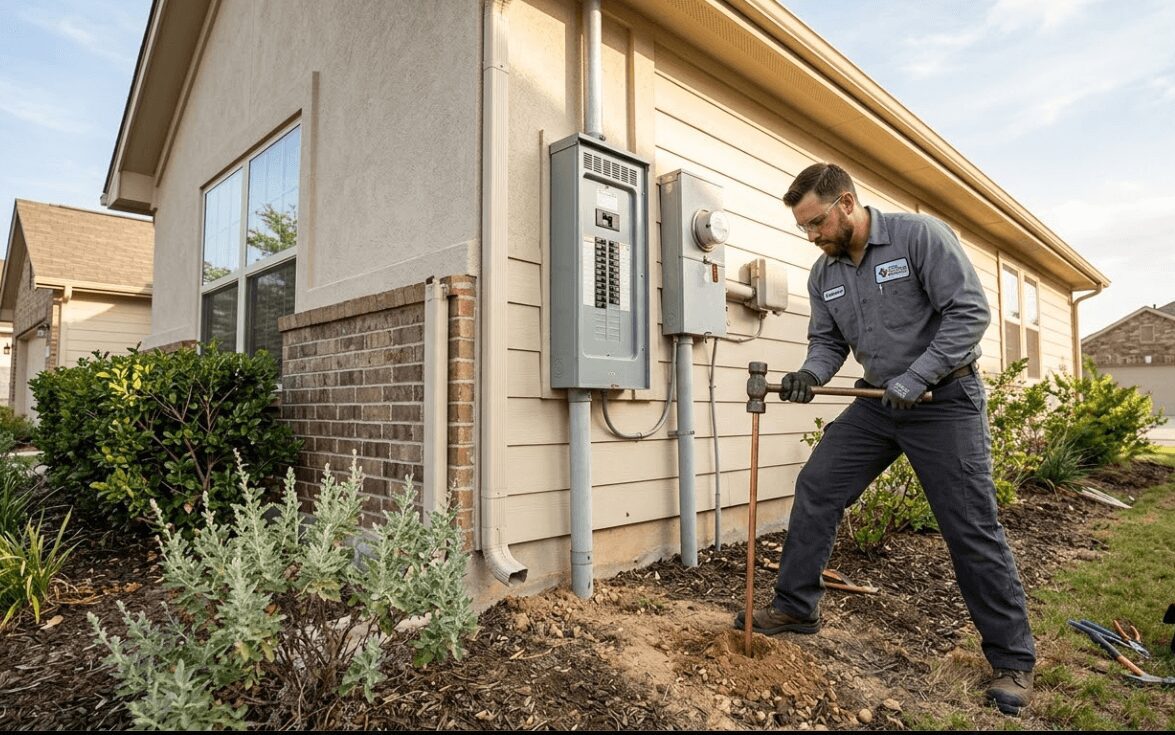
A ground rod — also called a grounding electrode — is a metal rod, usually 5/8 of an inch wide and 8 feet long, that gets driven into the earth near your electrical panel. A wire connects the rod to your home’s electrical system.
That’s it. A metal rod in the ground, connected to your house wiring.
But what it does is important. Think of it as an emergency exit for electricity. Under normal conditions, electricity flows through your home the way it’s supposed to — in through the hot wire, out through the neutral. But sometimes things go wrong: a power surge from a lightning strike, a wiring fault, a failing appliance. When that happens, excess voltage needs somewhere to go. The ground rod gives it a direct path into the earth — away from your outlets, away from your devices, and most importantly, away from you.
💡 Why “Ground”?
The word “ground” literally refers to the earth beneath your home. In electrical systems, the ground is always at zero voltage. Connecting your electrical system to the earth means that any dangerous excess voltage has a guaranteed low-resistance path to that zero-voltage reference — and that’s what keeps you safe.
What Does a Ground Rod Actually Do for Your Home?
The ground rod serves three main purposes, and all three matter.
1. It Protects You from Electric Shock
If a wire inside an appliance or your walls comes loose and touches a metal surface — a panel cover, an outlet box, an appliance chassis — that metal surface becomes energized. If you touch it, electricity flows through you to the ground. That’s a shock, and depending on the voltage, it can be deadly.
A properly grounded system changes that equation. The electricity follows the ground wire to the ground rod, which trips your breaker almost instantly. The metal surface never stays energized long enough to hurt you.
This is also why getting a shock from a light switch is worth taking seriously — it can be a sign that your grounding system isn’t doing its job.
2. It Stabilizes Voltage in Your Home
Voltage in the power grid fluctuates constantly. Your grounding system — which includes the ground rod — provides a reference point that helps keep that voltage stable inside your home. Without it, small fluctuations that are normally harmless can become damaging to sensitive electronics.
3. It Protects Against Lightning Surges
When lightning strikes near your home (or even your utility line), it can send thousands of volts surging through your electrical system in a fraction of a second. A proper grounding system — including your ground rods — gives that surge somewhere to go that isn’t your TV, your computer, or your appliances.
⚠️ Ground Rods and Surge Protectors Aren’t the Same Thing
A ground rod is part of your permanent grounding system. A whole-house surge protector adds an additional layer of protection for lightning and utility-side surges. Both have a role — one doesn’t replace the other.
Where Is the Ground Rod Located?
In most homes, the ground rod is driven into the earth directly outside the electrical panel — often right against the exterior wall of the house. A green or bare copper wire runs from the rod up through the wall and connects to the grounding bar inside your panel.
Some homes have ground rods in other accessible locations: near the meter base, at the corner of the house, or even in a utility room. You may also have what’s called a “cold water pipe ground” — an older method where the ground wire connects to the metal cold water supply pipe entering the home, using the buried pipe as a supplemental electrode.
In DFW, the expansive clay soil can actually affect how well a ground rod performs over time. Clay soil holds moisture, which generally helps conductivity — but it can also shift with temperature and drought cycles, which is why older ground rod connections sometimes loosen or corrode. It’s worth having them checked if your home is more than 20–25 years old.
Standard Ground Rod Depth
The NEC (National Electrical Code) requires ground rods to be driven at least 8 feet into the earth, or buried at least 2.5 feet horizontally if rock prevents full vertical installation.
What Are Ground Rods Made Of?
The most common ground rod is copper-clad steel — a steel core with a thin layer of copper bonded to the outside. The steel gives it strength for driving into hard Texas soil; the copper provides excellent conductivity and corrosion resistance.
You may also see:
- Solid copper rods — very corrosion-resistant but more expensive
- Galvanized steel rods — used in some areas, but not as corrosion-resistant as copper-clad
- Stainless steel rods — used in highly corrosive soils
The standard diameter is 5/8 inch for copper-clad and solid copper rods. Some local codes allow 1/2 inch for stainless steel.
How Many Ground Rods Does a Home Need?
This is where a lot of older homes fall short — and where home inspections flag problems most frequently.
Under current NEC (National Electrical Code) requirements, a home is required to have at least two grounding electrodes spaced at least 6 feet apart. That usually means two ground rods — though a metal underground water pipe, concrete-encased electrode (rebar in your foundation), or other approved electrode can count as one of the two.
Many homes built before the 1990s only have one ground rod. That was code-compliant at the time, but it doesn’t meet current standards — and it can become a flagged item on a home inspection when you go to sell.
💡 Selling Your Home in DFW?
Grounding deficiencies are among the most commonly flagged electrical issues during real estate inspections in the DFW area. If your report says “single ground rod,” “improper grounding electrode,” or “grounding electrode conductor not secured,” those are real items that buyers may ask you to fix. The good news: in most cases, adding a second ground rod is a relatively quick repair — not a major renovation.
Ground Rod vs. Ground Wire: What’s the Difference?
These two terms get confused a lot, so let’s clear it up.
The ground rod is the physical rod driven into the earth. It’s the destination for the grounding system.
The ground wire (also called the grounding electrode conductor, or GEC) is the wire that connects your electrical panel to that rod. It’s typically a bare copper wire, and it needs to be properly sized based on your service size — usually #4 AWG copper for a 200-amp service.
Inside your panel, there’s also a grounding bar (or ground bus) where the ground wires from all your circuits connect. That bar connects to the grounding electrode conductor, which runs to your ground rod.
All three components — the rod, the wire, and the connections — need to be in good shape for your grounding system to work correctly. A corroded connection or an undersized wire can make the whole system ineffective, even if the rod itself is perfectly driven.
⚠️ Neutral and Ground Are NOT the Same Thing
In your panel, neutrals and grounds connect to separate bars — and they should stay separate in your branch circuits. Mixing them up is called a “neutral-ground fault” and it’s a code violation that can cause shock hazards and nuisance tripping. This is a common mistake in DIY electrical work and a frequent inspection flag on older homes.
Signs Your Grounding System May Have a Problem
Here’s the frustrating part: a grounding problem often gives you no obvious warning signs. Your lights work, your outlets work, your breakers don’t trip — and you have no idea there’s an issue until something goes wrong, or until an inspector tells you.
That said, there are some signals worth paying attention to. Our full guide on signs of bad grounding in DFW homes covers this in depth, but here are the most common ones:
- Getting shocked by outlets, appliances, or switches — even mild “tingle” shocks shouldn’t happen in a properly grounded home
- Your home has two-prong outlets — older ungrounded outlets can be a sign the grounding system was never extended to branch circuits
- Electronics behave strangely — flickering monitors, unexplained reboots, or buzzing from audio equipment can indicate unstable voltage from poor grounding
- Electrical smell with no visible cause — sometimes a sign of arcing related to a wiring or grounding fault
- Your inspector flagged it — this is the most common way people find out. Take it seriously.
If any of these apply to your situation, a thorough electrical safety inspection is the right first step — not guesswork.
Ground Rods and GFCI Outlets: How Do They Work Together?
This is one of the most common questions we get — especially from homeowners who’ve been told their older home has ungrounded outlets.
A GFCI outlet (Ground Fault Circuit Interrupter) monitors the flow of current between the hot and neutral wires. If even a tiny imbalance is detected — the kind that would happen if electricity were flowing through you to the ground — it trips the outlet in milliseconds, cutting power before you’re harmed.
A ground rod protects differently. It provides a physical path to the earth so that fault current flows safely away from people and trips a breaker.
They serve different functions, and ideally, you have both. In older homes without grounded branch circuits, GFCI outlets can be installed as a code-compliant safety measure — but they don’t actually add a ground to the system. The ground rod situation still needs to be addressed as a separate item.
Older Fort Worth and Arlington neighborhoods — many of which were built in the 1950s through 1970s — commonly have both issues: older grounding electrode systems and ungrounded branch circuits. We see this combination regularly. The fix usually isn’t as expensive or disruptive as homeowners expect.
What Happens During a Ground Rod Installation?
If you need a new ground rod installed — whether it’s your first, a required second, or a replacement — here’s what that process actually looks like.
What We Do:
✅ Ground Rod Installation Process:
- Identify the proper location — typically near the panel, away from utility lines
- Drive the rod into the earth (8 feet minimum depth per NEC)
- Connect the grounding electrode conductor — sized correctly for your service
- Secure the clamp connection at the rod with an approved ground clamp
- Verify the connection at the panel’s grounding bar
- Test the ground resistance with a proper meter
- Label as required and document for permit if applicable
In most cases, adding a ground rod to an existing system takes a few hours. It doesn’t require digging up your yard or major panel work — it’s a targeted repair.
💡 Do Ground Rod Installations Require a Permit in Texas?
It depends on your city. Some DFW municipalities require a permit for any work that touches your grounding electrode system; others classify it differently. Our guide to electrical work that requires a permit in Texas breaks this down by type of work. When in doubt, we pull permits — it protects you if you ever sell the home.
Can I Install a Ground Rod Myself?
Technically, yes — driving a rod into the ground and attaching a wire isn’t rocket science. But there are a few reasons we’d recommend against the DIY approach here:
- Sizing matters. The wire gauge connecting your rod to the panel has to meet NEC requirements based on your service size. Wrong size = code violation.
- Connections must be done right. The clamp at the rod and the connection inside the panel need to be solid and properly rated. A loose or improper connection makes the whole system unreliable.
- You can’t test it without the right equipment. A proper ground rod test requires a clamp meter or ground resistance tester. Without it, you’re guessing.
- Permit requirements vary. In many DFW cities, this work requires a licensed electrician and an inspection.
We’re not here to scare you out of DIY work in general — but grounding is one of those areas where “close enough” isn’t close enough. If the system isn’t properly installed, it won’t protect you when it matters most.
If you’ve noticed signs of electrical problems in your home or had an inspector flag your grounding, a licensed electrician should be the next call.
How Much Does Ground Rod Work Cost?
We believe in giving you real numbers, not “call for a quote” non-answers. Here’s what ground rod work typically looks like in the DFW area:
| Service | Typical Cost Range | Notes |
|---|---|---|
| Add a second ground rod | $150–$350 | Most common inspection fix; 2–3 hours of work |
| Replace corroded ground rod connection | $100–$250 | Clamp + wire repair, no new rod needed |
| Full grounding electrode system repair/upgrade | $300–$700 | Includes rod(s), GEC wire, panel connections |
| Ground rod installation + panel bonding review | $400–$900 | Older homes needing multiple corrections |
Prices vary based on your specific situation, panel location, soil conditions, and local permit requirements. These are typical ranges for the DFW area — not guaranteed quotes. Every job gets a transparent, upfront price before any work begins.
✅ Our Approach to Pricing
“Affordable, upfront pricing” — that’s what our customers consistently say about us. We diagnose the real issue, explain what needs to be done and why, and give you options without pressure. No upsells, no vague estimates. Just honest electrical work.
The Bigger Picture: Your Home’s Complete Grounding System
The ground rod is one part of a larger grounding system that includes your panel’s grounding bar, the ground wires in your branch circuits, and any supplemental electrodes like a water pipe ground or concrete-encased electrode (Ufer ground).
All these components work together. If your electrical panel is older, or if your home has been through multiple generations of electrical work, the grounding system can end up with mismatched components, outdated methods, or missing connections that nobody noticed at the time.
A proper grounding inspection looks at the whole picture — not just whether a rod is present, but whether the connections are solid, the wire is properly sized, and everything meets current code standards.
In DFW, we see a lot of homes where a ground rod exists but the grounding electrode conductor is undersized, improperly run, or connected with a clamp that’s corroded through. The rod is there — but it’s not actually doing its job. This is why “inspector says you have a ground rod” doesn’t always mean the system is working correctly.
When Ground Rods Were First Required
The requirement for driven ground rods as grounding electrodes became more strictly standardized in the NEC around this era. Many homes built before the late 1970s may have minimal or non-code-compliant grounding that has never been updated.
Frequently Asked Questions About Ground Rods
How do I know if my home has a ground rod?
Look outside near your electrical panel for a bare copper wire running into the ground or along the exterior wall down to the soil. If you see it, there’s likely a ground rod at the end. However, the presence of a wire doesn’t guarantee the rod is in good condition or that the connections are solid. A visual inspection by a licensed electrician is the only reliable way to verify the system is functioning properly.
What happens if a house has no ground rod?
Without a ground rod, your electrical system has no direct connection to the earth. That means fault currents have nowhere safe to go — which can result in electrical shock from energized surfaces, damage to appliances and electronics from unstable voltage, and a slower or absent breaker trip during a fault. It’s a real safety gap, not just a code technicality.
Can a ground rod go bad?
Yes. Ground rods can corrode over time, especially at the connection point where the wire meets the rod above ground. The clamp can loosen, the wire can corrode, or the rod itself can deteriorate in highly acidic or corrosive soils. In DFW’s clay-heavy soil, movement during drought cycles can also affect the connection. A ground rod that’s visually present isn’t necessarily a ground rod that’s working.
My inspector said I need a second ground rod. Is that a big deal?
It’s a real item that needs to be addressed — but it’s typically not a big or expensive project. Adding a second ground rod, properly connected and spaced from the first, usually takes a few hours and costs a few hundred dollars in the DFW area. It’s one of the more straightforward electrical inspection corrections we handle.
Does a ground rod protect against lightning?
A ground rod is part of your electrical system’s grounding, which does provide some protection against lightning-induced surges by giving that energy a path to earth. However, it’s not a dedicated lightning protection system. For comprehensive surge protection, a whole-house surge protector installed at your panel provides an important additional layer of protection — especially for sensitive electronics.
Is the ground rod connected to my GFCI outlets?
Not directly. GFCI outlets work by monitoring current imbalance and don’t require a physical ground connection to trip. However, both the ground rod and GFCI outlets serve important — and complementary — safety functions. One doesn’t replace the other. Older ungrounded homes can use GFCI outlets as a code-compliant workaround, but it doesn’t actually add a ground to the system.
How do I find a trustworthy electrician to check my grounding?
Look for a licensed electrician who will give you a clear diagnosis and transparent pricing before any work begins — not someone who shows up, finds “everything wrong,” and hands you a five-figure quote. We’re informative without being pushy: we’ll tell you what we found, explain the danger level honestly, and give you options so you can make the right call for your home and budget.
The Bottom Line on Ground Rods
A ground rod isn’t the most glamorous part of your home’s electrical system. You’ll never see it work. On a good day, it just sits there in the earth, doing nothing — because nothing’s going wrong.
But when something does go wrong — a surge, a fault, a lightning strike — your ground rod is the reason that problem doesn’t become a tragedy. It’s a small piece of metal doing a very important job.
If a home inspector has flagged your grounding, if you’re not sure whether your system is up to current standards, or if you’ve been getting unexplained shocks or odd electrical behavior, it’s worth having a licensed electrician take a look. Most grounding corrections are much simpler and less expensive than people expect.
What to Do Next
If your home inspection flagged a grounding issue — or if you’re just not sure your grounding system is in good shape — give us a call or text at (682) 478-6088. We’ll take a look, tell you honestly what we find, and give you a straightforward quote before any work begins. No pressure, no upsell. Just clear answers and honest electrical work.
Call or Text: (682) 478-6088
Serving Fort Worth, Arlington, Keller, Southlake, Colleyville, Grapevine, Lewisville, and all of DFW