
How Much Does It Cost to Add an Electrical Outlet for a Bidet? A Fort Worth Electrician Breaks It Down
⚡ Key Takeaways
- Most bidet outlet installs in DFW cost $150–$600 — depending on your home’s layout, foundation type, and existing wiring
- You need a GFCI-protected outlet — it’s not optional, it’s 2023 NEC code adopted in Texas and Fort Worth
- Extension cords and power strips are dangerous and code violations — never use them for a bidet
- Slab foundations (most DFW homes) add complexity — wire runs go through the attic, not under the floor
- Tankless bidet seats draw up to 1,400 watts — some need a dedicated 20-amp circuit to avoid tripping breakers
- A licensed electrician can typically install a bidet outlet in 1.5–3 hours
- Unpermitted electrical work can void your homeowner’s insurance — and result in fines up to $2,000 in DFW
You Bought a Bidet. Now You Need an Outlet.
It usually happens the same way. You finally pulled the trigger on a bidet toilet seat — maybe a TOTO Washlet, maybe a Bio Bidet or Brondell — and you’re genuinely excited to try it. The box shows up, you open it, skim the instructions… and then you look behind your toilet.
No outlet.
If you’re staring at a blank wall behind your toilet right now, you’re not alone. This is one of the most common calls we get. Most homes — especially here in the DFW area — were never built with an electrical outlet near the toilet. Why would they be? Until recently, toilets didn’t need electricity.
💡 You’re Not Alone
Bidet adoption in the U.S. has jumped from under 1% of households to nearly 48% in urban areas over the past five years. But most homes still don’t have an outlet near the toilet. If you’re dealing with this right now, it’s one of the most common and straightforward electrical service calls we handle.
The good news? Adding a bidet outlet is a straightforward job for a licensed electrician. It’s not a full-day project, it’s not going to require tearing apart your bathroom, and it doesn’t have to cost a fortune. But there are some things you need to know before you start — about code requirements, what kind of outlet you actually need, and what makes the cost go up or down depending on your home.
Let’s walk through all of it. No jargon, no runaround — just the honest breakdown.
Does Your Bidet Even Need an Electrical Outlet?
Before we get into costs, let’s make sure you actually need electrical work. Not every bidet requires power.
Bidets that DO NOT need electricity: Basic cold-water bidet attachments (like Luxe or Tushy), handheld sprayers, and non-electric bidet seats. These connect to your water supply line only — no outlet needed. If your bidet doesn’t have a power cord, you’re good to go.
Bidets that DO need electricity: Electric bidet seats (TOTO Washlet, Brondell Swash, Bio Bidet, Kohler, HOROW) and integrated bidet toilets. These use power for heated water, a warm air dryer, a heated seat, a night light, and the electronic controls. If your bidet has a plug, you need an outlet.
💡 Quick Test
Does your bidet have a power cord coming out of it? If yes, you need an outlet. If it only connects to the water supply line with no cord, you don’t need electrical work.
What Kind of Outlet Does a Bidet Need?
This is where a lot of people get confused — or make dangerous mistakes. Your bidet can’t just plug into any outlet, and it definitely shouldn’t be plugged into whatever’s most convenient.
Here’s exactly what you need: a GFCI-protected, 3-prong grounded outlet rated for 120 volts on a 15-amp or 20-amp circuit. That’s it. But every part of that matters.
Why GFCI Protection Is Non-Negotiable
A GFCI (Ground-Fault Circuit-Interrupter) outlet constantly monitors the electrical current flowing through its circuit. If it detects even a tiny imbalance — as small as 0.006 amps, which could mean current is leaking through water or through you — it cuts the power in under 25 milliseconds. That’s faster than your heartbeat.
In a bathroom, where water is everywhere and you’re touching grounded surfaces like faucets and drains, this protection is critical. It’s not a recommendation. It’s electrical safety code.
GFCIs Save Lives
GFCIs reduce the risk of electrocution by up to 95%. Before their widespread adoption, approximately 800 people died annually from household electrocutions in the U.S. Today, that number has dropped below 200.
What the Code Actually Says
Texas adopted the 2023 NEC (National Electrical Code) as the statewide standard on September 1, 2023. Fort Worth adopted it even earlier — effective March 1, 2023. Under NEC 210.8(A), all 125-volt through 250-volt receptacles in bathrooms must be GFCI protected. That includes the outlet behind your toilet for your bidet.
The code also requires at least one 20-amp branch circuit for bathroom receptacle outlets (NEC 210.11(C)(3)). That circuit can serve multiple outlets within the same bathroom, but it can’t leave the bathroom to power things in other rooms.
Where Does the Outlet Go?
The outlet is typically installed behind or beside the toilet, about 6 to 12 inches from the floor. Placement matters more than you might think — most bidet power cords are only 3.5 to 4 feet long, so the outlet has to be close.
Here’s a detail your electrician will ask about: which side does the cord come out? Bio Bidet and Brondell units typically have the cord on the right side of the toilet (when facing it). TOTO Washlets usually exit on the left. Getting this right avoids running the cord across the back of the toilet — which looks messy and can create issues.
⚠️ Never Do This
Never plug a bidet into a power strip, an extension cord, or a non-GFCI outlet. All three violate NEC code and create a serious electrocution risk in a wet environment. Extension cords aren’t rated for high-moisture areas, and power strips can overheat when used with high-wattage bidet seats. If your GFCI outlet won’t reset, that’s a sign something needs attention — not a reason to bypass it.
How Much Does a Bidet Outlet Installation Cost in DFW?
Now for the question you came here to answer. The cost depends on three main things: how far the new outlet is from your electrical panel, whether your home has easy attic access, and whether you need a new circuit or can tap into an existing one.
Here’s what we typically see across Fort Worth, Arlington, and the surrounding DFW area:
Simple Retrofit: $150–$350
This is the best-case scenario. There’s already a circuit nearby — maybe there’s an outlet on the other side of the wall, or the vanity circuit is easily accessible. Your electrician taps into that existing circuit, mounts a new GFCI outlet box behind the toilet, and runs a short length of wire. Minimal drywall work, quick turnaround.
Standard Professional Install: $350–$600
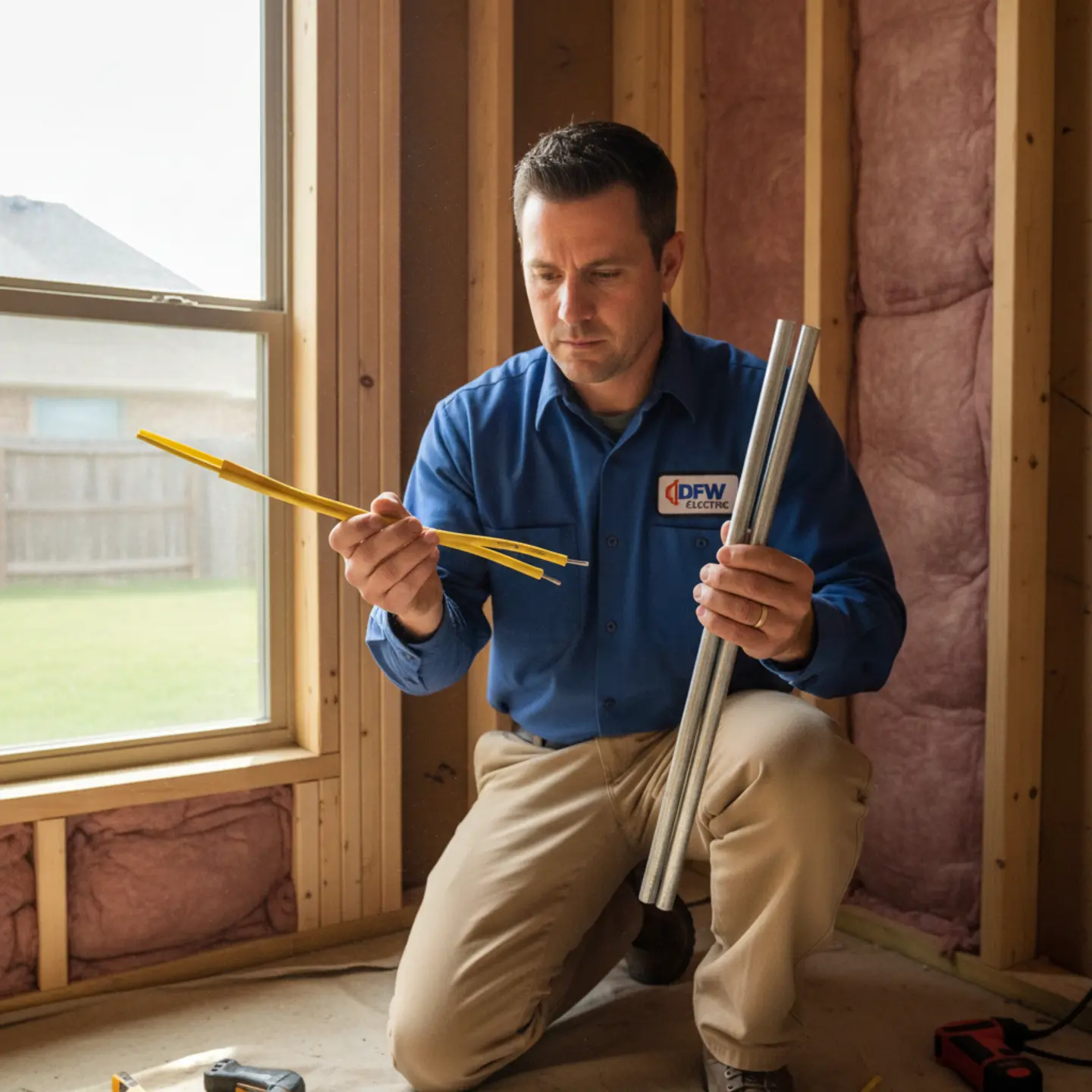
This is the most common scenario for DFW homeowners. It involves running a new 20-amp line from your electrical panel, routing 12/2 wire through the attic, fishing it down through the bathroom wall, and installing a GFCI outlet. This price includes the permit and materials.
Complex Installation: $600–$1,200
If you live in a two-story home and the bathroom is on the first floor (meaning no attic access above it), the job gets more involved. Your electrician may need to cut small access holes in the drywall to route the wire, which means patching and painting afterward. Long wire runs over 50 feet, panels that need additional breaker slots, or tile walls that require diamond-blade cutting also push costs into this range.
| Installation Type | Typical Cost | What’s Included |
|---|---|---|
| Simple Retrofit | $150 – $350 | Tap existing nearby circuit, GFCI outlet, short wire run |
| Standard Install | $350 – $600 | New 20A circuit, attic routing, permit, GFCI outlet |
| Complex Install | $600 – $1,200 | No attic access, long wire run, drywall cuts, panel work |
| DIY Materials Only | $50 – $150 | Wire, GFCI outlet, box, faceplate (labor not included) |
💡 The Most Common Scenario
Most bidet outlet installs in single-story DFW homes fall in the $350–$600 range. That covers the permit, materials, labor, and a new dedicated 20-amp circuit run through the attic. No surprises.
What Drives the Cost Up?
Several factors can push your install toward the higher end of the range — and most of them are specific to how homes are built here in North Texas:
Slab-on-grade foundation: Nearly every DFW home built after 1960 sits on a concrete slab. That means there’s no crawl space underneath to route wiring. Your electrician runs the wire through the attic instead, which takes more time and more cable.
Distance from panel to bathroom: If your electrical panel is on the garage wall and the master bathroom is on the opposite side of the house, that’s a long wire run. More wire, more labor, higher cost.
Summer heat: This one surprises people. DFW attic temperatures can exceed 140°F during summer months, which limits how long an electrician can safely work up there. Jobs scheduled in July or August may take longer due to mandatory cool-down breaks.
Two-story homes with first-floor bathrooms: No attic above means the wire has to be fished through walls horizontally, often requiring small drywall access cuts.
Permit fees: Fort Worth residential electrical permits range from $40 to $300 depending on the scope. Arlington’s base permit fee is $100. These are included in a professional install but worth knowing about.
Here in DFW, nearly every home built after 1960 sits on a slab foundation. That means your electrician is routing wire through the attic — not under the floor. It’s standard procedure for us, but it’s why the job takes a bit longer than the national average you might see quoted online.
Does Your Bidet Need a Dedicated Circuit?
This depends on what kind of bidet you bought — specifically, how much power it draws.
Tank-type bidet seats (like the TOTO Washlet E200) maintain a small reservoir of warm water using a lower-wattage heating element. These typically draw 400–600 watts, which works out to about 3.4–5.0 amps on a 120V circuit. That’s a light load. A tank-type bidet can usually share the existing 20-amp bathroom circuit without any issues.
Tankless bidet seats (like the Bio Bidet BB-2000 or TOTO Neorest) heat water instantly as it flows, which requires a lot more power — typically 1,000–1,400 watts. A 1,400-watt bidet draws about 11.7 amps. On a 15-amp breaker (which is only rated for 12 amps of continuous load under the NEC’s 80% rule), that bidet alone nearly maxes out the circuit.
Now imagine someone plugs in a hair dryer on the same circuit. That’s a tripped breaker — and a frustrating pattern that won’t stop until the root cause is addressed.
| Bidet Brand/Model | Heating Type | Max Wattage | Amperage (at 120V) |
|---|---|---|---|
| TOTO Washlet E200 | Tank | 410W | ~3.4A |
| HOROW T33 | Tank | 850W | ~7.1A |
| Kohler Veil K-5401 | Tankless | 1,200W | ~10.0A |
| Brondell Swash 1400 | Tankless | 1,200W | ~10.0A |
| Bio Bidet BB-2000 | Tankless | 1,400W | ~11.7A |
| TOTO Neorest 700H | Tankless | 1,400W | ~11.7A |
💡 How to Check Your Bidet’s Power Draw
Look at the specification label on the bottom or back of the unit, or check the product listing online. If it draws over 1,000 watts, we typically recommend a dedicated 20-amp circuit. That way your bidet works reliably every time — even when someone is drying their hair in the same bathroom.
Can You DIY a Bidet Outlet in Texas?
Honest answer: legally, yes — with some significant caveats.
Texas law includes a “homeowner exemption” that allows you to do electrical work on your own primary residence. But it’s not as simple as just picking up some wire at the hardware store. To legally do it yourself, you have to own and occupy the home (not a rental), file a homestead affidavit with the city, pull the same electrical permit a contractor would, and pass both a rough-in inspection and a final inspection.
That said, this isn’t the same as swapping a light switch or replacing a standard outlet. You’re potentially running new wire through an attic in Texas heat, connecting to your electrical panel, and making sure the circuit is properly grounded and GFCI-protected. If any of those steps sound outside your comfort zone, they probably are.
Here’s the part that really matters: if you do the work without a permit and something goes wrong — a fire, a shock, water damage from an electrical failure — your homeowner’s insurance company can deny the entire claim. That leaves you personally responsible for everything. And if the city finds unpermitted work during a home inspection (like when you’re trying to sell), they can double the permit fee and impose fines up to $2,000.
We’re not trying to scare you out of doing things yourself. We’re making sure you know when you need an electrician and what the real stakes are.
What to Do
Want to save money and still stay safe? Here’s what you CAN do before your electrician arrives: clear the bathroom area, remove the toilet tank lid to give access to the wall behind it, figure out which side your bidet’s power cord exits, and have the bidet model number ready. That kind of prep saves time — and time is where the labor cost lives.
Special Considerations for Older DFW Homes
If your home was built between the 1960s and early 1980s, there are a few things that could affect your bidet outlet installation — and your overall electrical safety. This isn’t about creating fear. It’s about giving you an honest picture so there are no surprises on installation day.
⚠️ Check Your Panel Brand First
If your home was built in the 1970s and you still have the original electrical panel, ask your electrician to check the brand before any new work begins. Federal Pacific and Zinsco panels are known fire hazards — their breakers can fail to trip during an overload, which means your new bidet could be putting a heavy load on a circuit with no real safety net.
Federal Pacific and Zinsco panels: Many DFW neighborhoods built in the 1970s still have these. The breakers are known to fail — meaning they don’t trip when they should, which can cause wiring to overheat and start a fire. Before adding a high-wattage bidet to one of these panels, a licensed electrician needs to evaluate whether the panel is safe to expand. If it needs replacement, that’s typically $1,500–$3,000 — a separate cost from the bidet outlet itself.
Aluminum wiring: Some homes built in the late 1960s and early 1970s used aluminum branch-circuit wiring instead of copper. Aluminum expands and contracts at a different rate than the copper terminals on modern GFCI outlets, which can cause connections to loosen and arc over time. If your home has aluminum wiring, your electrician may need to run a completely new copper circuit to the bathroom.
Two-wire systems (no ground): Older homes may only have a two-wire system — hot and neutral — with no dedicated ground wire. Electric bidets require a grounded outlet to function safely. In this case, a new circuit from the panel is the only proper fix.
None of these issues are dealbreakers. They just mean your electrician needs to evaluate the situation before quoting the job — which is exactly what a good electrician should do.
Many of the older neighborhoods in Fort Worth, Arlington, and the mid-cities were built during the 1960s and 1970s housing boom. These homes are solid — but their electrical systems are often 50+ years old. A bidet outlet install is a great opportunity to have a professional take a quick look at the overall condition of your wiring and panel.
What to Expect During the Installation
Knowing what happens during the install takes the mystery out of it. Here’s the typical process from start to finish — from your perspective as the homeowner.
Step 1 — Load assessment: Your electrician checks the existing load on the bathroom circuit. If it’s already powering multiple outlets or heavy-draw appliances, they’ll recommend a new dedicated 20-amp line instead of tapping into what’s there.
Step 2 — Circuit pathfinding: In a DFW slab home, the electrician identifies the best route — usually running 12/2 NM-B cable from the breaker panel up into the attic, across the ceiling joists, and down into the bathroom wall cavity.
Step 3 — Drywall and box prep: A precise hole is cut in the drywall behind the toilet and an “old work” electrical box is secured into the wall. If the wall is tiled, a diamond-blade saw prevents cracking.
Step 4 — Wiring and GFCI installation: The 12 AWG wire is connected to a 20-amp GFCI receptacle. Your electrician verifies correct polarity and a secure ground bond.
Step 5 — Testing and inspection: The outlet is tested with a circuit analyzer and GFCI tester. Everything is verified, and the electrician coordinates the municipal inspection to close out the permit.
✅ Before Your Electrician Arrives:
- Clear a path from the front door to the electrical panel (usually in the garage)
- Remove personal items from the bathroom vanity and toilet area
- Know your bidet model number and which side the power cord exits
- If possible, remove the toilet tank lid to give easier wall access
- Make sure the attic access (usually in a hallway closet) is reachable
- Have any HOA or building management contacts ready if applicable
In most single-story DFW homes with clear attic access, we can have your bidet outlet installed and ready to use in under 3 hours — including testing and cleanup. You’ll be using your new bidet the same day.
Frequently Asked Questions
How much does it cost to add an outlet for a bidet near the toilet?
In the DFW area, most bidet outlet installations cost between $150 and $600. A simple retrofit where you can tap into an existing nearby circuit runs $150–$350. A standard install with a new 20-amp line routed through the attic — which is the most common scenario in DFW slab homes — typically costs $350–$600. More complex jobs involving two-story homes, long wire runs, or panel work can reach $600–$1,200.
Do I need a GFCI outlet for a bidet?
Yes — it’s required by code, not just recommended. Under the 2023 NEC (adopted in Texas on September 1, 2023, and in Fort Worth on March 1, 2023), all bathroom receptacles must be GFCI protected. A GFCI outlet detects dangerous current leaks and shuts off power in under 25 milliseconds, which is critical in a bathroom where water is present.
Can I plug my bidet into an extension cord or power strip?
No — and you should never do this. Both extension cords and power strips violate NEC code when used in bathrooms. They’re not rated for high-moisture environments and can overheat with the high wattage that tankless bidet seats draw (up to 1,400 watts). This is a genuine safety hazard, not just a technicality.
Does a bidet need a dedicated circuit?
It depends on the model. Lower-wattage tank-type bidets (400–600W) can usually share the existing 20-amp bathroom circuit. But tankless models drawing 1,000–1,400 watts pull up to 11.7 amps — nearly maxing out a 15-amp breaker. For tankless bidets, a dedicated 20-amp circuit is the safest and most reliable choice, especially if you use a hair dryer or space heater in the same bathroom.
Do I need a permit to install an outlet for a bidet in Fort Worth?
Yes. In Fort Worth, Arlington, and throughout the DFW area, installing new wiring or a dedicated circuit requires an electrical permit. Fort Worth permit fees typically range from $40 to $300 depending on scope. Performing electrical work without a permit can result in doubled fees and fines up to $2,000 if discovered during a home inspection or following a safety incident.
How long does it take to install a bidet outlet?
For a standard single-story DFW home with attic access, the typical installation takes 1.5 to 3 hours. This includes running the new circuit, installing the GFCI outlet, testing, and cleanup. More complex installations in two-story homes or homes without attic access may take longer due to additional drywall work and wire routing.
Can I install a bidet outlet myself in Texas?
Legally, yes — Texas allows homeowners to perform electrical work on their primary residence under the homeowner exemption. However, you still need to file a homestead affidavit, pull a permit, and pass city inspections. The practical risks are significant: working in a hot attic, connecting to your panel safely, and ensuring proper GFCI protection and grounding. If the work is done without a permit and something goes wrong, your homeowner’s insurance may deny the claim entirely.
Ready to Get Your Bidet Outlet Installed?
If you’ve got a bidet seat sitting in a box (or already mounted on your toilet with the cord dangling), the hardest part is already done — you made the decision. The electrical side is the easy part when you have the right person handling it.
We’ll tell you exactly what’s needed, what it costs, and how long it’ll take. No mystery, no upsell. If you already have a circuit nearby that can handle the load, we’ll tell you that. If you need a new dedicated line, we’ll explain the simplest path to get it done. We give options, not pressure.
Everything works as it should when we’re done.
Call or Text: (682) 478-6088
Serving Fort Worth, Arlington, Keller, Southlake, Colleyville, Grapevine, Lewisville, and all of DFW