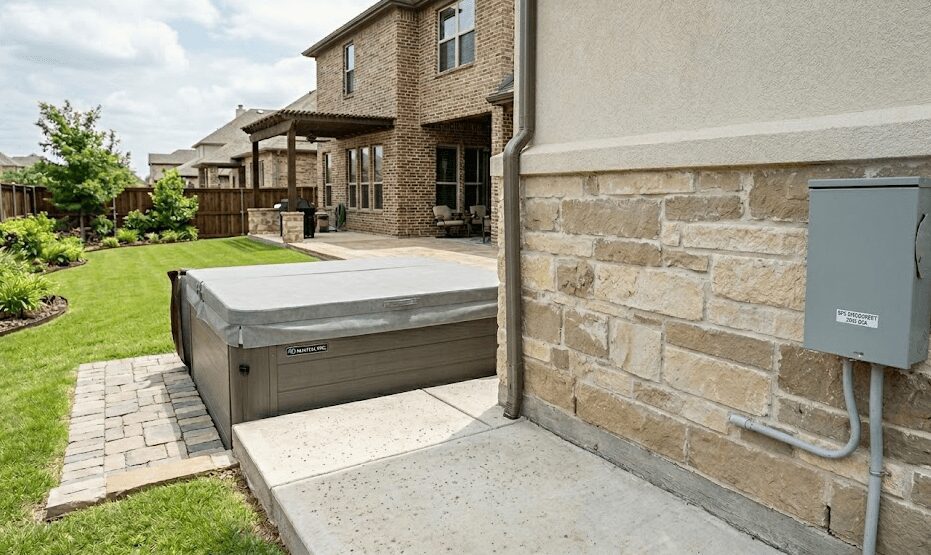
Hot Tub Electrical Installation Cost in DFW: What Fort Worth Homeowners Actually Pay
⚡ Key Takeaways
- Real DFW Cost Range: $2,100–$4,800 — Most Fort Worth homeowners pay $2,100–$2,500 for a straightforward install. Complex jobs with long runs and trenching reach $3,800–$4,800.
- Dealer Quotes Are Not Electrician Quotes — Hot tub retailers often cite $300–$800 for installation. That rarely covers the dedicated circuit, GFCI breaker, disconnect, conduit, and permit your city requires.
- Distance From Panel Is the #1 Cost Driver — The farther the tub is from your electrical panel, the more wire, conduit, and labor you need. DFW’s clay soil adds a trenching premium too.
- A Permit Is Not Optional — Every DFW city requires a permit for hot tub electrical work. Skipping it can void your homeowner’s insurance and create problems when you sell your home.
- Panel Upgrades Are a Hidden Cost — Older Fort Worth and Arlington homes with 100–125 amp panels may need an upgrade ($2,800–$4,500) before the hot tub circuit can be added safely.
- Plug-and-Play Has Real Limits in Texas — 120V “plug-and-play” tubs struggled during the 2021 freeze. A 240V hardwired system heats 5–8x faster and performs year-round in North Texas weather.
- Only a Licensed Electrician Can Do This Legally — Texas law requires a licensed Master Electrician for hot tub wiring. TDLR fines for unlicensed work start at $5,000.
You just bought a hot tub. Or you’re seriously thinking about it. The dealer made it sound simple — “just needs a 240V outlet, any electrician can do it.” So you hop online to get a sense of what that costs, and you find numbers ranging from $500 to $4,200 on the same page.
That’s not helpful. And it’s not your fault for being confused.
The truth is, the electrical cost to install a hot tub in the DFW area depends on a handful of very specific factors — and most of the generic national guides online don’t account for any of them: Fort Worth’s permitting fees, the black clay soil that makes trenching expensive, the Texas heat that affects how wire needs to be sized, or the fact that a lot of older homes in the area simply don’t have the panel capacity to add a 50-amp circuit without an upgrade.
This guide gives you the real numbers for the DFW market in 2025. Not national averages. Not dealer quotes. What Fort Worth, Arlington, Keller, Southlake, and Colleyville homeowners are actually paying — broken down honestly, component by component, so you can go into this project with your eyes open.
⚠️ What Hot Tub Dealers Don’t Tell You About Electrical Costs
Hot tub retailers are in the business of selling hot tubs — not wiring them. When a dealer quotes you “$300–$800 for installation,” they’re often describing a simple plug connection for a 120V unit, or they’re lowballing the electrical to make the overall sale look more affordable. A code-compliant 240V electrical installation in Fort Worth starts at $1,800 and goes up from there. Always get your electrical quote from a licensed electrician — not the dealership.
The Real Cost Range for Hot Tub Electrical in DFW (2025)
Let’s start with the numbers you came here for. National cost guides are a reasonable starting point, but DFW consistently runs on the higher end — and for good reasons we’ll get into.
Average Hot Tub Electrical Installation Cost
Average paid by DFW homeowners for a standard 240V hot tub electrical installation in 2025 (materials + labor + permit). Straightforward installs near the panel run $2,100–$2,500. Complex jobs with long runs or trenching reach $3,800–$4,800.
Here’s how the DFW market compares to national benchmarks:
| Install Type | National Average (2025) | DFW Regional Average (2025) |
|---|---|---|
| Basic Install (Close to Panel) | $1,900 – $2,300 | $2,100 – $2,500 |
| Complex Install (Long Run / Trenching) | $3,500 – $4,200 | $3,800 – $4,800 |
| Minimum Electrician Call-Out | $150 – $300 | $200 – $450 |
| Permit and Inspection Fees | $100 – $250 | $150 – $500 |
Why does DFW run higher? A few reasons. Licensed Master Electrician rates in Tarrant and Denton Counties run $85–$160 per hour, and demand for qualified spa electricians is high. Fort Worth’s clay-heavy soil (more on that shortly) makes trenching more labor-intensive. And local permit fees have been increasing — Fort Worth raised development fees 12.5% in October 2024 alone.
📍 DFW Homeowners: The single biggest cost variable is distance — how far your electrical panel is from where the hot tub will sit. Every additional foot means more wire, more conduit, more labor, and potentially more trenching through that famous North Texas black clay. If you’re placing the tub close to the house, you’re looking at the lower end. If it’s at the back of the yard, budget for the upper range.
What You’re Actually Paying For — Cost Breakdown by Component
A hot tub electrical installation isn’t one thing — it’s five or six things that all have to work together. Here’s what each piece costs in 2025 and why it’s required.
| Component | Why It’s Required | Cost Estimate (2025) |
|---|---|---|
| 240V Double-Pole GFCI Breaker | Code-mandated ground-fault protection near water | $250 – $400 |
| #6 AWG Stranded Copper Wire | Power delivery for most 50-amp installs (per 100 ft) | $480 – $650 |
| Spa Disconnect Panel | NEC-required local shutoff 5–15 ft from tub | $150 – $350 |
| Schedule 80 PVC Conduit | Protects wire underground in DFW shifting clay soil | $1.20 – $2.50 / ft |
| Liquid-Tight Flexible Conduit | Final flexible connection from disconnect to spa | $60 – $120 |
| Subpanel (if needed) | Adds breaker space when main panel is full | $900 – $1,500 |
| Permit and Inspection | Required by every DFW city — no exceptions | $150 – $500 |
💡 Why Copper Wire Costs More Than You Expect
Copper prices have been volatile, and the wire required for a hot tub isn’t the thin wire used in a standard outlet circuit. Most 50-amp installs require #6 AWG stranded copper — a thick, heavy-gauge wire that costs $480–$650 per 100 feet in 2025. Larger tubs with dual pumps may require #4 AWG, which costs even more. This is one reason your quote is higher than you expected — and it’s not padding, it’s materials.
If your hot tub requires a 60-amp circuit (common for larger units with dual pumps), expect wire costs to increase roughly 20% due to the heavier gauge required. Your electrician should tell you upfront which amperage your specific model needs — always check the manufacturer’s data plate before getting quotes.
The Hidden Cost Most Homeowners Don’t See Coming — Panel Upgrades
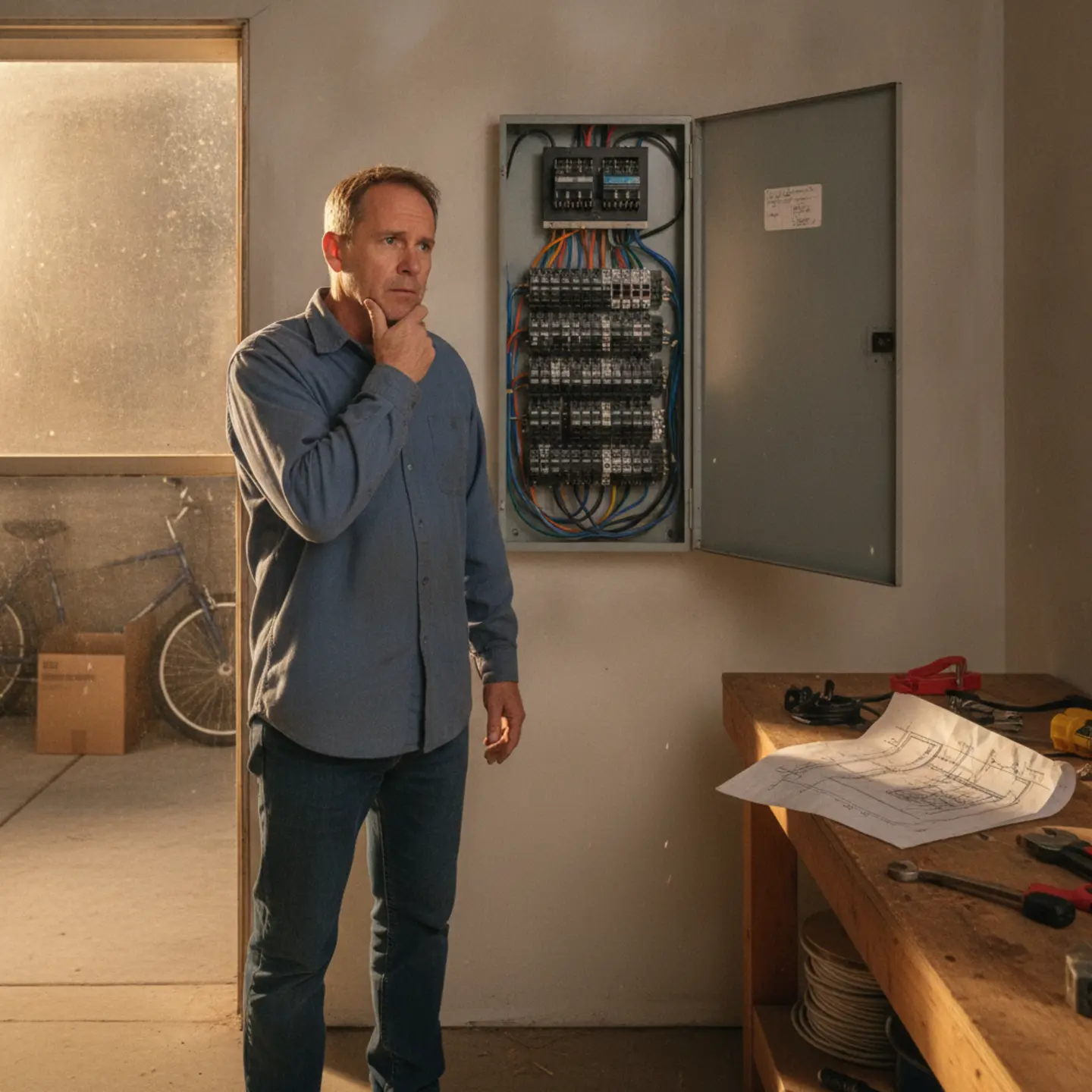
This is the one that catches people off guard more than anything else. You’ve budgeted for the hot tub electrical work. Then the electrician looks at your panel and says you need an upgrade first.
It’s not a scare tactic. It’s math.
A lot of homes in Fort Worth, Arlington, and the older DFW suburbs were built with 100-amp or 125-amp service. A hot tub draws 50 amps on its own. When you add that to your existing load — two HVAC units, an electric water heater, a dryer, and everything else running in a Texas summer — you can exceed what your panel can safely handle.
An electrician will run a demand load calculation based on NEC Article 220. If the total calculated load — including the new hot tub — exceeds 80% of your main breaker’s rating, an upgrade is required before the hot tub circuit can be installed safely.
| Upgrade Type | Average Cost in DFW (2025) | When You Need It |
|---|---|---|
| Subpanel Installation | $900 – $1,500 | Panel has capacity but is physically full |
| Panel Upgrade to 200A | $2,800 – $4,500 | Current service is 100A or 125A |
| Heavy-Up to 400A Service | $8,000 – $12,000 | Large estates with multiple high-draw appliances |
If your panel is simply full but your service amperage is already 200 amps, a subpanel is the more affordable path — it creates the breaker slots you need without a full service upgrade. You can learn more about when a panel replacement makes sense and what the process looks like.
⚠️ Is Your Panel Big Enough?
If your home was built before 1990 and you’ve never had an electrical service upgrade, there’s a real chance your panel isn’t ready for a hot tub. The fix is straightforward — but it does add to the budget. Always have an electrician assess your panel capacity before you finalize your hot tub purchase. That way, there are no surprises when the installation crew shows up. If you’re unsure whether your panel needs attention, our guide on signs your home electrical system needs attention is a good starting point.
Plug-and-Play vs. 240V Hardwired — Which One Are You Actually Buying?
Before we go any further on cost, it’s worth making sure we’re talking about the same type of hot tub — because the electrical requirements (and costs) are completely different depending on which one you have.
There are two main categories:
120V “Plug-and-Play” Hot Tubs — These run on a standard 120V household circuit, typically 15–20 amps. They plug into a dedicated GFCI outlet. Install cost: $150–$300. They heat slowly (1–2°F per hour) and can’t run the heater and jets at the same time.
240V Hardwired Hot Tubs — These require a dedicated 240V circuit with a 50- or 60-amp breaker, hardwired by a licensed electrician. Install cost: $1,900–$4,200+. They heat fast (6–10°F per hour) and run heater and jets simultaneously.
| Performance Factor | 120V (Plug-and-Play) | 240V (Hardwired) |
|---|---|---|
| Heating Speed | 1–2°F per hour | 6–10°F per hour |
| Heater + Jets Simultaneously | No — heater shuts off when jets run | Yes — both run together |
| Winter Performance (Texas) | Struggles below 40°F | Maintains temp in extreme cold |
| Upfront Electrical Cost | $150 – $300 | $1,900 – $4,200 |
| Upgrade Cost Later (if switching) | — | $1,000 – $2,000 additional |
📍 The Texas Freeze Lesson: During the February 2021 winter storm, 120V plug-and-play hot tubs across North Texas froze — they simply couldn’t generate enough heat to keep up when temperatures plunged into the teens. Homeowners with 240V systems kept their tubs running without issue. If you’re buying a hot tub in DFW to use year-round, a hardwired 240V system isn’t a luxury — it’s the practical choice.
💡 Thinking About Starting with Plug-and-Play and Upgrading Later?
It’s a common plan — start cheap, upgrade when you decide you love it. Just know that the upgrade from 120V to 240V costs an additional $1,000–$2,000 in labor and materials. If you’re already leaning toward a 240V tub, it often makes more financial sense to wire it right the first time. Talk to your electrician about both paths before you buy the tub.
What the Code Actually Requires — NEC 680 in Plain English
Here’s the part most blog posts make complicated. NEC Article 680 is the section of the National Electrical Code that governs all electrical work near water — pools, spas, and hot tubs. It exists because electricity and water are a lethal combination, and the rules it sets are not optional.
Here’s what it actually requires, without the jargon:
✅ NEC 680 Requirements for Hot Tub Electrical:
- Dedicated circuit — The hot tub must have its own breaker. No sharing with outdoor lighting, pool equipment, or anything else.
- 50-amp or 60-amp GFCI breaker — Most full-size hot tubs require a 50-amp circuit. The GFCI protection is not optional — it trips when it detects as little as 4–6 milliamps of ground fault current, protecting anyone in or near the water.
- Disconnect switch — A spa disconnect panel must be installed 5–15 feet from the tub, in line-of-sight of the spa. This allows a technician (or a homeowner in an emergency) to shut off power while being able to see the tub. In some DFW cities, it must be lockable in the off position.
- Bonding of all metal within 5 feet — Every metal component within 5 feet of the tub — the spa frame, pump housings, nearby metal railings or fencing, even outdoor kitchen structures — must be bonded using a solid #8 AWG copper wire. This eliminates dangerous voltage differences between surfaces.
- Conduit required for all outdoor wiring — You cannot run Romex or UF-B cable to a hot tub. All wiring must be individual conductors pulled through conduit. Underground conduit must be buried at the right depth (18 inches for Schedule 40 PVC, 6 inches for rigid metal conduit).
- Four-wire connection — Modern hot tubs require two hot conductors, one neutral, and one ground. The neutral is essential for the spa’s internal 120V electronics. Missing it causes “ghost tripping” of the GFCI breaker — one of the most common issues we troubleshoot on improperly wired tubs.
💡 The 5-Foot Rule Explained
The disconnect switch must be at least 5 feet from the inside wall of the tub — far enough that a person in the water can’t reach it. But it also must be “in sight” of the spa, meaning a technician working on the tub can see the disconnect without having to go around a corner. That “in sight, but not too close” requirement trips up a lot of DIYers who put the panel in the wrong place. DFW inspectors are looking for this specifically.
If you’ve had a circuit breaker that keeps tripping after a hot tub install, improper GFCI placement or a missing neutral wire are the most common culprits. These are fixable — but they need a licensed electrician to diagnose and correct properly.
DFW Permit Requirements — What Your City Requires in 2025
Here’s something that surprises a lot of homeowners: the permit isn’t just paperwork. It’s how the city verifies that the work was done safely, by a qualified electrician, and in a way that protects your home’s value and your family’s safety. Skipping it isn’t a shortcut — it’s a liability.
Every DFW municipality requires a permit for hot tub electrical installation. Here’s what each city requires in 2025:
📍 Fort Worth: Enforces the 2020 NEC. Hot tub electrical permits start at $112 and scale with project valuation. As of October 2024, the city implemented a 12.5% increase in development fees. Permits are processed through the CFW Permit Assist tool via the Accela portal. Your electrician must hold a valid Master Electrical Registration on file with the city.
📍 Arlington: Currently undergoing a phased fee update — the first major overhaul since 2008. Phase I took effect July 15, 2025, and Phase II takes effect October 1, 2025. Above-ground spa electrical permits are moving from $100 to approximately $150. Applications go through Arlington’s Civic Access Portal with a 10-business-day initial review period.
📍 Southlake: Enforces the 2023 NEC — one of the stricter versions in the area. Permits are processed through EnerGov. A residential remodel permit for new electrical circuits starts at $100. Southlake offers photo documentation in lieu of on-site inspections for some work, but not for new high-voltage spa installations.
📍 Keller: If your home has less than 200-amp electrical service, Keller requires a formal load calculation to be submitted with the permit application. This must demonstrate that the hot tub circuit won’t overload the main service entrance. Your electrician handles this, but it adds a step to the process.
📍 Colleyville: Bases alteration permit fees on the square footage of the project area, starting at $0.80 per square foot, plus a $100 contractor registration fee. The cost adds up quickly for larger project footprints.
To understand more about what electrical work requires a permit in Texas — and why it matters — take a look at our full guide on electrical work that requires a permit in Texas.
⚠️ What Happens If You Skip the Permit in Texas?
Three serious consequences. First, if an electrical fire or injury occurs and investigators find unpermitted work, your homeowner’s insurance carrier can deny the entire claim — leaving you personally responsible for property damage and potentially for injuries to guests. Second, when you sell your home, unpermitted work gets flagged during inspection and either has to be remediated (expensive) or disclosed to buyers (kills deals). Third, the Texas Department of Licensing and Regulation (TDLR) classifies unpermitted electrical work as unlicensed activity, with fines starting at $5,000 per occurrence. The permit isn’t red tape — it’s protection.
Why the DFW Climate Makes Hot Tub Wiring More Complex (And More Expensive)
This is the section most national guides skip entirely. But if you’re in North Texas, the climate matters to your electrical installation in ways that directly affect both cost and long-term safety.
The Black Gumbo Problem
Fort Worth sits on some of the most expansive clay soil in the country — locally called “black gumbo.” When it’s dry, it shrinks and cracks. When it rains, it swells with incredible pressure. This seasonal movement can literally pull apart PVC conduit joints if they weren’t primed, cemented, and assembled correctly — which means the wiring inside gets exposed to moisture and mechanical damage.
Professional DFW electricians use deep-socket fittings and Schedule 80 PVC specifically because of this soil behavior. It’s not an upsell. It’s the right material for this environment. Expect to add $400–$700 to your project if the run requires mechanized trenching equipment through heavy clay.
The Texas Heat Factor
Attic temperatures in North Texas can reach 140°F in summer. Conduit running along south-facing walls or through direct sun can get nearly as hot. According to NEC conductor derating tables, wire running through high-ambient temperatures loses a portion of its safe capacity. A #6 AWG copper wire rated for 75 amps at standard temperature may only safely carry 65 amps at 113°F — still fine for a 50-amp load, but it puts thermal stress on the wire’s insulation over time.
🌡️ The Texas Heat Factor
This is why DFW electricians specify THWN-2 wire (rated for 90°C in both wet and dry locations) rather than standard THHN wire. It handles the thermal load better and lasts longer in the North Texas environment. If you get a quote that uses THWN-2 and Schedule 80 PVC, that’s not padding — that’s an electrician who knows how to build something that lasts in this climate.
These climate-specific requirements are part of why a proper DFW installation occasionally runs higher than what a national cost guide would suggest — and why the cheapest quote isn’t always the best one.
TDLR Fine for Unlicensed Electrical Work
The Texas Department of Licensing and Regulation (TDLR) classifies unlicensed electrical work — including hot tub wiring by an unqualified handyman — as the most serious violation category, with fines starting at $5,000 per occurrence plus potential license revocation.
What to Ask Your Electrician Before You Hire Anyone
Not every electrician who says they can wire a hot tub has actually done it to code. NEC Article 680 is one of the more specialized areas of residential electrical work, and the consequences of getting it wrong near water are serious. Here’s how to qualify anyone you’re considering hiring.
✅ Questions to Ask Every Electrician Before You Hire:
- “Are you licensed with TDLR?” — Ask for their license number and verify it at tdlr.texas.gov. This is non-negotiable in Texas.
- “Will you pull the permit?” — Any qualified electrician will pull the permit themselves. If they suggest you pull it, or suggest skipping it to save money, walk away.
- “Do you have experience specifically with NEC Article 680 spa installations?” — General residential electricians are capable, but experience with spa-specific code requirements matters. Ask if they’ve done hot tub installations in your city before.
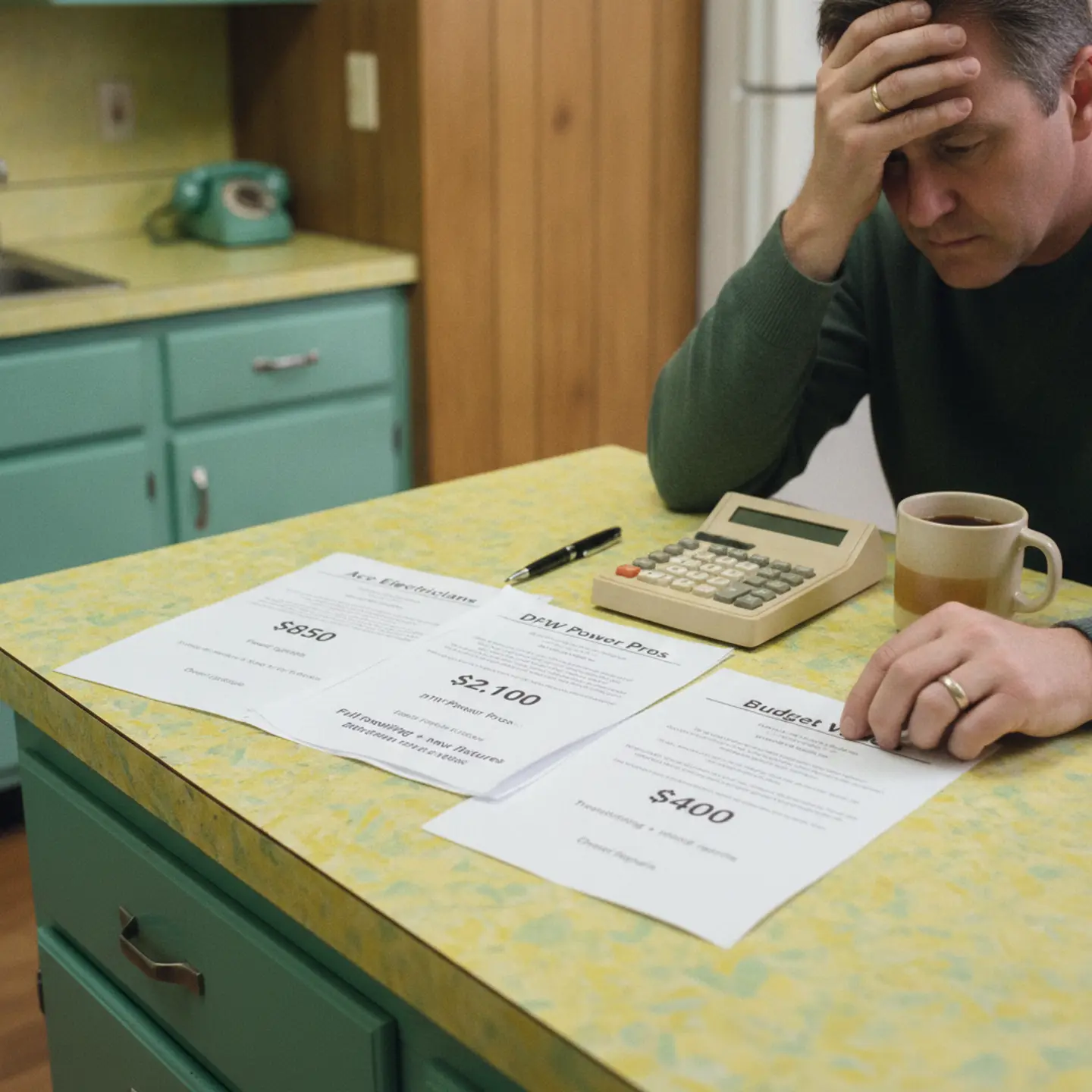
- “Can you give me an itemized quote?” — A professional quote should list wire, breaker, disconnect, conduit, permit, and labor separately. Lump-sum quotes make it impossible to compare apples to apples.
- “Will you do a load calculation before finalizing the price?” — This tells you whether your panel can handle the hot tub without an upgrade. Any electrician who quotes you without looking at your panel first is guessing.
- “What wire gauge and conduit type will you use?” — The right answer for DFW is THWN-2 wire and Schedule 80 PVC conduit. If they say anything else, ask why.
If you’re not sure what your home’s electrical system looks like or whether it’s ready for a hot tub, a quick assessment can save you from a surprise mid-project. We do load calculations and panel assessments as part of every hot tub quote — no charge, no pressure.
Frequently Asked Questions — Hot Tub Electrical in DFW
How much do electricians charge to hook up a hot tub in Fort Worth?
For a standard 240V installation in Fort Worth, most homeowners pay between $2,100 and $2,500 for a straightforward job close to the panel. If the run is long, requires trenching through clay soil, or your panel needs an upgrade, expect $3,800–$4,800 or more. Always get an itemized quote — not a ballpark — from a licensed electrician after they’ve assessed your specific site and panel.
Can you wire a hot tub yourself in Texas?
Legally, no. Texas law requires a licensed Master Electrician to perform hot tub wiring. This isn’t just a formality — the combination of high-amperage circuits, GFCI requirements, bonding rules, and proximity to water makes this one of the most technically demanding residential electrical installations. The TDLR enforces this with fines starting at $5,000 for unlicensed electrical work. Beyond legality, improper DIY wiring near water is a serious electrocution risk.
What size breaker do I need for a 240V hot tub?
Most standard 4-person hot tubs require a 50-amp, 240V double-pole GFCI breaker. Larger models with dual pumps or high-output heaters may require 60 amps. Always check your hot tub’s data plate (usually inside the equipment compartment) for the manufacturer’s specified amperage — then verify it with your electrician. Using the wrong breaker size can damage the spa’s control board or create a fire hazard. If you’ve had a breaker issue with an existing hot tub circuit, wrong breaker sizing is often the cause.
How far does the disconnect switch need to be from the hot tub?
The NEC requires the disconnect to be at least 5 feet from the inside wall of the tub. It must also be “in sight” of the spa — meaning a technician working at the tub can see the disconnect without going around a corner or through a gate. DFW city inspectors typically look for a range of 5–15 feet. In some local jurisdictions, the disconnect must also be lockable in the off position to protect technicians during maintenance.
Do I need a permit to install a hot tub electrically in Fort Worth?
Yes, without exception. Fort Worth requires an electrical permit for any new circuit installation, including hot tub wiring. The city has enforced this consistently, and inspectors actively flag unpermitted work — sometimes triggered by neighbor reports or during home sales. Your licensed electrician should pull the permit as part of the job. If they suggest skipping it, find a different electrician. See our complete guide on what electrical work requires a permit in Texas for more detail.
What happens if I wire a hot tub without a permit in Texas?
Three things can happen, and none of them are good. Your homeowner’s insurance can deny any related claims (fire, injury) if they discover unpermitted work. When you sell your home, unpermitted electrical work must be disclosed or remediated — both cost you money. And the TDLR can fine anyone involved in unlicensed electrical work starting at $5,000 per occurrence. The permit fee ($150–$500 depending on your city) is the cheapest part of this project. Don’t skip it.
Will I need a panel upgrade for a hot tub?
Possibly — especially if your home was built before 1990 or has never had an electrical service upgrade. A hot tub draws 50 amps on its own. If your existing panel is already running close to capacity, adding that load could require an upgrade from 100A or 125A service to 200A service ($2,800–$4,500 in DFW). The only way to know for sure is a load calculation — which any reputable electrician should do before finalizing your quote. If your panel is full but your service is already 200A, a subpanel may be a more affordable solution ($900–$1,500). Learn more about when a panel upgrade is actually necessary for high-draw appliances.
Ready to Get a Real Quote for Your Hot Tub Electrical in DFW?
If you’ve read this far, you’re ahead of most homeowners. You know what the real costs look like, what the code actually requires, and what questions to ask. That puts you in a much better position than starting with a dealer quote and hoping for the best.
When you’re ready to move forward — or even if you just want to know whether your panel is ready before you buy the tub — we’re happy to take a look and give you straight answers. We’ll tell you exactly what your installation will need, what it will cost, and whether there are any surprises to plan for. No upsell, no pressure. Just an honest assessment and a clear quote.
What to Do Next
Give us a call or text at (682) 478-6088 to schedule a site assessment. We’ll look at your panel, measure the run, and give you a complete, itemized quote for your hot tub electrical installation — including whether a permit is required and what your city’s process looks like. Everything works as it should when we’re done.
Call or Text: (682) 478-6088
Serving Fort Worth, Arlington, Keller, Southlake, Colleyville, Grapevine, Lewisville, and all of DFW