Wrong Size Breaker for Your AC? What Inspectors Flag and How to Fix It
⚡ Key Takeaways
- Your AC breaker size comes from the nameplate on your outdoor unit — not from a generic chart, not from the tonnage, and not from what the last person told you.
- An oversized breaker is the #1 electrical defect inspectors flag on AC circuits — and it’s more common than most homeowners realize.
- This usually happens after an HVAC replacement — a newer, more efficient unit gets installed, but nobody swaps the old oversized breaker to match.
- An oversized breaker won’t protect your wiring during a short circuit — that’s a real fire risk, especially with wiring running through DFW attics that hit 140°F in summer.
- The fix is usually straightforward — a breaker swap or wire upgrade, not a full panel replacement. Most corrections are done in a single visit.
- Wire size matters just as much as breaker size — and extreme DFW attic heat can reduce your wiring’s safe capacity below what you’d expect.
- A licensed electrician can diagnose and correct this quickly — often the same day, with clear pricing and no surprises.
The Inspector Flagged Something on Your AC Breaker — Now What?
You just got your inspection report back. Maybe you’re selling your home. Maybe you’re buying one. Either way, buried somewhere in that report is a note about your AC breaker being the wrong size — and now you’re wondering how serious this is.
Is it dangerous? Is it going to cost thousands to fix? Is someone about to try to sell you a whole new electrical panel?
Take a breath. This is one of the most common findings on electrical inspection reports across the DFW area. You’re not alone, and it doesn’t mean your house is falling apart.
📋 If You Just Got an Inspection Report
If you’re reading this because an inspector flagged your AC breaker size — you’re in the right place. By the end of this post, you’ll understand exactly what they found, why it matters, and what it actually takes to fix it. Most of the time, it’s simpler and less expensive than you’d think.
The truth is, most electrical issues can be solved simply, safely, and honestly. The problem is that too many homeowners get scared into thinking they need major work when the real fix might be a single breaker swap. We see it all the time — and we’re going to walk you through exactly what’s going on so you can make an informed decision.
How AC Breaker Sizing Actually Works (The Nameplate Is the Answer)
Before we get into what goes wrong, let’s talk about how it’s supposed to work. And the good news is — the manufacturer already did the hard part for you.
What MCA and MOP Mean (In Plain English)
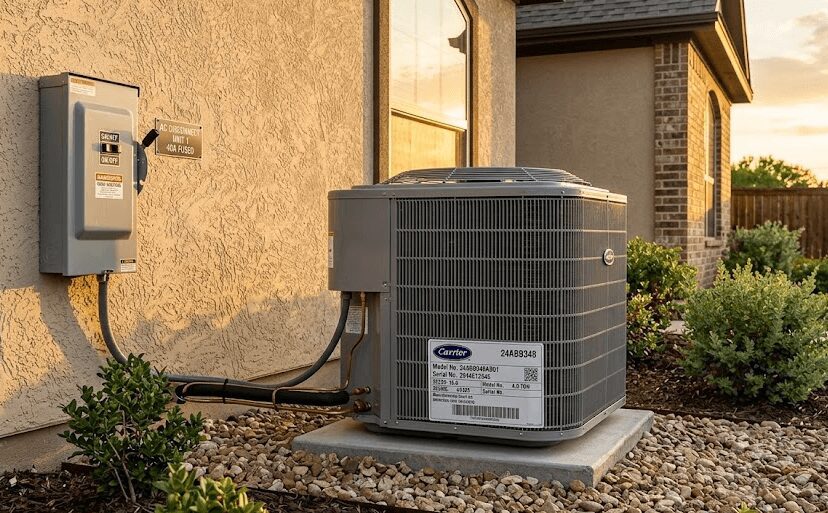
Every air conditioning unit has a metal data plate — usually on the side of the outdoor condenser. On that plate, there are two numbers that determine everything about your electrical circuit:
2 Numbers That Matter Most
MCA (Minimum Circuit Ampacity) tells your electrician what size wire the circuit needs. MOP (Maximum Overcurrent Protection) tells them the largest breaker allowed. These two values — printed right on your unit — are the final word on how your circuit should be set up.
The manufacturer calculated these numbers based on your unit’s compressor, fan motor, and startup power draw. They already factored in the safety margins required by the National Electrical Code (NEC Article 440). Your electrician’s job is to match what’s in your panel to what’s on that label.
Why AC Breakers Don’t Follow the “Normal” Rules
Here’s something that confuses a lot of people — including some home inspectors. AC circuits don’t follow the same breaker-to-wire rules as your regular household circuits.
On a standard circuit, a breaker protects the wire from carrying too much current. But on an AC circuit, the breaker’s main job is short-circuit and ground-fault protection — protecting your house from a catastrophic electrical fault. The AC unit itself has built-in thermal overload protection that handles everyday current management.
This means it’s perfectly legal (and correct) to have a breaker that’s rated higher than what you’d normally expect for that wire size. For example, #10 wire on a 30-amp or even 40-amp breaker is code-compliant for AC circuits — even though on a regular circuit, that same wire would max out at 30 amps.
💡 Pro Tip
The nameplate on your outdoor condenser is the final word on breaker sizing. Not the tonnage, not a chart you found online, not what the previous homeowner told you. If you can read the MOP value on that label, you know the maximum breaker size allowed for your specific unit.
This dual-layer approach — internal protection for the equipment, external protection for your home’s wiring — is how modern HVAC electrical safety is designed to work. Problems start when those layers get mismatched.
The #1 Defect: Oversized AC Breakers (And Why It’s a Fire Risk)
Now let’s talk about what inspectors actually find — because this is where it gets real.
How This Happens (It’s Usually an HVAC Swap)
The single most common scenario goes like this: Your home originally had an older, less efficient AC unit — maybe an 8-SEER or 10-SEER system. That unit required a 40-amp or 50-amp breaker, and a corresponding wire size was installed to match.
Years later, the AC unit dies or gets upgraded. A new high-efficiency 14-SEER or 16-SEER system goes in. This newer unit draws significantly less power and only needs a 25-amp or 30-amp breaker.
But here’s the problem — the HVAC technician replaces the outdoor unit and connects the wiring. The AC works great. They leave. And that old 40-amp or 50-amp breaker? It’s still sitting in your panel, protecting a circuit that now only needs half that capacity.
Nobody swapped it. Nobody flagged it. And most homeowners have no idea there’s a mismatch — until an inspector catches it.
⚠️ Heads Up, DFW Homeowners
This is especially common in DFW homes built in the late 1990s and 2000s that have had their AC units replaced with higher-efficiency models. If your home has had an HVAC replacement in the last 10 years and nobody touched the electrical panel, there’s a real chance your breaker is oversized for the current unit.
It also happens in new construction. In the fast-paced building cycles across North Texas, electricians sometimes install a standard 30-amp breaker before the specific AC unit has been selected. If the builder or homeowner ends up choosing a unit that only requires a 20-amp MOP, that circuit is now improperly protected.
Why an Oversized Breaker Is Dangerous
An oversized breaker is like a safety net with holes that are too big. If something goes wrong — a short circuit, a ground fault, a wire that gets damaged — the breaker is supposed to trip and cut power before the wiring overheats. But if the breaker is rated for 40 amps and the wire can only safely handle 25 amps, there’s a gap where dangerous overheating can happen before the breaker reacts.
Annual Residential Electrical Fire Damage
Between 2014 and 2023, residential electrical malfunction fires caused over $1.5 billion in property damage annually, with a 28% increase in losses over the decade. A significant portion of these fires involve situations where overcurrent protection failed to isolate a fault before wiring insulation ignited. (Source: NFPA/USFA)
The risk doesn’t just exist on paper. In DFW, where AC units run 12 to 18 hours a day during the summer and attic temperatures regularly exceed 140°F, the wiring is already under stress. Add an oversized breaker that won’t trip when it should, and you’ve got a hazard that’s invisible until something goes wrong.
Undersized Breakers and Wire Gauge Issues
While oversized breakers get most of the attention, the opposite problem shows up too — and it brings its own headaches.
When the Breaker Is Too Small (Nuisance Tripping)
If the breaker serving your AC is undersized — smaller than what the unit requires — you’ll know about it fast. The breaker trips every time the AC kicks on, especially on the hottest days when you need cooling the most.
This usually happens when someone guessed at the breaker size instead of reading the nameplate. Maybe a handyman installed it. Maybe a previous homeowner swapped breakers without checking the specs. Either way, the unit is trying to draw more current than the breaker allows, and it shuts down as a result.
An undersized breaker isn’t a fire risk the way an oversized one is — but it makes your AC system unreliable exactly when you need it most.
Wire Size and DFW Attic Heat — A Hidden Problem
Here’s something most homeowners never think about: the wire running to your AC unit loses capacity when it gets hot.
The National Electrical Code rates wire ampacity at a standard ambient temperature of 86°F. But during a DFW summer, your attic isn’t 86°F. It’s 140°F to 150°F. Wiring installed in those spaces has to be “derated” — meaning its safe carrying capacity drops significantly.
In the Dallas-Fort Worth area, attic temperatures during July and August regularly reach 140°F or higher. This directly impacts the safe capacity of the electrical wiring running through those spaces to your AC condenser — a factor that’s unique to our climate and often overlooked.
For example, a #10 AWG copper wire that’s rated for 40 amps under normal conditions drops to roughly 28 amps in a 140°F attic. If your AC unit has an MCA of 29 amps, that #10 wire is technically non-compliant — even though it would be perfectly fine in a cooler environment.
💡 Why Your AC Works Fine in Spring But Trips in August
This is exactly why some homeowners experience “mysterious” breaker tripping that only happens during peak summer. The wire is fine in cooler weather, but once your attic hits 140°F and your AC is running hard all day, the combination overwhelms the circuit. It’s not a fluke — it’s physics.
If you’ve been dealing with lights flickering when your AC runs or your house losing power on one side, wire capacity and breaker sizing should be one of the first things checked.
AC Breaker Size Chart by Tonnage (General Reference)
This is the chart most people are looking for — and it’s a helpful starting point. But before you use it, one critical caveat:
⚠️ Important: This Chart Is a General Reference Only
Your outdoor unit’s nameplate is the final authority on breaker and wire sizing. Two 3-ton units from different manufacturers can have completely different MCA and MOP values. Always check your specific unit’s data plate before making any changes. These figures reflect typical ranges for modern high-efficiency (SEER2) residential split systems on 208/230V single-phase circuits.
| AC Unit Size | Typical MCA Range | Typical Breaker (MOP) | Minimum Wire (Copper) |
|---|---|---|---|
| 1.5 Ton | 10 – 15 Amps | 15 – 20 Amps | #14 AWG |
| 2.0 Ton | 13 – 18 Amps | 20 – 25 Amps | #12 AWG |
| 2.5 Ton | 17 – 23 Amps | 25 – 30 Amps | #10 AWG |
| 3.0 Ton | 20 – 30 Amps | 30 – 40 Amps | #10 / #8 AWG |
| 3.5 Ton | 24 – 34 Amps | 35 – 45 Amps | #8 AWG |
| 4.0 Ton | 27 – 38 Amps | 45 – 50 Amps | #8 / #6 AWG |
| 5.0 Ton | 34 – 45 Amps | 50 – 60 Amps | #6 AWG |
Notice how wide those ranges are — especially for 3-ton and 4-ton units. That’s exactly why you can’t just Google “what size breaker for a 3-ton AC” and get one answer. The actual breaker size depends on your specific unit’s compressor, fan motor, and electrical design. The nameplate tells you exactly what your unit needs.
Wire size also depends on the length of the run between your panel and the outdoor unit. In many DFW homes where the condenser sits on the opposite side of the house from the electrical panel, a 75- to 100-foot wire run is common. Longer runs may require a thicker wire gauge to prevent voltage drop — even if the MCA would technically allow a smaller wire on a shorter run.
How a Licensed Electrician Fixes This
Here’s where we get to the part most people are worried about: what does the fix actually look like, and what’s it going to cost?
The short answer: for most AC breaker issues, it’s a lot simpler and less expensive than you’ve been led to believe.
The Diagnosis
A proper assessment isn’t complicated, but it does require someone who knows what they’re looking at. The electrician will:
✅ What a Proper AC Breaker Assessment Includes:
- Read the MCA and MOP values on your outdoor unit’s nameplate
- Compare those values to the breaker currently installed in your panel
- Verify the wire gauge and measure the run length
- Check for loose connections at the breaker terminals (thermal cycling in DFW causes connections to loosen over time)
- Test voltage at the outdoor disconnect under load
- Inspect the outdoor disconnect for signs of pitting or arcing
That last point — loose connections — is worth calling out. In North Texas, the extreme swings between summer heat and winter cold cause metal components to expand and contract repeatedly. Over time, breaker terminal lugs loosen. This creates resistance, which creates heat, which creates a potential failure point. A good electrician checks and re-torques those connections as part of any AC circuit assessment.
The Fix
Once the diagnosis is clear, the repair falls into one of a few categories:
If it’s just an oversized breaker: The existing breaker gets replaced with one that matches the MOP on your unit’s nameplate. This is typically done in under an hour, during the same visit. No drama, no major work.
If the wire is undersized for the MCA: New conductors need to be pulled. In DFW, this often means upgrading from #12 AWG to #10 AWG — or from #10 to #8 if the attic derating requires it. This is more involved but usually still a single-day job.
If the outdoor disconnect is worn out: Old pull-out style disconnects that show signs of pitting or arcing get replaced with a modern fused or non-fused disconnect. Fused disconnects are common in DFW because they add an extra layer of overcurrent protection right at the unit.
✅ Real Example: Breaker Issue, Not a Panel Replacement
We got a call from a homeowner whose AC wasn’t working. Their HVAC contractor suspected an electrical problem. Another electrician had already been out and told them they needed a full panel replacement — thousands of dollars. We came out, diagnosed the real issue: a burnt breaker connection. We replaced the breaker, addressed a couple of small panel issues, and the AC started working immediately. They avoided thousands in unnecessary upgrades and got a fast, honest repair. That’s how it should work.
What It Typically Costs in DFW
Here’s a realistic look at what these repairs run in the Dallas-Fort Worth area. Every home is different, but these ranges cover the vast majority of AC breaker corrections we handle:
| Service | Typical Cost (DFW) | What’s Involved |
|---|---|---|
| Breaker Replacement | $150 – $400 | Swap to correct size, re-torque terminals |
| Fused Disconnect Install | $250 – $450 | New disconnect, conduit modifications if needed |
| Branch Circuit Re-Wire | $600 – $1,500 | New conductors, depends on run length and attic access |
| Panel Upgrade (if needed) | $2,500 – $5,600 | Full panel replacement, utility coordination, permits |
| Comprehensive Safety Inspection | $100 – $260 | Full circuit assessment, written report |
Most AC breaker issues fall into that first category — a breaker replacement in the $150 to $400 range. The key is getting an honest diagnosis first so you know exactly what you’re dealing with before any work starts.
What to Do If Your Inspection Report Flags Your AC Breaker
Step 1: Don’t panic. This is common and usually fixable.
Step 2: Go look at the metal data plate on your outdoor AC condenser. Find the MOP value.
Step 3: Check the breaker in your electrical panel that serves the AC. If it’s larger than the MOP number, that confirms the finding.
Step 4: Call a licensed electrician to assess the full circuit — breaker size, wire gauge, connections, and disconnect. Get a clear diagnosis and upfront pricing before any work begins.
When You Need an Electrician vs. an HVAC Tech
This is a question that comes up constantly, and the answer is more straightforward than you’d think.
If the issue is with the breaker, wiring, electrical panel, or disconnect — that’s electrical work. You need a licensed electrician. HVAC technicians are trained on mechanical and refrigerant systems, but the electrical panel and branch-circuit wiring are outside their scope.
If the issue is with the AC unit itself — the compressor, refrigerant levels, fan motor, or the system not cooling properly — that’s HVAC work. You need a qualified HVAC company.
Sometimes you need both. And when that happens, having two companies that communicate and don’t point fingers makes all the difference.
💡 Our HVAC Recommendation for DFW Homeowners
When our customers need HVAC work done right, we recommend Shirley Air. They’re a family-owned HVAC company based in Euless that serves the same communities we do — Fort Worth, Arlington, Bedford, Keller, Grapevine, Irving, and across Tarrant County. They’ve got over 100 years of combined experience, 260+ Google reviews, and their customers describe them the same way ours describe us: honest, upfront, and fair. When we handle the electrical side and they handle the HVAC side, everything gets done right from start to finish.
In the DFW area, AC breaker issues and HVAC problems often show up at the same time — especially after a system replacement. Having trusted professionals on both sides who understand how electrical and HVAC systems work together saves you time, money, and headaches.
FAQ — Your AC Breaker Questions Answered
What size breaker does an AC unit need?
It depends on your specific unit. Every air conditioner has a data plate on the outdoor condenser that lists the MOP (Maximum Overcurrent Protection) — that’s the largest breaker allowed for your system. Common residential AC breakers range from 15 amps for small units up to 60 amps for large 5-ton systems. Always check the nameplate rather than relying on general charts.
Can I use a 30 amp breaker for a 25 amp AC?
Only if the unit’s nameplate MOP allows it. If the MOP says “Maximum 25 Amps,” then 25 amps is the largest breaker you can use — a 30-amp breaker would be oversized and a code violation. However, if the MOP says “Maximum 30 Amps,” then a 30-amp breaker is perfectly acceptable even though the unit only draws 25 amps during normal operation. The MOP value on the nameplate is what matters.
What happens if a breaker is too big for your AC?
An oversized breaker won’t trip quickly enough if there’s a short circuit or ground fault in the wiring. This means the wire could overheat before the breaker shuts off power, creating a fire risk — especially in hot attic spaces common in DFW homes. The breaker is there to protect your house wiring, not the AC unit, so the sizing has to be right.
How do I determine the correct breaker size for my AC?
Find the metal data plate on the side of your outdoor condenser unit. Look for the value labeled MOP or MOCP (Maximum Overcurrent Protection). That number is the maximum breaker size allowed for your unit. Then look at MCA (Minimum Circuit Ampacity) — that determines the minimum wire size your circuit needs. A licensed electrician can verify both values and confirm your circuit is set up correctly.
Why does my new AC unit keep tripping the breaker?
Several things can cause this. If the breaker is undersized for the new unit’s requirements, it’ll trip during startup. Loose connections in the panel — common in North Texas due to thermal cycling — can also cause intermittent tripping. If the wiring runs through a hot attic, heat derating may reduce the wire’s capacity below what the unit needs. And in some cases, the unit itself may have an issue that an HVAC technician needs to address. Start with an electrical assessment to rule out breaker and wiring problems first.
What is the 80% rule for breakers?
The 80% rule applies to standard (non-continuous rated) breakers on continuous loads — meaning loads that run for three hours or more. Under this rule, a standard breaker should only be loaded to 80% of its rating. For example, a 30-amp breaker should carry no more than 24 amps continuously. However, AC circuits are sized differently using the MCA and MOP values from the manufacturer, which already account for continuous operation. So while the 80% concept is good general knowledge, the nameplate values take priority for AC breaker sizing.
What does it mean when the breaker trips on an air conditioner?
A tripping breaker means the circuit is drawing more current than the breaker allows. This could be caused by a faulty breaker, loose wiring connections, undersized wire, a failing compressor, a dirty condenser coil restricting airflow, or a refrigerant issue. If it happens once on an extremely hot day, it may be a temporary overload. If it happens repeatedly, something in the circuit or the AC unit needs professional attention — don’t just keep resetting it.
Get the Right Answer — Not a Sales Pitch
If your inspection report flagged your AC breaker — or if your AC keeps tripping and you’re not sure why — we can take a look and tell you exactly what’s going on. No pressure, no upsell. Just a clear diagnosis, honest pricing, and repairs done right.
We give options, not pressure. And everything works as it should when we’re done.
Call or Text: (682) 478-6088
Serving Fort Worth, Arlington, Keller, Southlake, Colleyville, Grapevine, Lewisville, and all of DFW