Why Is My Electric Bill So High in Texas? Old Appliances vs. Electrical Issues
⚡ Key Takeaways
- Texas electricity rates jumped 30% since 2020 – DFW homeowners now pay 16¢-19¢ per kWh, up from sub-10¢ rates just a few years ago
- That old refrigerator is costing you $150+ per year – compared to a modern Energy Star model, but it might not be your biggest problem
- Loose electrical connections act like hidden space heaters – a single 2-ohm loose connection can waste 1,152 watts continuously while driving up your bill
- The “floating neutral” problem causes appliances to work harder – voltage imbalances force motors to draw more current, use more electricity, and fail faster
- Your 2005-era appliances cost $1,200+ more per year – compared to modern equivalents, creating a massive “inefficiency tax”
- DFW attic heat (140°F+) reduces wire efficiency – your electrical system is literally fighting Texas heat before it even powers your AC
- Not everything needs replacing – sometimes it’s a $500 electrical repair, not a $5,000 appliance shopping spree
You’re staring at your July electric bill, and the number doesn’t make sense. $427. You kept the thermostat at 78 all month. You turned off lights. You unplugged the extra freezer. Yet somehow, you owe more than your neighbor with the bigger house.
Sound familiar?
Here in the DFW area, we hear this frustration constantly. Homeowners call us after getting conflicting advice from appliance salespeople (who want to sell you a new fridge), HVAC companies (who want to replace your AC), and even other electricians (who might push a full panel upgrade you don’t need).
The truth? High electric bills in Texas are rarely caused by just one thing. They’re usually a combination of three factors: the new reality of Texas electricity rates, aging appliances that consume more power, and electrical issues that silently waste energy 24 hours a day.
In this guide, we’re going to help you figure out which problem you’re actually dealing with – because the solution is very different depending on the real cause.
What Changed in Texas? The Rate Reality Check
Before we blame your old fridge or suspect your electrical panel, let’s talk about what’s happening with Texas electricity rates. Because even if everything in your home was working perfectly, your bill would still be higher than it was a few years ago.
Here’s what changed:
The Post-Uri Price Jump
Between 2020 and 2025, residential electricity rates in Texas surged by approximately 30%. That’s significantly higher than the national average increase. If you had a 10¢ per kWh rate in 2020, you’re probably paying 14¢-19¢ per kWh now in the DFW area.
Texas used to be cheap. Sub-10¢ rates were normal. Those days are over.
The New Texas Electricity Reality
Residential electricity rates in Texas have surged 30% since 2020, outpacing the national average as the state invests in grid hardening after Winter Storm Uri.
This increase isn’t just about natural gas prices or wholesale market volatility. It’s also about infrastructure. The state is investing heavily in grid reliability, and those costs are being passed through to consumers. Retail Electric Providers now build “winter risk premiums” into their pricing to hedge against extreme weather events.
The Oncor Delivery Charge – The Hidden Floor
Here’s what most people don’t understand: your electric bill has two parts. The energy charge (which you can shop for) and the Oncor delivery charge (which you can’t avoid).
In the DFW area, where Oncor handles the transmission lines and meters, the delivery charge is approximately $4.23 per month plus 5¢ per kWh.
This means even if you find an amazing 10¢ per kWh energy rate, you’re actually paying 15¢ minimum once the delivery charge is added. For a household using 2,000 kWh in July, that’s over $100 just in delivery fees – before you even pay for the actual electricity.
💡 Why Shopping for Lower Rates Isn’t Enough Anymore
The Oncor delivery charge creates a fixed cost floor. Shopping for a slightly lower energy rate (say, 12¢ vs. 13¢) only saves you pennies when the delivery charge adds another 5¢ on top. The only way to significantly lower your total bill is to reduce your actual consumption – measured in kilowatt-hours.
This is important to understand because it changes the math on everything else. When electricity was 9¢ per kWh, an inefficient appliance was annoying. At 16¢-19¢ per kWh, that same appliance is expensive.
Old Appliances – The Obvious Culprit
Let’s start with the expected answer: yes, old appliances absolutely use more electricity. The question is how much more, and when replacement actually makes financial sense.
Your HVAC System – The 60% Problem
In Texas summers, your air conditioning system accounts for 60-70% of your electric bill. If you’re going to focus on anything, focus here first.
HVAC efficiency is measured by SEER rating (Seasonal Energy Efficiency Ratio). Think of it like MPG for your car – higher numbers mean less energy to do the same work.
Here’s the cost comparison for a typical 3.5-ton unit cooling a 2,000 sq. ft. DFW home:
- 2005-era unit (SEER 10): Consumes about 4,200 kWh per cooling season = $672/year at 16¢/kWh
- Modern unit (SEER 16): Consumes about 2,600 kWh per cooling season = $416/year at 16¢/kWh
- Annual savings: $256 minimum – and that’s in a mild summer
Over the 15-year lifespan of the new unit, you’re looking at $3,840+ in energy savings. That covers a substantial portion of the replacement cost.
But here’s the critical question: Is your AC actually the problem, or is something else making it work harder than it should? Keep reading – we’ll cover that in the electrical issues section.
✅ When HVAC Replacement Makes Sense
If your AC unit is 15+ years old, struggles to keep up on hot days, or you’re seeing lights flickering when the AC starts, replacement is probably a smart investment. The efficiency gap is too wide to ignore.
That Old Refrigerator
Your refrigerator runs 24/7/365, so efficiency matters more than you’d think. Unlike your AC (which only runs when it’s hot), your fridge is always drawing power.
The consumption gap is shocking:
- 1990s side-by-side refrigerator: 1,200-1,400 kWh/year
- Modern Energy Star equivalent: 400-600 kWh/year
- Difference: 800+ kWh/year = $128-$150 in savings annually at current DFW rates
Why do old refrigerators use so much more power? The insulation degrades over time, losing its ability to keep cold air in. The door seals crack and leak. The compressor technology is outdated. All of this forces the unit to run more cycles, consuming more electricity to maintain temperature.
With a new refrigerator costing $800-$1,200, you’re looking at a 6-8 year payback period just from energy savings. That’s actually a reasonable return on investment.
Electric Water Heating – The Silent Giant
For DFW homes without natural gas, the electric water heater is often the second-largest energy consumer behind the AC.
The old way vs. the new way:
- Traditional resistance tank: Heats water with electric coils, achieving about 90% efficiency. Uses roughly 4,500 kWh/year for a family of four (~$720/year)
- Modern hybrid heat pump water heater: Extracts heat from the air to warm the water, achieving 300-400% efficiency. Uses roughly 1,200 kWh/year (~$192/year)
- Annual savings: $500+
The bonus in Texas? These units work exceptionally well when installed in hot garages. They’re essentially pulling free heat from an already-hot space, making your garage slightly cooler in the process. It’s a double win in our climate.
💡 DFW Installation Tip
If you have a hot garage in the summer (and who doesn’t in Texas?), a hybrid heat pump water heater is one of the highest-ROI upgrades you can make. The payback period is typically 3-4 years, and you’re getting free garage cooling as a bonus.
The Vintage 2005 Home vs. Modern Home
When you add it all up, the total cost of operating a home with 2005-era appliances compared to a home with 2025 Energy Star appliances is staggering:
| Appliance | 2005 Vintage (kWh/year) | 2025 Energy Star (kWh/year) | Savings @ 16¢/kWh |
|---|---|---|---|
| Central AC (3.5 Ton) | 4,200 | 2,600 | $256 |
| Refrigerator | 1,400 | 450 | $152 |
| Electric Water Heater | 4,500 | 1,200 | $528 |
| Lighting (Whole Home) | 1,500 | 250 | $200 |
| Clothes Washer | 900 | 200 | $112 |
| TOTAL | 12,500 kWh | 4,700 kWh | $1,248/year |
That’s why new construction homes often have lower electric bills even when they’re the same size as older homes. It’s not magic – it’s efficiency standards that have improved dramatically over the past 20 years.
⚠️ But Wait – Don’t Start Shopping Yet
Before you spend $10,000 replacing all your appliances, read the next section. Sometimes the problem isn’t the appliance itself – it’s what’s feeding it power. We regularly find homeowners who’ve already replaced their AC, only to discover the real problem was electrical.
Electrical Issues – The Hidden Culprit
This is where things get interesting – and where most people (including many contractors) miss the real problem.
Your electrical system should be invisible. It should silently move power from your meter to your appliances without any loss or drama. But when connections loosen, wires heat up, or voltage becomes unstable, your electrical system itself becomes an energy consumer.
And you’re paying for every wasted watt.
The Physics of Waste (In Plain English)
Here’s the simple version: electricity flowing through a wire generates heat. In a properly working system, this heat is negligible – a few degrees at most. But when connections loosen or resistance increases, that heat becomes significant.
And heat is wasted electricity. Electricity you’re being charged for. Electricity that’s doing nothing except potentially starting a fire.
This is governed by a principle called Joule’s Law. Without getting too technical, it basically says that power loss increases exponentially with current. Translation: the problem gets much worse on high-load circuits like your AC, dryer, or electric range.
Loose Connections – The Silent Bill Inflator
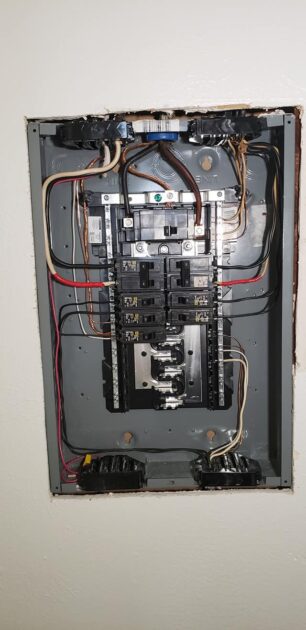
Let’s talk about what happens when a connection loosens in your electrical panel, outlet, or junction box.
Over time, thermal cycling (heating and cooling), vibration, and oxidation cause electrical connections to loosen. A connection that was tight in 2010 might have significant resistance by 2025. This is normal entropy – but it’s expensive.
Here’s a real-world example:
Imagine a 240V electric dryer drawing 24 amps. Now imagine a corroded or loose terminal block introducing just 2 ohms of resistance into that circuit.
The math: 24 amps × 24 amps × 2 ohms = 1,152 watts of wasted power.
The Cost of One Loose Connection
A single 2-ohm loose connection on a dryer circuit wastes 1,152 watts continuously – that’s like running a space heater every time you dry clothes, except you’re not getting any heat, just a higher bill.
That’s over 1 kilowatt of continuous waste. If your dryer runs for 10 hours per week, that’s 11.5 kWh wasted – about $1.84 in direct cost, $96 per year. Multiply that across multiple loose connections in a 20-year-old home, and you’re looking at hundreds of dollars annually.
But the cost isn’t just financial. A connection dissipating 1,000+ watts is dangerous. That level of heat in a confined space (breaker panel, junction box, outlet) is a fire hazard. We’ve responded to service calls where loose connections were literally glowing red-hot inside the panel.
Where do loose connections happen?
- Breaker panel terminals (where breakers connect to the bus bar)
- Main lug connections (where your service entrance wires connect)
- Outlet backstab connections (especially in older homes)
- Junction boxes in attics or behind walls
- Appliance terminal blocks
Warning signs you might have loose connections:
- Electrical panel feels warm to the touch
- Flickering lights when major appliances start
- Outlets feel warm or make buzzing sounds
- Burnt plastic smell near panel or outlets
- Discolored outlets or switch plates
- Breakers that feel hot when you (carefully) touch them
If you notice any of these signs, don’t wait. A professional breaker terminal repair can fix the problem before it becomes dangerous or costs you hundreds in wasted electricity.
💡 Real DFW Service Call Example
Last month, we had a homeowner in Southlake convinced she needed a new dryer because it was “taking forever” and running hot. Her bill had jumped $80/month. The dryer was fine. We found a burnt connection at the dryer outlet – the terminals were so corroded they’d turned black. Replaced the outlet, tightened the breaker connection, bill dropped back to normal. Total cost: $385. She’d been about to buy a $1,200 dryer.
The “Floating Neutral” Problem – Voltage Chaos
This one’s more complicated, but it’s critical to understand because it can destroy appliances while simultaneously driving up your electric bill.
In Texas homes, you have split-phase electrical service. That means you have two 120-volt “legs” and a neutral wire that carries the unbalanced current back to the transformer. When that neutral connection is lost or degraded – usually at the service mast due to weather damage or tree limb contact – your voltage becomes unstable.
What happens:
Without a solid neutral, the voltages on your two 120V legs will “float” inversely to each other. If a heavy load (like a microwave) is applied to Line 1, its voltage might sag to 90V, while the voltage on Line 2 spikes to 150V.
Why this kills your budget:
Motors (in your refrigerator, AC, fans, etc.) are designed to run at specific voltages. When forced to run on low voltage, a motor must draw significantly more current to maintain the same power output. More current = more electricity consumed = higher bill.
It gets worse: the motor also runs hotter, wears out faster, and the appliance takes longer to do its job. Your AC runs longer cycles. Your refrigerator compressor works overtime. Everything costs more to operate.
Meanwhile, appliances on the high-voltage leg are at risk of instant destruction. Smart appliance control boards, HVAC circuit boards, and electronics can fry instantly when hit with 150V instead of the expected 120V.
⚠️ Signs You Might Have a Floating Neutral
Some lights in the house are bright, others are dim. Outlets on one side of the house seem “weak.” Appliances are dying prematurely. Your AC runs constantly but doesn’t cool well. If you see these symptoms, call an electrician immediately – this is both expensive and dangerous.
Texas Attic Heat – The Wire Efficiency Killer
Here’s something specific to our Texas climate that most people don’t consider: your attic is a hostile environment for electrical wiring.
In the DFW area, unconditioned attics regularly reach 140°F-150°F during summer months. That’s not just uncomfortable – it’s electrically significant.
The electrical resistance of copper wire increases with temperature. As the wire heats up, the vibration of the copper atoms interferes with electron flow. This means the wire itself becomes less efficient at conducting electricity.
The National Electrical Code recognizes this problem and requires “derating” wire capacity in high temperatures. A wire rated for 90°C (194°F) installed in a 140°F attic retains only about 71% of its rated capacity.
The real-world impact:
When older wiring (often rated for only 60°C / 140°F) is subjected to 140°F+ attic temperatures, it operates at or beyond its thermal limit. This results in significant voltage drop over long runs – say, from your main panel to a condenser unit on the far side of the house.
The HVAC unit receives lower voltage, runs hotter, draws more current to compensate, and consumes more power to do the same work. You’re essentially paying a “heat tax” on the electricity before it even reaches your appliances.
This is one reason why electrical wiring upgrades can sometimes improve efficiency even when the old wiring “still works.”
Undersized Electrical Panels – Running at Redline
Many DFW homes built in the 1970s and 1980s were equipped with 100-amp or 125-amp electrical panels. At the time, that was adequate. Today, with modern electronics, EVs, and dual HVAC systems, these panels are often pushed to their limits.
When a panel operates near maximum capacity, several problems occur:
- Bus bar heating: The main bus bars and breakers generate heat due to internal resistance. This heat is wasted energy you’re paying for.
- System-wide voltage sag: A saturated service entrance often results in lower voltage throughout the home, forcing all motors and appliances to operate less efficiently.
- Safety concerns: Overloaded panels are a fire risk, plain and simple.
Upgrading to a 200-amp service doesn’t just accommodate new loads – it reduces the resistive losses associated with running electrical infrastructure at capacity. Everything operates at proper voltage, motors don’t work as hard, and efficiency improves across the board.
Is it expensive? Yes – typically $3,600-$5,600 in the DFW market for a complete electrical panel upgrade. But it’s an enabling technology that allows you to add high-efficiency systems (heat pump water heaters, EV chargers, modern HVAC) that offer massive operational savings.
Phantom Loads – The Modern Annoyance
Let’s talk briefly about “phantom loads” or “vampire power” – the electricity consumed by devices when they’re supposedly turned off.
In the era of smart homes, this has become more significant than you might think.
The real culprits:
- Smart TVs in “Quick Start” mode: Can draw 15-20 watts continuously to stay ready for instant-on. Cost: $20-40/year per TV.
- Gaming consoles in “Instant On”: Draw 10-13 watts vs. less than 1 watt in “Energy Saver” mode. For two consoles: ~$30/year wasted.
- Cable boxes and DVRs: Often the worst offenders, drawing 20-30 watts even when the TV is off.
- Smart bulbs and plugs: Each smart bulb draws ~0.5 watts when “off” just to stay connected. With 40 smart bulbs, that’s 20 watts continuously (~$28/year) just for remote control capability.
Research indicates that phantom loads now account for 5-10% of total residential energy usage, costing the average household $100-200 annually.
Is this your $400 mystery? No. But it’s $15-20 per month that you can eliminate with zero cost.
✅ 5-Minute Phantom Load Audit:
- Check “Quick Start” settings on all TVs – disable unless you really need instant-on
- Switch gaming consoles to “Energy Saver” mode
- Use smart power strips for entertainment centers that cut power to peripherals when TV is off
- Audit smart bulb usage – do you really need 40 connected bulbs?
- Unplug rarely-used devices (guest bedroom TV, extra cable boxes, etc.)
The key with phantom loads is keeping perspective. They’re real, they cost money, and they’re worth fixing. But don’t expect this to cut your bill in half. We’re talking $10-20/month in savings, not $100-200.
How to Diagnose Your Real Problem
Alright, you’ve read about appliances, electrical issues, and phantom loads. Now you’re wondering: which problem do I actually have?
Let’s walk through a systematic diagnostic process, moving from simple homeowner checks to professional audits.
Level 1: The Meter Test (DIY – 5 Minutes)
This is the definitive test to verify if your high usage is real or if there’s a metering error.
Steps:
- Turn off all lights and unplug major appliances
- Switch off your HVAC system at the thermostat
- Go to your smart meter (usually on the side of your house)
- Look for the “KW” reading – this shows your instantaneous demand
- It should be near zero (less than 0.05 kW) with everything off
If the meter shows significant draw (0.5 kW or more) with everything off:
- Flip your main breaker in the electrical panel
- If the meter stops (goes to 0.00): The power drain is inside your house – phantom load, forgotten appliance, or wiring fault
- If the meter continues to register usage: The fault is likely in the meter itself or the utility-side wiring – call Oncor immediately
This test eliminates meter errors and confirms whether you have a real consumption issue.
Level 2: Safety Inspection (DIY – 10 Minutes)
You should perform a visual and sensory inspection of your electrical system. Important: Do NOT remove panel covers or open electrical boxes. This is strictly a look-and-feel inspection.
What to Do
Thermal Check: Carefully touch the door and deadfront of your breaker panel. It should be at ambient room temperature. Warmth indicates resistive heating inside – a problem.
Auditory Check: Listen for buzzing or crackling sounds near outlets, switches, or the panel. This is the sound of arcing – a serious issue.
Olfactory Check: A fishy smell, urine-like odor, or burning plastic smell is a specific indicator of overheating wire insulation. If you smell this, turn off power and call an electrician.
Visual Check: Look for discolored outlets, blackened areas around switches, or any melted plastic. These are fire hazards.
If you find any of these warning signs, don’t try to fix it yourself. These are indications of potentially dangerous electrical faults that require professional attention.
Level 3: Professional Electrical Audit
If your Level 1 and 2 checks are inconclusive, or if they revealed potential hazards, it’s time for a professional electrical safety inspection.
A comprehensive electrical audit includes:
- Load calculation: Verifying that your panel isn’t undersized for your home’s actual demand
- Torque and tune: Opening the panel and tightening all connections to manufacturer specifications, eliminating resistive heating
- Thermal imaging: Using infrared cameras to identify “hot spots” in wiring, panels, or attics that are invisible to the naked eye but represent significant energy waste
- Voltage testing: Checking for floating neutral conditions or voltage imbalances
- Arc fault testing: Identifying areas where wiring may be degraded or damaged
Cost: Typically $300-500 for a comprehensive audit in the DFW area.
ROI: If a single loose connection on a major appliance circuit is identified and fixed, the energy savings (~$100-175/year) pay for the inspection in 2-3 years. And you get the unquantifiable benefit of preventing a potential house fire.
Old Appliances vs. Electrical Issues – Which Is It?
This is the payoff section – the answer to the question in the headline. Let’s create a decision framework to help you figure out what you’re actually dealing with.
It’s Probably Your Old Appliances If:
- Your AC is 15+ years old (manufactured before 2010)
- Your refrigerator is from the 1990s or early 2000s
- You’re using a standard electric resistance water heater
- Your usage (measured in kWh, not dollars) has been gradually climbing year over year
- Everything works normally – no flickering, no warm panels, no unusual symptoms
- Your home is similar size to neighbors but your bill is higher
It’s Probably Electrical Issues If:
- Your bill spiked suddenly (within 1-2 billing cycles) with no obvious usage change
- Your electrical panel feels warm to the touch
- You experience lights flickering when major appliances start
- You’ve had breakers tripping repeatedly
- One side of your house has dimmer lights than the other side
- Outlets feel warm or make buzzing sounds
- Your AC runs constantly but the house won’t cool down to the set temperature
- You smell burning plastic or fishy odors near electrical components
It’s Probably BOTH If:
- You live in a pre-2000s DFW home with original appliances
- Your bill has been creeping up for years, then suddenly spiked
- Some appliances are clearly old, AND you have electrical symptoms (flickering, warm panels, etc.)
- You’ve replaced one major appliance but the bill didn’t drop as much as expected
In our experience serving DFW homeowners, about 30% of “high bill” calls turn out to be primarily electrical issues, not appliances. Another 40% are a combination of both. Only 30% are purely appliance-related.
💡 Epic Electrical’s Approach
When you call us about a high electric bill, we don’t automatically recommend a panel upgrade or tell you to buy new appliances. We start with diagnosis. We look at your electrical system first, because if there’s a wiring fault or loose connection causing inefficiency, fixing appliances won’t solve the problem. We give you honest information so you can make informed decisions.
✅ Your Diagnostic Action Plan:
- Step 1: Note all symptoms – flickering, warm panels, unusual smells, anything out of the ordinary
- Step 2: Check the age of your major appliances (AC, water heater, refrigerator)
- Step 3: Perform the meter test outlined above
- Step 4: If any electrical symptoms are present, call an electrician FIRST before shopping for appliances
- Step 5: Get your electrical system cleared before spending money on appliance replacements
Solutions & Return on Investment
Now that you know what you’re dealing with, let’s talk solutions. Not sales pitches – actual cost-benefit analysis so you can make smart decisions.
Electrical Repairs (Often the Highest ROI)
Torque & Tune Service: $300-500
This service involves opening your electrical panel, inspecting all connections, and tightening everything to manufacturer torque specifications. If loose connections are found and corrected, the energy savings can be substantial.
ROI: If a major loose connection is identified (like the dryer example earlier), savings of $100-175/year pay for the service in 2-3 years. Plus you eliminate a fire hazard.
Individual Breaker Replacement: $150-300 per breaker
If a specific breaker connection is burnt or corroded, replacing that breaker fixes the problem immediately.
ROI: Immediate – no more wasted energy through that circuit, and immediate safety improvement.
Panel Upgrade (100 to 200 amp): $3,600-5,600
This is the big one. Is it always necessary? No. But when is it worth it?
- Your current panel is a fire hazard (Federal Pacific, Zinsco, or other recalled brands)
- You’re adding major loads (EV charger, second AC, heat pump water heater)
- Your panel is literally running at capacity and causing voltage sag
- You want to future-proof your home for modern electrical demands
The direct energy savings from reduced resistance are modest. But this is an enabling technology – it allows you to install high-efficiency systems that offer massive operational savings. It’s also critical fire prevention insurance.
Check out our guide on residential electrical panel replacement for more details.
Appliance Replacements (Strategic Priorities)
Priority 1: HVAC (if 15+ years old)
Savings: $250-400/year minimum
Payback: 10-15 years on equipment cost, but remember you were going to replace it eventually anyway
DFW Reality: In our climate, AC is non-negotiable. If your unit is old, the efficiency jump from SEER 10 to SEER 16+ generates real cash flow.
Priority 2: Water Heater (resistance to heat pump)
Savings: $500+/year
Incremental cost over standard tank: ~$1,200-1,500
Payback: 3-4 years
Works great in DFW hot garages – bonus cooling effect.
Priority 3: Refrigerator (if pre-2005)
Savings: $150/year
Cost: $800-1,200
Payback: 5-7 years
Justification: If your fridge is making noise, not cooling well, or from the 1990s, replacement makes sense both for efficiency and reliability.
No-Cost & Low-Cost Wins
Not everything requires big spending:
- Phantom load audit: Free, saves $100-200/year
- Thermostat programming: Free, can save 10-15% on cooling costs
- HVAC maintenance: $150-200/year, improves efficiency by 5-15%
- LED bulb conversion: $100-200 upfront, saves $150-200/year
- Attic insulation upgrade (R-19 to R-49): $1,500-3,000, saves $225-300/year, 7-10 year payback
| Solution | Cost | Annual Savings | Payback Period |
|---|---|---|---|
| Electrical Audit & Tune-Up | $300-500 | $100-200 | 2-3 years |
| Panel Upgrade (100→200A) | $3,600-5,600 | Modest direct / Enables other savings | Insurance + enablement |
| HVAC Replacement (SEER 16) | $5,000-8,000 | $250-400 | 12-20 years |
| Heat Pump Water Heater | $1,200-2,000 | $500+ | 3-4 years |
| Refrigerator Upgrade | $800-1,200 | $150 | 5-8 years |
| Attic Insulation | $1,500-3,000 | $225-300 | 5-10 years |
✅ Our Honest Approach
We start with diagnosis, give you options with transparent costs, and let you decide what makes sense for your budget and priorities. Sometimes it’s a $400 repair. Sometimes it’s a $4,000 upgrade. We give you the information to choose. That’s what “informative without being pushy” actually means.
Frequently Asked Questions
Why is my electric bill so high all of a sudden in Texas?
There are several possible causes for a sudden spike in your Texas electric bill. First, check if your rate increased when your contract renewed – many homeowners forget about this and see jumps of 20-30% overnight. Second, compare your kWh usage (not just the dollar amount) to the same month last year – if usage jumped but nothing changed in your home, you might have a malfunctioning appliance (like a failing AC compressor running constantly) or an electrical fault. Third, check for loose electrical connections or a floating neutral condition, which can cause appliances to work harder and consume more electricity. Finally, verify there’s no billing error or meter malfunction by performing the meter test outlined in this article. If your bill jumped suddenly and you can’t identify an obvious cause, schedule an electrical audit before assuming you need to replace appliances.
Can a panel upgrade actually lower my electric bill?
An electrical panel upgrade can indirectly lower your electric bill, though the direct energy savings are modest. When an old 100-amp panel is operating near capacity, it creates system-wide voltage sag and resistive heating in bus bars – both waste energy. Upgrading to a 200-amp service eliminates these losses. More importantly, a panel upgrade is an “enabling technology” that allows you to install high-efficiency systems (heat pump water heaters, modern HVAC, EV chargers) that offer substantial operational savings. If you’re currently limited by your panel capacity, upgrading can unlock $500-1,000+ in annual savings from efficiency improvements you couldn’t previously make. It’s not the panel itself that saves money – it’s what the new panel allows you to install.
How much electricity does a 20-year-old refrigerator use?
A typical 20-year-old refrigerator uses between 1,200 and 1,400 kWh per year, compared to 400-600 kWh for a modern Energy Star model. At current DFW electricity rates (16-19¢ per kWh), that’s a difference of $128-$152 per year. Older refrigerators consume more power because their insulation degrades over time, door seals crack and leak, and compressor technology is outdated. The unit has to run more frequent cooling cycles to maintain temperature, consuming more electricity. If your refrigerator was manufactured before 2005, replacement typically pays for itself in energy savings within 6-8 years, plus you get improved reliability and features.
What are the warning signs of electrical problems causing high bills?
Key warning signs include: electrical panel that feels warm to the touch, lights that flicker when major appliances start (like AC or dryer), breakers that trip repeatedly without obvious cause, outlets that feel warm or make buzzing sounds, a fishy or burning plastic smell near electrical components, one side of the house with dimmer lights than the other (indicating floating neutral), appliances that seem to be working harder than normal (AC running constantly but not cooling well), and discolored outlets or switch plates. If you notice any of these symptoms, call a licensed electrician for an inspection before assuming you need new appliances. These signs indicate loose connections, voltage problems, or wiring faults that are both wasting energy and creating fire hazards. Learn more about when to call an electrician.
Is it worth replacing appliances that still work?
It depends on the appliance age, the efficiency gap, and your monthly usage. For HVAC systems 15+ years old, yes – the efficiency jump from SEER 10 to SEER 16 saves $250-400 annually in the DFW climate. For refrigerators manufactured before 2005, yes – you’ll save $150+ per year. For electric water heaters, if you’re using resistance heating and can switch to a heat pump model, yes – you’ll save $500+ annually. However, for newer appliances (less than 10 years old) or appliances you use infrequently, the payback period may be too long to justify replacement. Always check your electrical system first – if you have loose connections or voltage problems, those need to be fixed before replacing appliances. Otherwise, you’re just putting new appliances on a faulty electrical system, and they won’t perform efficiently anyway.
How do I know if I have a loose neutral connection?
Signs of a loose or floating neutral include: some lights or outlets in your home are bright while others on a different circuit are dim, voltage readings that fluctuate significantly between different outlets, appliances that seem “weak” or struggle to operate properly, appliances dying prematurely (especially electronics and motors), one side of your home consistently having problems while the other works fine, and flickering lights that don’t correspond to any particular appliance starting. A floating neutral is a serious safety issue that requires immediate professional attention. It causes voltage imbalances that force motors to work harder, increases electricity consumption, and can destroy sensitive electronics. If you suspect a floating neutral, don’t attempt to fix it yourself – contact a licensed electrician immediately.
What should I check first if my bill doubled?
First, compare your kWh usage (not just the dollar amount) to the same month last year – if only dollars increased but kWh stayed the same, your rate went up. Second, check if your contract renewed at a higher rate – this catches many people off guard. Third, perform the meter test described in this article: turn everything off and check if your meter shows near-zero usage. If not, you have a phantom load or electrical fault. Fourth, check for obvious changes: new appliances, family members visiting, kids home from college, thermostat malfunction, or pool pump running continuously. Fifth, look for warning signs of electrical problems: warm panel, flickering lights, buzzing outlets. If none of these reveal the cause, schedule a professional electrical audit before spending money on appliance replacements. About 30% of “doubled bill” cases we investigate turn out to be electrical issues, not appliances.
The Bottom Line: Knowledge Over Guesswork
High electric bills in Texas are frustrating. We get it. You work hard for your money, and watching hundreds of dollars disappear into the grid every month feels wrong.
But here’s what we want you to take away from this article: you don’t have to guess. You don’t need to drop $10,000 on new appliances hoping it fixes the problem. You don’t need to accept a massive electric bill as just “the cost of living in Texas.”
Most high bill situations are a combination of three factors:
- Texas electricity rates that have reset to a higher baseline (this affects everyone)
- Aging appliances operating below modern efficiency standards (this costs $1,000+ per year)
- Electrical issues silently wasting energy 24/7 (this can add hundreds without being obvious)
The key is diagnosis. Find out what you’re actually dealing with before you spend money on solutions.
Start with the simple checks: the meter test, the sensory panel inspection, comparing your kWh usage year-over-year. If those reveal potential electrical issues – warm panels, flickering lights, voltage problems – get those fixed first. A $400 electrical repair might solve a problem you were about to throw $8,000 worth of new appliances at.
If your electrical system checks out clean and your appliances are 15-20 years old, then yes, strategic replacements make financial sense. But do it with intention: prioritize HVAC first (biggest impact in Texas), then water heating, then refrigeration.
Here in the DFW area, we’ve seen every variation of this problem. Homeowners who replaced their entire HVAC system only to discover the real issue was a loose neutral. Homeowners convinced their old fridge was the problem when it was actually a failing AC compressor. And yes, plenty of homes where the appliances really were the issue.
We don’t upsell. We don’t push unnecessary panel upgrades. We start with honest diagnosis and give you the information you need to make smart decisions for your home and your budget.
Because at the end of the day, you deserve to know what’s actually going on. Not what someone wants to sell you.
Call or Text: (682) 478-6088
Serving Fort Worth, Arlington, Keller, Southlake, Colleyville, Grapevine, Lewisville, and all of DFW