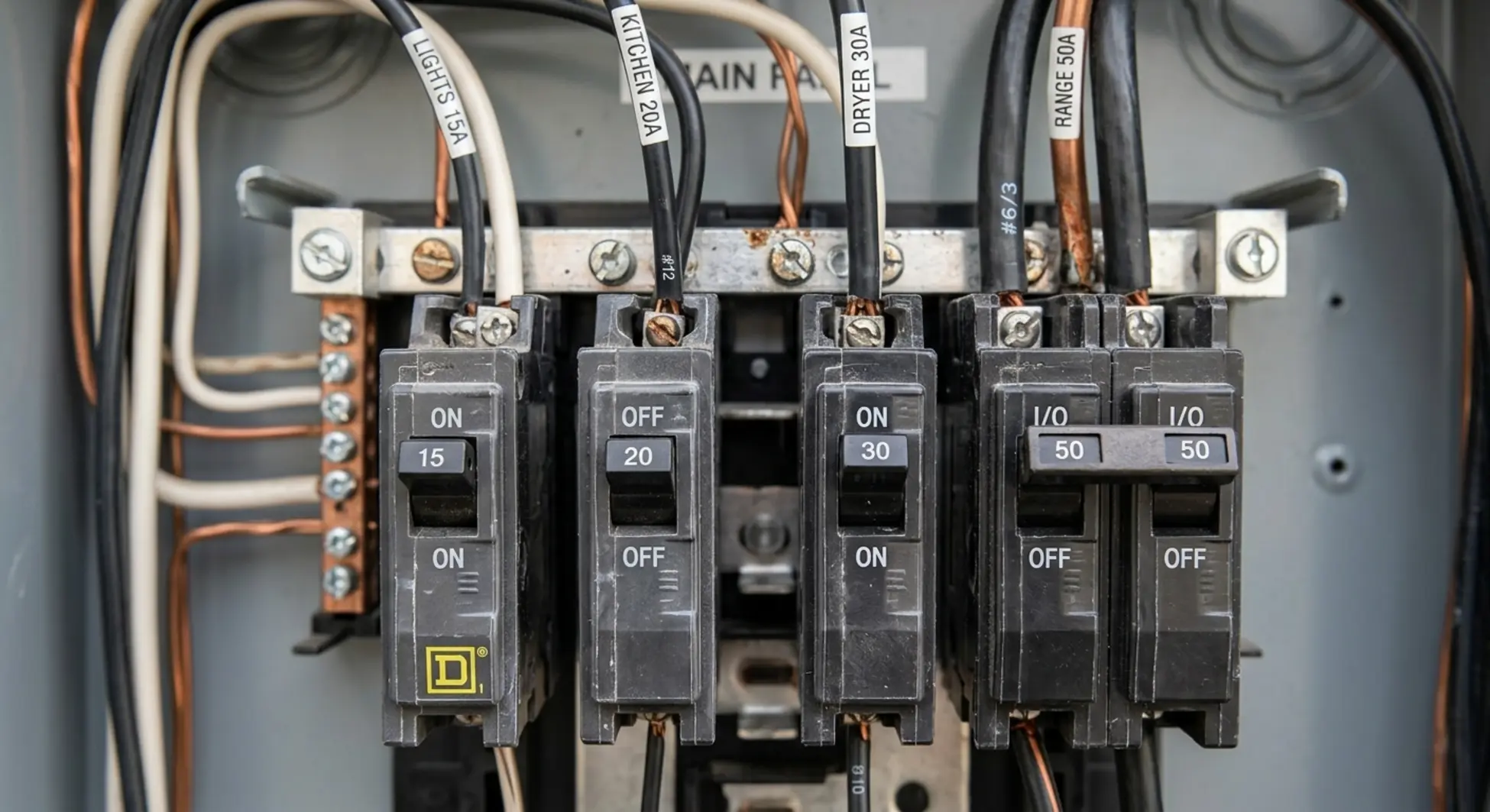
Key Takeaways
- Federal Pacific Electric (FPE) Stab-Lok breakers — Found in millions of homes built between the 1950s and 1980s, these are among the most widespread recalled breakers in the U.S.
- Zinsco and Pushmatic breakers — Common in DFW homes from the 1960s–1980s, these are known for failing to trip during electrical overloads.
- Silent failure is the real danger — Recalled breakers often show no warning signs before creating a fire hazard inside your walls.
- Free replacement programs exist — Many manufacturers offer no-cost replacement breakers through CPSC-coordinated recall programs.
- Replacement costs range from $300–$3,000 — A single breaker swap runs $300–$800; a full panel replacement is $1,500–$3,000, often offset by manufacturer programs.
- This is not a DIY job — Circuit breaker replacement must be performed by a licensed electrician to meet code and protect your home.
- You don’t need to panic — Most homes with recalled breakers have operated safely for years. What you need is a plan, not fear.
Your circuit breaker is one of the most important safety devices in your home, and you probably never think about it — until something goes wrong.
Maybe your breaker keeps tripping and you’re not sure why. Maybe you caught a news segment about a recall and thought, “Wait — could that be my panel?” Or maybe you’re getting ready to sell your home and the inspector flagged something in the electrical panel that you’ve never heard of. Whatever brought you here, you’re asking the right questions.
The honest answer is this: circuit breaker recalls are more common than most homeowners realize, and many people are living in homes with panels that were flagged for safety concerns decades ago — without ever knowing it. That’s not meant to scare you. It’s meant to help you understand what you’re dealing with so you can make a clear, informed decision about your next step.
This guide walks through the most significant recalls currently affecting homeowners, how to check whether your home is affected, what the actual risks are, and what your options look like — including free replacement programs that can reduce or eliminate your out-of-pocket costs. We’ll also cover what the replacement process actually looks like, so there are no surprises.
Knowledge is the antidote to worry. Let’s start there.
Why Circuit Breaker Recalls Matter for Your Home
Most homeowners think of their electrical panel as something that just sits in the garage or utility room doing its job quietly. And most of the time, that’s true. But the circuit breakers inside that panel are your home’s primary electrical safety device — and when they fail, the consequences can be serious.
A circuit breaker is designed to do one thing above all else: shut off power automatically when it detects too much current flowing through a circuit. That automatic shutoff is what prevents overloaded wiring from overheating, arcing, and starting a fire inside your walls. When a breaker works correctly, an overload trips the breaker, you reset it, and you figure out what caused the problem. When a breaker fails to trip — which is exactly what recalled breakers are known for doing — that protection disappears.
The reason recalls matter is that defective breakers often fail silently. There’s no alarm, no smoke, no obvious sign that something is wrong. The breaker looks fine. It may even trip occasionally, giving you false confidence that it’s working. But under specific conditions — the kind that matter most, like a significant overload — it doesn’t do what it’s supposed to do. That’s the core problem with the most widely recalled breaker types.
Recalls happen regularly across all kinds of consumer products, and electrical components are no exception. The Consumer Product Safety Commission (CPSC) maintains an active recall database, and manufacturers periodically issue their own safety notices when defects are identified. The challenge for homeowners is that many of the most significant circuit breaker recalls happened years or even decades ago — and the panels are still in homes today. A recall doesn’t automatically mean someone came out and fixed your panel. It means the problem was identified. Acting on it is still up to you.
Understanding electrical safety in your home starts with knowing what’s actually inside your panel. That knowledge empowers you to take action before a problem becomes dangerous — not after. If you’re reading this because you’re concerned about your home, that concern is worth following through on. The good news is that the path forward is clearer than you might think.
Major Circuit Breaker Recalls Currently Affecting Homeowners
Not all recalled breakers are the same, and not all of them carry the same level of risk. Some are older recalls that have been on safety organizations’ radar for decades. Others are more recent notices from manufacturers you’d recognize from the hardware store. Here’s what you need to know about the most significant ones — and how to tell which category your home might fall into.
Federal Pacific Electric (FPE) Stab-Lok Breakers
If there’s one name that comes up most often in conversations about recalled circuit breakers, it’s Federal Pacific Electric — specifically their Stab-Lok panels. These panels were installed in an estimated 2 to 3 million homes across the United States, primarily in homes built between the 1950s and 1980s. In the Dallas-Fort Worth area, where a significant portion of the housing stock dates to that era, FPE panels are not uncommon.
The core problem with Stab-Lok breakers is well-documented: they fail to trip during overloads at an alarming rate. Research conducted by electrical engineer Jesse Aronstein found that FPE Stab-Lok breakers failed to trip in a significant percentage of tests — meaning in real-world conditions, these breakers may not shut off power when they’re supposed to. That failure creates a direct pathway to electrical fires that start inside walls, often without any visible warning.
The CPSC investigated FPE breakers in the 1980s, and while a formal nationwide recall was never issued, the consensus among electrical safety organizations — including the International Association of Certified Home Inspectors (InterNACHI) — is that these panels should be replaced. If a home inspector has ever flagged your panel, there’s a reasonable chance this is what they were looking at.
FPE Stab-Lok panels are identifiable by the brand name on the panel door and the distinctive red stripe on the breaker switches. If your home was built between 1955 and 1983, it’s worth taking a look. A professional electrical panel inspection can confirm the brand and give you a clear picture of your options.
Zinsco and Pushmatic Breakers
Zinsco panels share a similar failure profile with FPE — breakers that don’t trip reliably during overloads. Zinsco (also sold under the GTE-Sylvania brand) was popular in homes built in the 1960s and 1970s. The failure mechanism is slightly different: Zinsco breakers are known for the bus bar connections inside the panel becoming fused to the breaker, which means the breaker can’t be removed or replaced — and may not trip even when it appears to be functioning.
Overheating is a particular concern with Zinsco panels. The aluminum bus bars can corrode and create resistance, which generates heat. In some cases, the plastic components inside the panel show visible signs of melting or discoloration — a clear indicator that something is wrong. Insurance companies have started flagging Zinsco panels as liability issues, and some insurers will decline to renew a homeowner’s policy if a Zinsco panel is present.
Pushmatic breakers, manufactured by ITE (later acquired by Siemens), are another older panel type that shows up frequently in homes from the same era. Unlike standard breakers that flip to the off position when tripped, Pushmatic breakers use a push-button mechanism. The failure concern is similar — degraded internal components that may not respond correctly to overloads. Parts for Pushmatic panels are no longer manufactured, which means repair is essentially impossible and full panel replacement is the standard recommendation.
Recent Manufacturer Recalls
It’s not just older panels that carry recall risk. Even modern breakers from well-known manufacturers occasionally have safety notices issued against them. Eaton, Square D (Schneider Electric), and Siemens have all had specific breaker models subject to recalls in recent years — typically for manufacturing defects that affect the tripping mechanism or create overheating risk.
The key distinction with modern recalls is that they’re usually model-specific. Not every breaker from a given manufacturer is affected — only specific model numbers, production runs, or date ranges. The CPSC website (cpsc.gov) maintains an updated recall database where you can search by manufacturer and product type. Manufacturer websites also maintain recall information and, importantly, instructions for accessing free replacement programs when they exist.
The important thing to understand is that a recall doesn’t mean your entire electrical system is compromised. It means a specific component has been identified as potentially defective, and there’s usually a clear path to resolution — often at little or no cost to you.
🏠 You’re Not Alone — Millions of Homes Are Affected
Federal Pacific Electric breakers alone are estimated to be in 2 to 3 million homes across the U.S. If your home was built in the 1960s–1980s, there’s a real chance you have one. This isn’t a rare or unusual problem — it’s a common situation that homeowners address every day. You’re not behind the curve for not knowing about it. You’re ahead of it now.
How to Check If Your Home Is Affected by a Recall
The good news is that checking whether your home has a recalled breaker doesn’t require any special tools or electrical knowledge. It does require a few minutes and a willingness to look at your electrical panel from the outside. Here’s how to do it safely and effectively.
Step-by-Step Identification Process
Step 1: Locate your electrical panel. In most DFW-area homes, the main electrical panel is in the garage, a utility room, a hallway closet, or (in older homes) sometimes on an exterior wall. It’s a metal box, usually gray or beige, mounted flush with the wall. Some homes have a subpanel in addition to the main panel — check both.
Step 2: Read the label on the outside of the panel enclosure. This is important — you do not need to open the panel door to identify the manufacturer. The manufacturer’s name is typically printed or embossed on the outside of the enclosure door. Common names you’re looking for include Federal Pacific Electric, FPE, Stab-Lok, Zinsco, GTE-Sylvania, ITE, Pushmatic, Eaton, Square D, Siemens, and Cutler-Hammer.
Step 3: Note the model number and amperage rating. These are usually on a label inside the door or on the enclosure itself. The model number is what you’ll need to cross-reference with recall databases. The amperage rating (100A, 150A, 200A) tells you the size of your panel and is useful information for any electrician you speak with.
Step 4: Write down the year of installation if visible. Some panels have installation dates stamped on the enclosure or on a sticker inside the door. This helps narrow down whether your panel falls within the affected production years for specific recalls.
Step 5: Take clear photos for your records. A photo of the panel label, the breaker switches, and the overall panel is invaluable when talking to an electrician or checking recall databases. You can do all of this with your phone without touching any electrical components.
Step 6: Cross-reference with the CPSC database. Go to cpsc.gov and use the recall search to look up your manufacturer and product type. Also check the manufacturer’s website directly — they often have dedicated recall pages with model-specific information and instructions for replacement programs.
If you’re not comfortable doing this yourself, or if the panel label is worn or illegible, a professional electrical inspection is the safest and most reliable way to confirm your breaker type and recall status. A licensed electrician can identify your panel type in minutes and give you a clear, honest assessment of what you’re working with.
⚡ Why Breakers Trip (And Why Some Don’t)
A circuit breaker is designed to automatically shut off power when it detects an overload or short circuit — essentially, when too much electrical current flows through a circuit. It does this through a bimetallic strip or electromagnetic mechanism that physically breaks the circuit. Recalled breakers fail to do this reliably, meaning dangerous electrical current can continue flowing through overloaded wiring even when it shouldn’t. That’s the core safety issue — not a dramatic explosion, but a quiet, invisible failure that creates heat and fire risk inside your walls.
Not sure what brand of breaker is in your panel, or whether your specific model is affected? That’s exactly what a professional inspection is designed to answer. We’ll identify your breaker type, check recall status, and give you a clear path forward — no pressure, just honest advice.
Safety Risks of Recalled Circuit Breakers
Understanding the actual risk of a recalled breaker helps you make an informed decision — not a fear-based one. The risks are real, but they’re also specific and manageable once you know what you’re dealing with.
Why Breakers Fail to Trip
The primary hazard with most recalled breakers — FPE, Zinsco, Pushmatic, and others — is failure to trip during an overload. This isn’t a random or unpredictable failure. It’s a result of specific design flaws or material degradation that affects the tripping mechanism inside the breaker.
In FPE Stab-Lok breakers, the issue is a design flaw in how the breaker connects to the bus bar inside the panel. The connection can become loose or corroded over time, and the internal tripping mechanism doesn’t respond correctly to overload conditions. In Zinsco breakers, the aluminum bus bars can fuse to the breaker terminals, physically preventing the breaker from tripping or even being removed. In older Pushmatic breakers, the internal springs and mechanisms degrade over decades of use, losing the tension needed to trip reliably.
The result in all cases is the same: electrical current continues flowing through a circuit that’s drawing more power than the wiring can safely handle. That excess current generates heat in the wiring itself — and that heat, sustained over time, can ignite insulation, framing, or other combustible materials inside your walls.
Fire Risk and Electrical Hazards
Electrical fires are particularly dangerous because they often start inside walls, in attic spaces, or in areas where they’re not immediately visible. By the time smoke or heat becomes noticeable, a fire may have been smoldering for hours. This is why the failure-to-trip problem is so significant — it removes the one automatic safeguard that’s supposed to stop an overload before it becomes a fire.
The risk isn’t constant or uniform. A home with a recalled breaker that’s lightly loaded — meaning the circuits aren’t regularly drawing near their rated capacity — may operate safely for years. The risk increases with electrical demand. In DFW homes, where summer air conditioning loads are substantial and modern households run significantly more electrical equipment than homes from the 1960s or 1970s were designed for, the cumulative stress on an aging panel is higher than it might have been originally.
There’s also an insurance dimension to this risk. Many homeowners’ insurance companies have become more aware of FPE and Zinsco panels over the past decade. Some insurers will flag these panels during underwriting, require replacement before issuing or renewing a policy, or charge higher premiums for homes that have them. If you’re selling your home, a buyer’s inspector will almost certainly flag a recalled panel — which can affect your sale price or timeline.
The cumulative picture is this: a recalled breaker doesn’t mean your home is in immediate danger, but it does mean you’re operating without the full protection your electrical system is supposed to provide. The longer a defective breaker is in service, the higher the cumulative risk — and the harder it becomes to address proactively rather than reactively.
⚠️ Red Flags: When to Act Immediately
If you notice frequent breaker trips that don’t have an obvious cause, a burning smell near your electrical panel, visible corrosion or discoloration on the panel interior, or breakers that feel warm or hot to the touch — don’t wait. These are signs of an active electrical problem that needs professional attention right away, regardless of whether your breaker is on a recall list. Call a licensed electrician the same day.
Free Replacement Programs and Manufacturer Support
Here’s something a lot of homeowners don’t realize: if your breaker is subject to a manufacturer recall, you may be entitled to free replacement components — and in some cases, reimbursement for installation labor. This is one of the most important things to check before you do anything else.
How Manufacturer Replacement Programs Work
When a manufacturer issues a recall in coordination with the CPSC, they’re typically required to offer a remedy — which for circuit breakers usually means free replacement units. The process varies by manufacturer and recall, but the general framework looks like this:
First, you identify your breaker model and confirm it falls within the recalled range. The manufacturer’s website and the CPSC recall database both provide model number lists and affected date ranges. Second, you register your product with the manufacturer using the serial number from your panel. Third, the manufacturer ships replacement breakers to you at no charge. Fourth, you arrange installation with a licensed electrician — which is a separate cost, though some programs include labor reimbursement.
The key detail to check is whether the specific program for your breaker includes labor coverage. Some do, some don’t. It’s worth spending 15 minutes on the manufacturer’s website to understand exactly what’s covered before you get quotes for installation. If labor is reimbursable, you’ll want to keep your receipts and follow the manufacturer’s documentation requirements.
For older recalls — like FPE and Zinsco — the original manufacturers are no longer in business, which means there’s no active manufacturer replacement program. In these cases, the cost of replacement falls entirely to the homeowner, though insurance and other assistance programs may help offset it. We’ll cover those options below.
Insurance and Utility Company Assistance
Your homeowner’s insurance policy is worth a direct conversation when it comes to recalled breaker replacement. Coverage varies significantly between insurers and policies, but many policies do cover electrical panel repairs and upgrades — particularly when the work is connected to a documented safety issue or recall. Some insurers will even proactively reach out if they become aware that your home has a flagged panel type.
The best approach is to call your insurance company directly and ask two specific questions: Does my policy cover the cost of replacing a recalled circuit breaker? And is there any requirement for me to replace it to maintain coverage? The answers will tell you exactly where you stand and may reveal coverage you didn’t know you had.
Local utility companies are another resource worth exploring. Oncor and other DFW-area utilities occasionally offer safety rebate programs or incentives for electrical upgrades, particularly those that improve safety or energy efficiency. These programs change periodically, so it’s worth checking their websites or calling their customer service lines to ask what’s currently available.
If you’d like help navigating your specific options — manufacturer programs, insurance coverage, and financing — contact us for a free estimate and we’ll walk through the full picture with you. We’ve helped a lot of DFW homeowners figure out the most cost-effective path to getting their panels addressed.
💡 Pro Tip: Check the Manufacturer’s Website Before Calling Anyone
Before scheduling an inspection or getting quotes, spend 10 minutes on the manufacturer’s website to see if there’s an active free replacement program for your specific breaker model. Search the CPSC database at cpsc.gov as well. You might save hundreds of dollars by confirming what’s covered before the work begins. Bring that information to your electrician — a good one will factor it into your quote.
What to Do If Your Home Has a Recalled Breaker
Finding out your home has a recalled circuit breaker can feel alarming — but it doesn’t have to be. Most homes with recalled breakers have operated safely for years, and the path forward is straightforward once you know what it looks like. Here’s how to approach it without getting overwhelmed.
Getting a Professional Inspection
The first step is confirming what you actually have. If you’ve done the visual check described earlier and believe you have a recalled panel, the next move is scheduling a professional inspection with a licensed electrician in DFW who can confirm the panel type, check for any immediate safety concerns, and give you an honest assessment of your options.
A professional inspection does more than just confirm the recall. It also identifies any other issues in the panel — signs of overheating, improper wiring, undersized circuits, or other problems that may have developed over time. This gives you a complete picture rather than just addressing one issue in isolation. The inspection also produces documentation that’s useful for insurance claims, manufacturer replacement programs, and home sale disclosures.
The inspection itself typically takes 30 minutes to an hour. A good electrician will explain what they find in plain language, tell you what’s urgent versus what can wait, and give you options — not just a single recommendation with a high-pressure price attached to it. If you’re getting quotes, make sure each electrician is assessing the same scope of work so you can compare accurately.
Understanding Replacement Costs
Being clear-eyed about costs helps you plan and avoid surprises. Here’s what you can generally expect in the DFW market:
Single breaker replacement: $300–$800, depending on the breaker type, amperage, and accessibility. This is appropriate when only one or a few specific breakers are recalled and the panel itself is otherwise in good condition.
Full panel replacement: $1,500–$3,000 for most residential panels. This is the standard recommendation for FPE, Zinsco, and Pushmatic panels, where the entire panel — not just individual breakers — is considered compromised. Panel replacement includes a new main breaker panel, all circuit breakers, updated wiring connections, and a permit and inspection from the local authority having jurisdiction.
Panel upgrade (if needed): If your current panel is undersized for your home’s electrical demands — common in older homes — you may want to upgrade to a higher-amperage panel at the same time. This adds cost but avoids doing the work twice. Your electrician can advise whether this makes sense for your specific situation.
Manufacturer replacement programs, insurance coverage, and financing options can all reduce your out-of-pocket cost. Don’t assume you’ll be paying the full amount before you’ve explored those avenues.
🙌 This Isn’t an Emergency — But It Is Important
Most homes with recalled breakers have operated safely for years. You don’t need to panic or rush into an expensive decision. What you do need to do is schedule a professional inspection and plan for replacement on a reasonable timeline. That’s the responsible approach — and it puts you in control of the process rather than reacting to a crisis.
Ready to understand your replacement options and what they’ll actually cost for your specific home? We offer free estimates and can walk you through manufacturer programs, insurance coverage, and financing — no obligation, just a straightforward conversation about keeping your home safe.
Circuit Breaker Replacement Process: What to Expect
One of the most common reasons homeowners delay addressing a recalled breaker is uncertainty about what the replacement process actually involves. Will the power be out all day? Will it be disruptive? How long will it take? These are reasonable questions, and the answers are more reassuring than most people expect.
The Replacement Timeline
Initial inspection and quote: 30 minutes to 1 hour. This is the assessment visit where the electrician confirms your panel type, identifies the scope of work, and provides a written estimate. This is also when you’ll discuss manufacturer replacement programs and whether your specific situation qualifies for any free components.
Ordering replacement components: 1–2 weeks, or immediate if in stock. If your replacement breakers need to be ordered — either through a manufacturer recall program or standard supply channels — allow one to two weeks for delivery. Many common breaker types are stocked locally and can be installed at the next available appointment without a wait.
Installation appointment: 1–3 hours. The actual installation is typically completed in a single visit. For a single breaker replacement, expect closer to one hour. For a full panel replacement, plan for two to three hours. During this time, power to the panel will be shut off — which means no power to the circuits served by that panel. Your electrician will let you know in advance which areas of your home will be affected and for how long.
Final inspection and testing: included in installation. After the work is complete, the electrician will test all circuits to confirm everything is functioning correctly. For panel replacements, a permit inspection from the local building department is typically required — your electrician handles scheduling this, and it’s included in the scope of work.
Preparing Your Home for Replacement
A little preparation makes the process smoother for everyone. Clear the area around your electrical panel before the appointment — the electrician needs unobstructed access to the panel and enough room to work safely. If you have a finished garage or utility room, this usually just means moving a few boxes or shelving items out of the way.
Let family members know in advance that there will be a period without power to certain areas of the home. If you work from home, plan to use a laptop on battery or relocate to a coffee shop for the duration of the work. If you have medical equipment that requires power, discuss this with your electrician before scheduling so accommodations can be made.
Have a list of questions ready for your electrician. This is a good time to ask about the condition of the rest of your electrical system, whether your panel amperage is adequate for your current and future needs, and whether there are any other items that should be addressed while the panel is open. A good electrician will welcome these questions — it’s how you make sure the job is done right the first time.
If you’re ready to move forward, we’re here to help. As a family-owned DFW electrical company, we’ve handled thousands of breaker replacements and know exactly how to navigate recalls and manufacturer programs. Reach out to schedule your inspection or replacement and we’ll take it from there.
If you’re ready to schedule your inspection or replacement, we’re here to make it easy. As a family-owned DFW electrical company, we’ve handled thousands of breaker replacements and know exactly how to navigate recalls, permits, and manufacturer programs — so you don’t have to figure it out alone.
Preventing Future Electrical Issues: Maintenance and Upgrades
Addressing a recalled breaker is an important step — but it’s also an opportunity to think more broadly about the long-term health of your home’s electrical system. Electrical safety isn’t a one-time event; it’s an ongoing part of responsible homeownership, especially in older homes where the electrical infrastructure was designed for a very different era of power consumption.
Recommended Inspection Schedule
For homes built before 1990, a professional electrical inspection every three to five years is a reasonable baseline. These inspections catch problems early — before a tripping breaker becomes a fire hazard, before a loose connection becomes an arc fault, before an undersized circuit becomes a daily frustration. The cost of a periodic inspection is a fraction of what emergency repairs cost, and it gives you documentation that’s valuable for insurance and resale.
Between professional inspections, a simple annual visual check of your electrical panel takes about five minutes. You’re looking for signs of corrosion or rust on the panel enclosure, any breakers that appear to be in the tripped position without an obvious cause, discoloration or burn marks around the panel, or any unusual smell near the panel. None of these require opening the panel — just a visual check from the outside.
Schedule an immediate inspection if you notice frequent breaker trips that don’t have a clear cause, if you’re adding significant new electrical loads (EV charger, hot tub, major appliance), or if you’re buying or selling a home. Buyers’ inspectors routinely flag electrical issues, and it’s far better to know about and address them before they become a negotiation point.
Thinking about electrical system upgrades is also worth doing proactively rather than reactively. Modern panels with arc fault circuit interrupters (AFCIs) and ground fault circuit interrupters (GFCIs) provide significantly better protection than older panels. They’re also better equipped to handle the electrical demands of today’s homes — multiple large appliances, home offices, EV charging, smart home systems — without the overload risk that older panels face.
The Texas climate adds a layer of consideration that’s specific to DFW homeowners. Extreme summer heat and the humidity swings that come with North Texas weather accelerate the degradation of electrical components — particularly in panels that are located in unconditioned spaces like garages or exterior utility rooms. Heat cycling causes metal components to expand and contract repeatedly, which can loosen connections over time. This is one reason why DFW homes may see electrical issues develop faster than homes in more temperate climates.
DFW-Specific Considerations for Circuit Breaker Safety
The Dallas-Fort Worth area has a housing stock that’s particularly well-represented in the recalled breaker categories. A significant portion of DFW homes were built during the 1960s, 1970s, and early 1980s — exactly the period when FPE Stab-Lok, Zinsco, and Pushmatic panels were most commonly installed. If you live in an established neighborhood in Fort Worth, Arlington, Keller, Garland, Mesquite, or any of the older DFW suburbs, the probability that your home has one of these panel types is meaningfully higher than the national average.
Texas building codes have evolved significantly over the past few decades, and the standards that apply to new construction and major renovations today are considerably more stringent than what was required when many of these panels were installed. That’s not a criticism of the original builders — it reflects how much our understanding of electrical safety has improved. What it means practically is that older DFW homes may have electrical systems that were perfectly code-compliant when built but don’t meet current safety standards.
The North Texas climate creates specific stress on electrical panels. Summer temperatures in the DFW area regularly exceed 100°F, and panels located in garages or on south-facing exterior walls can experience internal temperatures significantly higher than that. This heat accelerates the degradation of the plastic components, metal contacts, and spring mechanisms inside breakers — which is exactly the kind of degradation that contributes to failure-to-trip problems in already-compromised breaker types. If you have an FPE or Zinsco panel in an unconditioned garage, the cumulative thermal stress over decades of DFW summers is a real factor in assessing your risk.
Local electricians who work regularly in the DFW market are familiar with the specific panel types that show up most often in the region’s housing stock. When you work with a contractor who has deep experience in the area, you’re getting someone who has seen these panels hundreds of times — not someone who has to look up the manufacturer on their phone. That familiarity matters when it comes to identifying issues accurately and recommending the right solution.
If you’re in the Fort Worth, Arlington, Keller, Southlake, Colleyville, Grapevine, or Lewisville area and you have questions about your specific panel, our team at Epic Electrical has been serving DFW homeowners for three generations. We know the local housing stock, we know the local codes, and we know how to navigate the recall and replacement process efficiently. Our DFW electrical services are built around giving homeowners honest information and real options — not upselling work that isn’t needed.
Common Questions About Circuit Breaker Recalls
How do I know if my circuit breaker is on a recall list?
Start by locating the manufacturer name and model number on the outside of your electrical panel enclosure — you don’t need to open the panel to find this information. Once you have those details, search the CPSC recall database at cpsc.gov or go directly to the manufacturer’s website, which often has a dedicated recall page with model-specific information. If the label on your panel is worn or illegible, or if you’re not comfortable doing this yourself, a licensed electrician can identify your breaker type during a professional inspection in a matter of minutes. We can help you determine your recall status quickly and accurately.
Is my home in danger if I have a recalled circuit breaker?
Most homes with recalled breakers have operated safely for years, and having a recalled breaker doesn’t mean your home is in immediate danger. The risk is real but cumulative — the primary concern is that a recalled breaker may fail to trip during an overload, which removes the automatic protection against electrical fires. The longer a defective breaker is in service and the higher the electrical demand on your circuits, the greater the cumulative risk. Replacement is strongly recommended by electrical safety organizations including InterNACHI and the CPSC, but this is a planned repair, not an emergency evacuation situation.
Will my homeowner’s insurance cover the cost of replacing a recalled breaker?
Coverage varies significantly between insurance companies and individual policies, but many homeowner’s insurance policies do cover electrical panel repairs and upgrades — particularly when the work is connected to a documented safety issue or manufacturer recall. The best approach is to call your insurance company directly and ask two specific questions: whether your policy covers recalled breaker replacement, and whether there’s any requirement to replace it to maintain your coverage. Some insurers may even require replacement before renewing your policy, so it’s worth having this conversation sooner rather than later.
How much does it cost to replace a recalled circuit breaker?
In the DFW market, a single breaker replacement typically costs $300–$800 depending on the breaker type, amperage, and accessibility. A full panel replacement — which is the standard recommendation for FPE, Zinsco, and Pushmatic panels — runs $1,500–$3,000 for most residential installations. However, if your breaker is subject to an active manufacturer recall, you may be entitled to free replacement components through the manufacturer’s program, which can significantly reduce your out-of-pocket cost. We can help you check what programs apply to your specific breaker and factor that into your estimate.
Can I replace a circuit breaker myself, or do I need a licensed electrician?
Circuit breaker replacement must be performed by a licensed electrician — this is not a DIY project. Working inside an electrical panel exposes you to live electrical components that can cause serious injury or death, even with the main breaker turned off. Beyond the safety risk, unlicensed electrical work violates building codes in Texas, may void your homeowner’s insurance, and can create problems when you sell your home. A licensed electrician will complete the work safely, ensure it meets current code requirements, pull the necessary permits, and provide documentation for your insurance and home records.
How long does it take to replace a circuit breaker?
Most single breaker replacements take one to two hours from start to finish. A full panel replacement typically takes two to three hours, plus a permit inspection from the local building department which is scheduled separately. During the work, power to the panel will be temporarily shut off — your electrician will let you know in advance which areas of your home will be affected and for how long. If replacement components need to be ordered, allow one to two weeks for delivery before the installation appointment; if the parts are in stock, we can often schedule the installation within a few days of the initial inspection.
Don’t Let a Recalled Breaker Put Your Home at Risk — Let’s Figure Out Your Next Step Together
Whether you’ve confirmed a recall in your home or you just want peace of mind from a professional who’ll give you a straight answer, we’re here to help. We’ll assess your panel, walk you through your options — including any free replacement programs you qualify for — and give you an honest estimate with no pressure attached. That’s how we’ve operated for three generations, and it’s not changing.
Serving Fort Worth, Arlington, Keller, Southlake, Colleyville, Grapevine, Lewisville, and all of DFW | (682) 478-6088