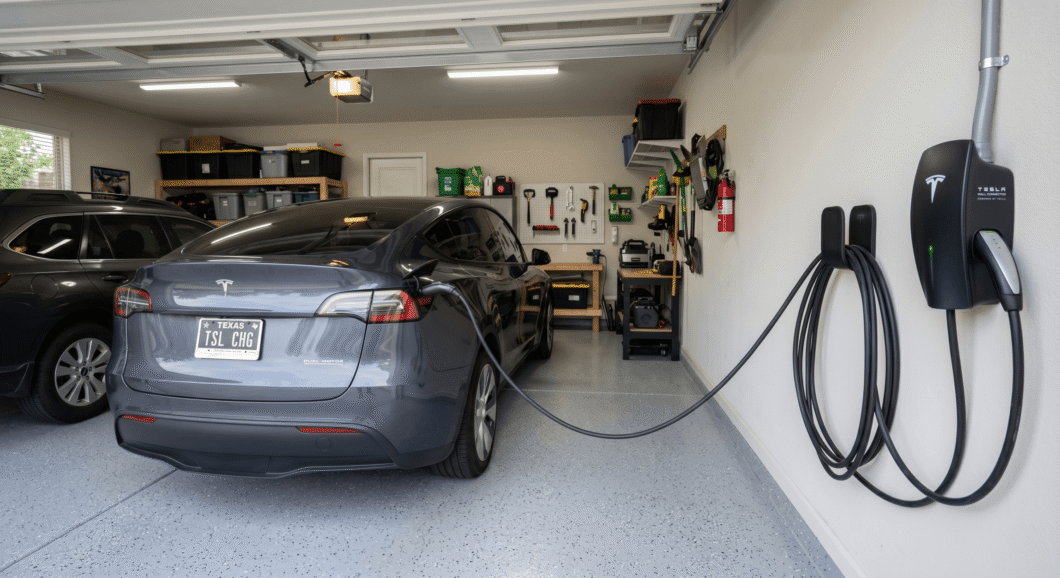
Key Takeaways
- Installation costs vary widely — Fort Worth Tesla Wall Connector installation runs $750–$6,000+ depending on your home’s electrical infrastructure, not contractor markups.
- Most Fort Worth homes fall in the $1,200–$2,500 range — standard installations requiring a new 240V circuit and conduit run are the most common scenario.
- A federal tax credit covers up to $1,000 — the IRA 30C credit reimburses 30% of hardware and labor costs; you’ll need an itemized invoice to claim it.
- Oncor TOU rates can save you $400–$900 annually — scheduling overnight charging during off-peak hours makes home charging dramatically cheaper than Superchargers.
- Permits are non-negotiable — the City of Fort Worth requires permits for new 240V circuits; any contractor who skips this step is a red flag.
- Older Fort Worth homes often need panel upgrades — homes built pre-1990s frequently lack the capacity for a 40–60 Amp dedicated circuit without panel work.
- Verify your electrician’s TECL license — Texas Master Electrician licensing is mandatory; unlicensed installation voids warranties and creates serious hazards.
Tarrant County EV registrations are projected to hit 30,000+ in 2026, and Tesla holds roughly 40–50% of the Texas EV market. That means tens of thousands of Fort Worth homeowners are going through the same experience right now: they buy a Tesla, get excited about home charging, start asking around for installation quotes — and then get hit with numbers ranging from $750 to $6,000+. The confusion is real. The frustration is understandable. And the wide range isn’t a scam — it reflects genuine differences in what your home’s electrical infrastructure requires.
This guide is designed to remove the mystery. We’ll walk through exactly what drives those cost differences in the Fort Worth market, what you should expect to pay for your specific situation, which incentives actually apply to Texas homeowners, and what to look for (and run from) when hiring an electrician. No fluff, no pressure — just the information you need to make a confident decision.
Why Fort Worth EV Owners Need a Home Charging Station
Fort Worth summers are brutal. Temperatures regularly exceed 100°F from June through August, and that heat directly impacts EV battery performance — reducing range and increasing the energy required for thermal management. When your battery is already stressed by the climate, the last thing you want is a charging setup that can’t keep up with your daily driving needs.
Here’s the practical reality of the charging options available to you:
- Level 1 (standard 120V outlet): Adds 3–5 miles of range per hour. A full charge from near-empty takes 2–3 days. Fine for a plug-in hybrid. Genuinely impractical for a Tesla.
- Level 2 (240V, Wall Connector or NEMA 14-50): Adds 25–40 miles of range per hour. Full charge overnight. This is what makes home charging actually work.
Beyond convenience, the economics are compelling. Oncor’s Time-of-Use (TOU) rates allow Fort Worth homeowners to charge during off-peak hours (typically 9 PM–6 AM) at roughly $0.10–$0.18/kWh. Compare that to Tesla Supercharger rates of $0.30–$0.50/kWh, and you’re looking at potential savings of $400–$900 per year just by charging at home overnight. Over five years, that’s $2,000–$4,500 back in your pocket.
The DFW metro now exceeds 8.1 million residents, and EV adoption is accelerating across Tarrant County. As more buyers look for move-in-ready homes, a properly installed Level 2 charger is increasingly becoming a selling point. It’s not guaranteed to add dollar-for-dollar value, but it enhances marketability in a market where EV ownership is becoming mainstream.
Many Fort Worth homes — especially those built in the 1980s and 1990s — weren’t designed with EV charging in mind. That’s why understanding your home’s electrical capacity matters before you get a quote. In some cases, residential panel installation or upgrades are part of the conversation from day one. We’ll cover exactly when that’s necessary and what it costs.
Tesla Wall Connector vs. Other Charging Options: What’s the Real Difference?
When homeowners start researching home EV charging, they typically encounter three options: keep using a standard 120V outlet, install a NEMA 14-50 outlet, or install a dedicated Tesla Wall Connector. The price differences between these options are real, and so are the performance differences. Here’s an honest breakdown.
| Option | Speed (Miles/Hour) | Smart Features | Typical Cost |
|---|---|---|---|
| Level 1 (120V outlet) | 3–5 mph | None | $0 (existing outlet) |
| NEMA 14-50 Outlet | 25–30 mph | None | $400–$1,200 installed |
| Tesla Wall Connector | 30–40 mph | App scheduling, load mgmt | $750–$6,000+ installed |
A NEMA 14-50 is a general-purpose 240V outlet — the same type used for electric dryers and ranges. It works for charging a Tesla, and it’s a legitimate option if budget is tight. But it’s not designed for EV charging specifically. It lacks the integrated safety protocols, heat management, and smart scheduling capabilities that the Wall Connector provides.
The Tesla Wall Connector (Gen 3) is purpose-built for Tesla vehicles. It communicates directly with the car, manages thermal conditions more effectively (important in Fort Worth’s summer heat), and integrates with the Tesla app for scheduling and monitoring. It also supports load management, which means it can work with other high-demand systems in your home to prevent tripping breakers. For anyone planning to keep their Tesla long-term, the Wall Connector is the better investment.
If you’re comparing options and want a deeper look at how the Wall Connector stacks up against other Level 2 chargers, our Emporia vs. Tesla Wall Connector comparison for DFW homeowners covers the key differences in detail.
Why the Tesla Wall Connector Wins for Fort Worth Homeowners
Fort Worth’s climate creates specific demands that make the Wall Connector’s advantages more pronounced. Extreme summer heat affects both battery performance and charging equipment. The Wall Connector’s superior heat dissipation means it maintains consistent charging speeds even when ambient temperatures are pushing 105°F — something a standard NEMA outlet can’t claim.
The smart scheduling feature is particularly valuable for Fort Worth homeowners on Oncor TOU rate plans. Rather than remembering to plug in at a specific time, you configure the Wall Connector once through the Tesla app, and it automatically charges during the cheapest hours every night. It’s a set-it-and-forget-it approach to saving $400–$900 annually on electricity.
The Wall Connector also future-proofs your home. As smart grid technology evolves and Oncor continues developing EV-specific rate programs, a connected Wall Connector is positioned to integrate with those systems in ways a basic outlet never could. Working with a licensed EV charger installation specialist ensures your setup is wired correctly for both current use and future upgrades.
Tesla Wall Connector Installation Costs in Fort Worth: The Real Breakdown
The $750–$6,000+ range you see quoted online isn’t arbitrary. It reflects three genuinely different installation scenarios, each driven by your home’s existing electrical infrastructure. Here’s what each tier actually involves.
Entry-Level Installation: $750–$1,500
This is the best-case scenario. Your electrical panel has available capacity, your garage is close to the panel (under 20 feet of conduit), and the installation is relatively straightforward. The quote at this level typically includes:
- Tesla Wall Connector hardware (~$400–$500)
- New 60-Amp dedicated 240V circuit
- Conduit (short run, surface-mount)
- Licensed electrician labor (4–6 hours)
- Fort Worth permit fee ($100–$300)
Timeline for this scenario is typically 1–2 days for installation plus 1–2 weeks for permit processing. If your home was built after 2010 and you have a modern 200-Amp panel with open breaker slots, this is likely your range.
Standard Installation: $1,200–$2,500
This is the most common scenario for Fort Worth homes built in the 1990s and 2000s. The panel has capacity, but the conduit run is longer (25–50 feet), may require routing through walls or around obstacles, and might involve minor drywall work. This range typically includes:
- All entry-level components
- Longer conduit run ($5–$15 per linear foot)
- Surface-mount or partially concealed conduit
- New breaker installation
- Minor drywall patching if needed ($100–$400)
- Full permitting and inspection coordination
Timeline is 2–3 days for installation plus permit processing. If you’re in a typical DFW suburban home with a detached or attached garage and a panel in the utility room or garage wall, expect this range.
Premium Installation: $2,500–$6,000+
This is where costs escalate significantly, and it’s almost always driven by one thing: the electrical panel. Older Fort Worth homes — particularly those built before 1990 — frequently have 100-Amp panels that are either full or undersized for modern electrical loads. Adding a 40–60 Amp EV circuit to an already-loaded panel isn’t safe, and it’s not code-compliant.
- Electrical panel upgrade: $1,500–$4,000+ (the primary cost driver)
- Extensive conduit runs or underground installation
- Load management devices if home has multiple high-demand systems
- Difficult access situations (finished walls, long distances, detached garages)
Timeline for this scenario is 3–5 days plus extended permit processing. If your home is older or you’ve been told your panel is “almost full,” this is the range to budget for. Our guide on whether you need a panel upgrade for EV charging in Fort Worth can help you assess your situation before getting quotes.
For a quick self-assessment of your panel’s capacity, the panel upgrade calculator can give you a preliminary read on whether an upgrade is likely before you schedule a site visit.
🤝 You’re Not Alone in the Confusion
Many Fort Worth EV owners are shocked by installation quotes ranging from $750 to $6,000+. The wide range isn’t a scam — it reflects real differences in home electrical infrastructure. A quote that seems high might be entirely justified once you understand what’s actually required. Understanding what drives costs helps you evaluate quotes accurately rather than just picking the lowest number.
Not sure if your Fort Worth home needs a panel upgrade before installation? That’s exactly what a free site assessment can answer — no obligation, no pressure, just honest answers.
Hidden Costs Fort Worth Homeowners Often Miss
The installation quotes you see advertised online often reflect the simplest possible scenario. Real-world installations frequently involve additional costs that aren’t obvious until a licensed electrician does a proper site assessment. Here’s what to budget for beyond the base quote:
🔌 Why Panel Upgrades Cost So Much
A Tesla Wall Connector requires a 40–60 Amp dedicated circuit. If your electrical panel is full or outdated — common in Fort Worth homes built before 1990 — upgrading the panel itself costs $1,500–$4,000+. This isn’t a markup; it’s the actual cost of bringing your home’s electrical infrastructure up to current NEC 2023 code. The labor, materials, utility coordination, and permitting involved in a panel upgrade are substantial. You can explore what’s typically involved with our residential electric panel replacement service.
- Electrical panel upgrade: $1,500–$4,000+ if your existing panel is full, outdated, or undersized. This is the biggest potential hidden cost and the one most likely to surprise homeowners.
- Load management devices: $100–$300 if your home has multiple high-demand systems (electric dryer, HVAC, hot tub) and the electrician needs to install a device that prevents simultaneous peak loads from tripping the main breaker.
- Fort Worth permit and inspection fees: $100–$300 total. Required by the City of Fort Worth for new 240V circuits. Reputable contractors include this in their quote, but confirm it’s itemized.
- Drywall patching and finishing: $100–$400 if the conduit route requires penetrating finished walls. Some homeowners choose surface-mount conduit to avoid this cost; others prefer a cleaner look.
- Upgraded breakers or disconnect switches: $100–$300 depending on code requirements and panel condition. Some older panels require arc-fault or ground-fault breakers for new circuits.
- Site assessment fees: Some contractors charge $50–$150 for an initial evaluation. Reputable local contractors often waive this for EV charger installations — it’s worth asking upfront.
The best way to avoid hidden costs isn’t to find the lowest quote — it’s to get an itemized quote from a contractor who has done a proper site assessment. A quote given over the phone or based on square footage alone is almost guaranteed to change once the electrician sees your actual panel and conduit routing requirements.
Fort Worth’s housing stock is diverse — you’ll find 1960s ranch homes in Wedgwood sitting next to 2015 construction in Fossil Creek. The age and condition of your electrical panel is the single biggest variable in your installation cost. If you’re in an older home and haven’t had your panel assessed recently, that’s the first thing to address before requesting charger installation quotes.
Federal Tax Credit & Incentives: How to Maximize Your Savings
The Inflation Reduction Act’s 30C tax credit is one of the most underutilized benefits available to Fort Worth homeowners installing EV charging equipment. Here’s how it works and how to make sure you capture it.
The 30C credit covers 30% of your total installation cost — hardware and labor combined — capped at $1,000 per installation. So on a $2,000 standard installation, you’d receive a $600 credit. On a $3,500 installation, you’d hit the $1,000 cap. The credit is non-refundable, meaning it reduces your tax liability but doesn’t generate a refund if it exceeds what you owe.
💡 Don’t Leave $1,000 on the Table
The federal 30C tax credit covers up to 30% of your installation costs, capped at $1,000. Make sure your electrician provides an itemized invoice separating hardware and labor — you’ll need this documentation to claim the credit on your tax return using IRS Form 8911. A single-line invoice that just says “EV charger installation — $2,000” won’t cut it for the IRS.
Eligibility requirements:
- Installation must be at your primary residence (not a rental property or vacation home)
- Modified adjusted gross income must be ≤ $300,000 (joint filers) or ≤ $150,000 (single filers)
- Equipment must be UL-listed (the Tesla Wall Connector qualifies)
- Installation must be complete in the tax year you’re claiming
How to Claim the 30C Credit
- Get an itemized invoice from your electrician that separates hardware costs (the Wall Connector unit) from labor costs and permit fees.
- File IRS Form 8911 (Alternative Fuel Vehicle Refueling Property Credit) with your federal tax return for the year of installation.
- Keep all documentation: permits, invoices, inspection approval, proof of installation completion. Store these with your tax records.
- Consult a tax professional if your income is near the limits or if you’re unsure how the non-refundable credit interacts with your overall tax situation.
On the state side, Texas doesn’t currently offer a dedicated EV charger installation rebate. However, Oncor periodically updates its EV rate programs and incentives — it’s worth checking their current offerings when you enroll in a TOU rate plan. These programs change, so verify directly with Oncor rather than relying on information more than a few months old.
Ready to move forward? A licensed electrician can walk you through the full permit process and make sure your invoice is structured correctly to capture that 30% federal tax credit.
Oncor Time-of-Use Rates: How to Maximize Your Charging Savings in Fort Worth
Understanding Oncor’s rate structure is one of the most practical things a Fort Worth EV owner can do. The difference between charging at peak rates and off-peak rates isn’t trivial — it’s the difference between spending $150/month on electricity for your Tesla versus $60–$90/month.
Oncor’s standard residential rate runs approximately $0.12–$0.15/kWh. Their Time-of-Use plans shift pricing based on when you use electricity:
- Off-peak hours (typically 9 PM–6 AM): $0.10–$0.12/kWh
- Peak hours (afternoons and early evenings): $0.18–$0.25/kWh
Run the numbers on a Tesla Model 3 or Model Y (approximately 3.5 miles per kWh of efficiency) driven 1,000 miles per month:
- Standard flat rate: ~$120–$150/month
- TOU off-peak charging: ~$60–$90/month
- Annual savings: $400–$900+
💡 Pro Tip: Maximize Your Savings with Oncor TOU Rates
Fort Worth homeowners can save $400–$900 annually by enrolling in Oncor’s Time-of-Use rate plan and scheduling charging during off-peak hours (typically 9 PM–6 AM). The Tesla Wall Connector’s smart scheduling feature makes this automatic — configure it once in the Tesla app and it handles the rest every night. Use the EV charging cost calculator to estimate your specific savings based on your driving habits.
Fort Worth’s summer heat adds another reason to charge overnight. Lithium-ion batteries charge more efficiently at cooler temperatures, and nighttime temperatures in Fort Worth — while still warm — are significantly lower than the 100°F+ afternoons. Charging at 11 PM instead of 3 PM is better for your battery, better for your electricity bill, and better for the grid.
Compare this to relying on public Superchargers. Tesla Supercharger rates in the DFW area run $0.30–$0.50/kWh. Charging 1,000 miles per month at Supercharger rates costs $100–$200/month — versus $60–$90 at home on TOU rates. The Wall Connector pays for itself through this savings over 3–5 years for most Fort Worth drivers. For a detailed breakdown of EV charging costs across the DFW area, our EV charger installation cost guide for Dallas-Fort Worth covers the full picture.
Licensing, Permits & Safety: What Fort Worth Homeowners Must Know Before Hiring
This is the section most homeowners skim — and it’s the one that matters most for protecting yourself. EV charger installation isn’t a DIY project, and it’s not a job for a handyman or an unlicensed electrician offering a “cash deal.” Here’s what the law requires and why it matters.
Texas law requires a Master Electrician (TECL) license for installing new 240V circuits. This isn’t a technicality — it’s a safety requirement backed by the Texas Occupations Code §1305 and enforced by the Texas Department of Licensing and Regulation (TDLR). Journeymen electricians can perform the work under a Master’s supervision, but the licensed Master must be responsible for the job.
The City of Fort Worth requires permits for new 240V circuits. Permit fees typically run $100–$300, and the installation is followed by an inspection from the City of Fort Worth Building Inspection Division. This inspection verifies that the work meets NEC 2023 standards and local code requirements — specifically NEC Article 625, which governs EV charging equipment installation.
Working with a properly licensed Fort Worth electrician also means the contractor carries General Liability insurance ($500,000+ minimum is standard) and Workers’ Compensation coverage. If something goes wrong during installation — a worker is injured, or damage occurs to your home — you’re protected. Unlicensed work leaves you exposed on both fronts.
What’s at stake if you skip proper licensing and permitting:
- Tesla warranty on the Wall Connector may be voided
- Homeowner’s insurance may deny claims related to unpermitted electrical work
- You may be required to remove and redo the installation when selling your home
- Fire and electrical hazard risk increases significantly with unlicensed work
Red Flags: What to Avoid When Hiring an EV Charger Installer
⚠️ Red Flags That Should Stop You
Contractors who refuse to pull permits, offer “cash deals” to skip permitting, or claim to be licensed without being willing to verify with TDLR are cutting corners on your safety. Unlicensed installation voids warranties and creates serious electrical hazards. Always verify a contractor’s TECL license at tdlr.texas.gov before any work begins — it takes two minutes and could save you thousands.
- Contractors who refuse to pull permits or suggest skipping them to save money
- Vague or unverifiable licensing claims — always check TDLR directly
- Quotes provided without a site assessment or itemized breakdown
- Installation of non-UL-listed equipment or generic chargers marketed as “compatible”
- Guarantees of specific tax credit amounts without reviewing your tax situation
- Pressure to sign same-day or offers that expire immediately
Questions to Ask Before Hiring an EV Charger Installer in Fort Worth
- “Are you a licensed Master Electrician (TECL) in Texas?” — Verify the license number at tdlr.texas.gov before scheduling.
- “Will you pull a permit from the City of Fort Worth?” — This is non-negotiable. No permit = no legitimate installation.
- “Do you have specific experience with Tesla Wall Connector installations?” — General electrical experience is good; EV-specific experience is better.
- “Can you provide an itemized quote separating hardware, labor, and permit costs?” — You’ll need this for the federal tax credit.
- “What warranty do you offer on parts and labor?” — Standard is 1–2 years on labor; parts are covered under manufacturer warranty.
- “Do you carry General Liability and Workers’ Compensation insurance?” — Request proof, not just a verbal confirmation.
Want to skip the red flags entirely? Get a free estimate from a licensed, local contractor who pulls permits, handles the full process, and won’t try to upsell you on work you don’t need.
Top EV Charger Installers in Fort Worth: Compared and Reviewed
Fort Worth has a growing number of licensed electricians offering EV charger installation, ranging from independent Master Electricians to mid-size contracting firms to national networks. Here’s an honest look at the main options available to Tarrant County homeowners, including what each does well and where the tradeoffs are.
Epic Electrical — North Richland Hills, TX
Address: 7304 Hialeah Cir W, North Richland Hills, TX 76182
Epic Electrical’s EV charger installation service is built around a simple principle: tell people what they actually need, not what generates the biggest invoice. As a 3rd-generation family business with a father-son team at the core, Epic has built its reputation in DFW on honest assessments and transparent pricing. If there’s a cheaper solution that works just as well, they’ll tell you.
- TECL License: Active, verified with TDLR
- Service Area: Dallas-Fort Worth metro, including Fort Worth and surrounding Tarrant County
- Specialties: Full-service EV charger installation, electrical panel upgrades, permit handling, residential electrical work
- Experience: 3rd-generation family business with deep roots in DFW; known for honest, no-pressure approach and transparent pricing
- Key Differentiator: Father-son team committed to not upselling unnecessary work. Handles full permitting process and post-installation support. Free estimates with no obligation.
- Warranty: Standard 1-year labor warranty; parts covered under manufacturer warranty
Qmerit — National Network with Local Fort Worth Partners
Qmerit is a national platform that connects homeowners with vetted local electricians for EV charger installation. They’ve built a standardized process across thousands of installations and offer online scheduling and project coordination.
- TECL License: Partners with licensed local electricians in the Fort Worth area
- Service Area: National coverage; Fort Worth served by vetted local contractors
- Specialties: EV charger installation, solar, battery storage; standardized processes
- Key Differentiator: Standardized pricing, bundled packages, online scheduling, customer support coordination. Good option for homeowners who prefer a managed process.
- Tradeoff: Less flexibility on scope; local contractor quality can vary within the network.
- Warranty: Typically 1–2 years labor; parts covered under manufacturer
Tesla’s Installer Referral Network — Fort Worth Area
Tesla maintains a referral network of pre-screened licensed electricians accessible through the Tesla app. These contractors have been vetted for Tesla-specific knowledge and customer service standards.
- TECL License: All referred contractors are licensed Master Electricians
- Service Area: Fort Worth and DFW metro; accessed through Tesla app or website
- Specialties: Tesla Wall Connector installation; vetted for Tesla-specific knowledge
- Key Differentiator: Direct integration with Tesla app; contractors familiar with Tesla’s standards and expectations. Convenient starting point for new Tesla owners.
- Tradeoff: Pricing varies by individual contractor; referral doesn’t guarantee lowest cost or best fit for complex installations like panel upgrades.
- Warranty: Varies by contractor; typically 1 year labor
Local Independent Master Electricians — DFW Market
The DFW market has numerous independent Master Electricians who offer EV charger installation alongside general residential electrical work. Quality and experience vary significantly, making due diligence essential.
- TECL License: Individual verification required; check TDLR database before hiring
- Service Area: Typically local to Fort Worth or specific DFW neighborhoods
- Key Differentiator: Often more flexible pricing, personalized service, direct owner contact. Best option when you find a highly-rated local electrician with specific EV charger experience.
- Tradeoff: Quality ranges from excellent to poor; requires more research on your part. Check Google Reviews, Angi, and Nextdoor — and always ask for references.
- Warranty: Typically 1 year labor; negotiable
“The best electrician for your EV charger installation isn’t necessarily the cheapest or the one with the most recognizable name — it’s the one who does a proper site assessment, pulls the permit, and gives you an itemized quote before any work starts.”
Step-by-Step: What to Expect During Tesla Wall Connector Installation Day
One of the things that makes the installation process feel overwhelming is not knowing what’s actually going to happen. Here’s a straightforward walkthrough of what to expect from initial quote to first charge.
Before Installation: Preparation Checklist
- Clear garage access — the electrician needs to reach the installation area and your electrical panel
- Know where your electrical panel is located and when it was last inspected
- Discuss conduit routing preferences (hidden vs. surface-mount) with your contractor before installation day
- Confirm parking arrangements if the work vehicle needs extended access
- Ask about noise, dust, or disruption expectations — especially if drywall work is involved
- Have your Tesla app downloaded and account set up so you can configure the charger immediately after installation
The installation process itself typically follows this sequence:
- Site assessment and final quote: The electrician evaluates your panel, identifies the conduit route, and confirms the final scope and price before any work begins.
- Permit application: Your licensed contractor submits the permit application to the City of Fort Worth Building Permit Services. Processing typically takes 1–2 weeks.
- Installation day: The electrician turns off power to relevant circuits, runs conduit from the panel to the installation location, installs the new breaker, mounts the Wall Connector, and tests all connections. This typically takes 4–8 hours depending on complexity.
- City inspection: A Fort Worth Building Inspector verifies the installation meets code. This is typically scheduled within 1–2 weeks of installation completion.
- Activation: Once the inspection passes, you receive approval documentation and can begin using the Wall Connector.
Total timeline from initial quote to first charge: Typically 3–6 weeks, with most of that time being permit processing and inspection scheduling rather than actual installation work.
After Installation: Next Steps to Maximize Your Setup
- Receive and file your inspection approval documentation from the City of Fort Worth
- Open the Tesla app and configure your Wall Connector settings — set your scheduled charging window to align with Oncor’s off-peak hours
- Test charging with your Tesla vehicle and verify the charge rate matches expectations
- Contact Oncor to enroll in a Time-of-Use rate plan if you haven’t already
- Keep all documentation — permits, invoices, inspection approval — for warranty claims and the federal tax credit
If you’re wondering whether Level 2 charging is the right choice for your driving habits before committing to installation, our guide on whether you need a Level 2 EV charger at home in Fort Worth walks through the decision honestly.
Total Cost of Ownership: 5-Year Savings Analysis for Fort Worth EV Owners
The upfront installation cost is the number that gets most of the attention, but the long-term financial picture tells a different story. Here’s how the math works out over five years for a typical Fort Worth Tesla owner.
Estimated 5-year net savings for the average Fort Worth Tesla owner who installs a Wall Connector and charges on Oncor TOU off-peak rates versus relying on Superchargers.
Here’s how that breaks down:
| Cost/Savings Factor | Low Estimate | High Estimate |
|---|---|---|
| Installation cost | $750 | $6,000+ |
| Federal 30C tax credit | -$225 | -$1,000 |
| 5-year electricity savings vs. Supercharger | -$2,000 | -$4,500 |
| Maintenance costs (5 years) | $0 | $0 |
| Home value impact | $0 | +$5,000 |
The Wall Connector itself has no moving parts and requires essentially no maintenance over its lifespan. The savings come entirely from the electricity cost differential between home charging and public Supercharging.
For a standard installation ($1,500–$2,500) with the federal tax credit applied, most Fort Worth EV owners reach break-even within 3–4 years. For premium installations involving panel upgrades, the break-even extends to 5–7 years — but the panel upgrade itself adds value to your home’s electrical infrastructure beyond just EV charging.
On home value: studies from the National Association of Realtors suggest a Level 2 charger can add $0–$5,000 in resale value depending on the market and buyer pool. In DFW’s rapidly growing EV market, a properly installed and permitted Wall Connector is increasingly viewed as a desirable feature — particularly among buyers who already own or are considering EVs.
Common Questions About Tesla Wall Connector Installation in Fort Worth
Do I need a permit to install a Tesla Wall Connector in my Fort Worth home?
Yes, in virtually all cases. The City of Fort Worth requires electrical permits for new 240V circuits, which are necessary for Tesla Wall Connector installation. This permitting process ensures the installation meets NEC 2023 safety codes and triggers a follow-up inspection by the City of Fort Worth Building Inspection Division. Reputable licensed electricians handle the permit application as part of their service — if a contractor suggests skipping the permit to save time or money, that’s a significant red flag. Unpermitted electrical work can create problems when you sell your home and may void your homeowner’s insurance coverage for related claims.
Will I need an electrical panel upgrade to install a Tesla Wall Connector?
It depends on your panel’s current condition and available capacity. A Tesla Wall Connector requires a dedicated 40–60 Amp circuit, which is a significant electrical load. Many Fort Worth homes built before 1990 have 100-Amp panels that may already be at or near capacity with existing loads — HVAC, electric water heater, electric range, and other appliances. If your panel is full or outdated, adding an EV circuit safely requires an upgrade. A licensed electrician will assess this during a site evaluation, and there’s no way to know for certain without that assessment. Our guide on panel upgrades for EV charging in Fort Worth can help you understand what to expect before scheduling that visit.
How does the federal tax credit for EV charger installation work in Texas?
The IRA 30C credit covers 30% of your total installation cost — hardware and labor combined — capped at $1,000 per installation. To qualify, the installation must be at your primary residence, and your modified adjusted gross income must be at or below $300,000 (joint filers) or $150,000 (single filers). You’ll claim the credit by filing IRS Form 8911 with your federal tax return for the year the installation was completed. The most important step is making sure your electrician provides an itemized invoice that separates hardware costs from labor — a single-line total won’t satisfy IRS documentation requirements. Texas doesn’t currently offer a separate state rebate for EV charger installation, though Oncor periodically updates its EV rate programs.
Can any licensed electrician install a Tesla Wall Connector, or do I need a Tesla-certified installer?
Any licensed Master Electrician (TECL) in Texas can legally and competently install a Tesla Wall Connector. Tesla’s installer referral network is a convenient starting point, but using a Tesla-referred contractor is not a requirement — and it doesn’t guarantee the best price or the best fit for your specific installation needs, particularly if a panel upgrade is involved. What matters most is verifying the electrician’s active TECL license through the TDLR database, confirming they have experience with EV charger installations specifically, and ensuring they’ll pull the required Fort Worth permit. An experienced local electrician who knows the Fort Worth permitting process and has done multiple Wall Connector installations is often a better choice than a national referral network contractor who may be less familiar with local code nuances.
What’s the difference between installing a Tesla Wall Connector and just using a NEMA 14-50 outlet?
A NEMA 14-50 is a general-purpose 240V outlet — the same type used for electric dryers and RV hookups. It works for charging a Tesla and costs less upfront, but it’s not purpose-built for EV charging. The Tesla Wall Connector is a dedicated EV charging station that charges faster (30–40 miles/hour vs. 25–30 miles/hour for NEMA 14-50), manages heat more effectively (important in Fort Worth summers), includes integrated safety protocols specific to EV charging, and connects to the Tesla app for smart scheduling and monitoring. The Wall Connector also supports load management features that a basic outlet cannot. For daily use, the Wall Connector’s smart scheduling capability alone — allowing automatic off-peak charging on Oncor TOU rates — can justify the cost difference through electricity savings within a few years.
Is it cheaper to charge my Tesla at home in Fort Worth or use a public Supercharger?
Home charging is significantly cheaper, especially when you use Oncor’s Time-of-Use rates and charge overnight during off-peak hours. Tesla Supercharger rates in the DFW area typically run $0.30–$0.50/kWh. Home charging on Oncor’s off-peak TOU rate runs approximately $0.10–$0.18/kWh — roughly one-third to one-half the Supercharger cost. For a Tesla Model 3 or Model Y driven 1,000 miles per month, that difference translates to $400–$900 in annual savings. Over five years, that’s $2,000–$4,500 — enough to cover the installation cost of a standard Wall Connector setup and then some. Superchargers are excellent for road trips and occasional top-ups, but relying on them for daily charging is an expensive habit that home charging eliminates.
Ready to Install Your Tesla Wall Connector in Fort Worth?
We know the quotes can feel overwhelming, and the last thing you want is to hire someone who finds problems that weren’t there or skips the permit to finish faster. That’s not how we operate.
Epic Electrical is a 3rd-generation family business serving Fort Worth and the DFW metro. We give you honest pricing, handle the full permitting process, and tell you upfront if there’s a simpler solution that saves you money. No pressure. No surprises.
Get a free, no-obligation estimate and we’ll walk you through exactly what your home needs — and what it doesn’t.
Serving Fort Worth, Arlington, Keller, Southlake, Colleyville, Grapevine, Lewisville, and all of DFW.