
Emporia vs. Tesla Wall Connector: An Electrician’s Honest Breakdown (2026)
⚡ Key Takeaways
- Both chargers deliver 48A / 11.5 kW — the difference is in installation flexibility, smart features, and how they handle your home’s existing panel.
- Emporia Classic ($429) and Pro ($599) are more affordable than the Tesla Universal Wall Connector ($600) — and the Pro can eliminate the need for a costly panel upgrade.
- Tesla’s Magic Dock handles J1772 and NACS in one unit — the best choice for households with multiple EV brands or mixed connector types.
- DFW homes with 100-amp service are often better served by the Emporia Pro, which uses dynamic load management to avoid a $3,000–$4,500 panel upgrade.
- Every installation in DFW requires a permit — costs range from $50 to $175 depending on your city. Skipping it can void your homeowner’s insurance.
- The federal 30C tax credit (up to $1,000) expires June 30, 2026 — if you’re planning an install, now is the time to move.
- Texas heat matters — the Tesla unit can throttle from 48A down to 16A in hot garages. Placement and proper torque spec are critical in DFW.
- Both units need a 60-amp dedicated circuit — and in Texas attics, #6 THHN in conduit is strongly preferred over standard Romex.
We’ve Installed Both. Here’s What We Actually See.
You just got a new EV — or you’re about to. You’ve done your homework, watched the YouTube reviews, read the Reddit threads. And now you’re more confused than when you started.
One person says Emporia is the best thing ever. Another says Tesla or nothing. A third says you’ll need to upgrade your panel regardless. And everyone seems to be selling something.
Here’s the thing: most of those opinions come from people who own one of these chargers. We’ve installed both of them — in real DFW homes, with real panels, in real Texas heat. What we see on the job is a little different from what you read in a spec sheet.
This breakdown is not a sales pitch for either brand. It’s what we’d tell a neighbor who asked us which charger to get before writing a check. If you’re still trying to figure out whether you even need a Level 2 charger at home, start with this guide first — then come back here.
Otherwise, let’s get into it.
What Are We Actually Comparing?
Level 2 charging runs on 240V — the same voltage as your dryer or oven — and charges your car roughly 5 to 10 times faster than a standard 120V wall outlet. For most EV owners, it’s the right long-term setup for home charging.
In this comparison, we’re looking at three specific units:
Emporia Classic — The value play. Smart app, 48A hardwired, NEMA 4 enclosure, $429.
Emporia Pro — The smart home version. Includes a Vue 3 Energy Monitor for dynamic load management. $599. This one is a game-changer for older DFW homes.
Tesla Universal Wall Connector — Tesla’s current flagship home charger. Built-in Magic Dock handles both NACS and J1772 connectors. $600. Hardwired only.
Why does this comparison matter right now? Two reasons. First, the North American Charging Standard (NACS) has taken over — nearly every new EV from Ford, GM, Rivian, and others now uses a Tesla-style plug. Second, the federal tax credit for home charger installation expires June 30, 2026. If you’re going to do this, doing it now saves you real money.
You can get a full picture of what EV charger installation costs in DFW here — but this article will cover the numbers too.
Side-by-Side Specs — The Numbers That Actually Matter
Here’s everything in one place. We’ll explain what each spec means in plain English below the table.
| Spec | Emporia Classic | Emporia Pro | Tesla Universal |
|---|---|---|---|
| Price (2025/2026) | $429 | $599 | $600 |
| Max Amperage (Hardwired) | 48A | 48A | 48A |
| Max Amperage (Plug-in) | 40A | 40A | Not available |
| Peak Power Output | 11.5 kW | 11.5 kW | 11.5 kW |
| Cable Length | 25 ft | 25 ft | 24 ft |
| Enclosure Rating | NEMA 4 | NEMA 4 | Type 3R / IP54 |
| Connector Type | J1772 or NACS | J1772 or NACS | NACS + built-in J1772 adapter |
| Operating Temp | -22°F to 122°F | -22°F to 122°F | -22°F to 122°F |
| Load Management | Basic scheduling | PowerSmart (dynamic) | Group Power (multi-unit) |
| Warranty | 3-Year Limited | 3-Year Limited | 4-Year Residential |
💡 The Spec Most People Miss
The enclosure rating matters more than people realize in DFW. Emporia’s NEMA 4 rating offers better protection against wind-driven rain and dust — important in North Texas where severe thunderstorms and seasonal dust are common. Tesla’s Type 3R / IP54 is solid, but NEMA 4 is a step above for exposed or semi-outdoor installations.
On paper, all three chargers are nearly identical in power output. The real differences show up in installation flexibility, how they handle your home’s panel, how they behave in Texas heat, and whether they work with every car in your driveway. That’s what the rest of this article is about.
Compatibility — Which Charger Works With Your Car?
This is the question we get most often: “Can I use an Emporia charger for a Tesla?” And right behind it: “Is the Tesla Wall Connector worth it if I don’t have a Tesla?”
Here’s the plain-English answer to both.
The Connector Situation in 2026
Almost every new EV rolling off the line today — Ford, GM, Rivian, Honda, Nissan, and yes, Tesla — uses the NACS (Tesla-style) connector. The old J1772 connector is effectively a legacy standard at this point. It’s still on plenty of cars already on the road, but new purchases are overwhelmingly NACS.
Both Emporia and Tesla have adapted to this, but in different ways.
Emporia: Pick Your Connector When You Order
Emporia sells their Classic and Pro with either a J1772 cable or a NACS cable — you choose at purchase. If your car uses NACS (any Tesla, new Ford, new GM, new Rivian), order the NACS version and you’re done. If you have an older J1772 vehicle, order that version. Simple.
The limitation: whichever cable you order is what you’ve got. If you later buy a different EV with a different connector, you’ll need an adapter or a new charger.
Tesla: The Magic Dock Handles Both
The Tesla Universal Wall Connector includes what Tesla calls a “Magic Dock” — a mechanical adapter built right into the handle. It can charge any NACS vehicle natively, and when you need J1772, a J1772 adapter locks into the unit. No separate dongle to lose. No extra purchase.
For a household with a 2023 Chevy Bolt (J1772) and a 2025 Rivian R1S (NACS), the Tesla Universal is the cleanest solution. One charger handles both without any fumbling.
⚠️ Planning to Mix EV Brands Now or in the Future?
If there’s any chance your household will have both NACS and J1772 vehicles — even temporarily — the Tesla Universal Wall Connector’s built-in adapter makes life significantly easier. Emporia’s approach works well, but only for the connector type you ordered.
Can You Use Emporia With a Tesla?
Yes — if you order the Emporia with a NACS cable, it charges any Tesla perfectly. Tesla vehicles accept charging from any compliant Level 2 charger. The brand of the charger on the wall doesn’t matter to the car.
Can You Use Tesla Wall Connector With a Non-Tesla?
Yes — the Universal Wall Connector was specifically designed for this. The built-in J1772 adapter handles any legacy EV. And any new NACS vehicle charges natively without an adapter at all.
Installation — What It Actually Takes in a DFW Home
This is where the conversation gets real. The charger you buy is maybe 30% of the job. The other 70% is what’s behind your wall.
The Circuit You Need
Both chargers at 48A hardwired require a 60-amp dedicated circuit breaker. That’s the NEC rule for continuous loads — you size the breaker at 125% of the load. A 48A charger running for hours qualifies as a continuous load. No exceptions.
That 60-amp circuit needs to run from your main panel to wherever the charger is mounted — usually a garage wall. The distance matters for material cost. A typical DFW install with a 50-foot wire run runs between $900 and $1,000 in labor, plus materials.
Why We Don’t Run Romex in Texas Attics
Here’s something most online guides skip: in North Texas, standard Romex (NM-B cable) is often not the right choice for this run. Attic temperatures in DFW regularly hit 140°F in summer. Romex is rated at the 60°C ampacity column, which means #6 Romex is only good for 55 amps — technically short of what a 60-amp breaker requires.
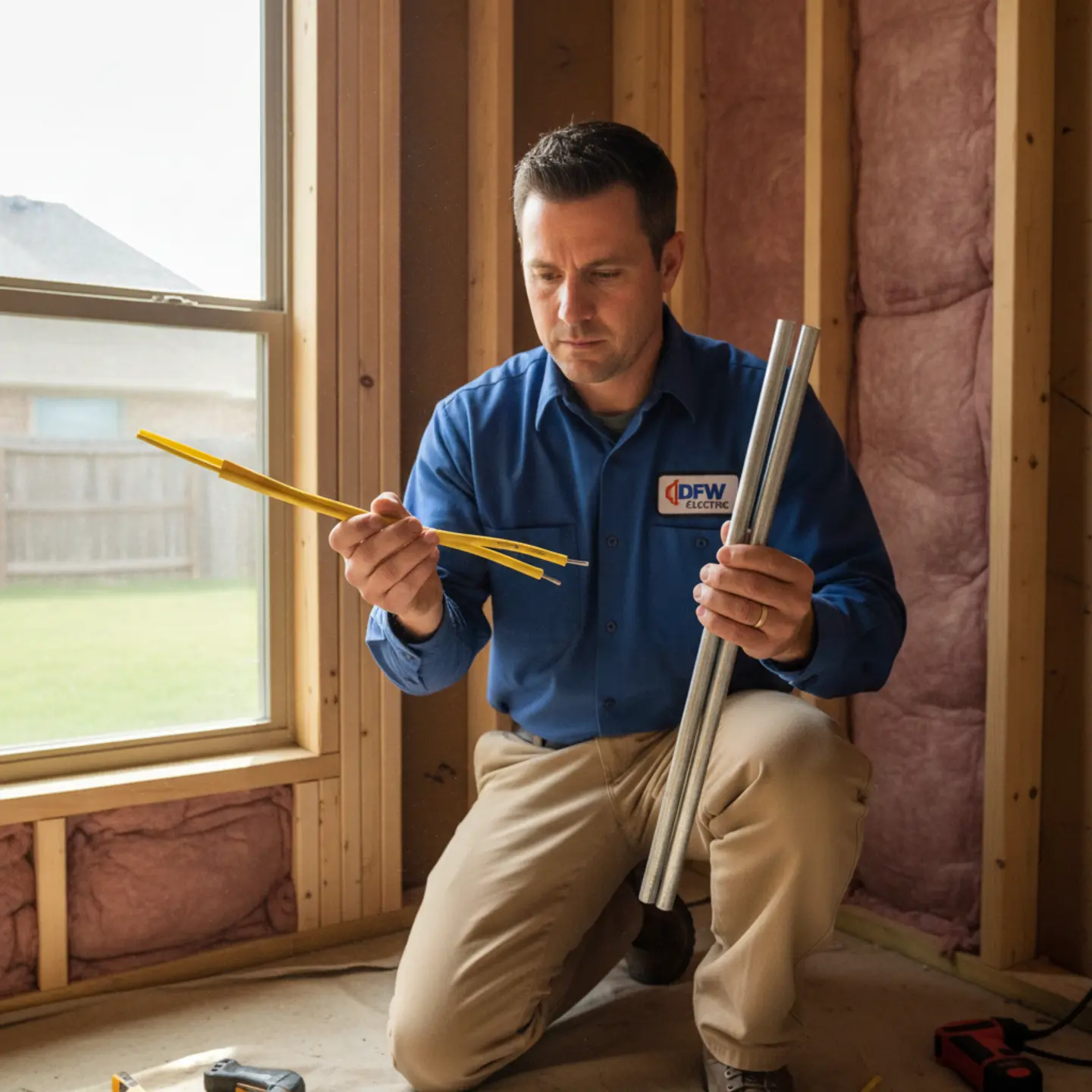
Professional DFW electricians run #6 THHN copper wire inside EMT or PVC conduit for EV charger circuits. It handles the heat properly, meets code, and holds up long-term in a Texas attic. If a contractor quotes you a job using just Romex in the attic, that’s worth asking about.
Typical All-In Installation Cost (DFW)
Includes hardware, professional labor, permits, and materials for a standard 50-ft wire run. Does not include panel upgrade if needed. Federal tax credit can reduce this by up to $1,000.
Hardwired vs. NEMA 14-50 Plug-In
One meaningful difference between these chargers: Tesla’s Universal Wall Connector is hardwired only. There’s no plug-in option. Once it’s installed, it’s part of the house.
Emporia offers both. The NEMA 14-50 plug-in option runs at 40A (slightly less power) but gives you flexibility — you can take it with you if you move, or unplug it for any reason. For most permanent installs, hardwired is preferred for reliability and maximum amperage. But the option matters to some homeowners.
⚠️ Tesla Stays When You Move
Because the Tesla Universal is hardwired only, it becomes a fixture of the home. Some homeowners want that simplicity. Others prefer knowing they can take their charger with them. If portability matters at all, Emporia’s plug-in option is worth considering.
For a full look at what our EV charger installation process looks like in DFW, including what we check before we pull wire, that page walks through it in detail.
DFW Permits — Yes, You Need One. Here’s Why It Matters.
We’re going to be straight with you: every Level 2 EV charger installation in DFW that involves adding a new 240V circuit requires a permit. Not most. All of them.
This isn’t us being overly cautious. It’s the NEC 2026 code, which was ratified in mid-2025 and now effectively prohibits DIY installation of permanently wired EV chargers in most jurisdictions. Qualified, licensed electricians only.
What Permits Cost in DFW Cities
| City | Permit Type | Estimated Cost (2025) | Inspection Required |
|---|---|---|---|
| Dallas | Trade Validation | $125 – $175 | Final Electrical |
| Fort Worth | Residential Electric | $112 – $130 | Rough-in & Final |
| Arlington | Residential Electric | $75 – $120 | Final Electrical |
| Plano | Electrical Permit | $50 – $90 | Final Electrical |
| Frisco | Electrical Permit | $50 – $90 | Final Electrical |
| Garland | Trade Permit | $175 | Final Electrical |
⚠️ What Happens When You Skip the Permit
Unpermitted electrical work can void your homeowner’s insurance if there’s a fire. It will also flag during a home inspection when you sell — and the buyer’s agent will ask for documentation. The permit fee is $75–$175. The cost of dealing with unpermitted work at closing is significantly higher.
Dallas uses a system called ProjectDox for permit submittals, which has digitized the process — but approvals still typically take one to three weeks. Fort Worth requires both a rough-in and final inspection. We handle all of this as part of every installation we do. You can read more about what electrical work requires a permit in Texas if you want the full picture.
The Panel Question — The Thing Nobody Tells You Before You Buy
Here’s the conversation we have on job sites more often than any other: “My neighbor said I need to upgrade my panel. Do I really?”
The honest answer is: it depends on which charger you pick.
The 100-Amp Problem in DFW
A lot of DFW homes built before 1990 — think Richardson, East Dallas, older parts of Plano, parts of Fort Worth — are running on 100-amp electrical service. That’s what was standard when those houses were built.
Installing a 60-amp EV charger circuit on a 100-amp panel is usually not possible under NEC load calculations. Your HVAC, water heater, dryer, range, and lighting already eat up most of that capacity. Add a 60-amp EV circuit and you’ll be tripping your main breaker regularly — or worse, overloading it without tripping.
The traditional fix is a panel upgrade to 200-amp service. In DFW, that runs between $3,000 and $4,500 depending on the scope of work and whether the meter base needs replacing too. It’s a real job.
The Emporia Pro Changes the Math
The Emporia Pro includes a Vue 3 Energy Monitor that installs at your main panel and monitors your total home electrical load in real time. When your AC kicks on or your dryer starts running, the Pro’s PowerSmart system automatically reduces the charger’s output to prevent overloading the panel. When those loads drop off, it ramps charging back up.
This means a homeowner with a 100-amp service can often install the Emporia Pro and skip the panel upgrade entirely. The charger works within whatever headroom the panel has at any given moment.
Tesla’s Approach
Tesla’s Universal Wall Connector supports “Group Power Management,” which is designed to share a circuit across multiple chargers. For single-charger residential installs, there’s no native dynamic load management equivalent to what Emporia Pro offers. Tesla’s ecosystem assumes you have 200-amp service — or a Powerwall, which provides its own energy management layer.
If you have a 200-amp panel or newer construction, this isn’t a concern. If you’re in an older DFW home with 100-amp service, it is.
Potential Panel Upgrade Savings
The Emporia Pro’s dynamic load management can eliminate the need for a full panel upgrade in homes with 100-amp service — saving DFW homeowners an average of $3,000–$4,500 in additional work.
If you’re unsure what your panel can handle, we cover that in detail here: Do I need a panel upgrade for an EV charger in Fort Worth? If a full panel replacement does turn out to be necessary, we can walk you through that too — but it’s not always the case.
How These Chargers Handle Texas Heat
This is the section you won’t find on most comparison sites — because most of them aren’t writing from DFW.
Both chargers are rated to 122°F. That sounds fine until you realize that an attached garage in North Texas on a July afternoon can hit 110°F — and when you add the heat generated by the charger itself during a 48A session, the internal components are working hard.
In DFW, we’ve seen unconditioned garages hit temperatures that push both units toward their thermal limits during summer afternoon charging sessions. This isn’t a dealbreaker — it’s manageable — but it’s something to know before you install.
Tesla’s Thermal Throttling
The Tesla Wall Connector has internal temperature sensors that reduce the charge rate when heat builds up at the handle or terminals. In practice, DFW users report seeing a “High Temperature Detected” warning during daytime summer charging, which drops the output from 48A down to 24A or even 16A until things cool down.
The most common cause of this isn’t just ambient heat — it’s loose terminal connections that create extra resistance, which generates extra heat. In a Texas garage where everything expands and contracts with temperature swings, connections that weren’t torqued to spec (50 inch-pounds for Tesla) will loosen over time.
Emporia’s Thermal Stability
Emporia’s NEMA 4 enclosure and larger physical footprint give it more surface area for passive heat dissipation. The unit will shut down if its internal board hits 98°C, but in real-world DFW installs, this threshold is less commonly triggered than Tesla’s thermal throttling — particularly when the unit is properly placed.
Emporia’s 25-foot cable (one foot longer than Tesla’s) also gives you more placement flexibility to keep the unit away from direct sun exposure.
💡 Best Practice for DFW Installs
Mount on an interior garage wall, away from any wall that receives direct afternoon sunlight. West-facing and south-facing exterior walls are the worst placement in a Texas summer. This one decision alone reduces thermal issues significantly for both units.
This is the most common service call we see on both brands. The expansion and contraction cycles from DFW’s extreme temperature swings cause improperly torqued terminals to loosen over time. Loose connections create resistance, resistance creates heat, and heat at a high-amperage terminal creates arcing — which can cause a fire. For Tesla, the torque spec is 50 inch-pounds. For Emporia, use ferrules on stranded wire to ensure even pressure distribution. A calibrated torque screwdriver isn’t optional for this job.
If your EV charger was installed without a torque wrench being used on the terminal connections, it’s worth having a licensed electrician inspect it — especially before the first full summer of use.
Smart Features — App, Scheduling & Solar
Both chargers have smartphone apps and Wi-Fi connectivity. But they’re built for different kinds of users.
Emporia: For the Data-Driven Homeowner
The Emporia app gives you real-time wattage tracking, session history, cost analysis, and advanced scheduling. If you have solar panels, the “solar capture” feature can modulate your charging rate to match excess solar generation — meaning your car charges on the cleanest, cheapest energy you produce. For DFW homeowners with solar arrays, this is genuinely useful.
For residents who charge during ERCOT peak hours, the scheduling feature lets you automatically charge during off-peak times when electricity is cheapest.
Tesla: Simple, Unified, Reliable
Tesla’s app is the same one you use for your car. Everything lives in one place — charging schedule, session data, charger settings. It’s clean and intuitive. The unit also receives over-the-air software updates, which have been used to improve non-Tesla EV compatibility and refine thermal management over time.
What it doesn’t do is whole-home energy monitoring. Unless you also have a Tesla Powerwall or Tesla Solar, the app shows you charger data only — not how the charger fits into your home’s total energy picture.
💡 Important: Wi-Fi Dead Zones
DFW’s sprawling suburban homes often have garages that sit at the edge of Wi-Fi range. For the Emporia Pro specifically, a solid Wi-Fi connection isn’t optional — the PowerSmart load management depends on it. If the connection drops, the unit defaults to its lowest configured amperage as a safety measure, which means slow charging until it reconnects. If your garage is a Wi-Fi dead zone, fix that with a mesh extender before your install date.
Money — Tax Credits, Rebates & True Cost to Own
Let’s talk about what this actually costs — and what you can get back.
Federal 30C Tax Credit — Act Before June 30, 2026
The Alternative Fuel Vehicle Refueling Property Credit (IRS Form 8911) covers 30% of the charger hardware and professional installation labor, up to a $1,000 cap for residential properties.
This credit was originally slated to run through 2032. Legislative changes in mid-2025 moved the termination date to June 30, 2026. If you’re planning to install a Level 2 charger, every month you wait is a month closer to losing up to $1,000 in federal incentives.
Note: your home must be in an “eligible census tract” to qualify — typically low-income or non-urban areas. Many DFW fringe communities (outer Tarrant County, parts of Denton County, Ellis County) qualify. Consult your tax advisor to confirm your address.
Oncor and Local Utility Programs
Most DFW homeowners are in Oncor’s service territory. Oncor’s “Take a Load Off Texas” program has expanded to include select smart charger discounts through the Oncor Marketplace — approximately $100 in savings on qualifying units. It’s not a massive incentive, but it’s real money for doing nothing extra.
Full Cost Breakdown for a DFW Home
| Cost Element | Emporia Classic | Emporia Pro | Tesla Universal |
|---|---|---|---|
| Hardware Price | $429 | $599 | $600 |
| Professional Labor | $900 | $1,000 | $1,000 |
| Permits & Inspections | $125 | $125 | $125 |
| Materials (Wire/Conduit) | $450 | $450 | $450 |
| Federal Tax Credit (est.) | -$400 | -$500 | -$500 |
| Total Net Investment | $1,504 | $1,674 | $1,675 |
The Pro and Tesla end up at nearly identical net cost. The Classic saves you about $170. But remember: if your home needs a panel upgrade and the Emporia Pro’s load management lets you skip it, that’s $3,000–$4,500 in savings that doesn’t show up in this table.
For a more detailed look at what drives installation costs in DFW, including what adds time and what doesn’t, see our full breakdown of EV charger installation costs in Dallas-Fort Worth.
So Which One Should You Get? (The Honest Answer)
There’s no single right answer — but there is almost always a right answer for your situation. Here’s how we’d think about it.
✅ Use This to Decide in 60 Seconds:
- You only own Teslas and have 200-amp service → Tesla Universal Wall Connector. Seamless integration, 4-year warranty, clean install.
- You have multiple EV brands or plan to in the future → Tesla Universal Wall Connector. The Magic Dock handles everything without adapters.
- Your home has 100-amp service (pre-1990 DFW home) → Emporia Pro. Dynamic load management could save you $3,000–$4,500 in panel upgrade costs.
- You have solar panels and want to maximize clean charging → Emporia Pro. The solar capture and whole-home monitoring features are purpose-built for this.
- You want a great charger at the lowest total cost, 200-amp panel, non-Tesla EV → Emporia Classic. Solid, smart, well-rated, and the most affordable all-in option.
- New construction or updated panel, any brand of EV → Either. Slight edge to Emporia Classic for value, Tesla Universal for multi-brand flexibility.
💡 The Question to Ask Before Anything Else
Before you pick a charger brand, find out your panel size and the distance from your panel to your garage. Those two facts determine whether you need a panel upgrade and how much wire we’re pulling. Everything else follows from there. A quick call or site visit answers both questions in 15 minutes.
What to Expect From the Installation
If you’ve never had a 240V circuit installed, here’s what a typical EV charger installation in a DFW home actually looks like.
We start with a panel assessment — confirming available breaker slots, calculating your existing load, and checking the service size. From there we pull the permit, plan the wire route, and schedule the install. On installation day, most standard jobs take three to five hours. We run conduit and wire from the panel to the garage, mount the charger, make all connections to torque spec, and test the unit before we leave.
Before You Call Anyone, Know These 3 Things
1. Your panel’s amp rating — usually printed on the main breaker. 100A or 200A.
2. Distance from your panel to the charger location — more distance = more wire = slightly higher materials cost.
3. Which car(s) you’re charging — NACS or J1772 connector? This determines which cable configuration you need.
What can add time or cost: running wire through a finished attic or wall, replacing an outdated panel, installing conduit through masonry or brick. We’ll identify any of those during the initial assessment — no surprises.
Our team covers Fort Worth, Arlington, Keller, Southlake, Colleyville, Grapevine, Lewisville, and the surrounding DFW area. If you want to know what working with us looks like, here’s more about our Fort Worth electrical services.
Frequently Asked Questions
Can I use an Emporia charger with a Tesla?
Yes. If you order the Emporia with a NACS cable — which is the Tesla-style connector — it charges any Tesla vehicle without any adapter. Tesla cars accept Level 2 charging from any compliant charger, regardless of brand.
Is the Tesla Wall Connector worth it if I don’t own a Tesla?
Yes, especially the Universal version. The built-in Magic Dock adapter handles both NACS and J1772 vehicles, making it compatible with virtually every EV on the road today and every new one coming out. If you have or plan to have multiple EV brands, it’s the most flexible single unit available.
Do I need to upgrade my electrical panel to install a Level 2 charger?
Not necessarily. Homes with 200-amp service typically don’t need an upgrade. Homes with 100-amp service often do — unless you install the Emporia Pro, whose PowerSmart dynamic load management can allow a high-power charger to operate within a 100-amp service by automatically adjusting output based on real-time home usage. See our full guide on panel upgrades for EV chargers in Fort Worth.
What’s the difference between the Emporia Classic and the Emporia Pro?
Both chargers share the same hardware platform and deliver up to 48A hardwired. The key difference is the Pro includes a Vue 3 Energy Monitor that installs at your main panel. This enables PowerSmart dynamic load management — the feature that lets the charger automatically reduce its draw when other major appliances are running, making it safe for use on a 100-amp service without a panel upgrade. If your panel is 200-amp and you don’t care about whole-home energy data, the Classic does the job for $170 less.
Is hardwired always better than plug-in for a Level 2 charger?
Hardwired is generally preferred for permanent installations — it provides maximum amperage (48A vs. 40A for NEMA 14-50 plug-in), eliminates a potential failure point at the receptacle, and is more reliable long-term under continuous high-amperage use. That said, plug-in installations have their place: they’re easier to take with you if you move, and a NEMA 14-50 outlet gives you flexibility to swap chargers later. Tesla doesn’t offer a plug-in option at all; Emporia gives you the choice.
Do I need a permit to install an EV charger in Fort Worth or Dallas?
Yes. Any new 240V circuit installation requires a residential electrical permit in DFW municipalities. In Fort Worth, both a rough-in and final inspection are required. In Dallas, the process runs through the ProjectDox system with a typical 1–3 week approval timeline. Skipping the permit can void your homeowner’s insurance and create problems at home resale. Read more about what requires a permit in Texas here.
How long does a Level 2 EV charger installation take?
A standard installation — new 60-amp circuit, 50-foot wire run, charger mount and hookup — typically takes three to five hours for a licensed electrician. More complex runs through finished walls, attic obstructions, or masonry can add time. Any panel work needed adds additional time and a separate inspection. We’ll give you an honest estimate after a quick site assessment.
Ready to Get This Done Right?
You’ve got the information. You know which charger fits your situation. Now the most important step is making sure it gets installed correctly — right wire gauge, proper conduit for Texas heat, torqued connections, permit pulled, inspection passed.
That’s what we do. Every installation comes with a licensed electrician, a pulled permit, a final inspection, and connections torqued to spec. No shortcuts, no surprises, and we’ll tell you upfront if your panel needs attention before we start pulling wire.
The federal tax credit expires June 30, 2026. If you’ve been thinking about this, now is the time.
Call or Text: (682) 478-6088
Serving Fort Worth, Arlington, Keller, Southlake, Colleyville, Grapevine, Lewisville, and all of DFW