
Outside Emergency Disconnect Required: What NEC 230.85 Means for DFW Homeowners in 2025
Your electrician just mentioned a “new requirement” for an outside disconnect switch. Or maybe an inspector flagged it during a panel replacement quote. Now you’re wondering: Is this really necessary? What does it mean for me? And how much is this going to cost?
Here’s the truth: This isn’t about upselling. The outside emergency disconnect is a real code requirement that became Texas law on September 1, 2023, as part of the National Electrical Code (NEC) Section 230.85. But—and this is important—it doesn’t apply to every home or every electrical project.
This guide will explain what you actually need to know about NEC 230.85 in plain language, what it costs in the Dallas-Fort Worth area, and when this requirement applies to your specific situation.
⚡ Key Takeaways
- What It Is – An emergency disconnect is an outdoor shutoff switch that lets first responders cut power to your home without going inside during emergencies
- Code Timeline – NEC 230.85 became Texas law on September 1, 2023, as part of the 2023 National Electrical Code adoption
- Applies When – Required for new construction, service upgrades (like going from 100A to 200A), and panel replacements—not for minor repairs
- Existing Homes – NOT retroactive. Your 1980s home with an indoor panel is grandfathered unless you do qualifying work
- Cost Impact – Adds approximately $1,000-$1,650 to service upgrade projects in the DFW area compared to pre-2023 costs
- Safety Reason – Allows firefighters to safely shut off electrical power without entering a burning building or pulling the meter
- Three Ways to Comply – Meter-main combo (most common), separate disconnect switch, or generator transfer switch
- DFW-Specific Relief – Dallas, Fort Worth, and Arlington adopted regional amendments that protect homeowners from unnecessary costs on minor repairs
- Bottom Line – Not optional when triggered by qualifying work, but there are practical, cost-effective ways to comply
What Is NEC 230.85 and Why Does It Exist?
The Simple Explanation
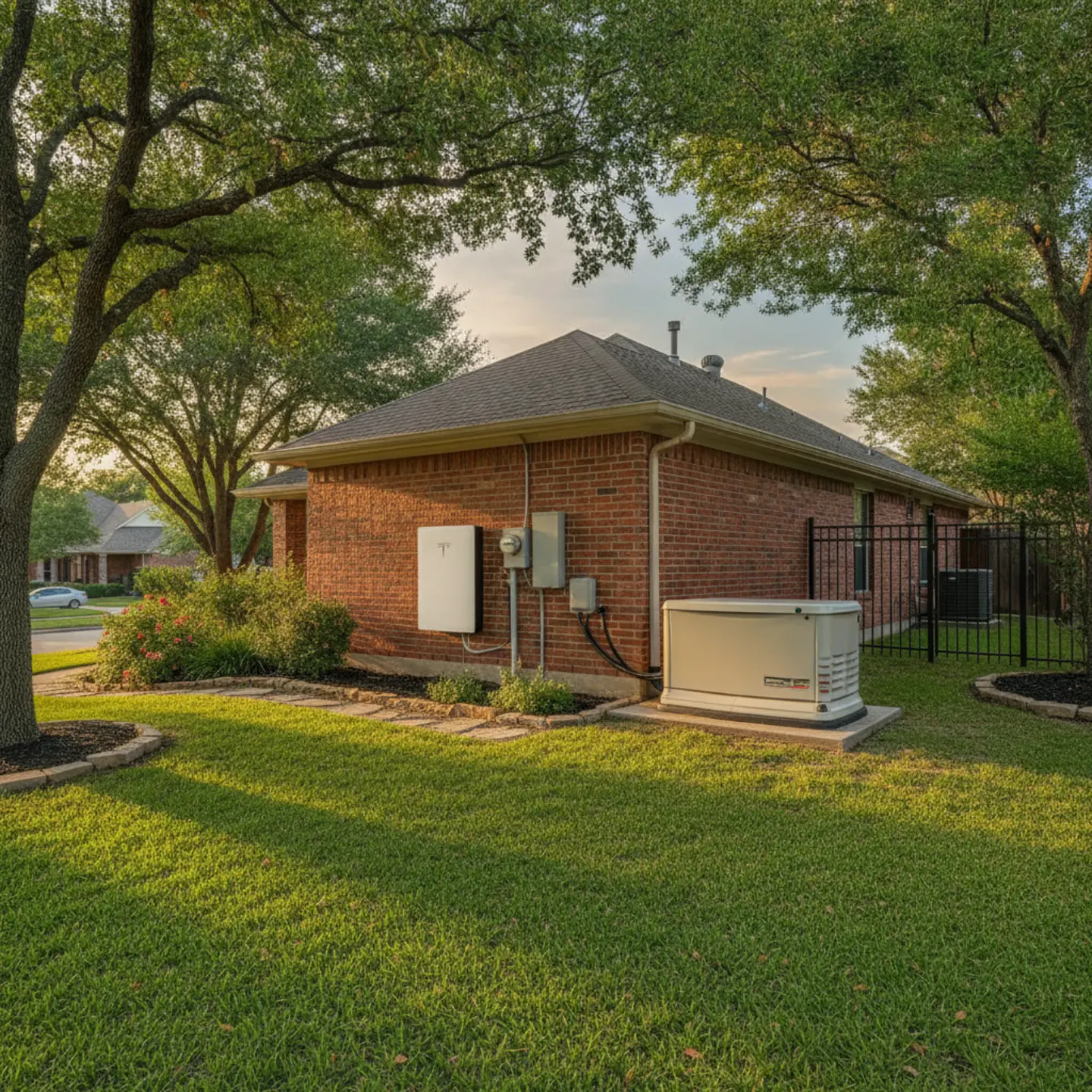
An emergency disconnect is a switch mounted on the outside of your home—usually right next to or combined with your electric meter—that shuts off all the power to your house. Think of it as a master “off” switch that’s accessible from outdoors.
Before this requirement, if your main breaker panel was located inside your garage or basement and there was a fire, firefighters had two risky options: enter the burning structure to find the breaker, or pull your electric meter off the wall to cut the power. Both options are dangerous.
Pulling a meter while the house is drawing power (air conditioner running, appliances on) can create a dangerous arc flash. And entering a burning building to search for an indoor panel puts firefighters at unnecessary risk.
💡 Why Firefighters Need This
In a structure fire, cutting power isn’t just about preventing electrocution. It allows fire crews to safely ventilate the building by cutting through the roof, prevents arc flash when water hits electrical equipment, and protects rescue teams during search operations. The outdoor emergency disconnect gives them immediate, safe control without entering the hazard zone.
The Code Timeline
The emergency disconnect requirement first appeared in the 2020 edition of the National Electrical Code under Section 230.85. However, it took time for states to adopt it. In Texas, the 2023 NEC—which refined and clarified the emergency disconnect requirements—became law on September 1, 2023, through the Texas Department of Licensing and Regulation (TDLR).
This means any electrical work permitted or started on or after September 1, 2023, in Texas must comply with NEC 230.85 if it falls into the categories that trigger the requirement (which we’ll cover next).
Understanding electrical permit requirements in Texas helps clarify when this code applies to your project.
When Does This Requirement Apply to YOUR Home?
This is the number one question we get: “Do I need to add this to my existing house?”
The short answer: Not unless you’re doing specific electrical work that triggers the requirement.
Scenarios That TRIGGER the Requirement
✅ New Construction
All new single-family and two-family homes permitted after September 1, 2023, must have an outdoor emergency disconnect. If you’re building a new house in Fort Worth, Arlington, Keller, or anywhere in DFW, your builder will handle this as part of the standard electrical installation. The cost is built into the original bid, so there’s no sticker shock.
✅ Service Upgrades (The “Heavy-Up”)
This is where most homeowners encounter NEC 230.85. If you’re upgrading your electrical service—for example, going from a 100-amp service to a 200-amp service—this work triggers the emergency disconnect requirement.
Common reasons for service upgrades in DFW include:
- Installing an EV charger for your electric vehicle
- Adding a swimming pool with pumps and heaters
- Installing a whole-home backup generator
- Major home additions that increase electrical demand
- Upgrading an older home’s inadequate electrical capacity
When you replace the service entrance conductors (the large wires coming from the utility) and the meter base, you’re replacing “service equipment” under NEC 230.85(C), which triggers the full requirement.
DFW Service Upgrade Cost Impact
Average cost increase for a typical service upgrade in the Dallas-Fort Worth area due to NEC 230.85 compliance requirements, including outdoor disconnect hardware, 4-wire feeder cable, and updated grounding system (compared to pre-2023 installations).
✅ Panel Replacements
If you’re replacing your main electrical panel—whether due to water damage, a failed inspection, or because you have a hazardous Federal Pacific or Zinsco panel that needs replacement—this also triggers NEC 230.85.
This surprises many homeowners. What looked like a straightforward panel replacement ($2,000-$2,500) becomes a full service upgrade project ($4,000-$5,500) because you now need to add the outdoor emergency disconnect and update the grounding system.
This is where honest communication matters. We explain upfront what the code requires and why the cost is what it is—no surprises on the final bill.
Scenarios That DON’T TRIGGER the Requirement
❌ Existing Homes (No Work Done)
If you own a home built before September 2023 and you’re not doing any qualifying electrical work, you don’t need to add an emergency disconnect. The code is not retroactive.
Your 1980s home with the main panel inside the garage is grandfathered. Home inspectors during real estate transactions may note that an outdoor disconnect “would be recommended under current code,” but it’s not a defect or a requirement for existing homes that haven’t been modified.
❌ Minor Repairs (Thanks to Regional Amendments)
Here’s where the North Central Texas Council of Governments (NCTCOG) helped homeowners. Regional amendments adopted by Dallas, Fort Worth, Arlington, and surrounding cities added an important exception:
If you’re only replacing the meter socket, service entrance conductors (the wires), or the conduit/raceways due to damage—like from a storm that tore down your service riser—you can make the repair without triggering the full emergency disconnect upgrade requirement.
✅ Good News for Storm Repairs
A tree limb tore off your meter base during a thunderstorm? Under the NCTCOG amendments, we can replace just the damaged meter socket and conductors without requiring a full service upgrade. This repair exemption saves homeowners thousands of dollars while maintaining safety.
This exception is huge. It prevents a $500 repair from turning into a $4,000 mandated upgrade. However, it only applies if the original installation was code-compliant when it was first installed.
❌ Adding Circuits or Breakers Inside Your Panel
Running a new 20-amp circuit for a kitchen appliance? Adding a dedicated outlet for a home office? As long as you’re not touching the service entrance equipment (meter, main disconnect, service conductors), these projects don’t trigger NEC 230.85.
Understanding what qualifies as routine electrical work versus service modifications helps you plan projects appropriately and avoid unexpected costs.
How It Works: The Three Installation Options
When you do need to comply with NEC 230.85, you have choices. Here’s what we typically install in the DFW area, and when each option makes sense:
Option 1: All-in-One Meter-Main Combo (Most Common)
This is a single weatherproof enclosure that houses both the utility meter socket and a main circuit breaker. It’s mounted on your exterior wall where your meter currently sits.
Advantages:
- Cleanest appearance—one box instead of multiple enclosures
- Lowest material cost among the options
- Simplest installation for new construction and full service upgrades
- Widely available from major manufacturers (Square D, Siemens, Eaton)
Considerations:
- If the main breaker trips, you’ll need to go outside to reset it (not inside your garage or basement)
- Takes up slightly more wall space than a standard meter socket
Best for: New construction, full electrical panel upgrades, and most service upgrade scenarios.
Option 2: Separate Meter Socket + Disconnect Switch
This configuration keeps your existing meter socket (or replaces it like-for-like) and adds a separate enclosed circuit breaker or fused disconnect switch mounted directly adjacent to the meter.
Advantages:
- Works well when the meter location is fixed and can’t be easily moved
- Allows for modular upgrades in tight retrofits
- Can sometimes utilize existing conduit layouts
Considerations:
- Requires more exterior wall space for two separate enclosures
- Higher labor cost to mount and connect (nipple) two boxes
- Can look less integrated aesthetically
Best for: Retrofit situations with space constraints or existing meter locations that can’t be modified.
Option 3: Generator Transfer Switch (Premium Solution)
A service-rated automatic transfer switch (ATS) installed after the meter can satisfy the emergency disconnect requirement while also providing generator backup capability.
Advantages:
- Solves two requirements with one installation
- Prepares your home for backup power (critical after events like Winter Storm Uri)
- Service-rated disconnect built into the transfer switch
Considerations:
- Most expensive option—typically part of a $10,000+ generator project
- Requires professional coordination with generator installation
- Still requires proper emergency disconnect labeling
Best for: Homeowners who are adding or already planning to add a whole-house generator. If you’re doing generator work anyway, this elegantly combines both needs into one professional installation.
Learn more about whole-home generator installation options for DFW homes.
⚠️ The Label Requirement Is NOT Optional
All emergency disconnects must have a permanent, weather-resistant label with a RED background and WHITE text. The letters must be at least 1/2 inch high and say “EMERGENCY DISCONNECT, SERVICE DISCONNECT” (or the appropriate variation based on the equipment type). Inspectors will fail the installation without this specific label—it’s a critical safety identifier for first responders.
The Technical Side (Simplified)
We’ll keep this straightforward. Here’s what actually happens during installation and why the cost increases:
The Grounding Change (Why Costs Increase)
This is the biggest technical change and the primary reason retrofit costs go up.
The old way (pre-2023):
- Three wires ran from your outdoor meter to your indoor main panel: two “hot” wires and one neutral
- The main bonding jumper (the connection between neutral and ground) was located at your indoor panel
- Your ground rods connected to this indoor panel
The new way (2023 NEC with outdoor disconnect):
- The outdoor emergency disconnect now becomes your service disconnect
- The main bonding jumper must be located at this outdoor disconnect
- Your ground rods connect to the outdoor disconnect
- A four-wire feeder runs from the outdoor disconnect to your indoor panel: two hot wires, one neutral, and one separate ground wire
- Your indoor panel is now technically a “subpanel” and the neutral bus must be isolated (separated) from the enclosure
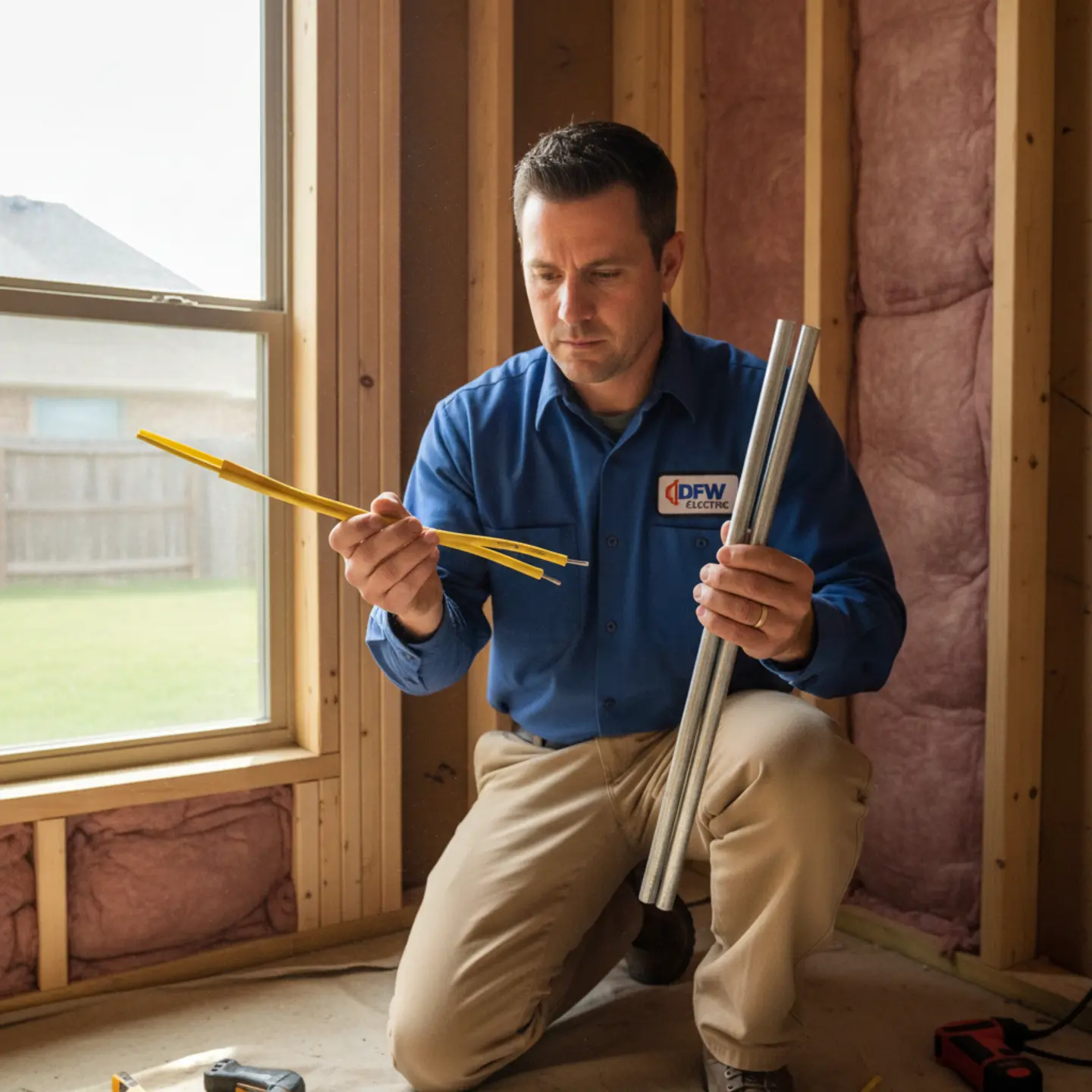
This architectural change often means replacing the existing cable between your meter and panel. If you had old-style three-wire cable (common in homes built before the 1990s), it lacks the separate ground conductor and must be replaced with four-wire cable.
This is labor-intensive work that adds 4-8 hours to the project—and that’s where much of the cost increase comes from.
If the neutral and ground aren’t properly separated at your indoor panel after adding an outdoor disconnect, you can have dangerous “objectionable current” flowing on metal conduit, water pipes, and other grounded metal parts. This creates a shock hazard and violates code. This is exactly why this work must be performed by a licensed, knowledgeable electrician who understands modern grounding requirements.
Short-Circuit Current Rating
The emergency disconnect equipment must be rated to handle the maximum fault current available at your service entrance. In the DFW area, where Oncor is the primary utility provider, this typically requires a 22,000-ampere interrupting capacity (22kAIC) rating.
Not all disconnect switches are equal. A generic air conditioning disconnect from the hardware store won’t work—it’s not rated for service equipment and won’t handle the available fault current. The equipment must be specifically listed as “suitable for use as service equipment” (SUSE).
Accessibility Requirements
The code uses the term “readily accessible,” which has a specific definition:
- No obstacles: Can’t be blocked by permanent landscaping, locked gates (that restrict emergency access), or air conditioning units
- No ladders: Must be reachable from standing position on the ground
- Height limit: The operating handle can’t be more than 6 feet 7 inches above ground level
- Within sight: Generally must be visible from the dwelling and within 50 feet
- Can be locked: Yes, you can lock it to prevent tampering—fire departments have bolt cutters for emergencies
In DFW homes with high foundations or sloping grades, sometimes we need to adjust the mounting height of the meter to keep the breaker handle within the legal height zone.
For comprehensive guidance on electrical safety requirements, see our electrical safety tips for Fort Worth residents.
Real DFW Costs: What to Expect
Let’s talk about the number everyone wants to know: what does this actually cost?
We believe in giving you options and clear pricing upfront—not pressure. Here’s what affects the price in the Dallas-Fort Worth area:
| Scenario | Cost Range | What’s Included |
|---|---|---|
| New Construction | Built into bid (~$300-$500 premium) | Meter-main combo integrated from start, no retrofit labor |
| Service Upgrade (100A → 200A) | $3,800 – $4,800 | Meter-main unit, 4-wire feeder, grounding system, permit, labor |
| Panel Replacement + Emergency Disconnect | $4,000 – $5,500 | New panel, outdoor disconnect, feeder conversion, grounding |
| Adding Disconnect Only | $1,200 – $1,800 | When main panel stays indoors but adding outdoor disconnect (less common) |
Cost Breakdown Components
Hardware:
- Standard meter socket: $100-$150
- Meter-main combo (200A): $350-$600
- Hardware premium: $250-$450
Wire and Materials:
- 4-wire copper SER cable: Approximately $10/foot
- Typical 20-foot run: $200+
- Two ground rods, bonding jumpers, conduit: $150-$250
Labor:
- Retrofit installation: 6-8 hours (typically two electricians)
- Separating grounds and neutrals at indoor panel
- Installing and connecting grounding electrode system
- Bonding gas and water piping to new outdoor location
- Labor cost: $2,000-$2,800
Permits:
- Dallas: $150-$300
- Fort Worth: $150-$250
- Arlington: $100-$175
The total “NEC 230.85 premium”—the cost directly attributable to the emergency disconnect requirement compared to pre-2023 installations—is approximately $1,000-$1,650 for a typical service upgrade.
✅ Ways to Manage Costs
- Combine projects: If you’re planning an EV charger and eventually need a panel upgrade, do them together
- Consider generator timing: If you’re thinking about backup power, a generator transfer switch solves both needs
- Verify if work qualifies: Minor repairs may not trigger the requirement—talk to a licensed electrician first
- Plan ahead: Don’t wait for an emergency panel failure—proactive upgrades are less stressful
If upfront costs are a concern, learn about financing options for residential electrical projects.
DFW City-Specific Requirements
While the 2023 NEC is Texas state law, local jurisdictions can adopt additional amendments. Here’s what you need to know in the major DFW cities:
Dallas
- Code adoption: 2023 NEC effective May 2025
- Unique requirement: Only Oncor utility employees can pull or reinstall meters—electricians must coordinate meter disconnects/reconnects, which can add scheduling time to your project
- Enforcement: Dallas inspectors strictly enforce the 4-wire feeder requirement when converting indoor panels to subpanels
- Permit fees: $150-$300 (valuation-based)
- Adopted NCTCOG amendments: Yes—includes repair exemptions
Fort Worth
- Code adoption: 2023 NEC effective March 1, 2023
- Specific definition: “Grouped” disconnects must be within 30 feet and on the same wall/elevation
- Permitting: Streamlined online portal for permit applications
- Permit fees: Base of ~$112 plus trade fees, typically $150-$250 total
- Adopted NCTCOG amendments: Yes
Arlington
- Code adoption: 2023 NEC
- Grounding requirement: Requires TWO ground rods spaced minimum 6 feet apart—no single-rod exceptions even if resistance testing would pass
- Conduit: May require rigid steel conduit for service risers in specific applications
- Permit fees: $100 base plus add-ons, typically $100-$175 total
- Adopted NCTCOG amendments: Yes
DFW Regional Insight: All three major cities follow the North Central Texas Council of Governments (NCTCOG) regional amendments. This means if you’re repairing storm damage to your service riser or meter base—not upgrading capacity—you can often make the repair without triggering the full emergency disconnect requirement. This consistency across DFW saves homeowners thousands in unnecessary upgrade costs.
Common Questions About Emergency Disconnects
Does my current home need this retrofit if I’m not doing any work?
No. The NEC 230.85 requirement is not retroactive for existing homes. If you own a home built before September 2023 and you’re not performing qualifying electrical work (service upgrades, panel replacements), you don’t need to add an emergency disconnect. Your home is grandfathered under the previous code it was built to.
Home inspectors during real estate transactions may note that an outdoor disconnect “would meet current code,” but it’s not a defect or a required repair for older homes. It only becomes mandatory when you trigger it through qualifying electrical work.
What if my main panel is already located outside?
If your main breaker panel is already mounted outdoors in a weatherproof enclosure and is readily accessible, it may already satisfy the NEC 230.85 requirement—you might just need to add the proper labeling.
However, the inspector will verify that it meets all current accessibility requirements (height, no obstructions, within sight of dwelling) and that the grounding system is correctly configured. Some older outdoor panels may need grounding upgrades even if the location is compliant.
Can I lock my emergency disconnect to prevent tampering?
Yes, you can absolutely lock the emergency disconnect. The code requires it to be “readily accessible,” which allows for locking. The lock prevents unauthorized people (like neighborhood kids or vandals) from turning off your power.
In an actual emergency, fire department crews carry bolt cutters and other tools to access locked electrical equipment quickly. The lock doesn’t impede emergency response—it just prevents casual tampering.
Will the lack of an emergency disconnect affect my home sale?
It depends on the home’s age and recent work history:
- Older homes (built before 2023) with no recent electrical work: Not a defect. Inspectors will note it doesn’t have one, but buyers typically understand it’s an older home built to previous code.
- Recently remodeled homes: If the home has a brand-new-looking panel but no outdoor disconnect, this raises red flags. It suggests either the work wasn’t permitted or wasn’t done to current code, which can complicate the sale.
- Unpermitted work: If major electrical work was done without permits, lack of an emergency disconnect can be evidence of code violations, potentially affecting insurance and financing.
If you’re selling a home with recent electrical upgrades, having permits and code-compliant installations (including the emergency disconnect) protects the transaction.
What about solar panels or backup generators?
This gets more complex because you’re dealing with multiple power sources:
Emergency Disconnect (NEC 230.85): Controls utility power coming into your home.
Solar Rapid Shutdown (NEC 690.12): Separate requirement that de-energizes the DC conductors from your solar array on the roof.
Generator Transfer Switch: Can serve as your emergency disconnect if it’s service-rated and properly labeled.
Important: Flipping the emergency disconnect does NOT automatically turn off your solar panels. Firefighters need to know about multiple power sources. NEC 690.56 requires a permanent placard at the service equipment showing the location of all disconnects, including solar rapid shutdown switches.
If you’re adding solar or a generator, work with an electrician who understands how to integrate these systems properly and provide the correct labeling for first responders.
Is the emergency disconnect the same as my main breaker?
It depends on your specific setup:
If you have a meter-main combo outside: Yes. The main breaker in that outdoor enclosure serves as both your service disconnect (main breaker) and your emergency disconnect. They’re the same device.
If you have a main breaker panel inside (garage, basement, closet): No. Your indoor main breaker is your service disconnect, but it doesn’t qualify as an emergency disconnect under NEC 230.85 because it’s not outdoors and readily accessible to first responders.
The distinction matters during retrofits. If you’re upgrading and your main panel is indoors, you’ll need to either relocate it outside or add a separate outdoor disconnect ahead of it (which then makes your indoor panel a subpanel with different grounding requirements).
What happens if I don’t comply with this requirement?
If your electrical work triggers NEC 230.85 and you don’t install the emergency disconnect:
- Failed inspection: The electrical inspector will not approve the work
- Permit won’t close: Open permits on your property can complicate home sales and refinancing
- Insurance implications: Unpermitted or non-code-compliant electrical work can void homeowner’s insurance claims if there’s an electrical fire
- Safety risk: First responders won’t have safe access to shut off power during emergencies
- Real estate complications: Buyers’ inspectors will flag non-compliant work, potentially killing deals or forcing expensive corrections
The requirement exists for legitimate safety reasons, and trying to skip it creates more problems than paying for compliant installation.
Making the Right Decision for Your Home
Here’s how to think about the emergency disconnect requirement for your specific situation. We’re here to help you understand what you actually need—not what costs the most.
If You’re Planning Electrical Service Work
✅ Action Steps:
- Talk to a licensed electrician BEFORE starting any service or panel work
- Ask specifically: “Will this project trigger NEC 230.85?”
- Get a detailed written estimate that includes all code requirements
- Consider timing—can you combine this with other electrical needs to save on multiple service calls?
- Verify the electrician pulls proper permits and schedules inspections
Understanding the full scope upfront prevents surprise costs halfway through the project. A reputable electrician will explain exactly what the code requires and why.
If an Inspector Already Flagged It
If you’re in the middle of work and an inspector has flagged a missing emergency disconnect:
- Understand what work was performed: Was this new construction? A service upgrade? A panel replacement? The inspector is enforcing code based on the work that triggered the requirement.
- Check if work was permitted: If the work was done without permits, you may need to bring multiple aspects up to current code, not just the disconnect.
- Get options for compliance: There may be different ways to satisfy the requirement depending on your home’s specific configuration.
- Don’t attempt DIY fixes: This isn’t the time to try to solve it yourself—work with a licensed electrician who can coordinate with the inspector.
If You’re Buying or Selling a Home
For Buyers:
- Home built before 2023 without an outdoor disconnect? This is normal—not a defect.
- Home has recent electrical work (new panel, upgraded service) but no outdoor disconnect? This is a red flag suggesting unpermitted or non-compliant work. Ask for documentation.
- Get repair estimates before finalizing purchase price if non-compliant work is discovered.
For Sellers:
- If you did recent electrical work, have permits and final inspection approval ready to show buyers.
- If you have unpermitted work, address it before listing or price accordingly—buyers’ inspectors will find it.
- Don’t let emergency disconnect questions kill an otherwise good deal—get an accurate assessment from a licensed electrician to provide concrete information to buyers.
Summary: What You Need to Know
The outside emergency disconnect requirement under NEC 230.85 is real, it’s law in Texas as of September 2023, and it applies to specific types of electrical work—not every situation.
Key points to remember:
- It’s a safety requirement for first responders, not an upsell tactic
- Applies to new construction, service upgrades, and panel replacements
- Does NOT apply retroactively to existing homes unless you’re doing qualifying work
- Adds approximately $1,000-$1,650 to service upgrade costs in DFW
- Dallas, Fort Worth, and Arlington adopted helpful amendments that protect homeowners from unnecessary upgrade costs on minor repairs
- Must be installed by a licensed electrician with proper permits and inspections
- There are practical, cost-effective ways to comply when the requirement is triggered
What to Do Next
If you’re planning electrical work or have questions about whether the emergency disconnect requirement applies to your project:
- Identify the scope of your project (new work, service upgrade, panel replacement, or minor repair)
- Contact a licensed electrician for a clear assessment and estimate that includes all NEC 230.85 requirements if applicable
- Ask about the NCTCOG repair amendments if you’re dealing with storm or accidental damage
- Verify permit requirements for your specific city (Dallas, Fort Worth, Arlington, or other DFW municipality)
- Choose an electrician who’s knowledgeable about current code and can explain your options clearly
At Epic Electrical, we explain what you actually need, give you options instead of pressure, and keep you informed every step of the way. If the code requires an emergency disconnect for your project, we’ll tell you why, show you the most practical way to comply, and give you upfront pricing with no surprises on the final bill.
That’s how electrical work should be done.
Call or Text: (682) 478-6088
Serving Fort Worth, Arlington, Keller, Southlake, Colleyville, Grapevine, Lewisville, and all of DFW