Low Voltage vs High Voltage Commercial Installation: Which Does Your North Texas Facility Need
Key Takeaways
- Low voltage — systems operating at 50 volts or less power your data networks, security cameras, fire alarms, and access control systems.
- High voltage — systems above 50 volts (typically 120V–480V in commercial settings) power your HVAC, lighting, machinery, and main electrical distribution.
- Most DFW facilities need both — they work together as an integrated system, not as competing options.
- Costs differ significantly — low voltage installation typically runs $1,500–$5,000 per system; high voltage varies widely based on facility size and existing infrastructure.
- Texas licensing requirements are strict — high voltage work requires a licensed master electrician; skipping permits creates real liability and insurance exposure.
- Planning ahead saves money — oversizing conduit and building in capacity during initial installation is always cheaper than retrofitting later.
- Warning signs matter — burning smells, frequent breaker trips, and flickering lights are signals your system needs professional attention now.
You’re sitting in a meeting with an electrician, and they’re throwing around terms like “low voltage” and “high voltage” like you should already know the difference. Your facility manager looks confused. You’re thinking about budget. And nobody’s explaining it in plain English.
Sound familiar? You’re not alone. Most business owners and facility managers in the Dallas-Fort Worth area aren’t electrical engineers — and they shouldn’t have to be. But when you’re making decisions that affect your building’s safety, your operations, and your budget, you deserve a straight answer about what you’re actually buying and why.
That’s what this guide is for. No jargon without explanation. No upselling disguised as advice. Just a clear breakdown of what low voltage and high voltage systems actually are, what they power, what they cost, and how to figure out what your North Texas facility actually needs.
We’ve worked with office buildings in Irving, warehouses in Grand Prairie, retail centers in Southlake, and manufacturing facilities in Fort Worth. The question of low voltage vs. high voltage comes up on almost every commercial project — and the honest answer is almost always the same: you probably need both, and here’s why.
The Basic Difference: Low Voltage vs High Voltage Explained
Let’s start with the actual definition, because this is where most of the confusion begins. The terms “low voltage” and “high voltage” aren’t just marketing labels — they’re technical classifications that determine how a system is installed, who can legally install it, what safety codes apply, and what it can actually power.
Low voltage systems operate at 50 volts or less. In most commercial applications, you’ll see 12V, 24V, or 48V systems. These are the systems running your data cabling, security cameras, fire alarms, access control keypads, and intercom systems.
High voltage systems operate above 50 volts. In commercial buildings across North Texas, that typically means 120V for standard outlets, 208V for three-phase power, 277V for commercial lighting circuits, or 480V for heavy industrial equipment. This is the power that runs your HVAC system, your main lighting, your elevators, and your production machinery.
The voltage level isn’t arbitrary — it directly determines what the system can power, how it’s safely installed, and what happens if something goes wrong. Higher voltage means more energy, more power delivery capacity, and significantly more risk if the system isn’t installed correctly. That’s why commercial electrical safety standards treat these two categories so differently.
What Low Voltage Actually Powers
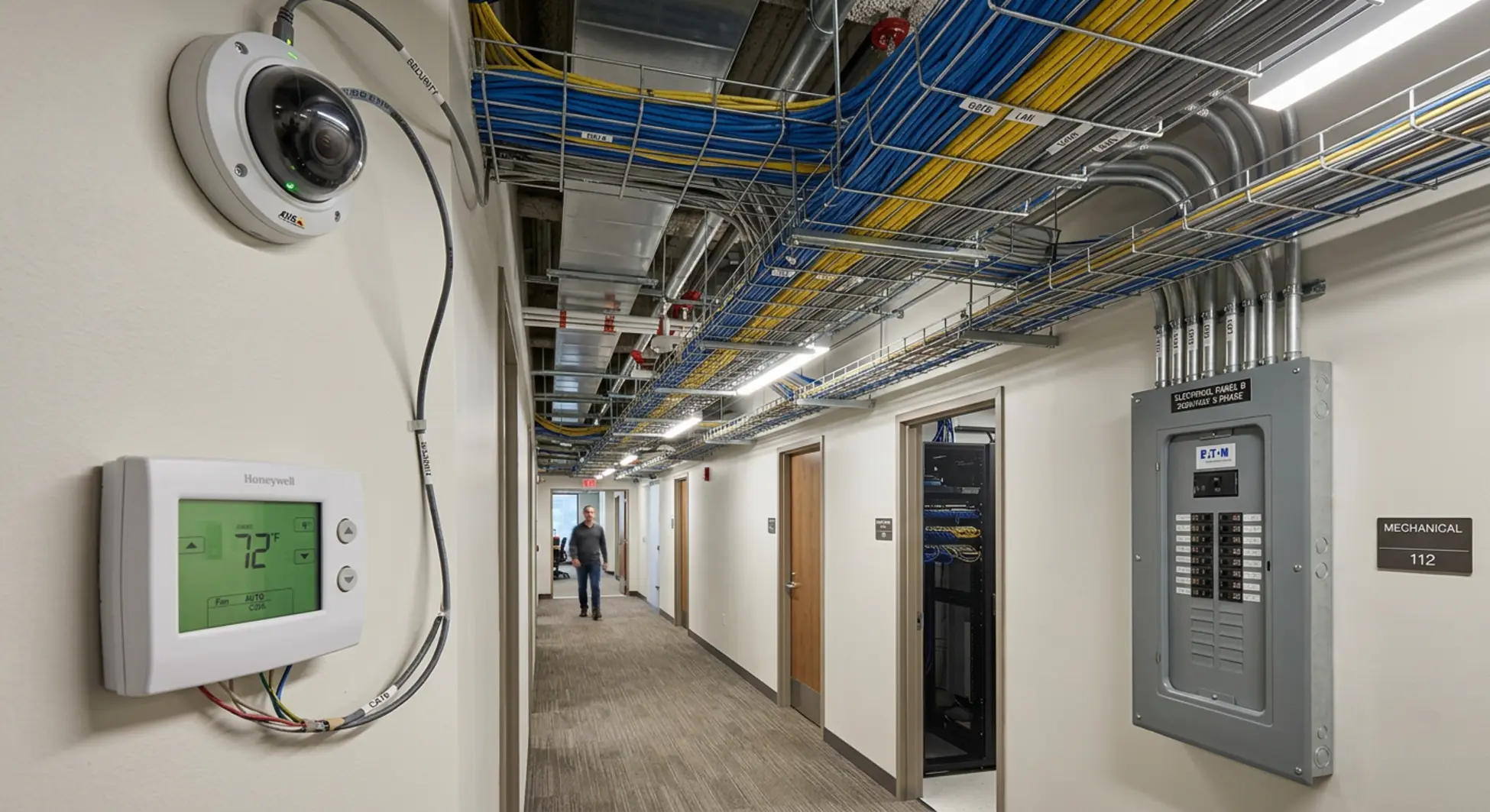
Think of low voltage as the nervous system of your building. It carries information, signals, and light control — not heavy power loads. Here’s what typically runs on low voltage in a commercial facility:
- Data networks and structured cabling (Cat6, fiber optic)
- Security camera systems (CCTV and IP cameras)
- Fire alarm and smoke detection systems
- Access control systems (key fobs, card readers, biometric entry)
- LED lighting controls and dimming systems
- Phone systems, VoIP infrastructure, and intercoms
- Building automation and environmental controls
- Audio/visual systems and digital signage
It’s called “low” voltage for a reason — it’s safer to work with, carries a lower fire risk, and is generally less expensive to install. A technician touching a 24V data cable faces a very different risk than someone working on a 480V motor feed. That difference in risk is reflected in the licensing requirements, installation standards, and inspection processes for each system type.
What High Voltage Actually Powers
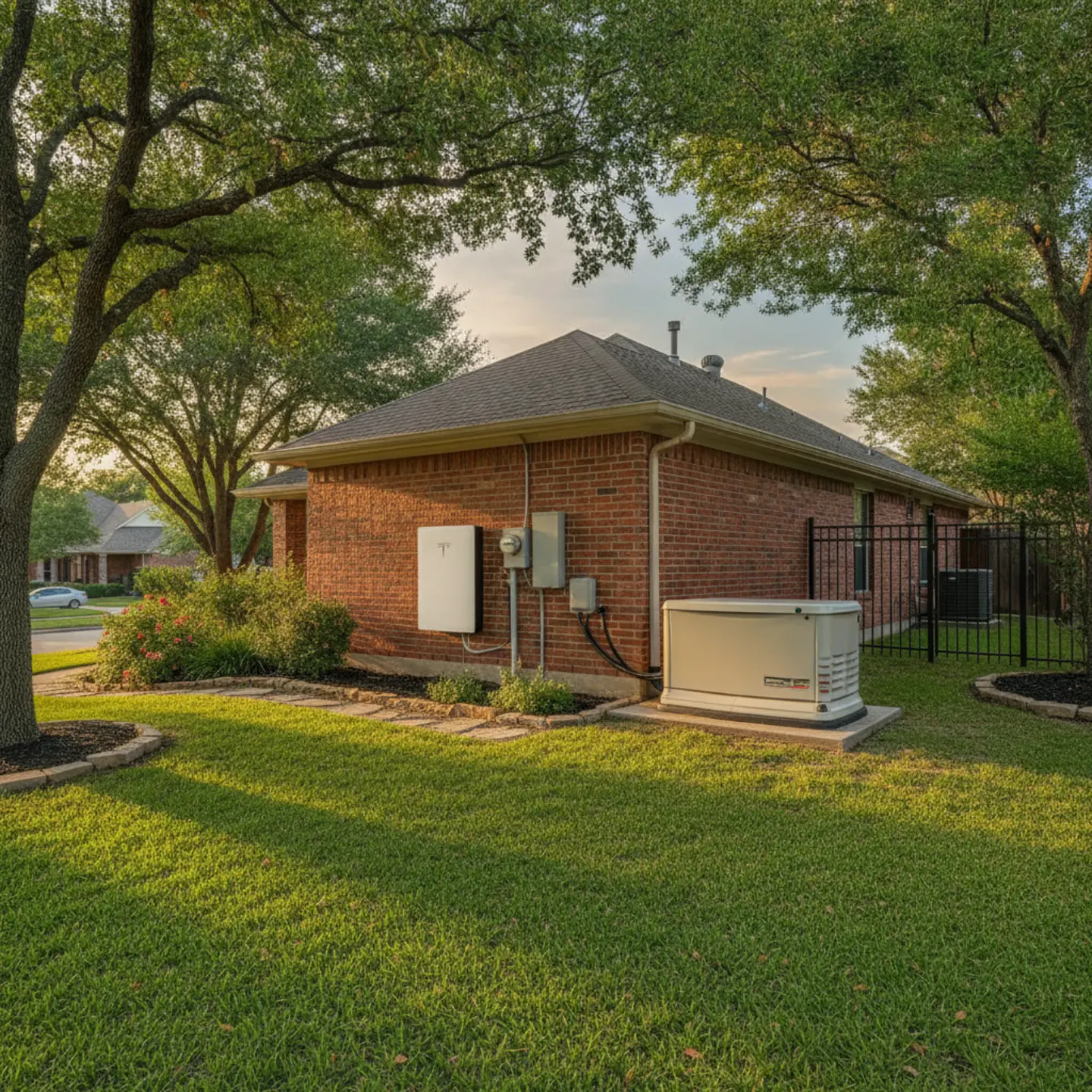
High voltage is the muscle of your building. It delivers the actual energy needed to run equipment, heat and cool spaces, and keep the lights on. In a typical North Texas commercial facility, high voltage systems power:
- HVAC systems — rooftop units, chillers, air handlers, and heat pumps
- Main facility lighting (fluorescent, LED fixtures, parking lot lighting)
- Power distribution panels and subpanels throughout the building
- Industrial motors and heavy machinery
- Elevators and escalators
- Commercial kitchen equipment and refrigeration
- Electric vehicle charging stations
- Production lines and manufacturing equipment
High voltage systems require licensed master electricians in Texas, strict code compliance, detailed permitting, and multiple inspections. The reason isn’t bureaucracy for its own sake — it’s because a mistake in a high voltage system can cause fires, equipment failures, serious injuries, or worse. The standards exist because the consequences of getting it wrong are severe.
🤝 You’re Not Alone in the Confusion
Most facility managers and business owners don’t know the difference between low and high voltage — and that’s completely okay. This is specialized knowledge that takes years to develop. The important thing isn’t knowing every technical detail yourself. It’s knowing the right questions to ask and working with someone who explains things clearly, without making you feel like you should already know the answers.
Why Your North Texas Facility Probably Needs Both
Here’s the thing most electricians don’t say clearly enough: for almost every commercial facility in the DFW area, the question isn’t “low voltage or high voltage?” It’s “how do these two systems work together in my building?”
The either/or framing is a false choice. Modern commercial buildings — whether you’re running a 10,000 square foot office in Plano or a 200,000 square foot distribution center in Garland — use both systems simultaneously. They’re not competing options. They’re complementary systems that are specifically designed to work together.
Think about a typical office building in North Texas. The HVAC system that keeps your employees comfortable in August? High voltage. The thermostat that controls that HVAC system and sends data to your building management software? Low voltage. The overhead lighting fixtures? High voltage. The dimming controls and occupancy sensors that manage those fixtures? Low voltage. The security cameras watching your parking lot? Low voltage. The electric door locks those cameras are integrated with? Low voltage. The power feeding the server room that runs all of it? High voltage.
You can’t have one without the other in a modern facility. They’re interdependent.
The Integrated System Approach
The most useful way to think about this is the nervous system and muscle analogy. Low voltage runs the nervous system — it carries signals, controls, monitoring data, and communication throughout your building. High voltage runs the muscles — it delivers the actual energy that makes things move, heat, cool, and operate.
A well-designed commercial electrical system in North Texas treats these two systems as an integrated whole, not as separate projects. When you’re planning a new facility or a major renovation, the smart approach is to design both systems together so they’re coordinated, properly separated (which is a code requirement — more on that later), and sized for your future needs, not just your current ones.
This integrated approach is the standard for modern DFW commercial buildings, and it’s what separates a well-planned electrical system from one that causes headaches for years. When a facility has been built or renovated piecemeal — low voltage added here, high voltage upgraded there, systems from different contractors that don’t quite talk to each other — that’s when you start seeing the problems: interference between systems, capacity issues, code violations, and expensive retrofits.
The good news is that when both systems are planned and installed together by an experienced team, they’re actually more efficient, easier to maintain, and more cost-effective over the long run. Separation between low and high voltage isn’t just a safety requirement — it also reduces electromagnetic interference that can cause data transmission problems and equipment malfunctions.
Cost Comparison: Installation, Materials, and Long-Term Expenses
Let’s talk numbers — because this is usually what’s actually on your mind when you’re sitting in that meeting with an electrician. Understanding the cost difference between low voltage and high voltage installation helps you budget accurately, evaluate estimates, and avoid the two most common mistakes: sticker shock and false economy.
Low voltage installation typically runs $1,500 to $5,000 per system depending on scope. A basic security camera system for a small retail space might be on the lower end. A full structured cabling installation with fiber backbone, patch panels, and data drops throughout a 50,000 square foot office building will be significantly higher. But the per-system cost is generally manageable and predictable.
High voltage installation costs vary dramatically based on your facility size, the condition of your existing infrastructure, and what you’re actually installing. A panel upgrade for a small commercial space might run $3,000–$8,000. A full electrical service installation for a new manufacturing facility could be $50,000–$200,000 or more. The range is wide because the variables are wide.
Why Low Voltage Costs Less to Install
The cost difference isn’t arbitrary — it reflects real differences in materials, labor, and complexity. Low voltage systems use smaller gauge wire that costs less per foot. The conduit requirements are less stringent, which means faster installation and lower material costs. In many cases, low voltage work can be performed by licensed technicians who don’t require a master electrician’s license, which affects labor rates.
Low voltage systems also require fewer safety devices. You’re not installing large breakers, heavy-duty panels, or extensive grounding and bonding systems. The inspection process is typically faster and less involved. All of these factors combine to make low voltage installation more affordable per square foot than high voltage work.
Why High Voltage Installation Costs More
High voltage installation costs more for legitimate reasons. In Texas, all high voltage commercial work requires a licensed master electrician — and that expertise comes at a premium that reflects years of training, licensing, and experience. The materials are more expensive: heavier gauge copper wire, larger conduit, more complex panels, and the safety equipment required by code.
The permitting and inspection process for high voltage work is more extensive and takes longer, which adds to project timelines and costs. Arc flash hazard analysis, detailed engineering calculations, and compliance documentation all add to the professional services cost. And the safety equipment itself — grounding systems, bonding, protection devices, arc flash mitigation — adds material cost that simply doesn’t exist at low voltage levels.
None of this is padding or unnecessary expense. It’s what responsible, code-compliant commercial electrical installation actually costs in North Texas.
The Hidden Cost Nobody Mentions
Here’s the cost conversation most electricians skip: the cost of downtime during installation, and the cost of not planning ahead.
When your facility is without power during an installation or upgrade, you’re losing productivity. Depending on your business, that downtime might cost more per hour than the installation itself. A phased installation approach — where work is done in sections to keep parts of your facility operational — costs more upfront than a full shutdown and single-phase installation, but it often makes financial sense when you factor in lost revenue.
Future upgrades are another hidden cost. Installing slightly oversized conduit during initial work costs very little extra. Retrofitting that same conduit later — cutting through walls, pulling new wire, patching and repainting — costs a lot. Every experienced commercial electrician has seen facilities where someone saved $2,000 on the original installation and then spent $15,000 fixing it five years later when the business grew.
Undersizing systems is the most expensive mistake in commercial electrical work. If your panel is sized for your current load and you add equipment, you’ll trip breakers, damage equipment, and eventually need an expensive retrofit. If your data cabling is installed without capacity for future network expansion, you’ll be pulling new cable through finished walls. Planning for tomorrow during today’s installation is always the smarter financial decision.
💡 Pro Tip: Plan for Tomorrow, Not Just Today
When you’re installing electrical systems — whether low voltage or high voltage — spend a little extra now to build in capacity for future growth. Installing oversized conduit and adding a few extra circuits during initial work costs a fraction of what it costs to retrofit later. A good electrician will ask about your 5-year plans before finalizing the design. If they don’t ask, you should bring it up.
Trying to figure out what a system upgrade would actually cost for your specific facility? That’s exactly what a free estimate is designed to answer — honest numbers based on your actual situation, not a generic ballpark.
Safety Requirements: What Texas Code Actually Demands
Safety codes exist because electrical failures kill people and destroy buildings. That’s not fear-mongering — it’s the reason the National Electrical Code exists and why Texas has its own additional requirements on top of it. Understanding what’s actually required helps you make informed decisions and recognize when a contractor is cutting corners.
Both low voltage and high voltage systems must comply with the NEC (National Electrical Code), which is adopted in Texas with state-specific amendments. The Texas Electrical Safety Standards (TESS) add additional requirements for commercial installations. Non-compliance isn’t just a technical violation — it creates real liability exposure, can void your insurance coverage, and can result in fines or forced remediation during a sale or refinancing.
Low Voltage Safety Standards
Low voltage systems are often perceived as “safe enough to skip the rules,” and that perception is wrong. While the risk profile is lower than high voltage work, low voltage systems still must be installed per NEC standards — specifically Articles 725, 760, 800, and 820 depending on the system type.
Fire rating requirements apply to low voltage cabling. In commercial buildings, cables running through plenum spaces (the space above drop ceilings used for air return) must be plenum-rated, which costs more than standard cable but is required by code. Running non-plenum cable in a plenum space is a fire hazard and a code violation.
Grounding requirements for low voltage systems are less stringent than high voltage, but they’re still mandatory. Improperly grounded data and security systems cause interference, equipment damage, and in some cases, safety hazards. The inspection process for low voltage work is faster than high voltage — typically a single inspection — but it’s still required, and skipping it creates liability.
High Voltage Safety Standards
High voltage commercial installation in Texas is heavily regulated, and for good reason. A licensed master electrician is required for all high voltage work — not just supervision, but actual hands-on involvement in the installation. This is a Texas state requirement, not a suggestion.
Grounding and bonding requirements for high voltage systems are extensive. Every metal enclosure, conduit, and equipment chassis must be properly bonded to the grounding system. This isn’t just about protecting people from shock — it’s about ensuring that fault current is safely directed to ground rather than through equipment or people.
For facilities with significant high voltage equipment, an arc flash hazard analysis is often required. Arc flash — when electricity jumps through the air between conductors — releases enormous energy in a fraction of a second and can cause severe burns and fatalities. The analysis determines the safe working distance and required personal protective equipment for anyone working on energized equipment.
Regular inspections and maintenance documentation are mandatory for many commercial high voltage systems. This isn’t just about initial installation — it’s an ongoing requirement that affects your facility’s safety, your insurance coverage, and your compliance status.
Licensing and Permitting: What You Actually Need to Know
The permitting process is where a lot of commercial electrical projects run into trouble — not because of the work itself, but because of misunderstandings about what’s required, how long it takes, and what happens if you skip it. Let’s clear this up.
In Texas, electrical work is regulated by the Texas Department of Licensing and Regulation (TDLR). The licensing requirements are different for low voltage and high voltage work, and the permit process reflects those differences. Working with experienced commercial electricians in Dallas-Fort Worth who understand both systems means you’re not navigating this alone.
The Permit Process for Low Voltage
Low voltage permits in most DFW municipalities have a faster approval timeline — typically 3 to 5 business days for standard commercial projects. Permit fees are lower, reflecting the lower risk profile of the work. In most cases, a single inspection is sufficient for low voltage systems, and the inspection process is less involved than high voltage.
For emergency situations — say, a security system that needs to be replaced after a break-in, or a fire alarm system that’s failed — low voltage permits can often be expedited. Most municipalities in the DFW area have provisions for emergency permitting that can compress the timeline significantly.
Even though the process is faster and less expensive, it’s still required. Low voltage work done without permits creates the same liability issues as any other unpermitted work: code violations that surface during property sales, insurance claims that get denied, and potential forced remediation.
The Permit Process for High Voltage
High voltage permits take longer and cost more — typically 7 to 14 business days for approval in most DFW cities, with higher fees based on project scope and valuation. Multiple inspections at different stages of the project are standard: rough-in inspection before walls are closed, equipment inspection when panels and gear are installed, and final inspection when the system is complete.
High voltage permits require detailed plans and calculations. Your electrician needs to submit load calculations, panel schedules, one-line diagrams, and in some cases, engineer-stamped drawings. This isn’t bureaucratic overhead — it’s documentation that verifies the system is designed safely and correctly before installation begins.
Different cities in the DFW area have slightly different requirements and timelines. Fort Worth, Dallas, Arlington, Plano, and Frisco all have their own municipal inspection departments with their own processes. An electrician who regularly works across the DFW area knows these differences and can plan your project timeline accordingly.
⚠️ Red Flag: Unlicensed Electricians and Unpermitted Work
If someone offers to do high voltage commercial work without pulling permits, without a licensed master electrician on the job, or at a price that seems too good to be true — walk away. You’re not saving money. You’re taking on liability for code violations, voiding your insurance coverage on any failures, and creating safety hazards that could affect your employees and customers. The savings aren’t worth it. They never are.
Confused about what permits you actually need for your facility, or how long the process takes in your specific city? A quick conversation with an experienced commercial electrician can clear that up — no obligation, just clarity.
Common DFW Facility Types and What They Actually Need
The abstract explanation of low voltage vs. high voltage becomes a lot clearer when you look at specific facility types. Here’s how these systems actually break down in the kinds of commercial buildings we work in across North Texas every week.
Office Buildings and Corporate Spaces
A typical office building in the DFW area — whether it’s a 5,000 square foot professional suite in Southlake or a 100,000 square foot corporate campus in Las Colinas — uses both systems extensively and in close coordination.
On the high voltage side: the building’s main electrical service comes in at 208V or 277V three-phase, feeds the main distribution panel, and branches out to subpanels on each floor. HVAC units, elevator systems, and main lighting fixtures all run on high voltage. Standard 120V outlets throughout the office are fed from the high voltage distribution system.
On the low voltage side: structured data cabling (typically Cat6 or Cat6A) runs to every workstation and conference room. Security cameras cover entrances, parking areas, and common spaces. Access control systems manage who can enter which areas. Fire alarm and smoke detection systems are required by code. Phone and VoIP systems run on low voltage infrastructure. In modern buildings, building automation systems (BAS) that control HVAC scheduling, lighting, and energy management are low voltage.
These two systems are coordinated throughout the building — the BAS controls the HVAC (high voltage) through low voltage signals, the access control system (low voltage) may interface with door strikes powered at low voltage, and the security system (low voltage) may trigger lighting (high voltage) in response to motion detection.
Retail and Commercial Spaces
Retail facilities in North Texas — from strip mall tenants in Grapevine to big-box stores in Lewisville — have a specific set of electrical needs that reflect the combination of customer-facing operations and back-of-house equipment.
High voltage handles the heavy lifting: HVAC systems (critical in Texas summers), main lighting, refrigeration cases in grocery and convenience stores, commercial kitchen equipment, and the main electrical service feeding all of it. Most retail spaces operate on 120/208V three-phase service, though larger facilities may require higher voltage feeds.
Low voltage handles the intelligence layer: point-of-sale (POS) system networks, security camera systems (often extensive in retail), digital signage controls, music and PA systems, and fire alarm systems. Backup power for security systems is a consideration — if your main power goes out, your security cameras and access control should stay operational, which requires battery backup systems on the low voltage side.
Future expansion planning is particularly critical in retail. If you’re opening a location with plans to add a second register, expand your camera coverage, or add outdoor digital signage, building that capacity into the initial installation is far cheaper than retrofitting later.
Industrial and Manufacturing Facilities
Manufacturing and industrial facilities in the DFW area — particularly in the industrial corridors around Fort Worth, Grand Prairie, and the Alliance area — have the most demanding electrical requirements of any commercial facility type.
High voltage is the dominant system here, often at 480V three-phase to power large motors, production equipment, compressors, and heavy machinery. Motor control centers (MCCs) distribute power to individual pieces of equipment. Variable frequency drives (VFDs) control motor speeds. The electrical infrastructure in a manufacturing facility is complex, expensive, and absolutely critical to operations.
Low voltage handles controls, monitoring, and safety: programmable logic controllers (PLCs) that run production sequences, safety interlocks that shut down equipment when guards are opened, monitoring systems that track equipment performance, and the network infrastructure that connects everything to your business systems. In modern manufacturing, the low voltage controls layer is what makes the high voltage equipment intelligent and efficient.
Redundancy and backup systems are often required in industrial settings — both for safety and for business continuity. Regular maintenance and scheduled upgrades are essential, not optional, because equipment failures in a manufacturing environment have immediate and significant financial consequences.
When to Upgrade: Signs Your Facility Needs New Electrical Work
Knowing the difference between low and high voltage is useful context. But for many facility managers reading this, the more pressing question is: does my current system need attention? Here’s how to recognize the signals — and how serious each one is.
🔌 Why Your Electrician Keeps Talking About “Capacity”
Capacity is how much power your electrical system can handle at once. If you’re regularly running near your system’s capacity — or exceeding it — adding new equipment will cause breaker trips, voltage sags, and equipment damage. When an electrician talks about capacity, they’re not trying to upsell you on a bigger system. They’re describing a real physical limitation that affects your operations today and your ability to grow tomorrow.
Immediate Red Flags (Call Today)
Some electrical problems require immediate attention — not “schedule something for next month,” but a call today. These are the situations where waiting creates serious safety risk:
- Burning smells from outlets, panels, or electrical equipment — this is a fire risk
- Visible damage to outlets, panels, or wiring — discoloration, melting, or physical damage
- Frequent electrical shocks from equipment or outlets — indicates a grounding or wiring problem
- Sparking or arcing sounds from any electrical equipment or panel
- Smoke or fire near any electrical component — evacuate and call 911 first, then an electrician
- Complete power loss or multiple simultaneous breaker failures across unrelated circuits
If you’re experiencing any of these, stop reading and make the call. These are not “keep an eye on it” situations.
Warning Signs (Schedule an Inspection)
These issues aren’t emergencies, but they’re telling you that something in your electrical system needs professional attention. Don’t ignore them — they tend to get worse, not better:
- Breakers tripping regularly during normal operation — not after unusual loads, but routinely
- Lights dimming noticeably when large equipment turns on (HVAC, compressors, etc.)
- Outlets or switch plates that are warm or hot to the touch
- Buzzing or humming sounds from electrical panels or junction boxes
- Inability to power new equipment without tripping breakers
- Flickering lights that aren’t related to bulb issues
A professional electrical inspection for any of these symptoms will tell you exactly what’s happening and what needs to be done — and what can wait. You’ll leave the conversation with clarity, not a sales pitch.
Planning Upgrades (Think Ahead)
Not every reason to upgrade is a warning sign. Sometimes the right time to upgrade is before something breaks — especially if you’re planning growth or changes to your facility:
- Your building is over 20 years old with original electrical infrastructure
- You’re planning a facility expansion, renovation, or tenant improvement
- You’re adding significant new equipment, technology systems, or EV charging
- Your current system regularly runs at or near peak demand
- An insurance inspection or code compliance review has identified issues
- You’re preparing to sell or refinance the property
If you’re seeing any of these warning signs in your facility, a professional inspection will tell you exactly what needs attention and what can wait — and it won’t cost you anything to find out.
The Real Conversation: Questions to Ask Your Electrician
One of the most valuable things you can do before signing any commercial electrical contract is know what questions to ask. Not to catch anyone in a lie — but because the answers tell you a lot about whether you’re working with someone who’s looking out for your interests or just trying to close a sale.
“A good electrician will tell you what you don’t need, not just what they can sell you. If someone can’t explain why they’re recommending something in plain English, that’s a problem.”
Questions About the Scope
Before any work begins, you should understand exactly what’s being recommended and why. These questions help you get there:
- “Why are you recommending this specific voltage level or system configuration?” — The answer should be specific to your facility’s needs, not generic.
- “What happens if we need to expand in 5 years?” — A good answer addresses scalability and what provisions are being built in now.
- “Are there code requirements I should know about that affect this project?” — This tests whether they’re proactive about compliance.
- “What’s included in the estimate and what would be extra?” — Get this in writing. Surprises on electrical invoices are never pleasant.
- “Is there a less expensive option that would still meet my needs?” — If they can’t answer this honestly, take note.
Questions About the Timeline
Timeline questions protect your operations. Electrical work that takes longer than expected or causes unexpected downtime has real business costs:
- “How long will this take from permit approval to final inspection?” — Get a realistic range, not just the best-case scenario.
- “Will we have downtime during installation, and how long?” — Ask specifically about which systems will be offline and when.
- “What’s the permitting timeline in our specific city?” — This varies across DFW municipalities.
- “Are there any factors that could extend the timeline?” — Supply chain issues, inspection backlogs, and weather can all affect schedules.
Questions About the Warranty
Warranty questions protect you after the job is done. The installation is only as good as the support behind it:
- “What’s covered under your workmanship warranty and for how long?” — Standard commercial warranties are typically 1-2 years on labor.
- “What happens if something fails after installation?” — Understand the process before you need it.
- “Do you provide ongoing maintenance or service agreements?” — Especially important for complex systems.
- “Who handles emergency repairs if something goes wrong after hours?” — For commercial facilities, this matters.
✅ It’s Okay to Ask for a Second Opinion
If an estimate seems high, the recommendations don’t quite make sense to you, or you just want to verify what you’re being told, getting a second assessment is completely reasonable. A contractor who’s confident in their work and honest in their recommendations won’t be offended by that request. They’ll understand that you’re making an important decision for your business and want to get it right.
Why Hiring the Right Electrician Matters More Than You Think
The difference between a good commercial electrical installation and a poor one isn’t always visible when the work is done. It shows up six months later when a breaker fails, or two years later when you’re trying to expand and discover the conduit is already full, or five years later when an insurance inspector finds code violations in work that was never properly permitted.
Commercial electrical work is not a commodity where the lowest price is the best choice. The quality of the installation, the accuracy of the design, and the integrity of the contractor you hire have long-term consequences for your facility’s safety, your operational reliability, and your financial exposure.
The Cost of Cutting Corners
Cheap installation almost always means expensive repairs later. Here’s how that plays out in practice:
A facility hires an unlicensed contractor to save money on a panel upgrade. The work is done without permits. Three years later, during a property sale, an inspection reveals the unpermitted work. The buyer’s lender requires the work to be redone by a licensed electrician, permitted and inspected — at full cost. The seller pays twice for the same job, plus the cost of delays in the sale.
Or: a warehouse installs a low voltage security system using standard cable in plenum spaces to save on materials. During a fire alarm inspection, the non-compliant cable is flagged. The entire system has to be replaced with properly rated cable. The “savings” on materials cost three times as much to fix.
Or: a manufacturing facility installs a high voltage system sized exactly for current load with no capacity for growth. Two years later, they add a production line. The panel can’t handle the additional load. A new panel, new conduit runs, and significant disruption to production follows — at a cost that dwarfs what it would have cost to install a properly sized system originally.
These aren’t hypothetical scenarios. They’re the kinds of situations that experienced family-owned commercial electrical contractors in DFW get called in to fix regularly. And in almost every case, the root cause is the same: someone prioritized short-term cost savings over long-term quality.
What to Look For in a Commercial Electrician
When you’re evaluating commercial electrical contractors for your North Texas facility, here’s what actually matters:
- Licensed master electrician with commercial experience — Not just residential. Commercial systems are fundamentally different in scale, complexity, and code requirements.
- References from similar-sized facilities in the DFW area — Ask for them and actually call. A contractor who’s done good work for facilities like yours will have references who’ll tell you so.
- Transparent, detailed written estimates — Line-item breakdowns of labor and materials, not just a total number. You should be able to see exactly what you’re paying for.
- Willingness to explain decisions in plain language — If they can’t explain why they’re recommending something without jargon, that’s a red flag.
- Track record of on-time, on-budget project completion — Ask specifically about this. Delays and cost overruns in commercial electrical work have real business consequences.
- Honesty about what you don’t need — The best contractors will tell you when a simpler, less expensive solution will do the job. That honesty is worth more than any discount.
We’ve been doing this work in the DFW area for three generations. The thing we’re most proud of isn’t the projects we’ve completed — it’s the times we’ve told a client they didn’t need what they thought they needed, saved them money, and earned their trust for the long term. That’s the kind of contractor relationship that actually serves your business.
Your Next Steps: From Decision to Installation
If you’ve made it this far, you have a solid foundation for making informed decisions about your facility’s electrical systems. Here’s a practical action plan to move from “I understand the concepts” to “I have a plan and a contractor I trust.”
Step 1: Get a professional assessment of your current system. Before you can make good decisions about what to install or upgrade, you need an accurate picture of what you have. A professional assessment will identify your current capacity, any existing code issues, and the condition of your infrastructure. This is the foundation for everything else.
Step 2: Understand your facility’s actual power needs. This means thinking about what you’re running now, what you plan to add in the next 3-5 years, and any seasonal or operational peaks that affect your load. A good electrician will help you think through this systematically.
Step 3: Get detailed estimates from licensed contractors. Not just one — get two or three. Compare them carefully, not just on total price but on what’s included, what’s excluded, and how the scope is defined. The cheapest estimate is often the one that’s missing something important.
Step 4: Review timeline, warranty, and ongoing support. Make sure you understand how the installation will affect your operations, what’s covered if something goes wrong, and who you call for service after the job is done. These details matter as much as the installation itself.
Step 5: Plan for installation with minimal operational disruption. Work with your contractor to schedule work during off-hours, plan phased installation if needed, and communicate clearly with your team about what to expect. The best installation is one that gets done right without shutting down your business.
When you’re ready to take that first step, schedule your free electrical assessment with our team. We’ll come to your facility, look at what you have, and give you an honest assessment of what you need — and what you don’t.
Frequently Asked Questions About Low Voltage vs High Voltage Commercial Installation
Can I mix low voltage and high voltage in the same conduit?
No — and this is a hard requirement, not a suggestion. The National Electrical Code requires that low voltage and high voltage conductors be separated to prevent electrical interference and safety hazards. Running them in the same conduit can cause induced voltage on low voltage cables, data transmission errors, and in worst-case scenarios, dangerous voltage levels appearing on low voltage equipment. If someone tells you it’s fine to run them together to save on conduit costs, that’s a red flag. Proper separation is a code requirement that protects both your equipment and your people.
How often do commercial electrical systems need maintenance?
High voltage commercial systems should receive a professional inspection annually and undergo more comprehensive testing — including thermal imaging and electrical testing — every 3 to 5 years. Low voltage systems are generally less maintenance-intensive, but should be reviewed during any facility upgrade or renovation to ensure they’re still performing correctly and meeting current code standards. Regular maintenance isn’t just about preventing failures — it extends the life of your equipment, maintains your insurance coverage, and keeps you in compliance with Texas electrical safety requirements. Deferred maintenance on commercial electrical systems is one of the most common causes of expensive emergency repairs.
What’s the difference between 208V and 277V in commercial buildings?
Both are common in North Texas commercial buildings, but they serve different purposes. 208V is derived from standard three-phase wye power systems and is the typical voltage for general commercial power distribution — feeding outlets, small equipment, and most commercial loads. 277V is the phase-to-neutral voltage of a 480V three-phase system and is commonly used for commercial lighting circuits in larger facilities because it allows for smaller wire sizes and lower current, which reduces material costs and energy losses over long runs. Your facility’s service type and the design of your electrical system determine which voltage is available and appropriate for specific applications. An electrician assessing your facility will evaluate your service entrance to determine what’s available and what makes sense for your specific needs.
Can I upgrade my electrical system without shutting down my facility?
Sometimes — but it depends entirely on what’s being upgraded and what your current infrastructure looks like. Low voltage upgrades can almost always be done without facility downtime. High voltage work is more complex: adding new circuits or subpanels can often be done while keeping most of the facility operational, but work on main service equipment, main panels, or utility connections typically requires a planned outage. A good electrician will design a phased installation plan that minimizes your downtime and keeps critical systems operational as long as possible. This approach costs more than a single-phase shutdown, but for many businesses the operational continuity is worth the premium. The key is planning this conversation before the project starts, not after.
How long does a commercial electrical installation typically take?
Low voltage system installations typically take 1 to 3 weeks depending on the scope and size of the facility. A basic security camera system might be done in a day or two; a full structured cabling installation for a large office building will take longer. High voltage upgrades generally run 2 to 8 weeks when you include the permitting and inspection timeline — and that timeline varies by municipality across the DFW area. Complex projects involving utility coordination, engineer-stamped drawings, or phased installation can take longer. Your electrician should provide a detailed timeline upfront that accounts for permitting, material lead times, installation phases, and inspections — not just the installation hours themselves.
What happens if my facility outgrows its electrical capacity?
When a commercial facility exceeds its electrical capacity, you’ll start seeing symptoms: breakers tripping under normal load, voltage sags when large equipment starts, inability to add new circuits without overloading the panel. The fix typically involves upgrading your main distribution panel, adding subpanels, and potentially coordinating with your utility company to upgrade your service entrance — which can be a significant project in terms of cost, timeline, and disruption. In some cases, you may need a new utility transformer, which involves the utility company directly and adds complexity. This is exactly why planning for future capacity during initial installation is so important — the cost of building in extra capacity upfront is a fraction of the cost of a capacity upgrade after the fact.
Ready to Make the Right Electrical Decision for Your North Texas Facility?
You don’t have to figure this out alone — and you shouldn’t have to. We’ve helped hundreds of DFW businesses navigate exactly these decisions, from small retail spaces in Keller to large manufacturing facilities in Fort Worth. We’re a family business, three generations deep, and we built our reputation on telling people what they actually need — not just what we can sell them.
If you want a straight answer about what your facility needs, a free estimate with no pressure and no obligation, that’s exactly what we offer. Come talk to us.
Get Your Free Facility Estimate
Serving Fort Worth · Arlington · Keller · Southlake · Colleyville · Grapevine · Lewisville · Plano · Irving · Grand Prairie · and all of DFW