
Commercial Electrical Maintenance Checklist for DFW Businesses: Prevent Costly Downtime
⚡ Key Takeaways
- 400% ROI on preventive maintenance – Businesses that switch from reactive to preventive maintenance see dramatic returns and avoid $500,000/hour downtime costs
- NFPA 70B is now mandatory (as of 2023) – What was once a “recommended practice” is now enforceable law. OSHA can cite your business for non-compliance
- 55% of workplace fires start with electrical equipment – Most are preventable with straightforward maintenance intervals
- DFW’s heat shortens equipment life by 50% – Every 10°C above design temperature cuts your electrical system’s lifespan in half
- Simple maintenance prevents 80% of failures – Daily visual checks, monthly tests, quarterly thermal scans, and annual professional inspections catch problems before they become emergencies
- Warning signs you can spot yourself – Flickering lights, buzzing sounds, burning smells, and warm outlets signal immediate attention needed
- Reactive maintenance costs 25-30% more – And that’s before you factor in lost revenue, emergency labor premiums, and secondary equipment damage
You’re Right to Question What’s Actually Necessary
If you’ve ever had an electrical contractor tell you that you need a $50,000 panel replacement when you just called them to fix a tripped breaker, you know the frustration.
You’re standing there wondering: “Do I really need all that, or is this a sales pitch?”
Here’s the truth most business owners dealing with electrical issues face two problems at once. First, you’re not sure if there’s a real safety issue or just normal wear and tear. Second, you have no way to know if you’re being taken advantage of by someone who sees dollar signs instead of circuit breakers.
The problem isn’t you. It’s an industry where too many contractors prioritize upselling over educating. Where technical jargon replaces clear explanations. Where fear tactics substitute for honest assessments.
💡 The Real Question Business Owners Ask
“Do we really need all that maintenance, or is this contractor just trying to sell us services we don’t need?”
Valid question. This guide gives you the answer — what commercial electrical maintenance actually requires, backed by NFPA standards and manufacturer recommendations. No jargon, no pressure, just clear answers.
Here’s what commercial electrical maintenance actually requires — no jargon, no pressure, just clear answers based on what the National Fire Protection Association requires and what actually keeps businesses running.
What Changed in 2023: NFPA 70B Is Now Mandatory (Here’s What That Means for DFW Businesses)
For years, electrical maintenance was guided by NFPA 70B as a “recommended practice.” Contractors would suggest following it. Insurance companies encouraged it. But it wasn’t required.
That changed in 2023.
NFPA 70B shifted from a “recommended practice” to a mandatory “standard.” That one word change has massive implications for every commercial building owner in Fort Worth, Arlington, and across DFW.
What this means legally: The document now uses the word “shall” instead of “should.” In legal and regulatory language, “shall” means required. OSHA can now cite businesses for non-compliance, using NFPA 70B as the industry-recognized safety benchmark.
For DFW business owners: If a fire starts on your property due to lack of maintenance, YOU are liable for the damages — not the utility company, not your tenant, not your electrician. The Smokehouse Creek Fire lawsuit in the Texas Panhandle proved this: when a decayed utility pole sparked the largest fire in Texas history, the resulting $1 billion lawsuit went straight to the property owner for failure to maintain aging infrastructure.
The Cost of Non-Compliance
Percentage of businesses experiencing monthly equipment failures. Most could have been prevented with scheduled maintenance.
Additional stats that matter:
- $150 billion: Annual cost of electrical failures across U.S. businesses
- 300-500%: Emergency repair cost premium over planned maintenance
- 55%: Workplace fires caused by electrical equipment failure
What NFPA 70B now requires: Every facility must have a written Electrical Maintenance Program (EMP) with a designated coordinator, documented equipment condition assessments, and specific maintenance intervals based on equipment type and environment.
The good news? You don’t need to hire a compliance specialist or spend tens of thousands on unnecessary upgrades. You need a clear plan, documentation, and a licensed electrician who knows the difference between required maintenance and optional upsells.
Why Reactive Maintenance Costs 25-30% More (And That’s Just the Start)
Most business owners operate on what’s called a “run to failure” model. If it’s working, leave it alone. Fix it when it breaks.
On the surface, this seems cost-effective. Why pay for maintenance when nothing’s wrong?
Here’s why: reactive maintenance might feel cheaper in the moment, but it’s catastrophically expensive over time.
⚠️ The Hidden Multiplier Effect
When electrical equipment fails without warning, you don’t just pay for the repair. You pay:
- Emergency labor rates: 150-200% of standard pricing
- Expedited parts: Rush shipping and limited availability drive costs up 200-300%
- Secondary equipment damage: One failure often cascades to connected systems
- Lost revenue during downtime: This is the killer — for some businesses, $500,000 per hour
A recent study of U.S. manufacturers found that over half experienced unplanned downtime in the last year, resulting in $207 million in weekly capital impact across the sector. For manufacturing, about 45% of outages last up to 12 hours, while 15% extend to 72 hours — effectively shutting down entire production cycles.
| Maintenance Type | Operating Cost Impact | Equipment Lifespan | ROI |
|---|---|---|---|
| Reactive (“run to failure”) | 30% higher expenses | Shortened by 40-50% | Negative (unpredictable costs) |
| Preventive (scheduled maintenance) | 12-18% lower expenses | Extended by 50-75% | ~400% |
| Predictive (data-driven maintenance) | 10-40% lower expenses | Extended by 20-40% | $5 saved per $1 spent |
The equipment degradation alone tells the story: in reactive maintenance environments, electrical components wear out 72% faster than in facilities with scheduled maintenance programs.
✅ Real ROI from Preventive Maintenance
Businesses that implement structured electrical maintenance programs see:
- 400% return on investment through reduced downtime
- Equipment lifespans extended by 50-75%
- Energy costs reduced by 15-25% (well-maintained systems run more efficiently)
- Insurance premiums lowered due to demonstrated risk management
The math is simple: spend a few thousand dollars per year on scheduled maintenance, or risk a single failure that costs you hundreds of thousands — or millions — in lost revenue, emergency repairs, and equipment replacement.
10 Warning Signs Your Electrical System Needs Attention (Before It Becomes an Emergency)
You don’t need to be an electrician to spot trouble. Most catastrophic electrical failures are preceded by warning signs that anyone can recognize — if you know what to look for.
Here are the ten most critical warning signs, ranked by urgency:
1. Burning Smells (Fishy or Plastic Odor Near Outlets)
A distinct smell of burning plastic or a “fishy” odor near an outlet or electrical panel means insulation is melting due to extreme heat. This is often caused by a loose connection generating high resistance. If you smell this, shut down the affected circuit immediately and call a licensed electrician.
2. Buzzing or Humming Sounds from Panels or Outlets
Electrical systems should operate in near silence. If you hear buzzing, crackling, or humming from outlets, switches, or panels, electricity is “arcing” — jumping through gaps in wiring or faulty components. Arcing is a primary cause of electrical fires.
3. Warm or Hot Outlets and Switch Plates
Outlets or switch plates that are warm to the touch signal excessive current flow or a bottleneck in the circuit generating heat. This follows the formula: Power dissipated as heat = Current² × Resistance. Even slightly warm plates indicate a problem developing.
💡 The Touch Test
Walk your facility and touch outlet covers and switch plates (not the outlets themselves — the plastic covers). If any feel warm, that’s a red flag. Normal electrical systems don’t generate heat you can feel through the cover plate.
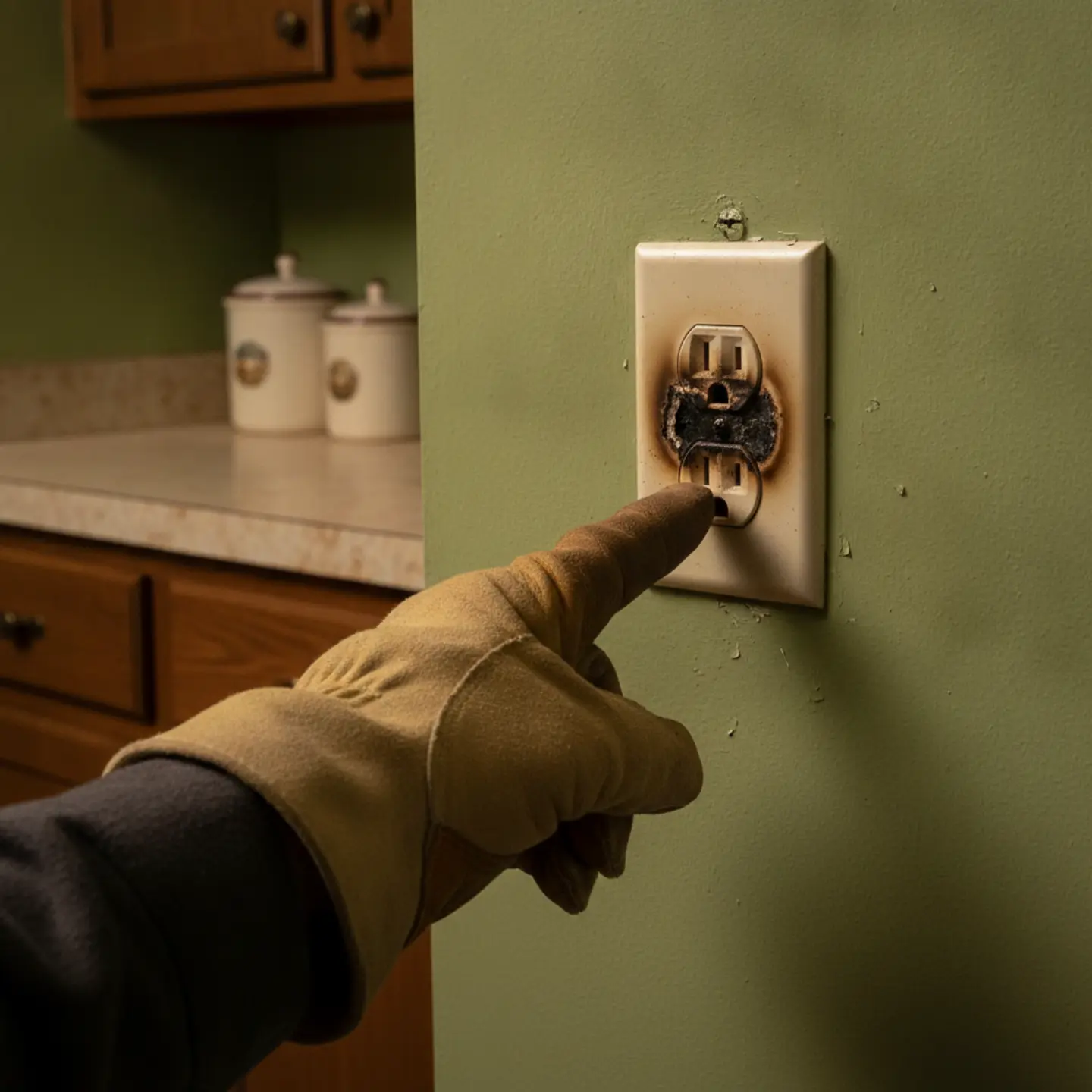
4. Scorch Marks or Discoloration Around Outlets
Scorch marks or discoloration around outlets and switches aren’t cosmetic issues — they’re evidence that the wiring inside the wall has already begun to break down. In the DFW climate, where buildings expand and contract significantly with temperature shifts, these marks often result from connections that have loosened over time due to thermal cycling.
5. Flickering Lights When HVAC or Machinery Kicks On
If lights flicker when your HVAC system, elevators, or heavy machinery cycles on, it suggests the power supply is under severe strain. The electrical system cannot handle the power demand from your equipment, which indicates either overloaded circuits or undersized service.
6. Frequent Circuit Breaker Trips
Breakers that trip frequently are doing their job — protecting you from overload or fault conditions. But if you’re resetting the same breaker weekly or monthly, that’s not normal. It’s a sign that the electrical system cannot handle the power demand, or there’s a fault in the circuit that needs professional diagnosis.
7. Flickering or Dimming Lights (General)
While often dismissed as a minor annoyance, flickering in a commercial facility is a leading indicator of unstable voltage, loose wiring, or overloaded circuits. Don’t ignore this — it’s your electrical system telling you something’s wrong.
8. Crackling Sounds When Flipping Switches
A light switch should operate silently. If you hear crackling or popping when you flip a switch, there’s arcing happening inside the switch housing. This is a fire risk and the switch needs replacement.
9. Equipment or Lighting That’s Over 25 Years Old
Electrical equipment doesn’t last forever. Panels, transformers, and major electrical infrastructure over 25 years old are at significantly higher risk of failure. Federal Pacific and Zinsco panels, in particular, are known fire hazards and should be replaced immediately regardless of age.
10. Visible Corrosion on Electrical Components
White, green, or rust-colored buildup on electrical connections, especially in outdoor switchgear or poorly ventilated electrical rooms, indicates oxidation and corrosion. This is particularly relevant in DFW’s humidity. Corroded connections increase resistance, generate heat, and accelerate failure.
If you’re seeing any of these warning signs, don’t wait. The cost of an inspection is minimal compared to the cost of a fire, equipment failure, or business shutdown.
Why North Texas Heat Makes Electrical Maintenance Even More Critical
DFW business owners face a challenge that companies in Seattle or Chicago don’t: extreme thermal stress on electrical systems.
The Dallas-Fort Worth metroplex spans Climate Zones 2A and 3A, which brings specific energy conservation and structural requirements — but more importantly, it brings brutal summer heat.
In North Texas, electrical systems regularly face temperatures well above their design parameters during summer months. Standard electrical equipment is designed for ambient temperatures between 104°F and 113°F (40°C to 45°C). DFW routinely exceeds this.
Here’s what that means for your equipment: For every 10°C (18°F) rise in temperature above the design threshold, the reliability and lifespan of electrical components is cut in half.
When your electrical room hits 120°F in July (which is common in buildings without climate-controlled electrical spaces), you’re not just uncomfortable — you’re actively shortening the life of transformers, breakers, and control systems.
The DFW Heat Factor
Reduction in equipment lifespan for every 10°C above design temperature. In DFW’s climate, this means your electrical infrastructure could fail twice as fast as the same equipment in a moderate climate.
The combination of high heat and DFW’s humidity creates another problem: accelerated oxidation and corrosion on electrical connections. This is particularly severe in outdoor switchgear, rooftop equipment, and poorly ventilated electrical rooms.
What DFW businesses must prioritize:
- Moisture sealing on outdoor electrical enclosures
- Thermal imaging in quarterly maintenance to detect hot spots before they fail
- More frequent inspections of outdoor equipment compared to national standards
- Climate control in electrical rooms (not just for comfort — for equipment survival)
Additionally, thermal cycling — the expansion and contraction of buildings and electrical components as temperatures swing from 100°F days to 40°F nights — loosens electrical connections over time. Scorch marks around outlets in North Texas buildings are often the result of connections that vibrated loose through years of thermal stress.
⚠️ DFW Code Compliance
Texas adopted the 2023 National Electrical Code (NEC) as of September 1, 2023. However, Dallas and Fort Worth implement local amendments:
- Dallas Energy Monitoring (C405.12): Buildings over 25,000 sq ft must meter specific electrical loads
- Fort Worth: Uses 2023 NEC, 2021 IBC, and 2021 IFC as baseline for all commercial permits
These aren’t optional — they affect how maintenance and upgrades must be performed.
The lesson: if you’re maintaining a commercial building in DFW, you can’t just follow the national maintenance schedule. You need to account for the climate stress your equipment faces every single day.
Your Commercial Electrical Maintenance Checklist: What to Do (And When)
This checklist follows NFPA 70B standards and is tailored for DFW’s climate. You don’t need to do everything yourself — but you should know what needs to happen, how often, and why it matters.
Daily/Weekly Visual Checks (You Can Do These)
These are simple observations that don’t require electrical knowledge, but they catch problems early:
✅ Daily/Weekly Checklist:
- Walk through your main electrical room or panel area
- Look for any discoloration, scorch marks, or signs of overheating
- Smell for burning plastic or “fishy” odors
- Listen for any buzzing, humming, or crackling sounds
- Note any flickering lights or equipment that’s acting strangely
- Check high-load machinery areas for unusual sounds or smells
Who does this: Facility manager, building maintenance staff, or designated employee
Why it matters: Early detection prevents small problems from becoming catastrophic failures
Monthly Maintenance Tasks
These require slightly more attention but are still manageable by in-house staff:
✅ Monthly Checklist:
- Test emergency and exit lights (press the test button, verify they illuminate — required by NFPA for life safety)
- Exercise backup generators under load per NFPA 110 requirements (run for 30 minutes minimum)
- Visual inspection of exterior electrical equipment (transformers, AC disconnect boxes, exterior panels)
- Clear debris, vegetation, and obstructions around outdoor electrical equipment
- Document all tests and observations in your maintenance log
Who does this: Facility maintenance team or building engineer
Why it matters: Ensures life safety systems work when needed and outdoor equipment isn’t compromised by environmental factors
Quarterly Professional Inspections
These require professional equipment and licensed electricians:
✅ Quarterly Checklist:
- Thermal imaging (infrared scans) of high-criticality electrical panels and switchgear
- Inspection for loose connections caused by thermal cycling (especially relevant in DFW)
- Moisture and corrosion inspection of outdoor equipment
- Load testing on critical circuits
- Clear debris around HVAC units and rooftop electrical equipment
What to Do
Thermal imaging is non-negotiable. Infrared cameras detect hot spots invisible to the naked eye — connections that are heating up but haven’t failed yet. This single quarterly service prevents the majority of electrical fires in commercial buildings. A thermal scan costs a few hundred dollars. An electrical fire costs millions.
Who does this: Licensed commercial electrician with thermal imaging equipment
Why it matters: Detects problems before they cause failures, fires, or downtime
Annual Maintenance (Licensed Electrician Required)
This is your comprehensive yearly inspection and maintenance visit:
✅ Annual Checklist:
- Tighten all electrical connections to manufacturer torque specifications
- Test all GFCIs (ground fault circuit interrupters) and AFCIs (arc fault circuit interrupters)
- Comprehensive panel inspection including interior cleaning
- Verify proper grounding and bonding
- Inspect and test surge protection devices
- Review and update electrical drawings if modifications were made
- Document all findings for NFPA 70B compliance
✅ Annual Maintenance: Your Insurance Policy
Annual professional maintenance catches approximately 80% of potential electrical failures before they happen. It’s not an expense — it’s insurance against catastrophic loss.
Many insurance companies reduce premiums for businesses with documented annual electrical maintenance programs.
Who does this: Texas-licensed electrician (must display TECL number)
Why it matters: Required for NFPA 70B compliance, prevents the majority of failures, maintains insurance coverage
3-5 Year Deep Maintenance and Studies
These are major maintenance events that involve detailed analysis:
✅ 3-5 Year Checklist:
- De-energized cleaning and contact resistance testing of main switchgear
- Equipment Condition Assessment (ECA) — comprehensive evaluation of all major electrical infrastructure
- Update Arc Flash and Short Circuit Studies (required every 5 years by NFPA 70E)
- Major equipment replacement planning based on age and condition
Who does this: Licensed electrical contractor, potentially with engineering support for studies
Why it matters: NFPA 70B and OSHA require Arc Flash studies to be updated every 5 years or whenever significant changes occur. These studies determine safe working distances and proper PPE for anyone working on energized equipment.
⚠️ NFPA 70B Compliance Is Now Mandatory
As of 2023, NFPA 70B is a standard, not a recommendation. If OSHA inspects your facility and you haven’t maintained documentation of your Electrical Maintenance Program (EMP), you can be cited.
Required documentation includes:
- Written EMP with designated coordinator
- Equipment Condition Assessment (ECA)
- Maintenance interval schedules
- Records of all inspections, repairs, and thermal scans
- Updated Arc Flash and Short Circuit studies
| Frequency | Task | Who Does It | Why It Matters |
|---|---|---|---|
| Daily/Weekly | Visual checks, smell/sound observations | Facility staff | Early problem detection |
| Monthly | Emergency light testing, generator exercise | Facility staff | Life safety compliance |
| Quarterly | Thermal imaging, professional inspection | Licensed electrician | Prevents 70% of failures |
| Annual | Comprehensive maintenance, tightening, testing | Licensed electrician | NFPA compliance, prevents 80% of failures |
| 3-5 Years | Deep cleaning, Arc Flash studies, major overhauls | Licensed contractor + engineer | Legal requirement, long-term planning |
Use this as your baseline. Adjust frequencies based on your Equipment Condition Assessment — equipment in harsh environments (like DFW heat) or critical applications may need more frequent attention.
Tailoring Maintenance to Your Business Type
Not all commercial buildings have the same electrical priorities. Here’s how to focus your maintenance based on your industry:
Healthcare Facilities and Medical Offices
🏥 Healthcare Priority: Essential Electrical Systems (EES)
Healthcare facilities must maintain an Essential Electrical System per NFPA 99. In “Category 1” spaces (where electrical failure could lead to death or major injury), maintenance isn’t optional — it’s a condition of licensure.
Focus areas:
- Emergency power systems and automatic transfer switches
- Critical branch circuits serving operating rooms and ICUs
- Life safety branch circuits for egress lighting and alarms
- Generator testing under load (monthly minimum)
- Site acceptance testing after any modifications
Restaurants and Food Service
🍽️ Restaurant Priority: Grease + Electricity Intersection
Restaurants face a unique hazard: the combination of electrical equipment and grease-laden environments.
Focus areas:
- Refrigeration and freezer circuit integrity (thermal failure = food loss)
- Condenser coil cleaning to prevent compressor overheating
- Hood vent and exhaust fan systems (grease + sparks = fire)
- GFCI protection in wet areas (dishwashing stations, prep sinks)
- Dedicated circuits for high-draw kitchen equipment
Warehouses and Distribution Centers
📦 Warehouse Priority: High-Voltage Equipment and Security
Focus areas:
- Forklift charging stations (high-voltage, high-current hazard)
- Outdoor security and parking lot lighting (safety and liability)
- HVAC systems for climate-controlled storage
- Loading dock electrical systems and overhead door operators
- Emergency egress lighting for large interior spaces
Retail and Office Buildings
🏢 Retail/Office Priority: Customer Experience and Data Protection
Focus areas:
- Point-of-sale system continuity (power loss = sales loss)
- HVAC reliability for customer comfort
- Parking lot and exterior lighting for safety
- Server rooms and network closets (climate control + clean power)
- Emergency lighting for safe evacuation
Understanding your industry-specific risks helps you allocate maintenance resources where they’ll have the biggest impact on safety and business continuity.
The Truth About Contractor Quotes: How to Know What You Actually Need
Here’s the part that makes most business owners uncomfortable: How do you know if a contractor’s recommendation is legitimate or an upsell?
The electrical industry has its share of honest professionals. It also has contractors who see business owners as opportunities to maximize profit rather than solve problems.
Here’s how to tell the difference:
Common Upsell Tactics (And How to Spot Them)
The “Good-Better-Best” Trap: Contractors present three service tiers. Psychologically, most people choose the middle “Better” option, believing they’re getting value. In reality, the “Good” (basic) option often satisfies all technical requirements. The upgrades provide marginal utility but significant profit.
Decoy Pricing: Offering an extremely expensive “premium” service makes the high-priced middle option look reasonable by comparison. The premium option was never meant to be purchased — it’s there to manipulate perception.
Scare Tactics and FOMO: Claims of “emergency” situations requiring immediate, expensive action. While electrical hazards are real, a professional will provide a detailed explanation of the specific code violation or safety risk rather than vague, dire pronouncements like “this could burn your building down any minute.”
⚠️ Red Flags: When to Get a Second Opinion
- Contractor resists providing an itemized quote
- Can’t explain the specific code violation or technical reason for the work
- Recommends replacement when repair would suffice (without clear justification)
- Maintenance intervals shorter than manufacturer recommendations without data to support it
- Pressure to “decide today” or “lock in this price”
- No TDLR license number displayed on vehicle or invoice
How to Verify Legitimate Needs
1. Request Detailed Itemization: Every quote should break down materials, labor, and specific tasks. If a contractor says “electrical panel maintenance: $3,500” without explaining what that includes, that’s a red flag.
2. Verify Licensing: In Texas, anyone performing electrical work must be licensed through the Texas Department of Licensing and Regulation (TDLR). Look for the “TECL” number (Texas Electrical Contractor License) on their vehicle, business card, and invoice. You can verify licenses at tdlr.texas.gov.
3. Cross-Reference Manufacturer Recommendations: If a contractor suggests a maintenance interval (e.g., quarterly instead of annual), ask for the manufacturer’s guideline or NFPA standard that justifies the increased frequency. Legitimate electricians can provide this. Upsellers cannot.
4. Get Multiple Opinions for Major Work: For large-scale projects (panel replacements, service upgrades, major infrastructure changes), always get at least two quotes from different contractors. Not just price comparisons — technical approaches and scope of work.
What to Ask For
When getting a quote for electrical maintenance or repairs, request:
- TDLR license number (TECL)
- Itemized breakdown of all work
- Specific code references or manufacturer recommendations supporting the work
- Timeline for completion
- Warranty on parts and labor
A professional electrician will provide all of this without hesitation. Someone trying to upsell you will resist transparency.
At Epic Electrical, we believe you should understand what’s wrong, why it’s a problem, and what your options are — not just be told what to buy. That’s not sales talk. That’s how we run service calls every single day across Fort Worth, Arlington, and the entire DFW area.
Setting Up Your Electrical Maintenance Program (EMP) in 4 Steps
NFPA 70B requires every commercial facility to have a documented Electrical Maintenance Program. Here’s how to create yours:
Step 1: Designate an Electrical Maintenance Coordinator
Under NFPA 70B Section 4.2, you must have a designated person responsible for the EMP. This doesn’t have to be an electrician — it can be your facility manager, building engineer, or operations director.
The coordinator is responsible for:
- Scheduling and tracking all maintenance activities
- Maintaining documentation and records
- Coordinating with licensed electricians for professional work
- Ensuring compliance with NFPA 70B and OSHA requirements
- Training staff on electrical safety and hazard recognition
Step 2: Conduct an Equipment Condition Assessment (ECA)
You can’t maintain what you haven’t inventoried. Create a comprehensive list of all electrical equipment in your facility:
- Main service panels and distribution boards
- Transformers (indoor and outdoor)
- Switchgear and motor control centers
- Generators and automatic transfer switches
- UPS systems and battery banks
- Major motors and HVAC equipment
Categorize each piece of equipment into one of three conditions:
✅ Equipment Condition Categories:
- Condition 1 (Good): New or well-maintained equipment in a clean, controlled environment. Standard maintenance intervals apply.
- Condition 2 (Average): Equipment showing some wear but still functioning within parameters. May require more frequent monitoring.
- Condition 3 (Poor): Equipment with visible degradation, history of failures, or operating in harsh environments. Requires immediate corrective action or replacement planning.
Your Condition 3 equipment gets priority attention. This is where failures are most likely.
Step 3: Establish Maintenance Intervals
Using the checklist provided earlier in this guide, create a schedule based on:
- NFPA 70B Chapter 9 standard intervals
- Manufacturer recommendations for your specific equipment
- Your Equipment Condition Assessment results
- Environmental factors (DFW heat = shorter intervals for outdoor equipment)
Document this schedule. Make it accessible to everyone who needs it. Put reminders in your calendar system.
Step 4: Document Everything
In the eyes of an OSHA inspector or insurance adjuster: if it’s not documented, it didn’t happen.
Your documentation should include:
- Maintenance schedules and completion records
- Inspection reports and thermal imaging results
- Work orders and repair records
- Equipment condition assessments
- Arc Flash study results and labels
- Training records for personnel
Store these electronically in a system that’s backed up and easily accessible. Many businesses use facilities management software, but even a well-organized shared drive works if it’s maintained consistently.
✅ ROI Reality Check
Businesses that implement structured Electrical Maintenance Programs see an average 400% return on investment through:
- Reduced unplanned downtime (66% reduction in outages according to industry data)
- Energy savings from well-maintained systems (15-25% efficiency improvement)
- Extended equipment lifespan (50-75% longer service life)
- Lower insurance premiums from demonstrated risk management
- Avoided catastrophic failures (each prevented failure saves $50K-$500K+)
Common Questions About Commercial Electrical Maintenance
How often should commercial buildings have electrical inspections?
It depends on your facility type and equipment condition. Standard schedule: Quarterly thermal imaging scans, annual comprehensive inspections, and 3-5 year deep maintenance with updated Arc Flash studies. High-risk facilities (healthcare, data centers, manufacturing) need more frequent inspections. Buildings with older equipment (25+ years) or harsh environmental conditions (like DFW’s heat and humidity) should shorten these intervals.
What are the three types of electrical maintenance?
Reactive maintenance: “Run to failure” — fix it when it breaks. This is the most expensive approach, costing 25-30% more than preventive maintenance and causing unpredictable downtime.
Preventive maintenance: Scheduled maintenance based on time intervals or manufacturer recommendations. This delivers the best ROI for most businesses (~400%) and extends equipment life by 50-75%.
Predictive maintenance: Data-driven maintenance using sensors, thermal imaging, and vibration analysis to determine exactly when maintenance is needed. Most efficient but requires significant upfront investment in monitoring equipment.
Is electrical maintenance really mandatory now?
Yes. As of 2023, NFPA 70B shifted from a “recommended practice” to a mandatory “standard.” The document now uses “shall” instead of “should,” which means OSHA can cite businesses for non-compliance. You must have a documented Electrical Maintenance Program (EMP) with a designated coordinator, equipment assessments, and maintenance records.
How much does commercial electrical maintenance cost?
Costs vary significantly based on building size, equipment age, and complexity. Ballpark figures: Quarterly thermal imaging runs $500-$1,500 per visit. Annual comprehensive maintenance for a 10,000-25,000 sq ft commercial building typically costs $2,000-$5,000. A 5-year Arc Flash study costs $3,000-$10,000 depending on facility complexity.
However, preventive maintenance costs 25-30% less than reactive maintenance over time, and emergency repairs cost 300-500% more than planned maintenance. The real question isn’t “how much does maintenance cost” — it’s “how much does failure cost.” For many businesses, a single unplanned outage costs more than a decade of preventive maintenance.
Do I need a maintenance contract or can I just call when there’s a problem?
You can call on-demand, but it’s not the most cost-effective or safest approach. Benefits of a maintenance contract: Scheduled visits ensure NFPA compliance, catch problems before they become emergencies, and often come with priority service and discounted rates. When on-demand makes sense: Very small facilities with minimal electrical equipment or brand-new buildings with simple electrical systems.
For most commercial buildings, especially those with critical equipment, a scheduled maintenance plan prevents far more expense than it costs.
What happens if I skip maintenance?
Short-term: Nothing obvious. Long-term: Catastrophic. Skipping maintenance leads to: Legal liability (NFPA 70B non-compliance), insurance coverage issues (some policies require documented maintenance), dramatically increased fire risk (55% of workplace fires start with electrical equipment), equipment failure when you can least afford it, OSHA citations if inspected, and shortened equipment lifespan (40-50% reduction).
The Smokehouse Creek Fire in Texas demonstrated this: a utility’s failure to maintain aging infrastructure led to a $1 billion lawsuit. For commercial building owners, the liability is the same — if fire starts due to poor maintenance, you’re responsible.
How do I know if a contractor is licensed in Texas?
In Texas, electrical contractors must be licensed through the Texas Department of Licensing and Regulation (TDLR). Look for the “TECL” number (Texas Electrical Contractor License) displayed on their vehicle, business cards, and invoices. You can verify any license at tdlr.texas.gov. Never hire an electrician who can’t provide their TECL number or whose license isn’t active.
💡 Still Have Questions?
We’re here to explain what you actually need for your specific facility — no pressure, just clear answers. Every building is different. Every business has different priorities. We’ll help you figure out what matters for yours.
Get a Transparent Assessment of Your Electrical System
Here’s what makes Epic Electrical different: we diagnose the real issue, explain it clearly in plain language, and give you options — not pressure.
If your building needs a major upgrade, we’ll tell you why and show you the code requirement or safety issue. If a simple repair solves the problem, we’ll fix it on the spot and save you thousands.
We’re not interested in selling you services you don’t need. We’re interested in keeping your business running safely and efficiently.
What to expect from our electrical safety assessment:
- Honest evaluation of your current electrical system
- Clear explanation of any safety concerns or code violations
- Itemized recommendations with priority levels (critical vs. optional)
- Transparent pricing with no surprise charges
- Same-day service for qualifying repairs
We serve Fort Worth, Arlington, Keller, Southlake, Colleyville, Grapevine, Lewisville, and communities throughout the DFW metroplex. Our trucks are stocked, our electricians are TDLR-licensed, and we show up when we say we will.
Call or Text: (682) 478-6088
Serving Fort Worth, Arlington, Keller, Southlake, Colleyville, Grapevine, Lewisville, and all of DFW