
What is a Tenant Improvement Allowance in DFW?
⚡ Key Takeaways
- TI Allowance Definition – A tenant improvement allowance is money your landlord provides to customize your commercial space, but it’s actually a loan repaid through higher rent over your lease term
- 2026 Reality Check – A $40/sq ft allowance today buys what $26/sq ft bought in 2022 due to labor inflation and code changes
- Electrical Budget Rule – Electrical work typically consumes 15-35% of your TI allowance for office space, but 35-50%+ for restaurants and 40-55% for medical facilities
- Hidden Cost Alert – Older DFW buildings from the 1980s oil boom era often contain aluminum wiring, Federal Pacific panels, and undersized electrical services not covered by standard allowances
- Class Matters – Class A office allowances in prime DFW submarkets range $40-$60/sq ft, but Class B buildings drop to $15-$25/sq ft (often insufficient for electrical remediation)
- Code Impact – The 2023 National Electrical Code adoption added $3-$5/sq ft in mandatory electrical compliance costs that weren’t required in previous cycles
- Lease Protection – The Work Letter in your lease is your financial shield—negotiate who pays for obsolete equipment, service upgrades, and base building electrical issues before signing
- DFW Advantage – Working with local commercial electricians who understand Dallas vs Fort Worth vs suburban permit nuances saves weeks in delays and thousands in costs
You’re about to sign a commercial lease for your new office, restaurant, or medical practice somewhere in the Dallas-Fort Worth area. The landlord casually mentions a “$40 per square foot tenant improvement allowance” in the proposal. It sounds generous—maybe even exciting.
But then the questions start piling up:
What does that number actually buy? Does it cover the electrical work you’ll need? Will you get stuck paying for cost overruns? How do you know if the contractor’s quote is fair? And most importantly—how do you protect yourself from budget-killing surprises halfway through the buildout?
If you’re feeling confused about tenant improvement allowance DFW requirements and electrical costs, you’re not alone. Most commercial tenants have never navigated a tenant improvement project before, and landlords assume you already understand their industry language. Understanding tenant improvement allowance DFW budgets is critical—these are complex financial instruments wrapped in confusing lease terminology, and the electrical component is often the biggest unknown in the entire budget.
We’re Epic Electrical, a Fort Worth-based commercial electrical contractor that’s helped dozens of DFW tenants navigate the electrical side of their TI projects. We’ve seen tenants lose $25,000 and wait four months because nobody verified whether “service available” meant single-phase or three-phase power. We’ve watched medical practices blow through 40% of their entire allowance just trenching concrete for dental chair wiring.
In this guide, we’re going to walk you through everything you need to know about tenant improvement allowances in the DFW market—what they are, what they actually cover, why electrical costs are so unpredictable, and most importantly, how to protect your budget before you sign that lease.
What is a Tenant Improvement Allowance? (The Basics)
A Tenant Improvement Allowance (TIA or TI allowance) is money that your landlord provides to help you customize a commercial space to fit your business needs. It’s typically expressed as a dollar amount per square foot—like “$40 per square foot” for a 3,000 square foot office, which equals $120,000 total.
Here’s what most landlords won’t tell you upfront: this isn’t free money. A TI allowance is essentially a loan from the landlord that gets amortized (paid back) through your monthly rent over the life of your lease. Every dollar of TI “given” by the landlord typically corresponds to a specific increase in your rental rate per square foot.
Think of it this way: if a landlord offers you a $50/sq ft TI allowance instead of $30/sq ft, your monthly rent will be higher to recover that extra $20/sq ft investment over your five or seven-year lease term. The landlord is fronting the construction money now, but you’re paying it back—with interest—over time.
Two Ways Landlords Deliver TI Allowances
In the DFW commercial market, there are two primary structures for how TI allowances work:
Turnkey Arrangements: The landlord agrees to deliver a “substantially completed” space based on your approved floor plan and finishes. The landlord controls the entire construction process, hires all the contractors (including the electrician), and absorbs the risk if costs run over budget.
⚠️ The Turnkey Trade-Off
While turnkey deals sound convenient, landlords protecting their margins often use “builder-grade” electrical specifications—minimum code-compliant lighting, standard-grade outlets, and sparse circuit distribution. You get a finished space, but it may not actually support your business operations without post-occupancy upgrades that come out of your pocket.
Allowance (TIA) Deals: The tenant manages the construction process and bears the risk of cost overruns, but you control the quality of the buildout. You hire your own general contractor and electrician, make decisions about materials and finishes, and prioritize where your money goes.
For tenants with sophisticated needs—like restaurants requiring heavy kitchen power, medical practices needing isolated ground circuits, or tech companies with dense server loads—the Allowance structure is usually preferable. It lets you invest in the infrastructure that matters to your business instead of cosmetic finishes that don’t.
DFW Market Norms: What’s a “Good” Tenant Improvement Allowance DFW?
Understanding tenant improvement allowance DFW rates varies widely across the market based on the type of space, building class, and location. Here’s what’s typical in 2026:
Class A Office (Uptown, Frisco, Legacy West)
Per square foot for prime locations. These allowances come with high-finish expectations and often require using specific high-end vendors, which can inflate costs by 15-20%.
Class B Office (LBJ Corridor, Parts of Downtown Fort Worth): $15 to $25 per square foot. These “refresh” allowances are intended for carpet, paint, and minor updates—but they rarely account for the major electrical remediation required in 1980s-era buildings.
Retail (Cold Dark Shell): $10 to $30 per square foot. Restaurant deals are highly specific; landlords often agree to fund infrastructure items like grease traps or heavy power upgrades as part of base building delivery rather than giving cash allowances.
Medical Office: $60 to $80 per square foot for competitive packages. Medical buildouts are the most capital-intensive due to specialized electrical requirements—shielded wiring for imaging equipment, isolated ground circuits, backup generator interconnects—and total costs often exceed $150-$200 per square foot.
Industrial/Warehouse: $5 to $15 per square foot, typically restricted to the office portion (usually 5-10% of total square footage). Flex spaces requiring 480V three-phase power for machinery may see higher allowances of $20-$40 per square foot.
💡 DFW Reality Check
That $50/sq ft allowance isn’t free money. Your landlord is recovering every penny through your rental rate over the lease term. What matters more than the dollar amount is whether it’s sufficient to actually build out the space you need—and whether it accounts for the electrical infrastructure your business requires.
Understanding Tenant Improvement Allowance DFW Budgets: What’s Actually Covered?
This is where confusion starts for most tenants. You see “$40 per square foot” and assume it covers everything. The reality is much more nuanced, and the electrical scope is where tenants get surprised most often.
What’s Typically Included
A standard TI allowance in DFW commercial leases generally covers:
- Demolition and Framing: Removing old walls, building new demising walls and interior partitions
- Basic Electrical: Standard office lighting (usually 2×4 LED troffers), convenience outlets (typically one per wall), and light switches
- HVAC Modifications: Relocating vents and returns to match your new layout
- Flooring, Paint, and Ceiling: Carpet or LVT, wall finishes, and drop ceiling grid with tiles
- Basic Plumbing: Connecting to existing restroom or breakroom locations
What’s Often NOT Covered (Tenant Pays Out-of-Pocket)
This is the critical list that catches tenants off guard:
- Data and Low-Voltage Cabling: Cat6 network drops, fiber optic runs, security system wiring, and AV cabling almost never appear in standard electrical bids
- Specialty Electrical: Dedicated server room circuits, isolated ground circuits for medical equipment, 480V machinery power
- Electrical Service Upgrades: Increasing the building’s electrical capacity from 200 amps to 400 amps to support your restaurant kitchen or medical equipment
- Replacing Obsolete Equipment: Federal Pacific panels, Zinsco panels, aluminum wiring remediation—if discovered during your buildout, these become your responsibility unless specifically negotiated in the lease
- Permit and Inspection Fees: Dallas, Fort Worth, and suburban cities all charge permit fees that can run $500 to $3,000+ depending on project scope
- Utility Connection Fees: If your suite needs a new Oncor meter or service upgrade, expect utility company fees
⚠️ The Data Cabling Trap
One of the most common mistakes we see: a tenant reviews the electrical line item in their GC’s bid and assumes it covers all wiring. But electrical contractors license only covers “line voltage” (120V and above). Data cabling, security, and AV require separate low-voltage contractors. Tenants often discover—one week before opening—that they have no internet jacks. Retrofitting data cables after drywall and paint costs 3x more than doing it during construction.
How “Shell Condition” Changes Your Budget
The condition in which the landlord delivers the space dramatically impacts your electrical costs:
Cold Dark Shell: You’re starting from bare walls. Power is capped at a disconnect switch somewhere. You must fund the installation of the main distribution panel, all branch wiring, and every outlet and light fixture. Hidden risk: if the landlord hasn’t pre-ordered switchgear, lead times are now 40-60 weeks, potentially delaying your move-in by a year.
Warm Lit Shell: Includes a basic electrical panel, code-minimum lighting, and outlets. Sounds like a money-saver, but it often creates a “demolition tax”—the existing lights are never aligned with your office layout, and outlets are never where your desks will be. You pay to remove and relocate these “warm” improvements.
Second Generation (Previously Occupied): Fully wired to the previous tenant’s specifications. Your primary risk is “ghost wiring” and code violations. When walls are opened for renovation, inspectors find abandoned cabling from decades of prior tenants. The 2023 NEC requires removal of all abandoned low-voltage cabling—a labor-intensive task that falls on you as the current permit holder.
✅ What to Verify in Your Lease Before Signing:
- Does the TI allowance cover electrical service upgrades if your equipment requires more capacity?
- Who pays if the existing electrical panel is obsolete, recalled (FPE/Zinsco), or undersized?
- Is low-voltage/data cabling included in the TI allowance or a separate tenant expense?
- Are electrical permits and city inspection fees covered by the allowance or added as tenant costs?
- If the space is “warm shell,” can you get a credit for removing and relocating existing fixtures that don’t match your layout?
The Tenant Improvement Allowance DFW Purchasing Power Problem: Why $40 Doesn’t Buy $40 Anymore
Here’s the uncomfortable truth about 2026 tenant improvement allowance DFW budgets: while the headline dollar amounts have stayed relatively stable over the past few years, the actual purchasing power of those dollars has eroded significantly. A $40 per square foot allowance today buys roughly what a $26 per square foot allowance bought in 2022.
Let us explain why this matters and what’s driving the squeeze.
Three Major Cost Drivers Crushing TI Budgets
1. Labor Inflation in the DFW Construction Market
The Dallas-Fort Worth labor market is under extreme pressure. Massive infrastructure projects, the data center construction boom in southern DFW, and the semiconductor industry expansion across Texas have created intense competition for skilled electricians. Journeyman electrician wages in DFW have increased approximately 18-20% compared to 2022 levels.
The base hourly wage for a skilled journeyman is now averaging $33-$36/hour, but the fully-burdened billable rate (which includes insurance, taxes, truck, tools, and company overhead) ranges from $75 to $125 per hour depending on the contractor. Since labor represents 40-50% of total electrical costs, this wage inflation directly impacts your bottom line.
The Shrinking Dollar
A $40/sq ft TI allowance in 2026 has only 65% of the purchasing power it had in 2022 due to labor inflation, material costs, and mandatory code compliance changes
2. The 2023 National Electrical Code Adoption
As of September 1, 2023, the Texas Department of Licensing and Regulation (TDLR) adopted the 2023 National Electrical Code (NEC) as the state minimum standard. Dallas, Fort Worth, and suburban cities have all adopted this code with local amendments. This isn’t just a regulatory update—it’s a significant cost driver that adds $3 to $5 per square foot to the electrical budget purely for mandatory compliance.
Here’s what changed:
- Surge Protection (NEC 230.67): Now mandatory for many commercial applications, requiring Type 1 or Type 2 Surge Protective Devices at the main service
- GFCI and AFCI Expansion: Ground Fault and Arc Fault protection requirements expanded significantly. A standard circuit breaker costs $8-$15, but a dual-function AFCI/GFCI breaker costs $50-$80. In a 42-circuit panel, this price difference alone adds thousands to material costs
- Outdoor Emergency Disconnects (NEC 230.85): Required for certain applications, adding $1,000-$1,650 to retrofit into existing services
- Automatic Lighting Controls: The 2021 International Energy Conservation Code (IECC), enforced strictly by Dallas, requires occupancy sensors and automatic receptacle controls that were previously optional
These aren’t optional upgrades or “best practices”—they’re code minimums. Every project now includes this scope whether the tenant perceives functional value or not.
3. Supply Chain Constraints and Lead Times
Critical electrical equipment like main switchgear, transformers, and specialized panels now have lead times of 40-60 weeks compared to the pre-pandemic norm of 8-12 weeks. This creates two problems: first, construction timelines extend significantly if equipment wasn’t pre-ordered. Second, manufacturers have raised prices 25-35% on major switchgear due to global component shortages.
💡 Epic’s Take: Don’t Trust Historical Data
When landlords say “comparable tenants spent $X,” they’re often citing projects from 2022 or earlier. Electrical costs have fundamentally changed. What a restaurant paid for their kitchen power in 2022 is no longer relevant to what you’ll pay in 2026. Get an independent electrical assessment based on current market conditions before you commit to a lease based on the landlord’s allowance amount.
In the DFW market specifically, we’re seeing Class B office allowances that were adequate in 2022 ($20-$25/sq ft) failing to cover basic electrical needs in 2026 due to the combination of aging building remediation costs plus these new code mandates. If you’re looking at older buildings along the LBJ corridor or in parts of downtown Fort Worth, factor an additional 20-30% electrical contingency beyond what the landlord’s allowance provides.
Electrical Work: The Biggest Unknown in Your TI Budget
If there’s one thing we want every DFW commercial tenant to understand, it’s this: electrical costs are the most unpredictable component of your TI budget, and they vary wildly based on factors most tenants never think to investigate before signing a lease.
How Much of Your TI Allowance Goes to Electrical?
The electrical portion of a TI buildout can range from 15% to over 50% of your total budget depending on your space type and business operations:
- Standard Office Space: 15-25% of TI budget ($6-$12/sq ft). Basic lighting, convenience power, data conduit stubs
- High-End Office: 25-35% of TI budget ($14-$22/sq ft). Architectural lighting, floor boxes, server room circuits, AV integration
- Restaurant/Food Service: 35-50%+ of TI budget ($18-$35+/sq ft). Kitchen equipment loads, Ansul system interlocks, multiple sub-panels, complex dimming
- Medical/Dental: 40-55% of TI budget ($25-$45/sq ft). Isolated ground circuits, imaging equipment power (often 480V), backup generator interconnects
Why such extreme variance? Power density. A fast-food restaurant kitchen consumes approximately 62.8 kWh per square foot annually, requiring massive switchgear and dedicated circuits, compared to a standard office at roughly 15 kWh per square foot.
Why Electrical Costs Are So Unpredictable
Unlike carpet or paint where you can reliably estimate costs per square foot, electrical budgets are heavily influenced by variables that aren’t visible until you start construction:
Building Age and Condition: A 2020 Class A office in Frisco has modern electrical infrastructure. A 1985 Class B building on LBJ Freeway may have aluminum wiring, Federal Pacific panels, and undersized service—all hidden liabilities that become your problem during renovation.
Your Business Type: An insurance office needs basic power. A dental practice needs isolated ground circuits for patient safety. A restaurant needs three-phase power for kitchen equipment. The building doesn’t care what your business does—you have to adapt to what’s there or pay to upgrade.
Code Compliance Triggers: When you pull a permit, inspectors examine the entire electrical system, not just your new work. If they discover code violations from previous tenants (missing panel covers, open junction boxes, improper grounding), you can’t get power turned on until those are fixed—at your expense.
Common Electrical “Budget Killers” in DFW Buildings
Based on our experience with commercial TI projects across Dallas-Fort Worth, these are the hidden costs that blow budgets:
⚠️ DANGER LEVEL: CRITICAL
Federal Pacific and Zinsco Panels: Many older DFW buildings still contain Federal Pacific Electric (FPE) Stab-Lok panels or Zinsco panels. These panels have documented high failure rates—breakers may fail to trip during an overload, creating fire risk. Many commercial property insurers won’t write a policy if these panels are present. When discovered during your TI permit process, city inspectors will require replacement as a condition of approval. Cost: $3,000-$8,000 for panel replacement plus bringing grounding up to current code.
Aluminum Wiring Remediation: From roughly 1965 to 1973, high copper prices led to widespread use of single-strand aluminum wiring in branch circuits. DFW’s 1980s office boom created thousands of buildings with this wiring. The problem: aluminum expands and contracts differently than brass or copper connections, causing joints to loosen over time and create fire hazards. If renovation work opens walls containing aluminum wiring, you may be required to “pigtail” every connection using special Alumiconn connectors and anti-oxidant compound. Cost: $35-$50 per device. A 5,000 sq ft office with 200 devices = $10,000 unbudgeted expense.
Electrical Service Upgrades and Utility Company Fees: If your equipment requires more power than the existing service provides (common for restaurants upgrading from 200A to 400-600A), you trigger a complex process with Oncor. They must perform a load study to verify transformer capacity. If the transformer is maxed out, you may pay a “Contribution in Aid of Construction” (CIAC) to upgrade the utility’s infrastructure—costs ranging $5,000 to $25,000+ and timelines of 3-6 months.
Shared Neutral Rewiring: Older buildings often used “shared neutral” circuits (one neutral wire serving 2-3 circuits) to save copper costs. Modern AFCI breakers required by 2023 NEC detect the current imbalance and trip constantly—they simply don’t function on shared-neutral circuits. The fix requires pulling new dedicated neutral wires for every circuit back to the panel, essentially rewiring the entire suite.
We recently helped a commercial tenant in Arlington discover Federal Pacific panels during a pre-lease walkthrough. The landlord hadn’t disclosed this, and the “as-is” lease language would have made the $7,500 replacement the tenant’s responsibility. We negotiated a lease amendment requiring the landlord to replace the panels before the tenant took possession—saving the entire amount from their TI budget.
What to Do Before Signing Your Lease
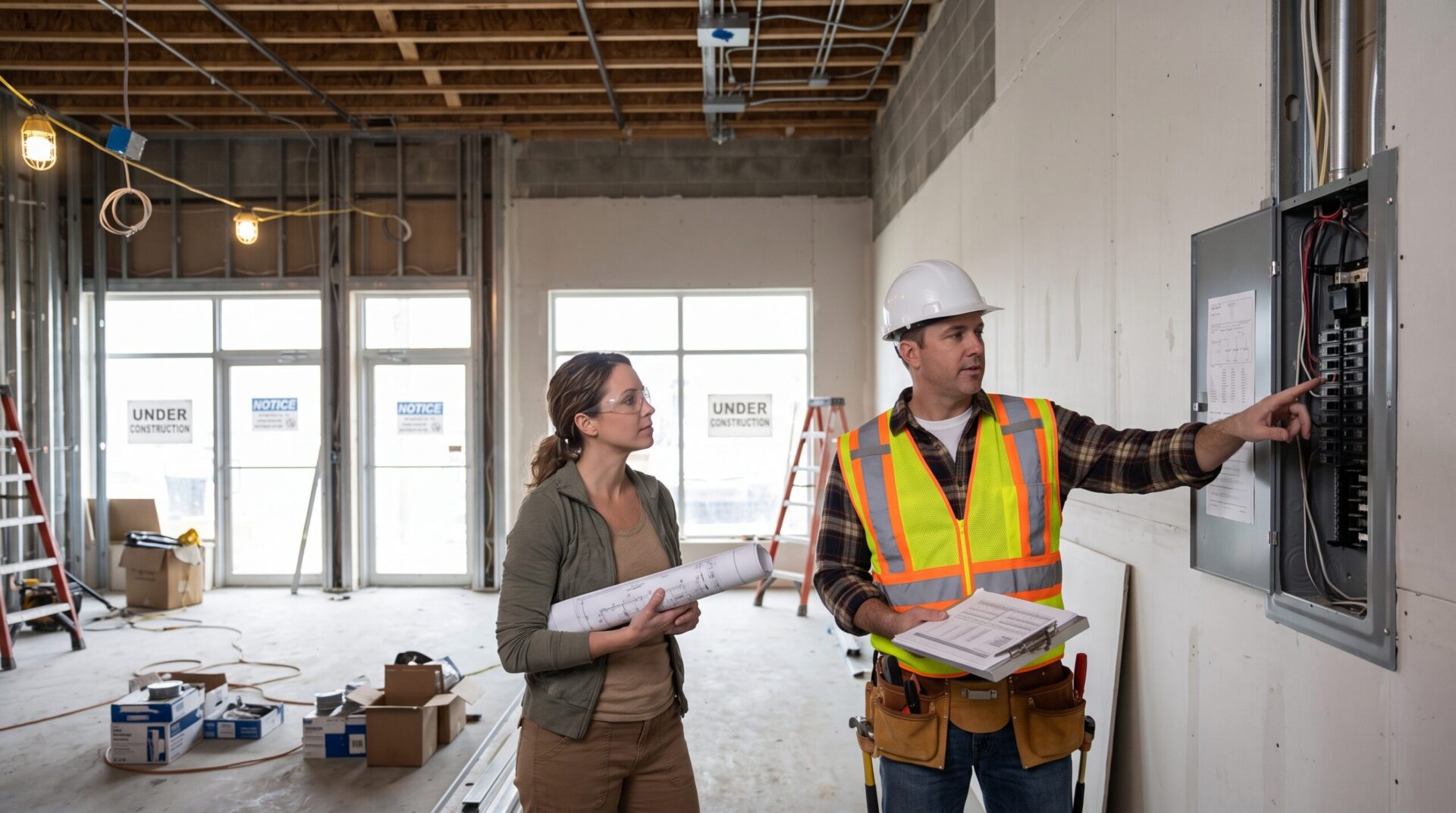
Step 1: Hire a master electrician for a 2-hour pre-lease walkthrough ($500-$1,000 investment)
Step 2: Open the electrical panel—check the brand (avoid FPE, Zinsco), look for corrosion, verify it’s not completely full
Step 3: Verify voltage and phase match your equipment needs (single-phase vs three-phase, 208V vs 480V)
Step 4: Get written confirmation of actual service amperage and available capacity
Step 5: Negotiate in the Work Letter who pays for obsolete equipment replacement and service upgrades
That $500-$1,000 pre-lease electrical assessment often saves tenants $10,000-$25,000 in hidden costs. It’s the best insurance policy you can buy.
DFW-Specific Challenges: Why Location Matters
Dallas-Fort Worth isn’t a monolithic market. It’s a patchwork of independent municipalities, each with different permitting processes, inspection standards, and electrical code interpretations. Where your space is located significantly impacts both cost and timeline.
Municipal Permitting Variance Across DFW
City of Dallas: The permitting process can be notoriously slow, with commercial remodel reviews often taking 4-8 weeks. Dallas offers a “Q-Team” expedited review service for a substantial premium fee (typically $1,000-$3,000), which is often worthwhile for time-sensitive projects. Critical bottleneck: Dallas’s strict “Green Building” program (Phase 2) requires specific energy compliance forms. Missing these forms results in immediate permit rejection and restarts the clock.
City of Fort Worth: Generally faster permitting, averaging 2-4 weeks for commercial remodels. Fort Worth has specific electrical code amendments regarding outdoor emergency disconnects that differ from Dallas requirements. Fort Worth inspectors tend to be more pragmatic about minor variances if the intent of code compliance is met.
Northern Suburbs (Frisco, Plano, Irving): Typically the fastest permitting (1-3 weeks), but these cities enforce stricter aesthetic requirements. Exterior electrical equipment like transformers or generators often require masonry screening walls that match the building architecture, adding civil and architectural costs to your electrical project.
💡 Why This Matters to Your Budget
Every week of permitting delay is a week you’re paying rent on an unusable space. A 4-week delay in Dallas vs 2-week turnaround in Fort Worth represents 2 weeks of lost revenue and holding costs. When evaluating spaces, factor permitting timelines into your financial model, especially if you have a specific opening deadline.
The 1980s Building Problem: DFW’s Electrical Time Bomb
Dallas experienced massive commercial construction during the oil boom of the late 1970s and early 1980s. These buildings—now 40-45 years old and classified as Class B or C—are scattered throughout the LBJ Freeway corridor, parts of downtown, and older suburban office parks. They represent some of the most affordable lease rates in DFW, which attracts cost-conscious tenants.
Here’s the problem: these buildings harbor specific electrical liabilities that weren’t considered defects when installed but are now obsolete or dangerous:
- Aluminum branch circuit wiring (fire hazard)
- Federal Pacific or Zinsco panels (recalled equipment)
- Undersized electrical services (designed for typewriters, not computers)
- Asbestos-wrapped electrical conduits (renovation trigger environmental remediation)
- Shared neutral circuits (incompatible with modern AFCI breakers)
The cruel irony: these buildings often come with the lowest TI allowances ($15-$25/sq ft) because landlords know the spaces are outdated. But that low allowance is insufficient to address the electrical infrastructure problems, leaving tenants trapped between cheap rent and expensive buildout costs.
If you’re evaluating older Class B office space in Dallas or Fort Worth with attractive lease rates, do NOT skip the pre-lease electrical inspection. We’ve seen tenants sign leases based on $20/sq ft allowances, only to discover they need $15,000-$25,000 in electrical remediation before they can even start their interior buildout.
The Oncor and Retail Electric Provider Dance
Texas has a deregulated electricity market, which creates a unique bureaucratic challenge for commercial tenants that doesn’t exist in most other states.
Oncor Electric Delivery owns and maintains the physical infrastructure—the wires, transformers, and meters—across most of DFW. They’re responsible for the physical connection.
Retail Electric Providers (REPs) like TXU, Reliant, and Champion Energy sell you the actual electricity and handle billing.
Here’s where it gets complicated: to get power turned on, you need BOTH an ESI ID (Electric Service Identifier) from Oncor AND a move-in order from your chosen REP. In new suite splits (where one large office is subdivided), Oncor must create a new ESI ID in their database—a purely administrative process that often takes 2-4 weeks. Until the ESI ID exists, you can’t sign up with a REP. Until you have a REP move-in order, Oncor won’t set your meter.
For service upgrades (increasing from 200A to 400A, for example), Oncor requires a load study to verify the transformer has sufficient capacity. If it doesn’t, you may be asked to pay for a transformer upgrade—a cost running $15,000-$40,000 with timelines of 3-6 months.
⚠️ Deep Ellum, Lower Greenville, and Downtown Dallas Tenants
If you’re leasing restaurant or retail space in a converted older building, verify the electrical service phase and voltage BEFORE signing your lease. We’ve responded to multiple emergency service calls where tenants discovered their “400 Amp service” was single-phase residential-style power, but their kitchen equipment required three-phase commercial power. The cost to bring three-phase from the utility pole ranged $20,000-$30,000, and the process took 3-5 months—during which the tenant paid rent but couldn’t open for business.
How to Protect Your TI Budget: Lease Negotiation Strategies
The most effective way to control electrical costs isn’t better project management during construction—it’s better contract negotiation before you sign the lease. The “Work Letter” (the exhibit in your lease that details construction obligations) is your primary defensive tool against budget-busting surprises.
The Work Letter: Your Financial Shield
Standard landlord-drafted Work Letters are intentionally vague to limit the landlord’s liability and shift risk to the tenant. Your job is to negotiate specific protections that define who pays for what, especially regarding electrical infrastructure.
Critical Electrical Deal Points to Negotiate
1. Define “Base Building” vs “Tenant Work” Clearly
Landlord should be responsible for:
- Bringing electrical power to your suite demising wall at the agreed capacity (e.g., “minimum 5 watts per square foot exclusive of HVAC and lighting”)
- Maintaining and replacing all main switchgear, transformers, and service entrance equipment
- Replacing any obsolete, recalled, or code-non-compliant panels (Federal Pacific, Zinsco) at landlord’s sole cost
- Ensuring the base building electrical system is code-compliant and insurable
Tenant should be responsible for:
- Internal distribution within the suite (branch circuits, outlets, lighting fixtures)
- Tenant-specific specialty circuits (server rooms, medical equipment, etc.)
2. Service Upgrade Cost Allocation
If your business requires upgrading the electrical service (e.g., restaurant increasing from 200A to 600A for kitchen equipment), argue that this upgrade increases the permanent value of the landlord’s asset. It should either be:
- Funded entirely by the landlord as a capital improvement, OR
- Amortized over the useful life of the equipment (typically 15-20 years)
If you have a 5-year lease and a service upgrade costs $30,000 with a 15-year useful life, you should only be responsible for 5/15ths of the cost = $10,000. The remaining $20,000 benefits future tenants and should be the landlord’s capital investment.
✅ Epic’s Real Example: The Plano Medical Office Win
We provided a pre-lease electrical assessment for a dental practice looking at space in a Plano strip center. Our inspection discovered Federal Pacific panels and aluminum wiring throughout. The “as-is” lease language made these the tenant’s responsibility to remediate—estimated cost $18,000. Armed with our written assessment, the tenant’s attorney negotiated a lease amendment requiring the landlord to replace the panels and remediate the aluminum wiring before lease commencement. The tenant saved $18,000 from their TI budget and avoided a 4-week construction delay.
3. Competitive Bidding Rights
For “turnkey” projects where the landlord controls construction, insert a clause requiring:
- Electrical scope to be bid to at least three qualified, unrelated subcontractors
- Tenant receives copies of all bids for review
- Tenant has the right to approve the selected electrical contractor
This prevents the landlord from using a subsidiary construction company or accepting kickbacks from preferred vendors at inflated prices.
4. Lien Waiver Requirements
Texas law grants electricians and material suppliers powerful mechanics lien rights. If the landlord or general contractor fails to pay the electrician, they can place a lien on the property—and potentially on your leasehold interest.
Protection: Require “Unconditional Lien Waivers” from all major subcontractors (especially electrical and mechanical) before each progress payment. This proves the subs have been paid and waives their lien rights for that work.
| Electrical Item | Standard Landlord Position | Recommended Tenant Counter-Position |
|---|---|---|
| Obsolete Equipment (FPE/Zinsco Panels) | “As-Is” – Tenant repairs all defects | “Landlord shall replace any recalled panels at Landlord’s sole cost as Capital Improvement” |
| Service Upgrade (200A → 400A) | Tenant pays 100% | “Cost amortized over 15-year equipment life; Tenant pays only for lease term portion” |
| Electrical Capacity Warranty | No warranty – space “As-Is” | “Landlord warrants minimum 5 Watts/RSF available at suite panel, exclusive of HVAC/lighting base load” |
| Aluminum Wiring Remediation | Tenant bears all costs | “If aluminum wiring present, Landlord provides additional TI allowance for code-compliant remediation” |
| Low Voltage/Data Cabling | Not addressed or excluded | “TI allowance includes Cat6 data drops to each workstation and conference room” |
When to Walk Away from a Deal
Sometimes the smartest financial decision is not signing the lease. Consider walking away if:
- Landlord refuses to replace recalled or obsolete electrical equipment
- Pre-lease inspection reveals electrical liabilities exceeding 50% of the offered TI allowance
- Building requires three-phase power upgrade costing $25,000+ with 6-month timeline
- Landlord won’t provide electrical capacity warranty and you have specialized equipment needs
The cost of finding another space is almost always less than the cost of a failed buildout.
Real DFW Examples: What Can Go Wrong (and How to Avoid It)
Let’s look at three real scenarios from DFW commercial TI projects where electrical issues derailed budgets and timelines—and the lessons learned.
Case Study 1: The Deep Ellum Restaurant Disaster
The Setup: A trendy restaurant group leased a historic 3,000 square foot brick building in Deep Ellum’s entertainment district. The lease stated “400 Amp Service Available” with a $35/sq ft TI allowance ($105,000 total).
The Reality: During the buildout, their electrician discovered the 400A service was single-phase power (typical for older residential or light commercial), not three-phase. Commercial restaurant equipment—dough mixers, combi ovens, heavy-duty ranges—almost exclusively requires three-phase power to operate.
The Fallout:
- Cost: The tenant had to pay Oncor $25,000 to bring three-phase power from the utility pole (which was several blocks away) and replace the entire service entrance equipment
- Timeline: The Oncor engineering and construction process took 4 months
- Carrying Costs: The restaurant paid rent for 4 months on a space they couldn’t occupy, plus ongoing operational expenses
The Lesson: Always verify PHASE (single vs three) and VOLTAGE (120/240V vs 120/208V vs 277/480V), not just amperage. “Service available” in a lease means nothing without specific electrical characteristics documented.
Case Study 2: The Plano Medical Slab Trenching Surprise
The Setup: A dental practice leased a former retail space in a Plano strip center. The landlord provided what seemed like a generous $50/sq ft TI allowance for the 2,500 square foot suite ($125,000 total).
The Reality: The retail space had slab-on-grade foundation (concrete poured directly on dirt). Dental operatories require power, data, water, and compressed air lines fed from the floor in the center of the room where the dental chairs sit. The existing retail space had all utilities in the walls.
The Fallout:
- Cost: “Trenching” the concrete slab—saw-cutting channels, excavating dirt, laying conduit and plumbing, re-pouring and finishing concrete—cost $18 per square foot. For 1,200 square feet of operatory space, this single line item was $21,600
- Budget Impact: Slab trenching consumed 17% of the entire TI allowance before a single wall was framed or light fixture installed
The Lesson: Medical and dental tenants should NEVER lease space without confirming whether floor-fed utilities are already in place or negotiating a specific “slab trenching contingency” in the Work Letter. The cost is too high to discover mid-construction.
Case Study 3: The Uptown Open Ceiling Aesthetic Disaster
The Setup: A tech startup moved into a Class A high-rise in Uptown Dallas and designed an “open ceiling” concept—no drop ceiling tiles, exposed concrete deck and MEP systems for an industrial-modern look.
The Reality: When the ceiling tiles were removed, the existing electrical cabling (MC cable from previous tenant) was revealed as a tangled “rat’s nest” of wires draped across the ceiling grid. While this was code-compliant when hidden above tiles, it violated NEC requirements for cable support when exposed (cables must be strapped to structure every 6 feet, not laying on grid).
The Fallout:
- Cost: The electrician had to re-strap, organize, and in some cases re-route all overhead cabling to meet code and aesthetic standards—$15,000 in unbudgeted labor
- Design Compromise: Some areas required dropped soffits to hide unavoidable cable runs, changing the architectural vision
The Lesson: If you’re planning an exposed ceiling design, inspect the plenum (space above the tiles) BEFORE finalizing your lease and design. What looks “clean” from below is often chaotic above. Budget for cable reorganization or accept design compromises.
Frequently Asked Questions: What DFW Commercial Tenants Ask Us
What’s a good TI allowance for office space in DFW?
It depends on building class and location. For Class A office space in prime DFW submarkets like Uptown Dallas, Frisco, or Legacy West, expect $40-$60 per square foot. Class B buildings in secondary markets (LBJ corridor, older downtown areas) typically offer $15-$25 per square foot. However, the dollar amount alone doesn’t tell you if it’s “good”—you need to compare it against the actual cost to build out your space, which requires getting preliminary bids from contractors. A $50/sq ft allowance in a building with major electrical deficiencies may be worse than a $35/sq ft allowance in a building with modern infrastructure.
Does the TI allowance cover all electrical work?
Not usually. A standard TI allowance typically covers basic electrical like standard office lighting (LED troffers), convenience outlets (one per wall), and light switches. It does NOT typically cover: low-voltage data cabling, electrical service upgrades, replacing obsolete panels, specialty circuits for server rooms or medical equipment, or remediation of code violations discovered during construction. Always get a detailed scope of work in writing that specifies exactly what electrical work is included in the allowance versus what you’ll pay for separately.
How much should I budget for electrical work in my TI project?
As a percentage of total TI budget: standard office space typically runs 15-25% for electrical ($6-$12/sq ft), high-end office with architectural lighting and technology runs 25-35% ($14-$22/sq ft), restaurants run 35-50%+ ($18-$35+/sq ft) due to heavy kitchen loads, and medical/dental facilities run 40-55% ($25-$45/sq ft) due to specialized equipment requirements. Always add a 10-15% electrical contingency on top of these estimates to cover unforeseen conditions in older buildings.
What are Federal Pacific panels and why should I care?
Federal Pacific Electric (FPE) “Stab-Lok” panels were commonly installed in commercial buildings from the 1950s through 1980s. Independent testing documented by the Consumer Product Safety Commission has shown these panels have a high failure rate—circuit breakers may fail to trip during an electrical overload, creating serious fire risk. Many commercial property insurance companies will not write policies for buildings with FPE panels. If discovered during your TI permit process, city electrical inspectors will almost certainly require replacement as a condition of approval. Replacement costs run $3,000-$8,000. The same issues apply to Zinsco panels. Both should be identified during pre-lease inspection and made the landlord’s responsibility to replace.
Can I use my own electrician or does the landlord choose?
This depends entirely on your lease structure. In a “Turnkey” arrangement where the landlord manages construction, the landlord typically selects all contractors including the electrician. However, you can (and should) negotiate lease language requiring competitive bidding to at least three qualified electrical contractors, with the right to review bids and approve the selection. In a “TI Allowance” structure where you control construction, you hire your own general contractor and electrician directly. For DFW commercial projects, we strongly recommend working with local licensed electricians who understand the specific permit requirements and inspection preferences in Dallas vs Fort Worth vs the suburban cities—this familiarity saves weeks in approval timelines.
What’s the difference between turnkey and TI allowance lease structures?
In a turnkey arrangement, the landlord agrees to deliver a finished space based on your approved plans. The landlord hires contractors, manages construction, and absorbs the risk of cost overruns. You get convenience but lose control over quality—landlords protecting margins often specify “builder-grade” materials and minimum code-compliant work. In a TI allowance arrangement, the landlord gives you a specific dollar amount per square foot, and you manage the entire construction process. You hire your own contractors, make all material selections, and bear the risk if costs exceed the allowance. You gain quality control but assume budget risk. For tenants with specialized needs (restaurants, medical offices, tech companies with server rooms), the TI allowance structure is usually preferable because you can prioritize infrastructure over cosmetic finishes.
How long does electrical permitting take in Dallas versus Fort Worth?
Permitting timelines vary significantly across DFW municipalities. In the City of Dallas, commercial electrical permit reviews typically take 4-8 weeks due to high volume and strict Green Building compliance requirements. Dallas offers an expedited “Q-Team” review service for an additional fee that can reduce this to 2-3 weeks. In Fort Worth, permitting is generally faster at 2-4 weeks for standard commercial remodels. Northern suburban cities like Frisco, Plano, and Irving typically process permits in 1-3 weeks but may have stricter aesthetic requirements for exterior electrical equipment. The variation in timelines significantly impacts your project schedule and carrying costs, so factor municipal differences into your site selection process.
Your Next Step: Protect Your Tenant Improvement Allowance DFW Budget Before Signing
We’ve covered a lot of ground in this guide—from the basics of what a tenant improvement allowance DFW lease includes to the complex electrical realities of DFW’s aging building stock. If you take away one thing, let it be this:
The best time to protect your tenant improvement allowance DFW budget is before you sign the lease, not after problems appear during construction.
Most commercial tenants focus on negotiating rent per square foot and the dollar amount of the TI allowance. That’s important, but it’s incomplete. If you don’t investigate the electrical condition of your prospective space and negotiate clear responsibility for infrastructure issues, you’re accepting enormous financial risk based on incomplete information.
A $40 per square foot TI allowance means nothing if:
- The building has Federal Pacific panels requiring $8,000 to replace
- You need three-phase power but the building only has single-phase ($20,000-$30,000 utility upgrade)
- Aluminum wiring throughout requires remediation ($10,000-$15,000)
- The electrical service is undersized for your equipment needs (service upgrade $15,000-$40,000)
These aren’t theoretical scenarios—we see them every month across Dallas, Fort Worth, Arlington, and the surrounding cities.
What Epic Electrical Does Differently
We’re not interested in upselling you on work you don’t need. Our approach is simple:
Honest Assessment: We tell you what’s actually wrong, what the danger is, and what it will cost to fix. No jargon, no scare tactics.
Pre-Lease Inspections: For a flat fee of $500-$1,000, we’ll walk your prospective space with you and provide a written assessment of the electrical system condition, capacity, code compliance issues, and estimated costs to support your business needs. This assessment gives you negotiating leverage with your landlord and prevents budget-killing surprises.
Transparent Quotes: When we bid your TI electrical work, you get an itemized breakdown showing exactly what you’re paying for—labor, materials, permits. No hidden markups, no contractor games.
DFW Expertise: We work across Dallas, Fort Worth, Arlington, Keller, Southlake, Frisco, and surrounding cities. We understand that Dallas permitting is different from Fort Worth permitting. We know which inspectors care about specific details and which code interpretations vary by jurisdiction. This local knowledge saves you weeks of delays and re-inspection fees.
We’re based in Fort Worth but serve the entire DFW Metroplex. Whether you’re looking at office space in Uptown Dallas, a restaurant in Deep Ellum, medical space in Plano, or industrial flex space in the Alliance corridor, we can help you understand your electrical reality before you commit.
The Investment That Pays for Itself
Spending $500-$1,000 now for a pre-lease electrical assessment can save you:
- $10,000-$25,000 in hidden electrical costs by identifying problems you can negotiate for the landlord to fix
- Weeks or months of construction delays by catching service upgrade needs early
- The financial disaster of signing a lease for a space that can’t support your business operations
It’s not just about saving money—it’s about making an informed decision. You’re committing to a 5, 7, or 10-year lease that will cost hundreds of thousands of dollars. Isn’t it worth spending less than 1% of your first year’s rent to make sure the electrical infrastructure can actually support your business?
Call or Text: (682) 478-6088
Serving Fort Worth, Dallas, Arlington, Keller, Southlake, Colleyville, Grapevine, Frisco, Plano, and all of DFW