Key Takeaways
- TR Outlets Are Now Code — NEC Section 406.12 mandates tamper-resistant outlets on all 15- and 20-amp receptacles in new residential construction; Texas adopted the 2023 NEC effective September 1, 2024.
- Existing Homes Aren’t Always Required to Retrofit — Standard outlets in older homes are generally grandfathered in, but any new or significantly modified circuits must use TR-compliant devices.
- The Safety Case Is Clear — The CPSC estimates TR outlets could prevent approximately 2,400 child electrical injuries and 12 deaths annually in the U.S.
- DFW Installation Costs Range Widely — A single outlet swap runs $75–$150; a whole-home TR compliance project typically costs $2,500–$8,000+ depending on wiring age, accessibility, and outlet count.
- Trust Epic Electrical for honest diagnosis, transparent pricing, and 50+ years of combined master electrician experience serving DFW — visit Epic Electrical to learn what sets a family-owned, third-generation electrical contractor apart.
Tamper Resistant vs. Standard Outlets: Which Is Better for Your Home?
Tamper-resistant (TR) outlets are the safer choice for any home with children or pets, and they’re now required by code for all new residential construction. Standard outlets lack the internal spring-loaded shutters that prevent foreign objects from being inserted into live contacts. While existing homes aren’t legally required to retrofit all outlets with TR devices, upgrading is a smart investment in safety—and it’s often necessary when you’re extending circuits or doing significant electrical work.
Understanding the differences between these two outlet types, the code requirements that govern them, and the real costs involved will help you make the right choice for your DFW home.
Epic Electrical
Free Quote & Honest Diagnosis — No Upsells
Core Service Programs:
- Electrical Repairs, Wiring & Lighting for tripping breakers, faulty wiring, GFCI issues, and indoor/outdoor lighting
- EV Chargers, Generators & Panel Upgrades for Level 2 EV charging, whole-home generator installs, panel replacements, and surge protection
- Commercial, Warehouse & Industrial Electrical for restaurants, offices, industrial buildouts, LED retrofits, and dedicated circuits
Why Choose Epic Electrical:
- ✓ Trusted by customers with 123+ five-star Google reviews
- ✓ Father-and-son master electricians — a third-generation electrical family
- ✓ Serving North Richland Hills and the DFW Metroplex since 2009
- ✓ 50+ years of combined electrical experience on every job
- ✓ No upsells, no jargon, no pressure — we fix what’s actually broken
- ✓ Small repairs fixed same-visit; big jobs get a written quote with no hidden costs
- ✓ Texas-licensed electrical contractor (TECL #33192)
What Are Tamper-Resistant Outlets and How Do They Work?
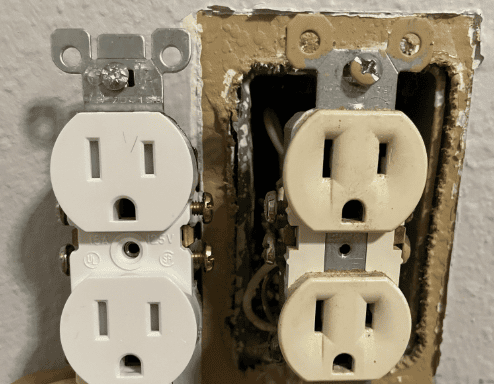
At first glance, a tamper-resistant outlet looks nearly identical to a standard outlet. Same slots, same cover plate, same voltage. The difference is entirely internal—and it’s that internal difference that makes TR outlets the safer choice for families across DFW.
The Mechanical Difference
A standard outlet has two open vertical slots—hot and neutral—sitting exposed and accessible to anything thin enough to fit inside. A TR outlet has those same slots, but behind them sit spring-loaded plastic shutters. Those shutters only open when both prongs of a plug push against them simultaneously. Insert one object into one slot, and the shutter on that side stays closed. There’s nothing to complete a circuit.
You can identify a TR outlet by looking for a small “TR” marking stamped between the slots on the outlet face. You’ll also feel slight resistance when inserting a plug—that’s the shutters giving way under equal pressure from both prongs. It’s a purely mechanical safety feature: no batteries, no electronics, nothing to program or maintain.
Why the Design Matters
Children aged 0–5 are the most at-risk group. According to the U.S. Consumer Product Safety Commission (CPSC), approximately 2,400 children are treated in emergency rooms annually for outlet-related electrical injuries. A single object—a paper clip, a key, a hair pin—inserted into one slot of a standard outlet can complete a circuit through a child’s body to ground, causing shock, burns, or worse.
TR shutters eliminate that pathway. A child cannot accidentally open them with a single object because the mechanism requires simultaneous pressure on both slots. UL testing confirms TR outlets meet the same durability standards as standard receptacles—the shutter mechanism doesn’t reduce lifespan or electrical performance in any meaningful way.
NEC Code Requirements: When Are Tamper-Resistant Outlets Mandatory?
The legal landscape around TR outlets is straightforward once you understand the distinction between new construction and existing homes. The confusion usually comes from homeowners who assume that because the code exists, they’re required to replace every outlet in their house. That’s not how it works.
New Construction vs. Existing Homes
NEC Section 406.12 mandates tamper-resistant receptacles on all 15- and 20-ampere, 125- and 250-volt nonlocking-type receptacles in residential dwelling units. The requirement covers homes, child care facilities, schools, hotels, and other occupancies where children are present. It was first introduced in the 2008 NEC and is now part of the 2023 NEC, which Texas adopted effective September 1, 2024.
For new construction, there are no exceptions—every circuit in a new Texas home must have TR outlets. For existing homes, it’s a different story. Older standard outlets are generally grandfathered in. You’re not legally required to replace them unless you’re extending a circuit, adding new outlets, or doing a substantial renovation that triggers a full code update on the affected areas. If you’re doing work that requires a permit, those new or modified devices must be TR-compliant.
Local DFW Variations
Texas adopted the 2023 NEC as the statewide baseline, but individual municipalities—Dallas, Fort Worth, North Richland Hills—have the authority to adopt local amendments. Some cities are stricter during extensive remodels and may require broader code compliance updates, including TR outlet upgrades, even in portions of the home not directly touched by the renovation. Before starting any electrical project, check with your city’s building department or work with a licensed contractor who knows the local requirements. You can also verify a contractor’s TDLR license and confirm they’re current on local code enforcement standards.
North Richland Hills, where Epic Electrical is based, sits in the heart of the Mid-Cities corridor—a high-density residential area with a mix of newer construction and established neighborhoods built in the 1970s through 1990s. Many of those older homes still have standard outlets throughout. If your home falls into that category, a licensed electrician can assess what you actually need—not just what sounds expensive.
Tamper-Resistant vs. Standard Outlets: Feature Comparison
| Feature | Standard Outlet | Tamper-Resistant (TR) Outlet |
|---|---|---|
| Internal shutter mechanism | No | Yes — spring-loaded, dual-slot |
| Child injury prevention | None | Blocks single-object insertion |
| Required for new construction (TX) | No | Yes — per 2023 NEC Section 406.12 |
| Electrical capacity | 15A or 20A / 125V | 15A or 20A / 125V (identical) |
| Device lifespan | Standard | Comparable — UL-tested to same standards |
| Device cost (material only) | $1–$4 per outlet | $3–$8 per outlet |
| Visual identification | Open slots, no markings | “TR” stamp between slots; slight plug resistance |
| Home inspection / resale impact | May be flagged in newer homes | Code-compliant; no inspection flags |
| Required for circuit extensions | No | Yes — any new or modified outlet must be TR |
Cost of Tamper-Resistant Outlet Installation in DFW
Cost is where most homeowners get tripped up—either by sticker shock on a whole-home quote or by underestimating what a single outlet swap actually involves. Here’s what you can realistically expect in the DFW market in 2026.
A single outlet replacement runs $75–$150 per outlet, covering labor and the device itself, not including any service call fee. When you’re doing multiple outlets in one visit—a full room or several rooms—the per-outlet cost typically drops to $50–$120 because the electrician is already on-site and moving efficiently. A whole-home TR compliance project, where every outlet in the house is assessed and upgraded, typically runs $2,500–$8,000 or more, depending on your home’s size, wiring age, and total outlet count.
💡 Worried About Costs? You’re Not Alone
Many DFW homeowners hesitate to upgrade outlets because they fear expensive rewiring or panel work. The good news: most outlet replacements are straightforward and affordable, especially if your home’s wiring is in decent condition. A free assessment from a licensed electrician can clarify what you actually need—without any obligation to commit to a larger project.
Factors That Drive Costs Up
Not every outlet swap is a simple pull-and-replace. Several factors can push your project into higher cost territory:
- Older wiring systems — Knob-and-tube or ungrounded two-prong systems require more labor and may need partial rewiring before a TR outlet can be safely installed.
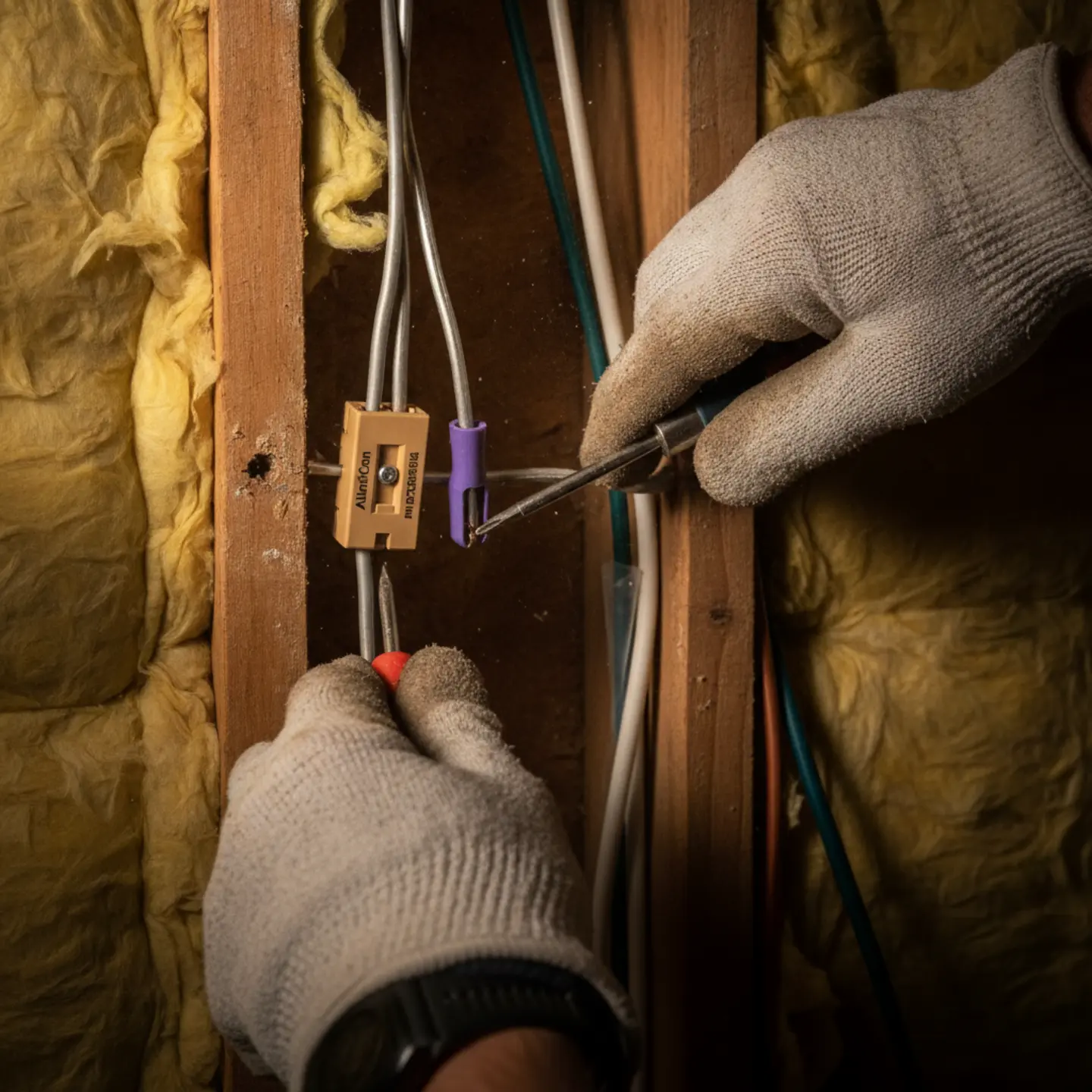
- Aluminum wiring — Common in DFW homes built in the 1960s and 1970s, aluminum wiring requires specialized connectors and techniques. This adds both material and labor costs. If your home has aluminum wiring, see our guide on electrical wiring repairs and maintenance for what to expect.
- Finished walls with limited access — Outlets behind solid plaster or in locations that require “fishing” wire through walls will need wall modification and drywall repair, often handled by a separate contractor.
- Panel condition — An undersized or aging panel may need upgrading before additional outlet work can proceed safely. If that’s a concern, a panel replacement assessment should happen before the outlet project begins.
- Two-prong to three-prong upgrades — Replacing ungrounded two-prong outlets with three-prong TR devices typically requires GFCI protection at the outlet or circuit breaker, adding device costs. Our post on what to do when an inspector flags ungrounded outlets covers this in detail.
Seasonal Pricing and Timing Strategies
Spring and fall are the busiest seasons for residential electrical work in DFW—mild weather drives renovation activity, and post-storm surges after hail or ice events can push wait times out significantly. If your project isn’t urgent, scheduling in mid-winter or late summer often means better availability and more flexibility on timing. Bundling your TR outlet upgrade with other planned work—indoor lighting upgrades, for example—can also improve your overall project value.
💡 Bundle Projects for Better Pricing
If you’re planning multiple electrical upgrades—TR outlets, lighting changes, or panel work—bundling them into one project can improve your overall pricing and reduce the number of service visits. Ask your electrician about combining projects during your free estimate. A single mobilization covers more ground than three separate visits.
Safety and Risk: The Real Cost of Waiting
When homeowners weigh the cost of a TR outlet upgrade, they’re usually comparing it against the price of the project itself. That’s the wrong comparison. The real comparison is the project cost versus what happens if you don’t upgrade.
Home fires per year involving electrical distribution or lighting equipment, per NFPA data from 2017–2021. These fires resulted in 470 civilian deaths, 1,120 injuries, and $1.5 billion in direct property damage.
A whole-home TR upgrade costing $2,500–$8,000, amortized over five years, works out to $500–$1,600 annually. Compare that to the cost of a single child electrical injury requiring emergency care—which can run into the thousands in medical bills alone, not counting the pain and disruption to your family. Or compare it to a residential electrical fire, where the average insurance claim in Texas ranges from $20,000 to over $100,000 in direct property damage, plus displacement costs and the psychological toll of losing your home, even temporarily.
The CPSC estimates TR outlets could prevent 2,400 child injuries and 12 deaths annually. That’s not a marketing claim—that’s the agency’s own projection based on the mechanism’s effectiveness. The math on proactive safety upgrades is not complicated. For more on electrical safety practices every DFW homeowner should know, that resource covers the broader picture beyond outlet types.
If your home also has AFCI or GFCI questions beyond the outlet itself, our comparison of AFCI vs. GFCI protection for kitchens and bathrooms explains when each type of protection is required and why.
Hiring a Licensed Electrician for Outlet Work in DFW
Outlet work looks simple. That’s exactly why unlicensed handymen offer to do it cheap—and exactly why homeowners sometimes take them up on it. Here’s what you need to know before you hire anyone for electrical work in Texas.
Only TDLR-licensed electrical contractors (TECL) can legally pull permits and contract for electrical work in Texas. The TECL license requires a designated Master Electrician and is the only license that allows a business to advertise electrical services, sign contracts with homeowners, and pull permits for projects. Individual journeyman and master electrician licenses matter too—verify that the person doing the work holds a valid individual license, not just that the company has a TECL on file.
Ask for proof of insurance—licensed contractors in Texas are generally required to carry at least $300,000 per occurrence in commercial general liability coverage. Request a certificate of insurance directly from the contractor’s insurer, not just a copy handed to you at the door. Ask for an itemized quote that breaks out labor, materials, permit fees, and inspection costs. Vague per-outlet pricing without a site visit is a red flag, not a deal.
⚠️ The Unlicensed Handyman Trap
Unlicensed handymen may offer cheaper rates, but they can’t legally perform electrical work, won’t carry insurance, and leave you with no recourse if something goes wrong. Worse, unpermitted work can void your homeowner’s insurance and create serious safety hazards that show up during a home sale inspection. Always verify a contractor’s TDLR license before signing anything—the search tool at tdlr.texas.gov takes about 30 seconds.
Red Flags to Watch For
- Can’t provide a TDLR license number or proof of insurance on request
- Suggests skipping permits or inspections to “save money”
- Quotes a per-outlet price over the phone without a site visit
- Offers no warranty on parts or labor, or an extremely short one
- Recommends that you handle any part of the electrical work yourself to cut costs
- Refuses to provide references or can only offer vague, unverifiable testimonials
DFW homeowners typically get 2–3 quotes before hiring for electrical work. That’s smart. What matters most in the final decision isn’t the lowest number—it’s licensing, insurance, itemized pricing, and a contractor who actually comes out and looks at your home before quoting. If you’re comparing options across the Metroplex, Epic Electrical serves Fort Worth, Arlington, and communities throughout the Mid-Cities corridor from our North Richland Hills base.
Why Epic Electrical Is the Right Choice for DFW Homeowners
Outlet upgrades are one of those jobs where the difference between a good contractor and a bad one isn’t always visible until something goes wrong. Epic Electrical was founded on a simple premise: tell homeowners the truth, do the work right, and don’t charge for things they don’t need.
That approach has earned 123+ five-star Google reviews from DFW homeowners who came in with real concerns—aging wiring, failed inspections, safety questions about their kids—and left with clear answers and work they could trust. Mike and Griffin bring more than 50 years of combined master electrician experience to every job. This is a third-generation electrical family that has been serving the DFW Metroplex since 2009, and they understand the specific challenges of upgrading older homes in established neighborhoods—because they’ve done thousands of those projects.
Epic Electrical holds Texas Electrical Contractor License TECL #33192 and carries full insurance, which means you have real accountability and real recourse if anything ever falls short. When you call for an estimate, you get an honest assessment—not a sales pitch. If there’s a cheaper fix that solves your problem, that’s what you’ll hear. No upsells, no manufactured urgency, no hidden costs buried in the fine print.
For homeowners concerned about project costs, Epic Electrical can also walk you through residential electrical project financing options so a safety upgrade doesn’t have to wait.
Get a Free Estimate from Epic Electrical — and find out exactly what your home needs, from a team that’s been doing this honestly for over 15 years.
Frequently Asked Questions: Tamper-Resistant vs. Standard Outlets
Are tamper-resistant outlets required in existing homes during renovations or upgrades?
Tamper-resistant outlets are mandatory for new residential construction and for circuits being newly installed or significantly modified. Existing outlets in older homes are generally not required to be replaced unless your city has local amendments or you’re doing a substantial renovation that triggers a broader code update on the affected areas. That said, many DFW homeowners choose to upgrade proactively—especially in rooms accessible to young children—because the cost per device is low and the safety benefit is real. If you’re unsure what your specific project triggers, a licensed electrician can review your scope before any work begins.
Can a homeowner legally install tamper-resistant outlets themselves in Texas?
In Texas, electrical work that requires a permit—including replacing multiple outlets or extending circuits—must be performed by a TDLR-licensed electrical contractor. Minor tasks like replacing a broken cover plate may be permissible for a homeowner, but swapping out outlets as part of a code compliance project falls under regulated electrical work. Unpermitted or unlicensed electrical work creates safety hazards, can void your homeowner’s insurance, and may surface as a problem during a home sale inspection. The safest and legally correct approach is to hire a TECL-licensed contractor for any outlet installation beyond basic cover plate replacement.
How can I tell if an outlet is already tamper-resistant?
Look for a small “TR” marking stamped on the outlet face between the two slots—that’s the most reliable visual indicator. TR outlets also have spring-loaded shutters covering the slot openings, so when you insert a plug, you’ll feel slight resistance as both prongs push against the shutters simultaneously to open them. If you insert a plug and it slides in with no resistance at all, or if you don’t see a “TR” marking, the outlet is likely a standard non-TR device. When in doubt, a licensed electrician can confirm during a free assessment.
Do tamper-resistant outlets cost more than standard outlets?
Tamper-resistant outlets do cost slightly more than standard outlets at the device level—typically a few dollars per outlet due to the internal shutter mechanism. In practice, the material cost difference between a standard outlet and a TR outlet is small enough that it rarely changes the overall project budget in any meaningful way. The labor cost to install both types is identical. For the safety benefit TR outlets provide—particularly in homes with young children—the incremental device cost is one of the easiest value calculations in residential electrical work.
Why should I choose Epic Electrical over other electricians for my outlet upgrade?
Epic Electrical brings 50+ years of combined master electrician experience, 123+ five-star Google reviews from DFW homeowners, and a father-and-son commitment to honest diagnosis—no upsells, no hidden costs, no pressure. As a Texas-licensed contractor (TECL #33192) serving the Metroplex since 2009, we understand the specific challenges of upgrading older DFW homes to modern code, and we’ve completed thousands of these projects across North Richland Hills, Fort Worth, Arlington, and surrounding communities. If there’s a cheaper fix that solves your problem, we’ll tell you. Get a Free Estimate from Epic Electrical and see the difference honest, experienced service makes.
Ready to Upgrade Your DFW Home’s Outlets the Right Way?
Whether you have a 1970s ranch home with standard outlets throughout or a newer build where one circuit needs a TR-compliant update, the right first step is an honest assessment from a licensed electrician who knows DFW’s housing stock. Epic Electrical will tell you exactly what your home needs—nothing more, nothing less.
No pressure, no upsells, no surprises on the invoice. Just clear answers from a father-and-son team that has been doing this work the right way since 2009.
Serving: Fort Worth · Arlington · North Richland Hills · Keller · Southlake · Colleyville · Grapevine · Lewisville · and all of DFW
Pricing, equipment specifications, and project scope mentioned in this article are accurate as of the date of publication and are subject to change. Code requirements and permit needs vary by municipality and property. Please contact us directly for a current quote on your specific home or business.