Key Takeaways
- Wired PoE systems outperform wireless — Wired cameras deliver consistent power and data over a single Ethernet cable, eliminating Wi-Fi interference, battery failure, and signal drops that plague wireless setups.
- True cost of ownership favors wired — Wired systems cost more upfront ($3,000–$7,500 for a 4–8 camera professional install) but avoid recurring cloud storage fees and battery replacement costs that add up over 5 years.
- DFW’s climate and construction create unique challenges — Sustained heat above 100°F degrades wireless camera batteries faster, and slab-foundation homes require professional conduit routing through attics or exterior walls.
- Licensing matters in Texas — Any installation involving line-voltage electrical work requires a Texas Electrical Contractor License (TECL); verify your contractor at tdlr.texas.gov before signing anything.
- Trust Epic Electrical for licensed, no-pressure security camera installation backed by 123+ five-star Google reviews and 50+ years of combined experience — visit Epic Electrical to see why DFW homeowners rely on this father-and-son team.
Wired vs. Wireless Security Cameras: Which System Is Right for Your DFW Home?
Wired (PoE) systems offer superior reliability, consistent power, and better long-term value, while wireless cameras provide easier installation and lower upfront costs. The best choice depends on your home’s layout, budget, and how much coverage you need. For most DFW homeowners seeking professional-grade security that lasts, wired systems win—but wireless can work well for smaller properties or renters.
Let’s break down the real differences, costs, and what matters most when choosing between these two approaches.
Epic Electrical
Free Quote & Honest Diagnosis — No Upsells
Core Service Programs:
- Electrical Repairs, Wiring & Lighting for tripping breakers, faulty wiring, GFCI issues, and indoor/outdoor lighting
- EV Chargers, Generators & Panel Upgrades for Level 2 EV charging, whole-home generator installs, panel replacements, and surge protection
- Commercial, Warehouse & Industrial Electrical for restaurants, offices, industrial buildouts, LED retrofits, and dedicated circuits
Why Choose Epic Electrical:
- ✓ Trusted by customers with 123+ five-star Google reviews
- ✓ Father-and-son master electricians — a third-generation electrical family
- ✓ Serving North Richland Hills and the DFW Metroplex since 2009
- ✓ 50+ years of combined electrical experience on every job
- ✓ No upsells, no jargon, no pressure — we fix what’s actually broken
- ✓ Small repairs fixed same-visit; big jobs get a written quote with no hidden costs
- ✓ Texas-licensed electrical contractor (TECL #33192)
Wired Security Cameras: How They Work and Why Professionals Prefer Them
ℹ️ Overwhelmed by the Wired vs. Wireless Decision?
You’re not alone. Most homeowners struggle with this choice because both options have real advantages. The key is matching the system to your specific situation—your home’s layout, your budget, and how much coverage you actually need.
Power over Ethernet (PoE) is the technology that makes wired systems the professional standard. A single Ethernet cable carries both power and data from a central PoE switch to each camera—no separate power outlet needed at every camera location. That simplicity at the camera end translates to rock-solid reliability at the recording end.
Wired cameras connect to a Network Video Recorder (NVR) that stores footage locally on hard drives. That means no mandatory cloud subscription, no monthly fee to access your own footage, and no privacy concerns about video living on a third-party server. For homeowners who want 24/7 recording without ongoing costs, local NVR storage is a significant advantage.
The performance gap is real, too. Professional PoE cameras routinely offer 4K resolution, superior night vision, and advanced features like pan-tilt-zoom (PTZ) and AI-powered analytics—person detection, vehicle detection, loitering alerts—that consumer wireless cameras simply don’t match. Because the power supply is constant, there’s no battery degradation, no missed recordings at 2 a.m. because a battery died, and no performance drop during a Texas summer when temps push past 100°F.
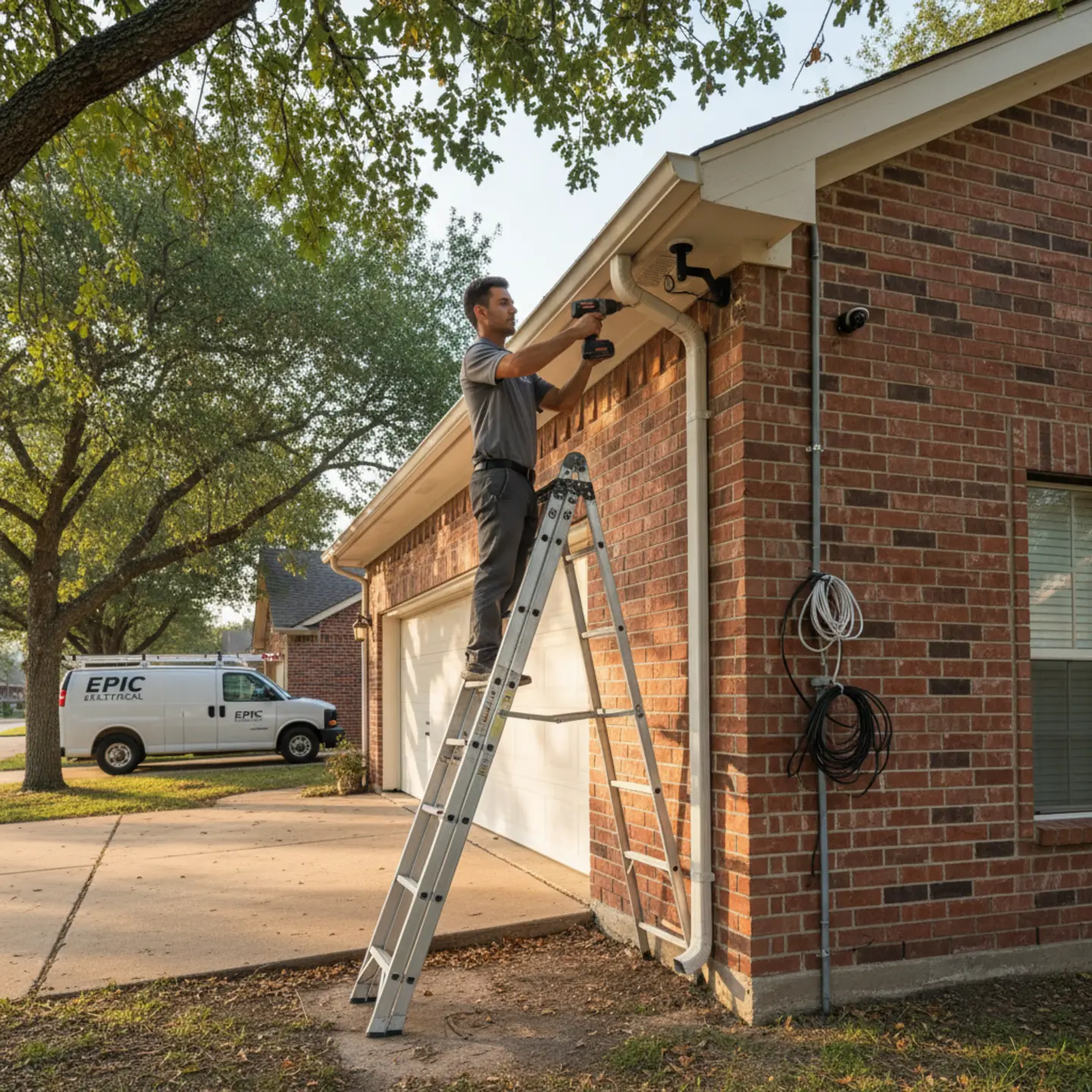
Professional installation also ensures proper conduit routing and wiring that meets code, integrates cleanly with your home’s electrical system, and holds up for 7–10+ years without the maintenance headaches of wireless alternatives.
Wireless Security Cameras: Flexibility and Ease of Installation
Wireless cameras—whether Wi-Fi connected or fully battery-powered—earn their place in the market for one primary reason: installation is fast and non-invasive. No conduit runs, no cable fishing through walls, no coordination with an electrician for new circuits. For renters, homeowners in HOA-heavy communities with exterior modification restrictions, or anyone who wants supplemental coverage in a hard-to-wire spot, wireless cameras solve a real problem.
Battery-powered models like Ring and Arlo offer true placement flexibility. You can mount a camera on a fence post, a detached garage, or a back corner of your property without worrying about power access. That’s genuinely useful for certain situations.
The trade-offs, though, are significant and often undersold in marketing materials. Cloud storage is the default for most wireless systems, adding $5–$20 per camera per month in ongoing subscription fees. Battery life typically runs 3–6 months under normal use—shorter in DFW’s summer heat—meaning regular maintenance and replacement costs. And in the dense suburban neighborhoods common across DFW (Frisco, Southlake, Keller), competing Wi-Fi networks on crowded channels create interference that causes connectivity drops, laggy video, and gaps in recording.
Wireless cameras work. But “works” and “works reliably for years with minimal intervention” are different standards. If you need professional-grade coverage that you don’t have to babysit, wired is the better long-term answer.
Cost Comparison: Wired vs. Wireless Security Camera Installation in DFW
Here’s the honest financial picture for both systems based on current 2026 DFW market pricing. DFW commands a premium for licensed electrical labor compared to state and national averages—factor that into any quote you receive.
| Cost Factor | Wired PoE System | Wireless System |
|---|---|---|
| Upfront Installation (4–8 cameras) | $3,000–$7,500 | $1,000–$2,500 |
| Cloud Storage (monthly) | Optional / $0 with local NVR | $5–$20 per camera |
| Battery Replacement | None | Every 3–6 months per camera |
| Hardware Lifespan | 7–10+ years | 3–5 years |
| PoE Switch / NVR Hardware | Included in install cost | Not applicable |
| Permit Fees (if applicable) | Required for new circuits | May not be required |
| 5-Year Total Cost of Ownership (6 cameras) | Lower — no recurring fees | Higher — subscriptions add up fast |
The five-year math often surprises homeowners. A wireless system with six cameras at $10/month per camera in cloud storage adds $7,200 in subscription fees alone over five years—before you factor in battery replacements or hardware that needs replacing when it degrades. If you’re planning to stay in your home and want comprehensive coverage, wired systems frequently win on total cost of ownership. If you’re financing a larger electrical project, residential project financing options can make the upfront investment more manageable.
Reliability and Performance in DFW’s Climate and Environment
DFW isn’t a forgiving environment for outdoor electronics. Sustained summer temperatures above 100°F are routine, and that heat directly affects wireless camera battery performance—degrading capacity faster and shortening the overall lifespan of battery-powered units. Wired cameras with consistent PoE power aren’t immune to heat, but they don’t have the battery degradation problem, and quality outdoor-rated PoE cameras are built to handle Texas summers.
The slab construction that dominates DFW residential building adds another layer of complexity. Unlike homes with crawl spaces, running new conduit through a slab foundation isn’t an option. Professional installers route cables through attics, down interior walls, or along exterior surfaces with weatherproof conduit—a process that requires planning and experience to do cleanly and to code. It’s not impossible, but it’s not a DIY project either.
Wi-Fi congestion is a real issue in DFW’s dense suburbs. In neighborhoods where every home has multiple smart devices, streaming services, and now wireless cameras competing for bandwidth, signal interference is common. This shows up as dropped connections, delayed alerts, and gaps in recorded footage—exactly what you don’t want from a security system. Wired systems sidestep this entirely by using dedicated Ethernet runs instead of shared wireless spectrum.
One often-overlooked reliability factor: power outages. DFW sees its share of severe weather, and when the grid goes down, both wired and wireless cameras that depend on AC power go offline. The solution for wired systems is a battery backup (UPS) connected to your NVR and PoE switch—this keeps cameras recording for 4–8 hours during an outage. Pairing your camera system with a whole-home generator provides even longer protection during extended outages.
Licensing, Permits, and Professional Installation Requirements in Texas
⚠️ Red Flag: Unlicensed Installers
If a contractor can’t produce a current TECL license or claims you don’t need permits for electrical work, walk away. Unlicensed installations void insurance coverage, create safety hazards, and may not pass inspection if you sell your home.
Texas has specific licensing requirements that protect homeowners—and that many contractors quietly ignore. Here’s what you need to know before hiring anyone.
Any camera installation involving new line-voltage electrical work (adding outlets, running new circuits, powering a PoE switch from your panel) requires a Texas Electrical Contractor License (TECL) issued by the Texas Department of Licensing and Regulation (TDLR). If your camera system is part of a monitored alarm system, the installing company also needs a TDLR Alarm Systems Installer License (Type AL). These aren’t optional—they’re how Texas ensures the person touching your electrical system knows what they’re doing.
Licensed contractors carry liability insurance—typically $1–$2 million for TECL holders—that protects you if something goes wrong during installation. Unlicensed work doesn’t come with that protection. Worse, if an unlicensed installation causes a fire or electrical fault, your homeowner’s insurance may deny the claim entirely.
Most DFW cities, including North Richland Hills, require electrical permits for new circuits or panel work. North Richland Hills has adopted the 2023 National Electrical Code (NEC), and permit requirements are enforced. Professional installers handle permitting as part of their service—if a contractor tells you permits aren’t needed for work that clearly requires them, that’s a red flag.
Verify any contractor’s licenses before signing a contract. The TDLR’s online search tool at tdlr.texas.gov lets you look up both TECL and alarm system licenses by company name or license number. For North Richland Hills electrical work, always confirm the contractor is current and in good standing.
Top Wired and Wireless Camera Systems for DFW Professional Installation
💡 Pro Tip: The Hybrid Approach
Many DFW homeowners get the best of both worlds by installing wired cameras at critical entry points (front door, driveway, garage) and adding wireless cameras for supplemental coverage in less critical areas. This balances reliability with flexibility.
Wired PoE Systems: Enterprise-Grade Reliability
For professional installations, brands like Hikvision, Axis, and Hanwha are the industry benchmarks. These systems offer 4K resolution, advanced AI analytics (person and vehicle detection, perimeter alerts), and NVR storage that keeps footage local—no cloud subscription required for basic recording. A properly installed PoE system from these manufacturers will run reliably for 7–10+ years with minimal maintenance.
The NVR is the backbone of a wired system. It stores footage on internal hard drives, manages camera feeds, and provides remote access through a secure app. Unlike cloud-dependent systems, your footage stays on your property. For homeowners who’ve invested in panel upgrades or whole-home electrical improvements, integrating a wired camera system into that infrastructure is a natural next step.
Wireless Systems: Consumer-Friendly Convenience
Ring, Arlo, and Eufy dominate the consumer wireless market for good reason—they’re genuinely easy to set up, offer solid mobile app integration, and work well for straightforward situations. Ring’s ecosystem integrates with Amazon Alexa; Arlo’s cameras offer strong video quality for the price. Battery life typically runs 3–6 months depending on activity levels and temperature.
The honest assessment: these systems are best suited for renters, temporary setups, or supplemental coverage in spots where running wiring is genuinely impractical. For primary security coverage of a DFW home you own, they’re a compromise—functional, but not the professional-grade solution most homeowners actually need.
| Feature | Wired PoE (Hikvision/Axis) | Wireless (Ring/Arlo) |
|---|---|---|
| Max Resolution | 4K standard | 1080p–4K (varies by model) |
| Power Source | Ethernet cable (PoE) | Battery or AC adapter |
| Storage | Local NVR (no subscription required) | Cloud (subscription required) |
| Wi-Fi Dependency | None | High |
| Lifespan | 7–10+ years | 3–5 years |
| Best For | Permanent homeowner installations | Renters, temporary, supplemental |
| Professional Installation Required | Yes | Recommended but optional |
Why Epic Electrical Is the Right Choice for Weatherford and DFW Homeowners
Epic Electrical isn’t a national franchise or a security company that subcontracts the electrical work to someone else. Mike and Griffin are a father-and-son team of master electricians—third generation—with 50+ years of combined experience and 123+ five-star Google reviews from real DFW homeowners. When you call Epic, the people who answer are the people who show up.
As a Texas-licensed electrical contractor (TECL #33192) serving DFW since 2009, Epic handles both the line-voltage electrical work and the low-voltage camera wiring in-house. No subcontractors, no handoffs, no surprises on the final invoice. Every installation is fully permitted, code-compliant, and backed by professional liability insurance—which matters when you’re trusting someone to work inside your home’s electrical system.
The honest diagnosis approach is what sets this team apart. If a wireless system genuinely fits your situation—maybe you’re renting, or you need coverage in one spot where running conduit isn’t practical—Epic will tell you that. If wired is the smarter long-term investment for your property, they’ll walk you through the numbers and show you why. No pressure, no upsell, no one-size-fits-all recommendation. That’s how a family business with a reputation to protect operates.
Epic’s installations cover the full DFW footprint—from Fort Worth to Southlake to Colleyville and everywhere in between. Whatever your home’s layout, budget, or security goals, the team has seen it and solved it.
Get a Free Estimate from Epic Electrical — no obligation, no sales pitch, just an honest assessment of what your home actually needs.
Frequently Asked Questions: Wired vs. Wireless Security Cameras
Are wired security cameras truly more reliable than wireless ones?
Yes. Wired PoE systems deliver consistent power and data over a physical Ethernet cable, which eliminates the three biggest failure points of wireless cameras: Wi-Fi interference, battery depletion, and signal drops. The result is stable 24/7 recording that doesn’t depend on your home network’s health or whether someone remembered to swap batteries. Wireless systems can work reliably in the right conditions, but they introduce variables that wired systems simply don’t have.
Will wireless security cameras interfere with my home’s Wi-Fi or other smart devices?
Yes, especially if you install multiple cameras. Wireless cameras consume bandwidth and compete for Wi-Fi channels with every other device on your network—smart TVs, thermostats, phones, tablets. In DFW’s dense suburbs where neighboring networks already crowd the 2.4GHz and 5GHz bands, adding several cameras can slow your entire network and degrade camera performance simultaneously. A professional installer can optimize channel selection and network configuration, but wired systems eliminate this problem entirely by running on dedicated Ethernet rather than shared wireless spectrum.
What happens to my security cameras if there’s a power outage?
Wired cameras connected to a battery backup (UPS) will continue recording until the backup power is exhausted—typically 4–8 hours depending on the system size. Without a UPS, both wired and wireless cameras that require AC power go offline when the grid fails. Battery-powered wireless cameras may continue local recording if they have onboard storage, but remote viewing and cloud uploads stop without internet. For continuous protection during extended outages, pairing your camera system with a standby generator is the most robust solution.
Do I need a permit from my city in DFW to install security cameras?
For camera-only installations with no new electrical work, permits may not be required in every DFW city. However, if your system involves new line-voltage wiring, a PoE switch connected to your electrical panel, or integration with a monitored alarm system, an electrical permit is required by most DFW municipalities—including North Richland Hills. The safest approach is always to check with your local building department before work begins. Licensed professional installers handle permitting as part of their service, so you don’t have to navigate that process yourself.
What makes Epic Electrical different from other security camera installers in DFW?
Epic Electrical combines licensed electrical expertise (TECL #33192) with the kind of honest, no-pressure service you’d expect from a family business with a reputation to protect. With 123+ five-star Google reviews and 50+ years of combined experience between Mike and Griffin, the team handles the entire installation in-house—electrical work, low-voltage wiring, permitting, and code compliance—without subcontracting any of it. They diagnose your actual needs and recommend the system that fits your home and budget, not the most expensive option on the menu. Get a Free Estimate from Epic Electrical and see what professional expertise without the sales pressure actually feels like.
Ready for a Professional Security Camera System Designed for Your DFW Home?
Choosing between wired and wireless isn’t a decision you should make based on a YouTube video or a door-to-door sales pitch. It depends on your home’s layout, your budget, and what level of reliability you actually need. Epic Electrical’s father-and-son team will assess your property honestly, explain your options clearly, and install whatever system is genuinely right for you—fully permitted, code-compliant, and built to last.
No obligation. No upsell. Just straight answers from licensed master electricians who’ve been doing this in DFW since 2009.
Serving Fort Worth, North Richland Hills, Keller, Southlake, Colleyville, Arlington, Grapevine, Lewisville, and all of DFW.
Pricing, equipment specifications, and project scope mentioned in this article are accurate as of the date of publication and are subject to change. Code requirements and permit needs vary by municipality and property. Please contact us directly for a current quote on your specific home or business.