Commercial Electrical Wiring for Small Businesses in North Texas: Free Estimates & What to Expect
Key Takeaways
- DFW’s rapid growth is a real problem — Older commercial buildings across North Texas weren’t designed for today’s electrical loads, and the region’s heat accelerates wear on wiring and components.
- Code compliance protects your business — Non-compliant electrical systems can void your insurance, create liability exposure, and halt operations during inspections.
- You may not need a full rewire — Many issues can be resolved with targeted panel upgrades or circuit additions. We’ll tell you which one actually applies to your situation.
- Costs vary widely by scope — Circuit additions run $150–$300 per circuit; panel upgrades $1,500–$5,000; full rewiring $5,000–$25,000+. A free assessment gives you the real number.
- Most projects don’t require shutting down your business — Phased upgrades and off-hours scheduling let us do the work around your operations.
- Permits and inspections are part of the process — They typically add 1–3 weeks to the overall timeline, and we handle all the paperwork.
- Local knowledge matters — North Texas has specific code amendments, permit processes, and climate factors that a local electrician navigates every day.
Here’s a scenario that plays out more often than you’d think in North Texas: A small business owner is planning a modest expansion — maybe adding a second workstation, upgrading to commercial kitchen equipment, or bringing in new HVAC units — and their electrician takes one look at the panel and says, “We’ve got a problem.” Suddenly you’re staring at an outdated electrical system you didn’t know was a liability, wondering whether you need a complete rewire, how long the project will take, what it’s going to cost, and whether your business can even stay open during the work.
That uncertainty is genuinely stressful. And it’s made worse by the fact that most people don’t know what to ask, don’t know who to trust, and worry they’re going to get talked into something they don’t need. We hear this constantly. It’s actually one of the reasons we built our entire approach around transparency — because the electrical industry doesn’t have a great reputation for straight answers.
So here’s what this guide does: it walks you through exactly what happens when you call a commercial electrician, what different projects actually involve, what they cost in the DFW market, and how to tell whether you’re getting honest advice or being oversold. No jargon, no pressure, no vague estimates. Just the real picture so you can make a confident decision about your business’s electrical system.
Why Commercial Electrical Wiring Matters for North Texas Small Businesses
If you own or operate a commercial space in the Dallas-Fort Worth area, your electrical system is doing more work than it was probably designed to do — and the stakes for getting it wrong are higher than most business owners realize until something goes wrong.
The DFW Growth Factor
Dallas-Fort Worth is consistently ranked among the fastest-growing metropolitan areas in the United States. That growth is great for business, but it creates a real problem for the built environment: a huge percentage of commercial buildings in the region were constructed decades ago, when electrical loads were a fraction of what modern businesses demand. A building that was wired in the 1980s or 1990s was designed for a world without cloud computing workstations, commercial espresso machines drawing 20 amps, or the kind of HVAC systems needed to handle a Texas summer in a space packed with servers and equipment.
On top of that, North Texas’s climate is genuinely hard on electrical systems. The combination of intense summer heat and humidity accelerates the degradation of insulation on wiring, causes thermal expansion and contraction in connections, and shortens the lifespan of components that might last decades in a milder climate. An electrical system that’s technically “functional” in a cooler region might be approaching failure in Garland or Mesquite simply because of the environment it’s been operating in.
North Texas cities including Dallas, Fort Worth, Arlington, Plano, and Irving all follow the National Electrical Code (NEC), but each municipality can adopt local amendments. What passes inspection in one city may require additional work in another — which is one reason local experience matters when you’re planning a commercial electrical project.
Code Compliance & Liability
Here’s something a lot of business owners don’t know until it’s too late: if your electrical system isn’t up to current code and something goes wrong — a fire, an injury, equipment damage — your business insurance may not cover it. Many commercial policies include clauses that void coverage if the electrical system doesn’t meet current standards. That’s not a hypothetical risk. It’s a real exposure that can turn an electrical problem into a business-ending event.
Beyond insurance, non-compliant wiring creates liability in personal injury lawsuits. If an employee or customer is harmed because of an electrical failure that a code-compliant system would have prevented, the argument that “we didn’t know” doesn’t carry much weight in court. And if you’re ever trying to sell the building, refinance, or bring in a major tenant, an outdated electrical system will surface in due diligence and either kill the deal or require emergency remediation at the worst possible time.
Starting with a thorough electrical system inspection is the right first step — it gives you a clear picture of where you stand before you make any decisions about upgrades or repairs.
🔵 You’re Not Alone — Most North Texas Businesses Face This
Rapid growth in DFW means many older commercial buildings have electrical systems that weren’t designed for modern demands. If you’re worried about your system, you’re right to be — and getting it assessed is the responsible move, not an overreaction.
Signs Your Commercial Electrical System Needs an Upgrade
Most electrical problems don’t announce themselves dramatically. They show up as small, easy-to-dismiss annoyances — a breaker that trips occasionally, a light that flickers when the HVAC kicks on, an outlet that feels slightly warm. The problem is that these “minor” issues are often early warning signs of something more serious, and ignoring them is how small problems become expensive emergencies.
Safety Red Flags You Can’t Ignore
Some warning signs are serious enough that they warrant an immediate call to a licensed electrician — not next week, not when it’s convenient. If you notice any of the following, stop and get a professional assessment before they become emergencies:
- Burning smells or visible scorching around outlets or switches — This indicates arcing or overheating, which is a direct fire hazard.
- Buzzing or humming sounds from the electrical panel — A properly functioning panel should be silent. Any audible sound is a red flag.
- Warm or hot switch plates or outlet covers — These should never be warm to the touch. Heat means resistance, and resistance means potential failure.
- Frequent power surges or unexplained equipment failures — If you’re replacing equipment more often than you should, your electrical system may be the culprit.
- Breakers that trip repeatedly on the same circuit — A breaker that trips once is doing its job. One that trips regularly is telling you the circuit is consistently overloaded.
⚠️ Red Flags That Demand Immediate Attention
Burning smells, frequent breaker trips, or warm outlets aren’t minor inconveniences — they’re fire hazards. If you notice any of these in your commercial space, get a professional assessment before they become emergencies. The cost of an inspection is nothing compared to the cost of a fire or an insurance claim denial.
Performance Issues That Slow Your Business
Beyond safety, there are performance problems that don’t put anyone in immediate danger but quietly cost your business money and productivity every day:
- Insufficient outlets forcing extension cord use — Extension cords are a temporary solution. Using them permanently overloads circuits and creates trip hazards. They’re also an OSHA concern in commercial environments.
- Power drops during peak usage times — If your lights dim or equipment slows when everything is running at once, your system doesn’t have the capacity for your actual load.
- Inability to add new equipment without tripping breakers — This is the one that usually forces the conversation. If you can’t grow your business without overloading your electrical system, the system is limiting you.
The age of your system matters too. Most commercial electrical systems should be evaluated after 20–30 years of service, even if they appear to be functioning normally. The components inside the panel, the insulation on the wiring, and the grounding system all degrade over time in ways that aren’t visible without a professional inspection.
Our commercial electrical services cover everything from diagnosing these warning signs to implementing the right fix — whether that’s a targeted repair or a more comprehensive upgrade.
If you’ve noticed any of these warning signs in your commercial space, a professional assessment is the right next move. Our free estimate covers a full inspection of your system — we’ll identify what’s actually wrong and give you honest recommendations with no pressure to commit to anything.
What to Expect During a Commercial Electrical Assessment
One of the biggest sources of anxiety for business owners is not knowing what they’re walking into when they call an electrician. Will they be told they need a complete rewire when all they really need is a panel upgrade? Will the estimate be vague and full of contingencies? Will the electrician actually explain what they found, or just hand over a number?
Here’s exactly how a thorough commercial electrical assessment works — and what you should expect from any electrician worth hiring.
The Consultation Phase
A good assessment starts before anyone touches a wire. The first conversation should cover your current electrical challenges — what’s not working, what you’ve noticed, what’s been causing problems. It should also cover where your business is headed: Are you adding equipment? Expanding into adjacent space? Planning a renovation? The electrical system needs to serve not just where you are today but where you’re going in the next five to ten years.
This is also where timeline and budget expectations get discussed honestly. If you need the work done in three weeks because of a lease requirement or a scheduled equipment installation, that affects how the project gets planned. If budget is a real constraint, that’s important information too — it shapes the conversation about what to prioritize.
The Physical Inspection
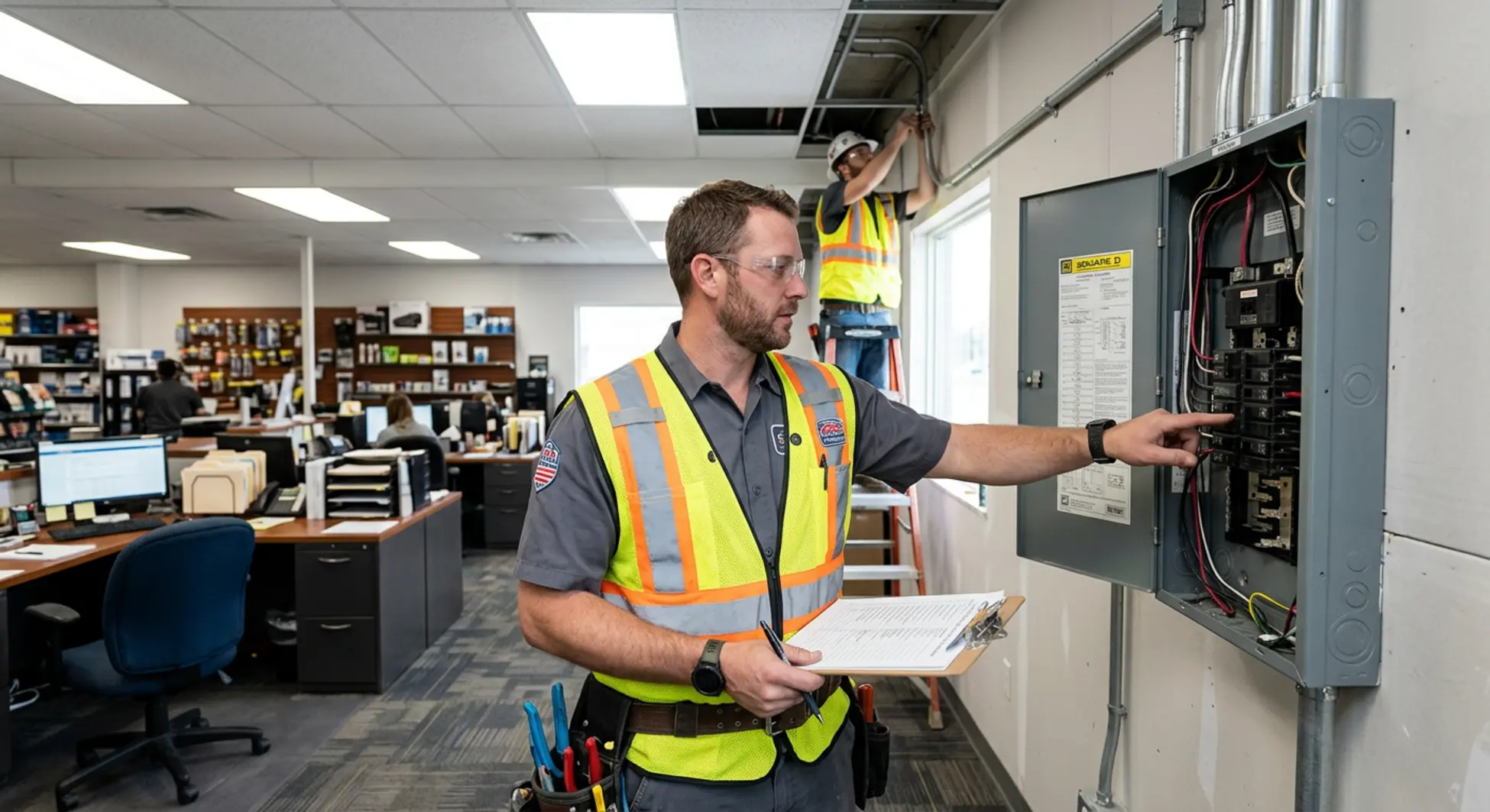
The physical inspection is where the electrician actually evaluates what you have. This includes:
- A detailed examination of the main panel and any sub-panels — looking at the age, condition, capacity, and whether the breakers are functioning correctly
- Testing of individual circuits for load capacity and proper grounding
- Assessment of wiring condition, including checking for outdated materials like aluminum wiring or cloth-insulated wire
- Documentation with photos and notes — a professional inspection leaves a paper trail
- A code compliance review against current NEC standards and any local amendments that apply to your city
This isn’t a quick walk-through. A thorough inspection of a commercial space takes time, and that time is what separates a real assessment from a contractor who’s just looking for an excuse to sell you something.
The Written Report
After the inspection, you should receive a written report — not just a verbal summary and a number. The report should clearly explain what was found, in plain language that doesn’t require an electrical engineering degree to understand. It should prioritize recommendations: what’s a critical safety issue that needs to be addressed immediately, what’s an important improvement that should happen soon, and what’s optional or nice-to-have.
That last distinction matters. A good electrician will tell you if a cheaper solution exists. If targeted circuit additions will solve your problem without a full panel replacement, that’s what they should recommend — even if the panel replacement would be a bigger job. That’s the honest approach, and it’s the only way to build a relationship with a client that lasts beyond one project.
The first step toward that clarity is a free electrical estimate — no obligation, no pressure, just a clear picture of what your system needs.
Types of Commercial Electrical Wiring Projects in North Texas
Not every commercial electrical project is the same, and understanding the different scope levels helps you have a more informed conversation with your electrician — and makes it easier to spot when someone is recommending more than you actually need.
Partial Upgrades vs. Full Rewiring
Panel upgrades are one of the most common commercial electrical projects. If your building’s electrical service is undersized for your current load — or if the existing panel is outdated, damaged, or full — upgrading the panel increases your capacity without replacing the wiring throughout the building. This is often the right solution when the wiring itself is in good condition but the panel can’t handle modern demands.
Circuit additions are exactly what they sound like: adding new circuits to serve specific equipment, areas, or loads. If you’re adding a commercial kitchen, a server room, or a new workstation area, dedicated circuits for those loads are the right approach. This is typically the least disruptive and least expensive type of commercial electrical work.
Full rewiring is the most comprehensive — and most expensive — option. It’s necessary when the existing wiring is outdated (aluminum wiring, cloth-insulated wire, or wiring that’s deteriorated beyond safe use), when the system has been modified incorrectly over the years, or when the building’s layout has changed so significantly that the existing wiring no longer makes sense. Full rewiring replaces all the conductors throughout the building, which is a significant project but also an opportunity to design a system that’s right for your current and future needs.
Code compliance updates are sometimes a standalone project — bringing specific elements of an existing system up to current standards without a full rewire. This might mean adding GFCI protection in wet areas, upgrading grounding, or correcting conduit routing that doesn’t meet current code.
Our commercial wiring solutions cover all of these project types, and we’ll always recommend the approach that’s right for your specific situation — not the most expensive one.
Future-Proofing Your Electrical System
One thing worth thinking about when you’re planning any commercial electrical project is the future. Building in extra capacity now — even if you don’t need it immediately — is almost always cheaper than coming back to do it later. If there’s any chance you’ll be adding EV charging stations for employees or customers, integrating solar, or significantly expanding your equipment load in the next several years, it makes sense to design that capacity into the system now rather than paying for another round of work in three years.
This isn’t upselling. It’s the kind of planning that saves money over time, and it’s a conversation worth having during the assessment phase when the scope of work is still being defined.
💡 Pro Tip: Ask About Phased Upgrades
If budget is tight right now, you don’t have to do everything at once. We can prioritize critical safety upgrades first, then phase in capacity improvements as your business grows. A good electrician will help you build a roadmap — not pressure you into doing everything in one shot.
Commercial Electrical Wiring Costs in North Texas: What You’ll Actually Pay
Let’s talk about money, because this is where a lot of business owners get either surprised or misled. The honest answer is that commercial electrical costs vary significantly based on scope, building conditions, and what the system actually needs. But that doesn’t mean we can’t give you real numbers to work with.
Typical Cost Ranges — North Texas Commercial Electrical
Per circuit addition
Panel upgrade
Full rewiring
Factors That Affect Your Final Cost
These ranges are real, but where your project lands within them depends on several factors:
- Building age and current system condition — An older building with deteriorated wiring, outdated materials, or previous DIY modifications will cost more to address than a newer building with a well-maintained system.
- Square footage and layout complexity — A 2,000-square-foot retail space is a very different project from a 10,000-square-foot commercial kitchen with specialized equipment requirements.
- Accessibility of existing wiring and panels — If wiring runs through finished walls, above drop ceilings, or in conduit that’s difficult to access, the labor cost goes up. Open warehouse-style spaces are generally less expensive to work in than finished office environments.
- Local permit and inspection requirements — Different North Texas municipalities have different permit fees and inspection processes. We handle all of this, but it’s a real cost that should be included in any honest estimate.
- Timeline and urgency — If you need work done on an accelerated schedule, that affects labor costs. We’ll always be upfront about what rush scheduling costs.
Why Cheap Quotes Should Raise Red Flags
If you get a quote that’s significantly lower than others, it’s worth asking why. In commercial electrical work, low bids almost always mean one of a few things: the contractor is unlicensed or uninsured (which creates direct liability for your business), they’re planning to cut corners on materials or code compliance, or they’ve underestimated the scope and will come back with change orders once the work is underway.
Non-compliant work that passes a casual inspection can fail a formal code inspection later — and the cost of fixing it falls on you, not the contractor. We’ve seen business owners pay twice for the same project because the first contractor’s work didn’t hold up. That’s not a savings; it’s a loss.
“We price fairly based on actual scope — no surprises, no change orders for things we should have seen during the assessment. If there’s a cheaper way to solve your problem, we’ll tell you.”
The only way to get accurate pricing for your specific situation is a proper assessment. That’s why we offer a get a free estimate for your project — so you know exactly what you’re looking at before any work starts.
The best way to know your actual costs is a free assessment of your specific space. We’ll walk through your options, explain what you need versus what’s optional, and give you a clear price before any work starts — no vague estimates, no surprise change orders.
The Commercial Electrical Wiring Timeline: How Long Does It Take?
Timeline is one of the first questions business owners ask, and it’s a fair one — downtime costs money, and uncertainty about when you can get back to normal operations is genuinely disruptive. Here’s a realistic picture of what different project types look like in terms of time.
- Simple circuit additions: 1–3 days for the electrical work itself
- Panel upgrades: 2–5 days depending on the complexity of the upgrade and the condition of the existing system
- Full rewiring: 1–4 weeks depending on building size, layout, and the extent of the work
- Permits and inspections: Add 1–3 weeks to the overall project timeline for the permitting and inspection process
Those permit and inspection timelines are often the part that surprises people. The electrical work itself might be done in a week, but the project isn’t complete until it passes final inspection — and that requires scheduling with the local municipality, which operates on its own timeline. We factor this into every project plan so you’re not caught off guard.
Planning Around Business Operations
For most commercial electrical projects, there will be periods when power to specific areas or circuits needs to be shut off. How disruptive that is depends on the scope of the work and how your business operates. Here’s how we approach minimizing disruption:
Off-hours and weekend scheduling — For businesses that operate standard weekday hours, we can schedule the most disruptive portions of the work for evenings or weekends. This costs a bit more in labor but often makes more sense than losing a full business day.
Phased approaches — For larger projects, we can often phase the work so that only one section of the building is affected at a time. This requires more coordination and planning but allows the business to continue operating in unaffected areas.
Clear communication — We’ll always tell you in advance when power will be affected, for how long, and what areas will be impacted. No surprises.
Permit and Inspection Process in North Texas
Every commercial electrical project of any significant scope requires permits in North Texas. This isn’t optional, and any contractor who tells you they can skip the permit process is creating a serious liability for your business. Unpermitted electrical work is a problem when you try to sell the building, when you file an insurance claim, and when the work fails — because the contractor’s liability disappears without a permit trail.
North Texas permits typically take one to two weeks to process, depending on the municipality. Inspections happen at key milestones — typically a rough-in inspection before walls are closed and a final inspection when the work is complete. We handle all permit paperwork and coordinate with inspectors directly, so you don’t have to manage that process. Our commercial electrical services in North Texas include full permit management as part of every project.
📋 Why Code Compliance Isn’t Optional
Non-compliant electrical systems void your business insurance, create liability in lawsuits, and can shut down operations during inspections. It’s not a nice-to-have — it’s foundational to protecting your business, your employees, and your customers. Every project we complete meets or exceeds current NEC standards, with documentation you can show your insurer.
Code Compliance & Safety Standards for Commercial Wiring in North Texas
The National Electrical Code (NEC) is the foundation for electrical safety standards across the United States, including North Texas. It’s updated every three years to reflect new research, new technologies, and lessons learned from electrical failures and fires. The current edition adopted by most North Texas municipalities includes requirements that simply didn’t exist in older versions — which is why a building that was “up to code” in 2005 may have significant compliance gaps today.
Why Code Updates Matter to Your Business
Each revision to the NEC reflects real-world electrical failures. Arc fault circuit interrupters (AFCIs), which detect the kind of electrical arcing that causes fires before a traditional breaker would trip, weren’t required in commercial applications until relatively recent code cycles. Ground fault circuit interrupter (GFCI) protection requirements have expanded significantly over the years. These aren’t arbitrary bureaucratic requirements — they’re responses to actual fires and injuries that happened because older systems didn’t have these protections.
For your business, the practical implications are significant. If your electrical system doesn’t meet current code:
- Your insurance company may deny claims related to electrical failures
- You face increased liability exposure if an employee or customer is injured
- You may be required to bring the system up to code before selling or refinancing the property
- A code inspection triggered by any permitted work can force immediate remediation of non-compliant elements
Common Code Issues We Find in North Texas Commercial Buildings
After years of working in commercial buildings across the DFW area, we see the same issues come up repeatedly. These are the most common code problems in older North Texas commercial spaces:
- Outdated aluminum wiring — Used extensively in the 1960s and 1970s, aluminum wiring is a fire hazard because it expands and contracts differently than copper, loosening connections over time. It’s not automatically a code violation in existing installations, but it requires specific handling and connection methods that many older buildings don’t have.
- Insufficient grounding or bonding — Proper grounding protects equipment and people. Many older commercial systems have grounding systems that don’t meet current standards.
- Overloaded circuits or undersized panels — As businesses add equipment over the years, circuits get loaded beyond their rated capacity. This is one of the most common issues we find.
- Missing GFCI protection in wet areas — Kitchens, bathrooms, and any area near water require GFCI protection under current code. Many older commercial spaces don’t have it.
- Improper conduit sizing or routing — Wiring that’s been modified or extended over the years often ends up in conduit that’s too small, improperly routed, or installed in ways that create heat buildup.
A professional electrical inspection services assessment is the definitive way to know where your system stands against current standards — and what it would take to bring it into compliance.
How We Approach Commercial Electrical Projects: Our Process
We’re a family business — father and son, three generations of electrical work in North Texas. That background shapes how we approach every project, and it’s worth explaining because it’s genuinely different from how a lot of contractors operate.
The short version: we treat your business like we’d want someone to treat ours. That means being honest about what you need, transparent about what it costs, and upfront about what we find — even when the honest answer is “you don’t need as much work as you thought.”
Here’s how every commercial project flows:
- Step 1: Free consultation and initial assessment — We start with a conversation about your business, your electrical challenges, and your goals. No charge, no obligation.
- Step 2: Detailed inspection with documentation — We physically inspect the system, test circuits, evaluate the panel, and document everything with photos and notes.
- Step 3: Written proposal with honest recommendations — You get a clear written proposal that explains what we found, what we recommend, why, and what it costs. No vague estimates.
- Step 4: Permit filing and scheduling — We handle all permit paperwork and coordinate the project schedule around your business operations.
- Step 5: Professional installation with quality checks — The work is done by licensed, insured electricians who know North Texas codes. We check our work at every stage.
- Step 6: Final inspection and handoff with documentation — After the work passes final inspection, you receive complete documentation — permits, inspection records, and warranty information — for your records and your insurer.
Why We Do It This Way
The transparency-first approach isn’t just a marketing position — it’s how we’ve built a reputation in North Texas over three generations. When you tell a customer they don’t need a full rewire when a panel upgrade will solve their problem, you lose a bigger job in the short term. But you gain a customer who trusts you, comes back when they do need more work, and refers their neighbors and colleagues.
We’ve had plenty of situations where we’ve walked into an assessment expecting a large project and found that targeted repairs were the right answer. We say so. Every time. That’s the family business difference — we’re not trying to maximize the invoice on any single job. We’re trying to be the electrician you call for the next twenty years.
Quality Assurance & Warranty
All work we perform meets or exceeds current NEC standards. Every electrician on our team is licensed, insured, and bonded. We stand behind our workmanship with a warranty, and we provide detailed documentation for every project so you have a complete record for your insurance company, your landlord, or the next buyer of your building.
We’ve been doing commercial electrical work in North Texas long enough to know the quirks of DFW’s permit offices, the specific code amendments that Dallas, Fort Worth, and Arlington apply, and the way Texas heat affects electrical systems differently than it would in a milder climate. That local knowledge is part of what you get when you work with us.
💡 The Honest Approach: We Tell You What You Actually Need
Some contractors upsell unnecessary upgrades. We assess your actual needs, recommend the right solution, and tell you if a cheaper fix exists. That’s how we’ve built trust in North Texas for three generations — and it’s the only way we know how to operate.
Ready to get your commercial electrical system assessed by someone who’ll give you a straight answer? Our free consultation is the no-obligation way to understand your options and get a clear picture of what’s actually needed — before you commit to anything.
Why Choose a Local North Texas Electrician for Your Commercial Project
There’s a practical case for working with a local electrician that goes beyond supporting small businesses. When it comes to commercial electrical work in DFW, local knowledge is a genuine technical advantage.
North Texas municipalities don’t all follow identical electrical codes. Dallas, Fort Worth, Arlington, Plano, Irving, and the dozens of other cities in the metro area each adopt the NEC with their own local amendments. What’s required in one city may differ from what’s required in another, and the permit process — how long it takes, what documentation is required, which inspectors handle commercial projects — varies by jurisdiction. An electrician who works in DFW every day knows these differences. One who doesn’t work in the area regularly has to figure them out on your project, at your expense.
Climate matters too. Texas heat is brutal on electrical systems in ways that aren’t always obvious. Thermal expansion and contraction in connections, accelerated insulation degradation, and the demands of commercial HVAC systems running at capacity for months at a time all affect how electrical systems should be designed and maintained in North Texas. A local electrician designs systems with those realities in mind.
The Family Business Difference
We’re a father-son team with three generations of electrical experience in North Texas. That’s not a marketing tagline — it’s a description of how we operate. When you call us, you’re talking to the people who will actually do the work, not a dispatcher routing you to a crew you’ve never met. When something comes up during a project, you’re talking to the same people you talked to during the estimate.
Our reputation in this community is built on honesty and fair pricing. We’ve turned down bigger jobs because the customer didn’t need them. We’ve recommended competitors when someone needed a specialty we don’t offer. We stand behind our work with warranties and ongoing support — because when you’re a family business in a community you’ve served for decades, your reputation is everything.
If you want to see the range of what we offer, our our commercial electrical services page covers the full scope — from inspections and panel upgrades to complete rewiring and specialized commercial installations.
We serve commercial clients throughout the Dallas-Fort Worth metroplex, including Fort Worth, Arlington, Keller, Southlake, Colleyville, Grapevine, Lewisville, Plano, Irving, Garland, and the surrounding communities. If your business is in North Texas, we’re your local electrician.
Common Questions About Commercial Electrical Wiring in North Texas
These are the questions we hear most often from small business owners who are trying to figure out what their electrical system needs. If your question isn’t here, a quick call or email gets you a straight answer — no sales pitch, no pressure.
How do I know if my commercial electrical system needs an upgrade?
The most obvious signs are frequent breaker trips, flickering lights, burning smells, warm outlets or switch plates, and the inability to add new equipment without overloading circuits. But many systems have problems that aren’t visible without a professional inspection — degraded insulation, undersized wiring, or grounding issues that don’t cause obvious symptoms until they cause a failure. If your system is 20–30 years old, it’s worth having a commercial electrical inspection regardless of whether you’ve noticed problems, simply because that’s the age range where issues become statistically likely. The inspection itself is the most reliable way to know where you actually stand.
What’s the difference between residential and commercial electrical wiring?
Commercial electrical systems are fundamentally different from residential in several important ways. They handle significantly higher loads, use heavier gauge wiring, require more robust panels with higher amperage capacity, and must meet stricter safety and code standards. Commercial systems are designed for continuous operation — often 24/7 — rather than the intermittent use patterns of a home. They also typically involve three-phase power for large equipment, dedicated circuits for specific loads, and more complex grounding and bonding requirements. This is why it’s important to work with an electrician who has real commercial experience, not just a residential electrician who occasionally takes commercial calls.
Can we upgrade our electrical system while the business is still operating?
Yes, in most cases — though the specifics depend on the scope of the work. Simple circuit additions and many panel upgrades can be scheduled during off-hours or weekends to minimize disruption to your operations. For larger projects like full rewiring, a phased approach often allows us to work through the building section by section, keeping unaffected areas operational. We’ll always discuss the impact on your operations during the planning phase and work with your schedule to minimize downtime. The goal is to get your system where it needs to be without shutting you down unnecessarily.
How much does commercial electrical wiring cost in North Texas?
Costs vary significantly based on scope. Circuit additions typically run $150–$300 per circuit plus materials. Panel upgrades range from $1,500–$5,000 depending on the capacity needed and the condition of the existing system. Full rewiring can range from $5,000 to $25,000 or more depending on building size, layout complexity, and the extent of the work required. Labor costs in DFW are competitive, but they reflect licensed, insured work that meets code — not the cheapest possible option. The only accurate way to know your cost is a free assessment of your specific space, which we provide at no charge and with no obligation.
What happens if we don’t upgrade an outdated electrical system?
The risks are real and they compound over time. Outdated systems are more likely to cause electrical fires, equipment damage from power surges, and sudden business interruptions when components fail. From a legal and financial standpoint, non-compliant systems can void your business insurance coverage, create liability exposure in personal injury lawsuits, and prevent you from selling or refinancing the property. In some cases, a code inspection triggered by any permitted work — even unrelated construction — can force immediate remediation of non-compliant electrical elements, turning a planned small project into an emergency large one. Addressing the system proactively is almost always less expensive than dealing with the consequences of a failure.
How long does a commercial electrical wiring project take?
The electrical work itself varies by scope: simple circuit additions typically take one to three days, panel upgrades two to five days, and full rewiring one to four weeks depending on building size and complexity. What surprises many business owners is the permit and inspection timeline — permits in North Texas typically take one to two weeks to process, and inspections happen at key milestones that need to be scheduled with the local municipality. Total project timeline from start to final inspection approval is usually two to six weeks for most commercial projects. We’ll give you a clear, realistic timeline during the assessment phase so you can plan accordingly.
Get Your Free Commercial Electrical Assessment in North Texas
Stop guessing about your electrical system. Get a free, no-obligation estimate from a family-owned business that’s been serving North Texas for three generations. We’ll inspect your system, explain exactly what you need, and give you honest pricing with no surprises and no pressure.
No high-pressure sales. No unnecessary upsells. Just honest advice about what your business actually needs — from people who treat your business like their own.
Serving Fort Worth, Arlington, Keller, Southlake, Colleyville, Grapevine, Lewisville, Plano, Irving, Garland, and all of DFW.