
Outside Emergency Disconnect: How Much Does NEC 230.85 Compliance Cost in DFW?
⚡ Key Takeaways
- NEC 230.85 is a code requirement — not an upsell. Any permitted panel replacement in Texas must include an outside emergency disconnect. There’s no way around it.
- The disconnect itself costs $150–$400 in parts and labor when installed as a standalone item, but it’s always done as part of a larger panel project.
- DFW panel replacements run $4,000–$8,000 because they include several mandatory code items — the outside disconnect, whole-home surge protection, AFCI breakers, and intersystem bonding. Online estimates that skip these are misleading.
- This protects first responders and utility workers — not just your home. The code exists for a clear safety reason.
- No permit, no outside disconnect = serious liability. Unpermitted work voids homeowner’s insurance coverage and creates problems at resale.
- It’s installed outside, near the meter, so firefighters can cut power without entering your home during an emergency.
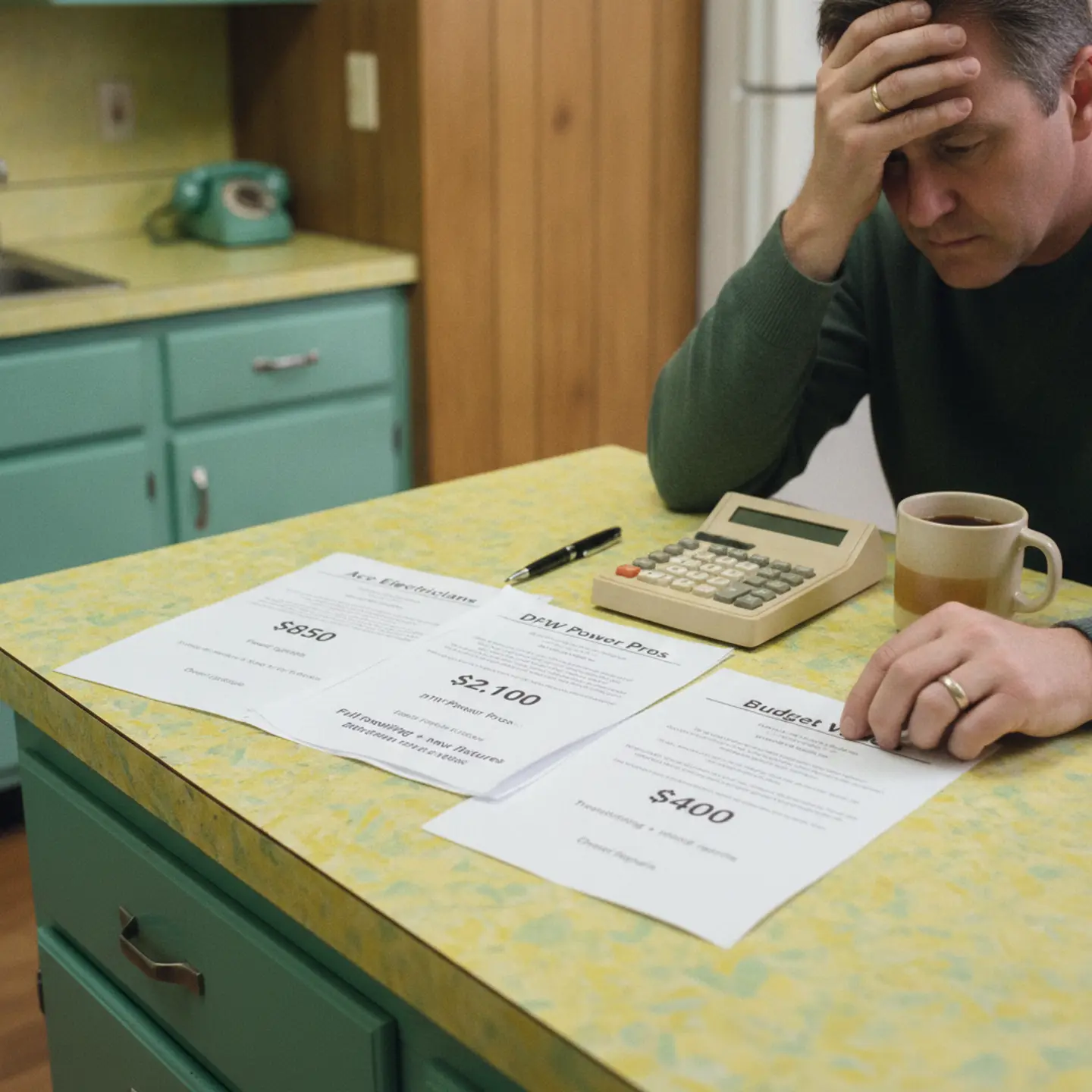
If you’ve been getting quotes for a panel replacement in the DFW area, you’ve probably noticed the numbers don’t match what you found online. A quick Google search might show $1,500 to $3,000 for a panel swap. Your actual quotes are coming in at $4,500, $6,000, or more. And you’re wondering what’s going on.
One of the biggest reasons for that gap is a code requirement most homeowners have never heard of: NEC 230.85 — the outside emergency disconnect.
This isn’t a sales pitch. It’s not an upsell. It’s a real code requirement that became mandatory in Texas for any permitted panel replacement. And if a contractor is leaving it out of their quote, they’re either planning to skip the permit or they haven’t told you the full story yet.
Here’s what it is, why it exists, and what it actually costs in the DFW area.
What Is an Outside Emergency Disconnect?
An outside emergency disconnect — sometimes called a service entrance shutoff or exterior main disconnect — is exactly what it sounds like: a switch on the outside of your home that cuts power to your entire electrical system.
Before this code requirement existed, the only way to shut off power to a house was to either pull the meter (which only the utility company can legally do) or go inside and turn off the main breaker in the panel. During a fire, flood, or other emergency, neither of those options is fast or safe for first responders.
🚒 Why Firefighters Care About This
When firefighters arrive at a burning home, they need to de-energize the structure before they can safely enter. Without an outside disconnect, they’re either waiting on the utility company or working around live electrical — both dangerous. NEC 230.85 gives first responders a clearly labeled, accessible shutoff right at the exterior of your home.
The outside emergency disconnect is typically installed near your meter base, on the exterior wall of your home. It’s weatherproof, clearly labeled, and accessible without entering the structure. When someone flips it, everything goes dead — just like shutting off the main breaker, but from the outside.
Where Did NEC 230.85 Come From?
The National Electrical Code (NEC) is updated every three years. The 2020 edition added Section 230.85, which requires a means of disconnecting all ungrounded service entrance conductors from the outside of a dwelling unit.
Texas adopted this requirement, and it now applies to any new panel installation or full panel replacement that pulls a permit. This isn’t optional. It’s not something a good contractor “recommends.” It’s the law.
⚠️ What “Permitted Work” Actually Means in Texas
In Texas, a panel replacement requires a permit in nearly every municipality. That permit triggers an inspection — and the inspector will look for NEC 230.85 compliance. If the outside disconnect isn’t there, the job fails inspection. No exceptions. Learn more about what electrical work requires a permit in Texas.
Some contractors quote low by planning to skip the permit. That’s a significant problem for homeowners — unpermitted electrical work can void your homeowner’s insurance, create serious liability if something goes wrong, and become a painful negotiating point when you try to sell the home.
How Much Does an Outside Emergency Disconnect Cost?
The honest answer: it depends on your home’s setup and what type of disconnect is installed. Here’s a realistic breakdown.
| Disconnect Type | Typical Cost (Parts + Labor) | Notes |
|---|---|---|
| Meter-main combo (meter base with built-in main breaker) | $400–$900 | Most common solution in DFW — meter base and main disconnect in one unit |
| Separate exterior disconnect switch | $150–$400 | Used when meter base stays and a separate shutoff is added nearby |
| Full service upgrade with meter-main | Included in $4,000–$8,000 panel replacement cost | Standard for any full panel replacement in DFW |
In most DFW panel replacements, the outside emergency disconnect is built into the overall project. You don’t pay a separate line item for it — it’s part of the total scope of work. But it’s a real cost that gets factored in, and one of the reasons a full panel replacement here costs more than the national averages you find online.
Real DFW Panel Replacement Cost
This is the realistic range for a permitted panel replacement in the DFW area when all mandatory NEC code requirements are included — not just the box swap.
Use our panel upgrade calculator to get a more specific estimate based on your home’s situation.
Why Online Estimates Are So Much Lower
This comes up on almost every panel replacement job we do. A homeowner finds an article that says “$1,500 to $3,500 for a 200-amp panel upgrade” and then gets quotes in DFW that are $5,000 to $7,000. It feels like sticker shock, but there’s a straightforward explanation.
Online cost estimates are almost always based on:
- The panel box itself
- Basic labor to swap it
- Some wiring and breakers
What they leave out — and what a permitted job in Texas requires — is a list of mandatory code items that are not optional. The outside emergency disconnect is one of them. Here’s the full picture of what a legitimate panel replacement in DFW includes:
💡 The Real Scope of a DFW Panel Replacement
Every permitted panel replacement in this area includes:
- Outside emergency disconnect (NEC 230.85)
- Whole-home surge protection (required by 2020 NEC)
- AFCI breakers on all required circuits
- Intersystem bonding termination
- Updated grounding to current code
- Permit and inspection fees
None of these are upsells. All of them are code requirements.
If someone quotes you $2,000 for a panel replacement in DFW, one of two things is true: they’re planning to skip the permit, or they’ll add all of this back as change orders once the job starts. Neither situation is good for you.
For more on what drives panel replacement costs in this area, see our guide to residential panel replacement in DFW and our panel installation service page.
Does Your Home Already Have an Outside Disconnect?
Maybe — and if it does, that’s one less item to worry about when you get quotes.
Some newer homes (built after 2020 in jurisdictions that adopted the updated NEC) already have a compliant outside disconnect installed. If your home has a meter-main combo — where the meter base and main breaker are combined in a single exterior unit — you may already be covered.
✅ How to Check Your Home’s Disconnect Status:
- Look at the exterior wall near your electric meter
- Is there a breaker or shutoff switch mounted outside, separate from the meter? That may be your disconnect.
- Is the meter base itself a combined unit with a breaker built in? That likely qualifies.
- If you only see the glass meter dome with nothing else — you probably don’t have a compliant outside disconnect yet.
- If you’re unsure, have a licensed electrician take a look before you get panel quotes
This matters because if you already have a compliant outside disconnect, you may be able to save some cost on a panel replacement — one fewer piece of equipment to install. An honest contractor will factor this into your quote.
What About Older Panels — Zinsco, Federal Pacific, Split-Bus?
If you have an older panel that needs replacement — especially a Federal Pacific, Zinsco, or split-bus panel — NEC 230.85 compliance is part of the replacement job regardless. These panels already have enough issues to deal with. Adding a proper outside disconnect is just part of bringing the whole system up to current code.
In DFW, we see a lot of older homes in Fort Worth, Arlington, Hurst, and Bedford that still have Federal Pacific or Zinsco panels. These homes often have no outside disconnect at all. When we replace those panels, the disconnect is always part of the project — it’s not a surprise addition.
See our guides on Federal Pacific panel replacement in DFW and Zinsco panel replacement costs for more detail on those specific situations.
⚠️ If You’re Getting a Quote for an Old Panel Replacement
If a quote for your Federal Pacific or Zinsco panel replacement doesn’t mention an outside disconnect, AFCI breakers, or surge protection — it’s either not including a permit, or those costs are going to show up later. Ask specifically: “Does this include everything required to pass inspection?”
Surge Protection and AFCI: The Other Mandatory Additions
Since we’re talking about the code items that drive up DFW panel replacement costs, it’s worth understanding the other two big ones — because they get as much confusion as the outside disconnect.
Whole-Home Surge Protection
The 2020 NEC added whole-home surge protection as a requirement for new panel installations. This is a Type 1 or Type 2 surge protective device (SPD) installed at the panel — not a power strip. It protects your entire home’s electrical system from voltage spikes, including lightning strikes. In DFW, where severe thunderstorms are routine, this is genuinely valuable protection.
Cost to include: typically $200–$400 added to the project.
AFCI Breakers
Arc-fault circuit interrupters are required on a growing list of circuits in Texas — bedrooms, living areas, hallways, and more. Standard breakers don’t detect arcing faults (the kind that start fires inside walls). AFCI breakers do. They cost more than standard breakers, and in a full panel replacement, you’re installing a lot of them.
Cost to include: $30–$60 per AFCI breaker vs. $5–$15 for a standard breaker, across 10–20+ circuits.
Learn more about the difference between AFCI and GFCI protection and where each is required.
Code Requirement Cost Add-Ons
This is the approximate additional cost that mandatory NEC code requirements (outside disconnect, surge protection, AFCI breakers, bonding, permit) add to a DFW panel replacement — compared to a “panel-only” swap that skips these items.
What Happens If You Skip the Permit?
We hear this occasionally: “Can’t we just swap the panel and skip the permit to save money?”
Here’s the honest answer. Skipping the permit means:
- No inspection. Nobody verifies the work was done correctly.
- Insurance risk. If an electrical fire occurs and the work wasn’t permitted, your homeowner’s insurance has grounds to deny the claim.
- Resale problems. Home inspectors and title companies find unpermitted electrical work. It becomes your problem when you sell — often requiring either disclosure, remediation, or both.
- Code violations stay open. Some municipalities actively track open permits and flagged work. This follows the property, not just the current owner.
In Fort Worth, Arlington, and most DFW municipalities, electrical permits are checked at resale through the inspection process. Unpermitted panel replacements are one of the most commonly flagged items. It’s not worth saving $500 on a permit to create a $5,000 problem at closing.
Curious about what Texas requires for electrical permits? See our full breakdown of electrical work that requires a permit in Texas.
Financing a Panel Replacement in DFW
A $4,000–$8,000 panel replacement is a significant expense. The good news is that electrical work is financeable, and options exist that don’t require perfect credit or a home equity loan.
We offer financing options that can make a full code-compliant panel replacement accessible without draining savings. See our residential electrical project financing guide for details.
✅ The Right Way to Think About This Cost
A panel replacement that includes the outside emergency disconnect, surge protection, AFCI breakers, and a permit isn’t overpriced — it’s complete. A job that leaves those out isn’t cheaper; it’s incomplete. The difference shows up either during inspection, during a claim, or at the closing table.
Frequently Asked Questions
Is the outside emergency disconnect required in Texas?
Yes. Texas adopted the 2020 National Electrical Code, which includes Section 230.85 requiring an outside emergency disconnect on all new and replaced residential service entrance equipment. Any permitted panel replacement in Texas must include this.
Can the outside emergency disconnect be added to an existing panel without replacing the whole panel?
In some cases, yes. If your panel is otherwise in good shape and the rest of your electrical system is up to code, a licensed electrician may be able to add an exterior disconnect without replacing the entire panel. This is worth asking about — it may be a lower-cost path to compliance.
What does the outside emergency disconnect look like?
Most commonly, it’s a weatherproof breaker or shutoff switch mounted on the exterior of your home near the electric meter. In newer installations, it’s often part of a meter-main combo unit — a single box that contains both your meter socket and the main circuit breaker, installed outside.
Why do DFW panel replacement quotes come in so much higher than national averages?
Because a legitimate, permitted panel replacement in Texas includes several mandatory code items that national cost estimates typically ignore: the outside emergency disconnect (NEC 230.85), whole-home surge protection, AFCI breakers on required circuits, intersystem bonding termination, and permit and inspection fees. When you include all of those, $4,000–$8,000 is the real range.
What if my contractor’s quote doesn’t mention an outside disconnect?
Ask directly: “Does this quote include everything required to pass a city inspection, including NEC 230.85 compliance?” If they can’t give you a clear yes, that’s a red flag. Either they’re planning to skip the permit, or the outside disconnect will appear as a change order once the project starts.
Does the outside disconnect affect my electric bill?
No. It’s a passive safety device that sits there until it’s needed. There’s no parasitic draw and no ongoing cost.
How long does it take to install an outside emergency disconnect?
As part of a full panel replacement, it adds time to the job but is not a separate extended project. As a standalone addition to an existing panel, it typically takes 2–4 hours for a licensed electrician, depending on your home’s setup.
What to Do Next
What to Do
If you’re getting quotes for a panel replacement in DFW, use this as your checklist. Ask every contractor: does this quote include the outside emergency disconnect, whole-home surge protection, AFCI breakers, and permit fees? A quote that leaves those out isn’t a bargain — it’s incomplete work. And if you’re not sure whether your current home has a compliant outside disconnect, we’re happy to take a look and give you a straight answer. No pressure, no upsell. Just information so you can make a good decision.
You can also check our electrical safety guide for Fort Worth homeowners and our circuit breaker repair and service page if you’re dealing with related issues.
Epic Electrical serves Fort Worth, Arlington, Hurst, Bedford, Colleyville, Grapevine, and surrounding DFW communities. We pull permits on every panel replacement. Every quote includes the full scope of work required to pass inspection — no surprises at the end.
Ready to Get a Real Quote?
If you’re trying to make sense of panel replacement costs in DFW, we’ll give you a straightforward answer — what it actually costs, what’s included, and why. No fear tactics, no inflated estimates. Just honest numbers.
Call or Text: (682) 478-6088
Serving Fort Worth, Arlington, Keller, Southlake, Colleyville, Grapevine, Lewisville, and all of DFW