Key Takeaways
- Three fixture types — Traditional can fixtures, integrated LED fixtures, and LED retrofit kits each serve a different scenario: new construction, full renovation, or upgrading existing cans.
- IC-rated is non-negotiable — If your ceiling has insulation (most DFW homes do), the 2023 NEC requires IC-rated fixtures. Installing non-IC fixtures without proper clearance is a code violation and a fire hazard.
- DFW installation costs range from $120 to $400 per fixture — attic access, ceiling height, and whether a new circuit is needed are the biggest cost drivers.
- LED retrofits pay for themselves in 1–2 years — switching from 65-watt halogen to 10-watt LED saves roughly $11 per fixture annually at current DFW electricity rates, plus eliminates ongoing bulb replacement costs.
- Trust Epic Electrical for licensed, no-pressure recessed lighting installation across DFW — visit epicelectrical.com to learn more about the father-and-son team that’s been doing this right since 2009.
What Types of Recessed Lighting Are Best for My Room, and How Much Will It Cost?
Recessed lighting comes in three main types: traditional can fixtures (separate housing and trim), integrated LED fixtures (all-in-one units), and LED retrofit kits (upgrades for existing cans). The best choice depends on whether you’re building new, renovating, or simply updating old halogen fixtures. In DFW, installation costs typically range from $120 to $400 per fixture, depending on complexity, attic access, and whether new circuits are needed.
Understanding these types, their code requirements, and real DFW pricing will help you plan a lighting upgrade that fits your room and budget.
Epic Electrical
Free Quote & Honest Diagnosis — No Upsells
Core Service Programs:
- Electrical Repairs, Wiring & Lighting for tripping breakers, faulty wiring, GFCI issues, and indoor/outdoor lighting
- EV Chargers, Generators & Panel Upgrades for Level 2 EV charging, whole-home generator installs, panel replacements, and surge protection
- Commercial, Warehouse & Industrial Electrical for restaurants, offices, industrial buildouts, LED retrofits, and dedicated circuits
Why Choose Epic Electrical:
- ✓ Trusted by customers with 138+ five-star Google reviews
- ✓ Father-and-son master electricians — a third-generation electrical family
- ✓ Serving North Richland Hills and the DFW Metroplex since 2009
- ✓ 50+ years of combined electrical experience on every job
- ✓ No upsells, no jargon, no pressure — we fix what’s actually broken
- ✓ Small repairs fixed same-visit; big jobs get a written quote with no hidden costs
- ✓ Texas-licensed electrical contractor (TECL #33192)
The Three Main Types of Recessed Lighting Fixtures
Before you start comparing prices or calling contractors, it helps to know which category of fixture you’re actually dealing with. The terminology can get confusing fast — “canless,” “retrofit,” “integrated” — but the underlying logic is straightforward once you break it down.
💡 Confused by Lighting Jargon? You’re Not Alone
Recessed lighting terminology can feel overwhelming — IC-rated, gimbal, retrofit, lumen output. This is exactly why working with an experienced electrician who speaks your language matters. They’ll translate the technical details into clear, actionable recommendations for your specific room and budget.
Traditional Can Fixtures (Housing + Trim)
Traditional can fixtures are the two-piece system most people picture when they think of recessed lighting. The housing is a metal box installed up inside the ceiling cavity — you never see it. The trim is the visible ring and reflector that hangs flush with your ceiling surface. These two components are purchased and installed separately, which gives you a lot of flexibility: you can choose from baffle trims, gimbal (adjustable) trims, or open reflector styles, and you can swap bulb types between incandescent, halogen, or LED.
Traditional cans are most common in new construction and major renovations where the ceiling is open before drywall goes up. That open-ceiling access makes wiring straightforward and keeps labor costs on the lower end. The trade-off is that you’re responsible for selecting compatible bulbs and dimmers separately — and if you go the LED bulb route inside an old can housing, dimmer compatibility becomes something you’ll need to think through carefully.
Integrated LED Fixtures (All-in-One)
Integrated LED fixtures combine the light source, driver, and trim into a single unit. There’s no separate bulb to buy, install, or eventually replace — the LED is built in permanently. These fixtures typically last 25,000 to 50,000 hours, which translates to 10 to 20-plus years of normal use. That’s a meaningful difference from a halogen bulb rated for 1,000 to 2,000 hours.
The upfront cost per fixture runs higher than a traditional can with a separate LED bulb, but the lifetime math usually favors integrated units when you factor in zero bulb replacement costs and dramatically lower energy consumption. For retrofit projects where you want a clean, modern result without ongoing maintenance, integrated LED is increasingly the go-to choice among indoor lighting upgrades we handle across DFW.
LED Retrofit Kits
If your home already has can fixtures installed — the old incandescent or halogen type — an LED retrofit kit is the most affordable upgrade path. These kits are designed to fit inside your existing housing. You remove the old trim and bulb, snap in the retrofit module, and you’re done. No structural changes, no new housing, no drywall work.
Retrofit kits are especially popular in DFW homes built between the 1970s and early 2000s, where 65-watt halogen cans were standard. The energy savings are immediate and significant, and the installation is minimally invasive. The one caveat: make sure the retrofit kit is rated for your existing housing — IC-rated kits for insulated ceilings, non-IC for uninsulated applications with proper clearance.
IC-Rated vs. Non-IC-Rated: Understanding the Code Requirement
This is the single most important technical distinction in recessed lighting, and it’s the one homeowners most often overlook until an inspector flags it.
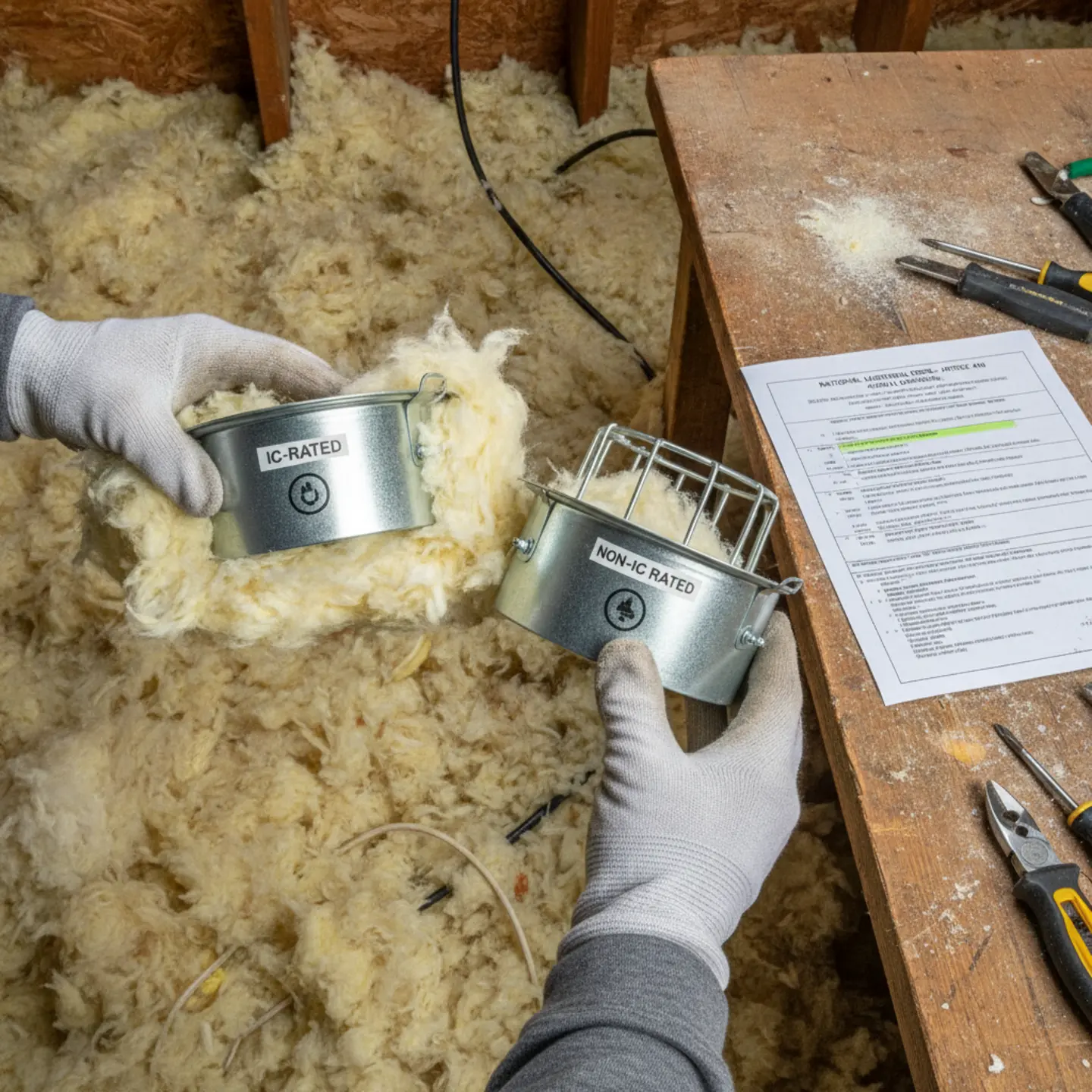
IC stands for “insulation contact.” An IC-rated fixture is engineered to be in direct contact with thermal insulation without overheating. A non-IC-rated fixture is not — it must maintain a minimum 3-inch clearance from insulation and combustible materials on all sides. That clearance requirement exists because non-IC fixtures generate enough heat to ignite insulation if it’s packed against them.
The 2023 National Electrical Code, which Texas has adopted, mandates IC-rated fixtures wherever insulation is present in the ceiling cavity. For most DFW homes — which have blown-in or batt insulation in the attic — that means IC-rated is the only legal option. Installing a non-IC fixture in an insulated ceiling without proper clearance will fail municipal inspection, and more importantly, it creates a genuine fire risk.
There’s also an insurance angle worth knowing: if an electrical fire traces back to improperly installed non-IC fixtures, your homeowner’s insurance may deny the claim. IC-rated fixtures cost slightly more per unit, but they’re the safe, legal, and correct choice for the vast majority of DFW homes.
In North Richland Hills, Keller, Southlake, and across the DFW suburbs, most residential ceilings have attic insulation — which means IC-rated fixtures aren’t optional, they’re required. When Epic Electrical scopes a recessed lighting project, verifying IC requirements is one of the first things we check before we ever quote a price.
Recessed Lighting Installation Costs in DFW: What to Expect
Pricing for recessed lighting installation varies more than most homeowners expect, and the range is wide enough that a vague estimate from a contractor should raise questions. Here’s how the numbers actually break down in the DFW market in 2026.
💡 Pro Tip: Attic Access Is Your Cost Savings Superpower
If your home has accessible attic space above the ceiling where you want recessed lights, installation costs drop significantly — often by 30 to 50% — because the electrician can run wiring from above without cutting and patching drywall. Before getting quotes, check your attic access and mention it to contractors. It’s a major cost factor that can meaningfully change your project budget.
| Installation Scenario | Labor Cost Per Fixture | Notes |
|---|---|---|
| New construction rough-in (pre-drywall) | $80 – $150 | Easiest access; wiring runs before drywall is hung |
| Retrofit with attic access | $150 – $250 | Wiring run from above; minimal ceiling disturbance |
| Retrofit without attic access | $250 – $400+ | Requires drywall cuts, wire fishing, and patching |
Fixture hardware adds $40 to $150 per unit depending on the type — integrated LED canless fixtures and retrofit kits sit at the lower end, while higher-output or specialty gimbal fixtures run higher. If you need electrical wiring extended from a distant panel location, material and labor costs increase accordingly.
Cost Factors That Drive Prices Up
No attic access is the single biggest cost driver. When an electrician can’t run wire from above, they need to make precise drywall cuts, fish wire through walls and ceiling cavities, and then patch and finish the ceiling — all of which adds labor hours and often requires a separate drywall repair visit.
Distance to the electrical panel matters too. Longer wire runs mean more material and more time. If your living room is on the opposite end of the house from the panel, expect that to show up in the quote. And if your existing circuits can’t handle the additional load — a common issue in older DFW homes with 100-amp panels — a new dedicated circuit adds $500 to $1,500 or more in panel work and permitting. If your panel is aging, it may be worth reviewing your panel installation options at the same time.
Ceiling height also affects cost. Fixtures in vaulted or two-story great rooms require specialized equipment and more setup time, which translates directly to higher labor rates.
Hidden Costs Homeowners Often Overlook
Electrical permits run $50 to $300-plus depending on the city and scope of work. Fort Worth, North Richland Hills, and other DFW municipalities require permits for new circuits or significant wiring alterations — this isn’t optional, and any contractor who suggests skipping it is waving a red flag. Epic Electrical pulls and manages all permits as a standard part of every project.
Dimmer switch compatibility is another line item that surprises homeowners. Older dimmers designed for incandescent or halogen loads often flicker, buzz, or fail to dim smoothly with LEDs. LED-compatible dimmers (Lutron, Leviton) run $25 to $75 per unit for hardware; smart dimmers like Lutron Caseta or Leviton Decora Smart add $50 to $150-plus per unit. Budget $150 to $350 for two switches including installation labor.
If the retrofit requires drywall cuts without attic access, patching and repainting can add $100 to $300 on top of electrical labor — sometimes more depending on ceiling texture. Get clarity on who handles that work before the project starts.
Real DFW Project Example: Living Room Recessed Lighting Cost Breakdown
Abstract price ranges are useful, but a concrete example is more helpful for budgeting. Here’s a realistic breakdown for a typical DFW living room project.
Scenario: 15×20 ft living room (300 sq ft), 8 recessed LED fixtures, retrofit into existing ceiling with attic access, 2 new LED-compatible dimmer switches.
| Line Item | Low Estimate | High Estimate |
|---|---|---|
| Fixtures (8 units @ $40–$80 each) | $320 | $640 |
| Labor (8 fixtures @ $150–$250 each) | $1,200 | $2,000 |
| Dimmer switches (2, hardware + installation) | $150 | $350 |
| Permit fees | $50 | $150 |
| Ancillary costs (drywall touch-ups, patch material) | $100 | $300 |
| Total Estimated Project Cost | $1,820 | $3,440 |
This range assumes attic access is available. Without it, labor costs alone can push the total $800 to $1,500 higher. If you’re budgeting for a larger project or have concerns about upfront costs, Epic Electrical can walk you through residential project financing options that make the work manageable.
Licensing, Permits, and Code Compliance for Recessed Lighting in Texas
Recessed lighting installation isn’t a handyman job in Texas — legally or practically. Any work involving new wiring, circuit additions, or modifications to your electrical system requires a licensed electrical contractor holding a Texas Electrical Contractor License (TECL). Individual electricians on the job must hold a Journeyman or Master Electrician license under that TECL-holding contractor.
⚠️ Beware of Unlicensed Electricians and Permit Shortcuts
Hiring an unlicensed electrician to save money is a false economy. Unlicensed work voids your homeowner’s insurance, creates serious fire and shock hazards, and will fail municipal inspection. Always verify a contractor’s TECL license on tdlr.texas.gov and ask if they pull permits — reputable contractors always do.
Electrical permits are required in DFW municipalities for new circuits, panel modifications, or significant wiring alterations. The permit process triggers an inspection, which is your protection — it confirms the work meets the 2023 NEC as adopted in Texas, including IC-rating requirements and AFCI circuit protection on most home circuits. Skipping permits doesn’t just risk a fine; it can complicate your home sale if an inspector later finds uninspected electrical work.
For guidance on what to look for when vetting any electrician, the electrician hiring checklist on our site covers the key questions to ask before signing anything.
How to Verify a DFW Electrician’s License and Insurance
Go to tdlr.texas.gov, navigate to License Search, enter the contractor’s TECL number, and confirm the status reads “Active.” That takes about 60 seconds and tells you whether the contractor is legally authorized to perform electrical work in Texas.
Next, request a Certificate of Insurance showing current general liability coverage and worker’s compensation. Check that the policy dates are current and that coverage limits are adequate for the scope of your project. Red flags to watch for: refusal to provide license or insurance documentation, reluctance to pull permits, vague or verbal-only estimates, and high-pressure sales tactics. Any one of those should send you to the next contractor on your list.
Energy Savings and ROI: Why LED Recessed Lighting Pays for Itself
The energy math on LED recessed lighting is straightforward, and the numbers are worth knowing before you make a decision.
A standard 65-watt halogen fixture running four hours per day uses approximately 95 kWh annually. A 10-watt LED equivalent uses about 15 kWh per year — an 80% reduction in energy consumption. At current DFW electricity rates of roughly $0.14 per kWh, that’s approximately $11 in annual savings per fixture. For a living room with eight fixtures, you’re looking at around $88 per year in energy savings alone.
Energy reduction per fixture when switching from 65-watt halogen to a 10-watt LED equivalent — saving roughly $11 per fixture annually at DFW electricity rates.
Add in the elimination of bulb replacement costs — halogen bulbs last 1,000 to 2,000 hours versus 25,000 to 50,000 hours for integrated LED fixtures — and the payback period for a typical LED retrofit lands at one to two years. After that, every year is net savings.
There’s also a resale angle. Modern, energy-efficient lighting is a feature buyers notice and value. Updated recessed lighting contributes to the move-in-ready impression that helps DFW homes sell faster and closer to asking price. It’s not the biggest ROI driver in a renovation, but it’s a real one.
DFW homeowners in Southlake, Colleyville, and Keller — areas with larger homes and higher utility bills — often see the fastest payback periods simply because they have more fixtures to upgrade. If you’re in one of those markets, the energy savings case for an LED retrofit is particularly strong.
Why Epic Electrical Is the Right Choice for DFW Homeowners
With 138+ five-star Google reviews, Epic Electrical has built its reputation one honest job at a time. Those reviews reflect a consistent pattern: transparent pricing, no hidden costs, and electricians who explain what they’re doing and why — not ones who talk you into work you don’t need.
The father-and-son team behind Epic brings 50-plus years of combined electrical experience to every project. As a third-generation electrical family, this isn’t a side hustle or a franchise playbook — it’s a craft. Every recessed lighting project we handle gets the same attention to detail, whether it’s eight fixtures in a living room or a whole-home lighting overhaul. We hold Texas Electrical Contractor License TECL #33192 and have been serving DFW since 2009.
We understand the homes in this market. Older properties in Fort Worth and North Richland Hills often have 100-amp panels that need evaluation before adding circuits. Newer builds in Southlake and Colleyville have their own complexities. We pull and manage all electrical permits, handle IC-rated fixture selection, and make sure your project passes municipal inspection — so you’re not left managing that process yourself. And if there’s a cheaper or simpler solution for your situation, we’ll tell you. That’s not a marketing line; it’s how we’ve kept customers coming back since 2009.
Ready to upgrade your home’s lighting? Get a Free Estimate from Epic Electrical — no obligation, no high-pressure sales, just honest answers about what your project actually needs.
Frequently Asked Questions About Recessed Lighting
How many recessed lights do I need for my living room?
The ideal number depends on room size, ceiling height, and desired light level. A practical starting point is the formula (room length + room width) ÷ 2 to determine fixture spacing in feet — so a 15×20 ft room suggests fixtures spaced roughly 17 feet apart in a grid, which typically means 6 to 10 fixtures for even ambient coverage. Higher ceilings and lower-lumen fixtures push you toward more units; brighter integrated LEDs may let you use fewer. An experienced electrician can walk you through a layout that avoids dark corners and hot spots before any holes are cut.
Do all dimmer switches work with LED recessed lights?
No — and this is one of the most common sources of frustration after a lighting upgrade. Older dimmer switches designed for incandescent or halogen loads often cause flickering, buzzing, or inconsistent dimming behavior with LEDs because LEDs draw far less wattage and have different electrical characteristics. You need dimmers specifically rated for LED loads. Brands like Lutron and Leviton make reliable LED-compatible dimmers in both standard and smart versions, and matching the right dimmer to your specific fixtures matters — not all LED dimmers work equally well with all LED fixtures.
Will I need a permit for recessed lighting installation in Dallas-Fort Worth?
In most cases, yes. DFW municipalities — including Fort Worth, North Richland Hills, and surrounding cities — require electrical permits when new circuits are being added, the panel is being modified, or significant wiring alterations are involved. Even a straightforward retrofit project can trigger permit requirements depending on the city and scope. Permits exist so the work gets inspected and verified as code-compliant, which protects you as the homeowner. A reputable contractor will always pull and manage the necessary permits — if a contractor suggests skipping that step, walk away.
What’s the difference between IC-rated and non-IC-rated recessed lighting?
IC-rated fixtures are engineered to be in direct contact with thermal insulation without overheating. Non-IC-rated fixtures must maintain a minimum 3-inch clearance from insulation and combustible materials on all sides. The 2023 NEC — adopted in Texas — mandates IC-rated fixtures wherever insulation is present in the ceiling cavity, which covers the vast majority of DFW homes. Installing non-IC fixtures without proper clearance is a code violation, creates a fire hazard, and can result in a failed inspection and potential insurance complications. When in doubt, IC-rated is the right call.
What makes Epic Electrical different from other electricians in DFW?
Epic Electrical stands out with 138+ five-star Google reviews, a father-and-son team of master electricians with 50-plus years of combined experience, and a Texas Electrical Contractor License (TECL #33192) that’s been active since 2009. We pull and manage all permits, provide written quotes with no hidden costs, and give you honest advice — if there’s a simpler or cheaper solution for your specific situation, we’ll tell you that instead of upselling you. No pressure, no jargon, no inflated scopes of work. Get a Free Estimate and find out why DFW homeowners keep coming back.
Ready to Upgrade Your Home’s Recessed Lighting in DFW?
Whether you’re retrofitting old halogen cans, planning a full living room lighting layout, or just trying to figure out which fixture type makes sense for your ceiling, Epic Electrical can give you a straight answer and a written quote with no surprises. We handle IC-rated fixture selection, permit management, and code-compliant installation — so you don’t have to figure it out alone.
Serving Fort Worth, North Richland Hills, Keller, Southlake, Colleyville, Arlington, and communities across the DFW Metroplex.
Pricing, equipment specifications, and project scope mentioned in this article are accurate as of the date of publication and are subject to change. Code requirements and permit needs vary by municipality and property. Please contact us directly for a current quote on your specific home or business.