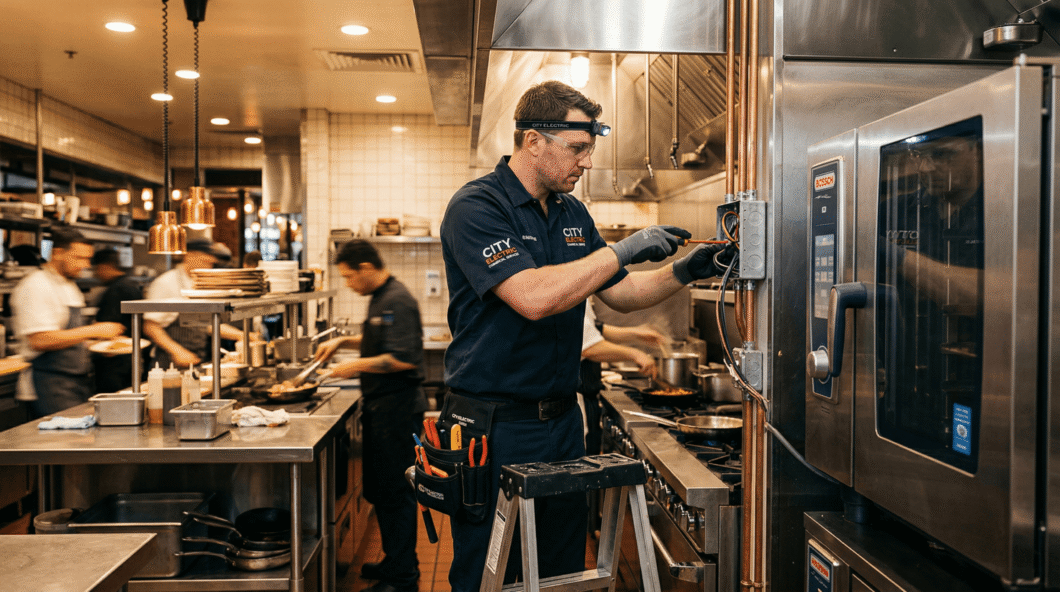
Key Takeaways
- Restaurant electrical systems are different — heavy equipment loads, three-phase power, and strict health/fire codes require a commercial specialist, not a residential electrician.
- Common warning signs — frequent breaker trips, flickering lights, burning smells, and outdated two-prong outlets all signal problems that need professional diagnosis now, not later.
- Free estimates mean no-risk decisions — a thorough on-site inspection gives you exact costs and a clear scope of work before you commit to anything.
- Panel upgrades are often unavoidable — older restaurants with 100-amp service simply cannot safely support modern kitchen equipment; upgrading to 200 or 400 amps protects your investment.
- GFCI protection is non-negotiable — health inspectors check for it, and missing GFCI outlets in wet and food prep areas can trigger fines or temporary closure orders.
- Backup power protects your inventory — a single overnight outage can mean thousands of dollars in spoiled food; properly sized generators and battery backups prevent that loss.
- Energy-efficient upgrades pay for themselves — LED conversions and HVAC optimization typically have 2–5 year payback periods through reduced utility bills.
- Local, family-owned expertise matters — a DFW-based electrician who knows local codes, utility company procedures, and inspector preferences gets your project done faster and right the first time.
Picture a Friday night at your restaurant. Every table is full, the kitchen is firing on all cylinders, tickets are stacking up, and then — nothing. The walk-in cooler goes dark. The compressor stops humming. Or maybe it’s not a cooler; maybe it’s the breaker panel throwing a fit every time the fryer and the hood vent run at the same time. Or worse: a health inspector walks in, clipboard in hand, and flags your food prep area for missing GFCI protection and outdated wiring. Your Friday night turns into a scramble, your weekend turns into a headache, and the revenue you were counting on evaporates while you wait for someone — anyone — who actually knows what they’re doing with commercial electrical systems.
That moment of panic is something we’ve seen hundreds of times across Dallas-Fort Worth. And we understand it completely. Your restaurant isn’t just a building with wires in the walls — it’s your livelihood, your reputation, and in many cases, your family’s future. Electrical problems don’t just inconvenience you; they cost you real money, real customers, and real peace of mind.
The good news is that most of these problems are completely solvable. The key is working with a commercial electrician who specializes in restaurants — someone who understands the unique demands of food service, knows the DFW codes inside and out, and will give you a straight answer about what actually needs to be done. That’s exactly what we do. And we start with a free estimate, so you know what you’re dealing with before you spend a dollar.
Why Restaurants Need a Specialized Commercial Electrician
If you’ve ever called a residential electrician to look at a commercial kitchen problem, you may have noticed something: they get quiet fast. The equipment is bigger, the wiring is more complex, the codes are stricter, and the stakes are higher. A residential electrician who handles home panel upgrades and outlet replacements is simply not equipped — by training or by licensing — to manage the electrical demands of a working restaurant.
Our commercial electrical services are built specifically for the kind of high-demand, code-intensive environments that restaurants represent. That’s not a marketing line — it’s a practical reality. Here’s why the distinction matters so much.
The Unique Electrical Demands of Food Service
A typical residential home runs on a single-phase, 200-amp service. A commercial restaurant kitchen is an entirely different animal. Walk-in coolers and freezers run 24 hours a day, 7 days a week, drawing consistent amperage on dedicated circuits. Commercial ranges, fryers, and flat-top grills pull enormous loads — a single commercial fryer can draw 30 to 50 amps on its own. Stack a few of those together with a convection oven, a commercial dishwasher, and an HVAC system that has to fight against the heat from all that cooking equipment, and you’re looking at electrical demands that would overwhelm most residential systems within minutes.
Three-phase power is standard in commercial kitchens for good reason: it distributes electrical load more efficiently across multiple circuits, reduces voltage fluctuations, and supports the kind of heavy-duty motors found in commercial refrigeration and HVAC. A commercial electrician understands how to design and install three-phase systems, calculate load requirements accurately, and ensure that every piece of equipment has the dedicated circuit it needs to run safely and efficiently.
Emergency lighting and backup power aren’t optional upgrades in a restaurant — they’re code requirements. Exit signs must illuminate automatically during a power failure. Emergency lights must provide at least 90 minutes of illumination. These systems need to be installed correctly, tested regularly, and maintained. A specialist knows this. A generalist often doesn’t.
Code Compliance and Health Department Inspections
The National Electrical Code (NEC) sets the baseline for all commercial electrical installations, but Dallas-Fort Worth also has local amendments and requirements that apply specifically to commercial properties in this region. Health inspectors are trained to look for specific electrical issues in food service environments: proper grounding, GFCI protection near water sources, safe wiring in food prep areas, and code-compliant panel installations.
Non-compliance isn’t just a paperwork problem. Inspectors can issue fines, require immediate corrections, or in serious cases, issue temporary closure orders until violations are resolved. If you’re trying to renew your food service license and your electrical system doesn’t meet current code, that renewal can be delayed or denied. The cost of a proper installation by a qualified commercial electrician is always less than the cost of a failed inspection, a forced closure, or a fire caused by outdated wiring.
We’ve worked with DFW restaurants through health department inspections, city inspections, and utility company approvals. We know what inspectors look for because we’ve been doing this work in this market for decades. That local knowledge is something you simply can’t get from a contractor who isn’t rooted in this community.
Common Electrical Problems in DFW Restaurants
Most restaurant electrical problems don’t appear out of nowhere. They build up over time — a breaker that trips a little more often than it used to, a light that flickers when the walk-in compressor kicks on, an outlet near the prep sink that feels warm to the touch. These are warning signs, and they’re telling you something important: your electrical system is under stress, and that stress is going to turn into a real problem if it isn’t addressed.
Understanding what you’re seeing — and what it means — is the first step toward fixing it. Scheduling electrical safety inspections on a regular basis is the most reliable way to catch these issues before they become emergencies. But in the meantime, here’s what to watch for.
Overloaded Circuits and Breaker Issues
Breakers trip for a reason. When a circuit is carrying more current than it’s rated for, the breaker trips to prevent the wiring from overheating and potentially catching fire. If your breakers are tripping regularly — especially during peak service hours when multiple pieces of equipment are running simultaneously — that’s a clear sign your circuits are overloaded.
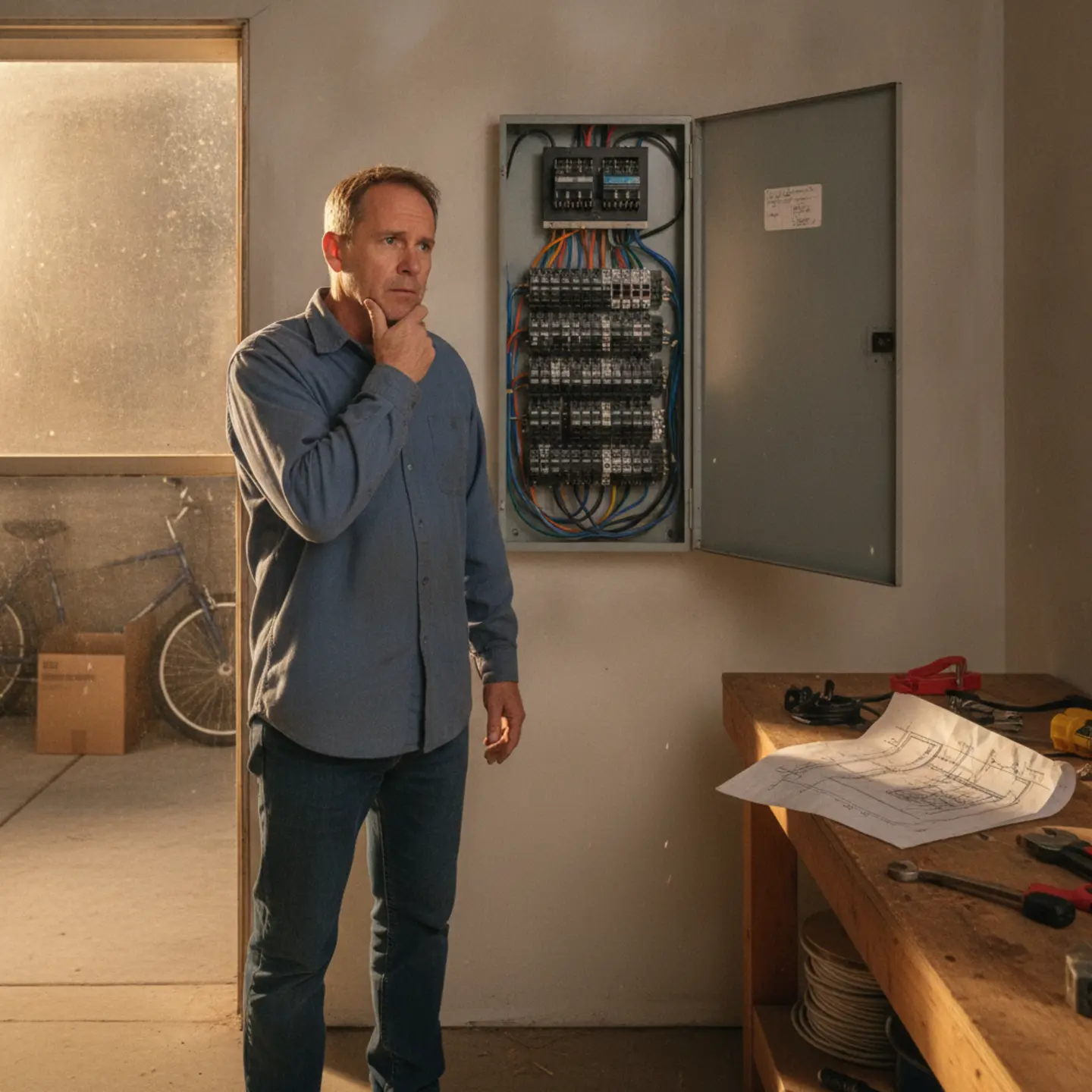
Older restaurants are particularly vulnerable to this problem. A building that was wired 20 or 30 years ago may have a 100-amp service panel that was perfectly adequate for the equipment that existed then. But commercial kitchen equipment has changed dramatically. Modern commercial ranges, refrigeration units, and HVAC systems draw significantly more power than their predecessors. A 100-amp service that worked fine in 1995 may be dangerously undersized for a kitchen operating in 2025.
The solution isn’t to just keep resetting the breaker. That’s treating the symptom while ignoring the cause. The real fix involves a load analysis to understand exactly how much power your equipment requires, followed by either circuit additions, panel upgrades, or service expansion — whatever is actually needed to bring your system into safe, code-compliant operation.
Aging Wiring and Outdated Infrastructure
Restaurants built before 2000 may have wiring that was acceptable at the time but has since become a safety liability. Aluminum wiring, which was commonly used in commercial construction during the 1970s and 1980s, expands and contracts with temperature changes in ways that can loosen connections over time — creating fire hazards at junction boxes and outlet connections. Cloth-insulated wiring, found in even older buildings, degrades as the insulation dries out and cracks, exposing bare conductors.
Knob-and-tube wiring — found in some older commercial properties — is a serious fire hazard and is completely incompatible with modern electrical loads. If your building has knob-and-tube wiring anywhere in the structure, it needs to be addressed. Full rewiring projects are disruptive, but they’re not optional when the alternative is a fire that destroys your business.
We approach rewiring projects with as much care for your operations as possible. We work in phases where feasible, schedule disruptive work during off-hours, and communicate clearly about what to expect at each stage. The goal is always to get your system up to code with the minimum possible disruption to your business.
⚠️ Don’t Ignore These Red Flags
Burning smells, scorch marks on outlets, or equipment that won’t stay powered are fire hazards — not minor inconveniences. These aren’t problems to troubleshoot yourself or put off until next week. They need immediate professional attention. A burning smell from an outlet or panel means something is already overheating, and the window between that warning and an actual fire can be very short.
What to Expect From a Commercial Electrical Estimate
One of the biggest reasons restaurant owners put off calling an electrician is the fear of what they’ll hear. They worry the estimate will be enormous, that they’ll be pressured into upgrades they don’t need, or that they’ll walk away more confused than when they started. We hear this all the time, and we understand it. That’s exactly why we approach estimates the way we do.
A free electrical estimate from our team isn’t a sales pitch. It’s a professional assessment of what’s actually going on with your electrical system, what it would take to fix it, and what that work would cost — broken down clearly so you can make an informed decision without pressure.
The On-Site Inspection Process
When we come out for an estimate, we’re not just walking around with a clipboard and making up numbers. We conduct a real inspection. That means assessing your current electrical load, identifying circuits that are overloaded or undersized, checking for code violations, and documenting everything we find — with photographs — for your records.
We look at your panel, your wiring, your outlets, your grounding, your emergency systems, and your equipment connections. For a typical restaurant, this inspection takes one to two hours depending on the size of the space and the complexity of the electrical system. At the end of it, you have a clear picture of where things stand — not a vague sense of “you probably need some work done.”
We also ask questions during the inspection. What problems have you been noticing? What equipment are you planning to add? Are you thinking about expanding the space? Understanding your plans and your pain points helps us give you recommendations that actually fit your situation — not a generic list of everything that could theoretically be upgraded.
How We Price Commercial Work
Our pricing is based on four things: materials, labor hours, equipment, and any permits or inspections required. We provide itemized quotes, which means you can see exactly what you’re paying for. There’s no line that says “miscellaneous fees” or “additional charges may apply.” If the final cost is going to be different from the estimate, we tell you before we do the work — not after.
Here’s something we tell every client: if there’s a cheaper solution that meets your needs just as well as a more expensive one, we’ll recommend the cheaper one. If your breaker issue can be resolved by adding a dedicated circuit rather than replacing the entire panel, we’ll tell you that. We’re not in the business of selling upgrades you don’t need. Our reputation in this community is built on giving honest advice, and that’s not something we’re willing to compromise.
💡 You’re Not Alone in Wondering About Cost
Most restaurant owners worry about electrical upgrades being expensive — and that worry is completely reasonable. The truth is that a free estimate lets you make an informed decision without any pressure or commitment. We’ve helped hundreds of DFW restaurants find solutions that fit their budget, and we’ve never once told someone they needed a $10,000 upgrade when a $500 repair would do the job.
Now that you understand what goes into a proper commercial estimate, the next step is simple: find out what your restaurant’s electrical system actually needs. No obligation, no sales pressure — just a clear picture of where things stand.
Panel Upgrades and Service Expansion for Growing Restaurants
Growth is a good problem to have — until your electrical system can’t keep up with it. We see this constantly with DFW restaurants that are adding equipment, expanding their dining room, building out a patio, or upgrading their kitchen. The business is doing well, the owner wants to invest in it, and then they discover that their electrical service is already maxed out. There’s no room in the panel for new circuits, and the utility service coming into the building isn’t adequate for the load they’re trying to add.
This is where electrical panel upgrades become a necessary conversation. It’s not always the answer every restaurant owner wants to hear, but it’s often the honest one. And understanding the process — what it involves, how long it takes, and what it costs — makes it a lot less intimidating.
Signs Your Restaurant Needs a Service Upgrade
The most obvious sign is a panel that’s full. If your electrician opens the panel and there are no available breaker slots, adding new circuits requires either a subpanel or a full service upgrade. But there are subtler signs too. If your breakers trip frequently even when you’re not running all your equipment at the same time, that’s a sign the service is undersized for your actual load. If you notice voltage fluctuations — lights dimming when the compressor kicks on, equipment running sluggishly — that’s another indicator that the electrical supply isn’t keeping up with demand.
Premature equipment failure is also a red flag. Commercial refrigeration units, HVAC systems, and cooking equipment are designed to operate within specific voltage ranges. When they’re consistently receiving under-voltage due to an overloaded service, they work harder, run hotter, and wear out faster. The money you spend on a service upgrade is often less than the money you’d spend replacing equipment that failed prematurely because of inadequate power supply.
The Panel Upgrade Process and Timeline
Upgrading your electrical service is a significant project, and we want you to go into it with realistic expectations. The work requires permits from the city, coordination with your utility company (Oncor, in most of DFW), and a final inspection before the upgraded service can be energized. The permitting and utility coordination process is something we handle entirely — you don’t need to navigate that yourself.
The physical work typically takes one to three days, depending on the complexity of the upgrade and the utility company’s response time for disconnecting and reconnecting service. We make every effort to schedule the work during off-hours — early mornings, late nights, or days when the restaurant is closed — to minimize the impact on your operations. In many cases, we can coordinate the work so that downtime is limited to just a few hours.
After installation, a city inspector must approve the new panel before you can operate at full capacity. We schedule that inspection and make sure everything is ready to pass the first time. We’ve done this enough times in DFW to know exactly what inspectors look for, and we don’t leave anything to chance.
💡 Plan Ahead for Growth
If you’re planning to expand your restaurant, add a new piece of equipment, or build out a patio space, get an electrical assessment before you finalize those plans. Discovering that your service needs an upgrade after you’ve already committed to a construction timeline is stressful and expensive. Knowing upfront lets you budget properly and schedule the electrical work as part of the overall project — not as a surprise addition.
GFCI Protection and Electrical Code Compliance in Restaurant Kitchens
GFCI protection is one of the most commonly cited violations in restaurant electrical inspections — and one of the easiest to fix when you work with someone who knows what they’re doing. GFCI stands for Ground Fault Circuit Interrupter. It’s a device that monitors the flow of electricity through a circuit and cuts power in a fraction of a second if it detects a fault — meaning electricity is flowing somewhere it shouldn’t, like through a person.
In a restaurant environment, where water and electricity are constantly in close proximity, GFCI protection isn’t just a code requirement — it’s a genuine life-safety measure. Understanding electrical code compliance requirements for your specific type of operation is something we can walk you through during an inspection, but here’s the baseline of what you need to know.
Where GFCI Protection Is Required
The NEC requires GFCI protection for all outlets within six feet of a sink or water source. In a commercial kitchen, that covers a lot of ground. Every outlet near a prep sink, hand-washing sink, or dishwashing station needs GFCI protection. Outdoor outlets — including patio areas — require GFCI protection as well. Walk-in coolers and freezers need GFCI-protected circuits to prevent shock hazards and equipment damage.
Health inspectors know exactly where to look for missing GFCI protection, and they check it every time. If you’re operating with standard outlets in any of these areas, you’re one inspection away from a violation notice. The fix is straightforward — replacing standard outlets with GFCI outlets or installing GFCI breakers for the affected circuits — but it needs to be done correctly to pass inspection and provide actual protection.
It’s also worth knowing that GFCI devices have a limited lifespan. They should be tested monthly using the test button on the outlet face, and they should be replaced if they fail to trip during testing. A GFCI outlet that doesn’t trip isn’t providing any protection — it’s just providing a false sense of security.
Equipment Grounding and Bonding
Proper grounding is the other major electrical safety requirement that health and fire inspectors check carefully. Every metal equipment frame in your kitchen — ranges, fryers, prep tables, refrigeration units — must be properly grounded to prevent shock hazards. If a wiring fault causes a piece of equipment to become energized, proper grounding ensures that fault current flows safely to ground rather than through the person touching the equipment.
Gas equipment requires an additional layer of protection called bonding, which connects metal gas lines and equipment frames to prevent static electricity buildup. In an environment where gas is present, static discharge is a potential ignition source. Proper bonding eliminates that risk. It’s a detail that gets overlooked sometimes, but it’s one we always check during an inspection because the consequences of getting it wrong are severe.
Proper grounding also protects your sensitive electronics — POS systems, refrigeration controls, and HVAC controllers — from damage caused by power surges. A well-grounded system gives surge protection devices a path to do their job effectively.
Emergency Lighting and Backup Power Systems for DFW Restaurants
Power outages in North Texas aren’t rare events. Severe thunderstorms, ice storms, and summer heat events that stress the grid can all knock out power — sometimes for hours, sometimes for days. For a restaurant, a power outage isn’t just an inconvenience. It’s a financial emergency. Every hour without power is lost revenue. Every hour without refrigeration is food inventory at risk. And if the outage happens during service, it’s a safety issue as well.
Investing in backup power and generator installation is one of the most practical decisions a restaurant owner can make in this climate. But before we get to generators, let’s talk about the baseline requirement: emergency lighting.
Emergency Lighting Requirements
Every commercial restaurant is required by code to have emergency lighting that activates automatically during a power failure. This includes illuminated exit signs and emergency lights positioned to ensure that customers and staff can safely navigate to exits even in complete darkness. Battery-backed emergency lights are required to provide a minimum of 90 minutes of illumination — enough time to safely evacuate the building and secure the space.
These systems need to be installed in specific locations based on the layout of your restaurant, and they need to be tested regularly. The test button on each unit should be pressed monthly to verify that the battery backup is functional. Annual load tests — where the unit is run on battery for the full 90-minute duration — are recommended to ensure reliability when it actually matters.
If your emergency lighting is outdated, not functioning correctly, or was never properly installed in the first place, that’s a code violation that needs to be addressed. It’s also a genuine safety risk that no restaurant owner should be comfortable leaving unresolved.
Generator and Backup Power Options
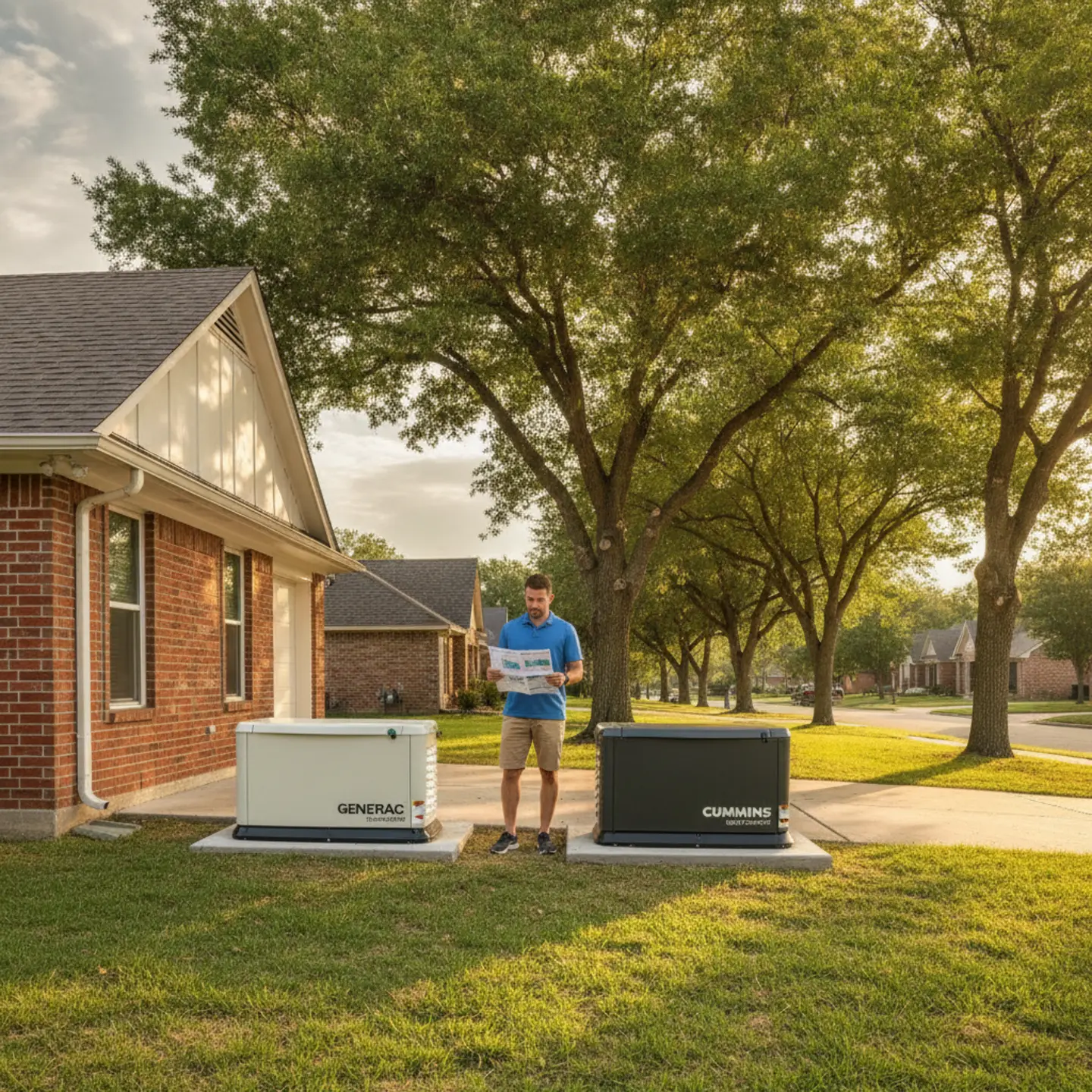
For restaurants that want to protect their operations and their inventory during outages, a standby generator is the most reliable solution. Unlike portable generators, which require manual setup and fuel management, standby generators are permanently installed and activate automatically within seconds of a power failure. They run on natural gas or propane — fuels that are continuously supplied — so you don’t have to worry about running out of fuel during an extended outage.
Sizing a generator correctly is critical. A generator that’s too small won’t be able to power your critical equipment — walk-in coolers, HVAC, and kitchen equipment — simultaneously. A generator that’s oversized wastes money on installation and fuel. Proper sizing requires a load analysis that accounts for the starting current of motors (which is significantly higher than running current) and the priority order of your equipment. We do this analysis as part of the generator installation process, so you end up with a system that actually does what you need it to do.
For restaurants that aren’t ready to invest in a full standby generator, battery backup systems for walk-in coolers and freezers offer a more affordable layer of protection. These systems can maintain safe temperatures for several hours during a short outage, preventing food spoilage without the cost of a full generator installation. They’re not a complete solution, but they’re a meaningful step up from no backup at all.
Not sure whether your restaurant needs a standby generator, a battery backup system, or both? We’ll assess your equipment, your risk exposure, and your budget — and give you honest options, not a one-size-fits-all recommendation.
Energy Efficiency and Cost Savings for Commercial Kitchens
Electrical upgrades in a restaurant aren’t always about fixing problems. Sometimes they’re about improving the bottom line. Commercial kitchens are among the most energy-intensive environments in any industry, and even modest improvements in electrical efficiency can translate to meaningful savings on monthly utility bills. When you’re running tight margins — as most restaurants do — those savings matter.
Exploring energy-efficient electrical upgrades is something we discuss with every restaurant client during the estimate process, because the return on investment is often better than people expect. Here’s where the biggest opportunities typically are.
LED Lighting Conversions
If your restaurant is still running fluorescent fixtures in the kitchen or incandescent lighting in the dining room, you’re leaving money on the table every month. LED lighting uses approximately 75% less energy than traditional incandescent fixtures and significantly less than fluorescent. In a restaurant that’s open 12 to 16 hours a day, that difference adds up fast.
LED fixtures also last dramatically longer than their predecessors — 25,000 hours or more, compared to 1,000 to 2,000 hours for incandescent bulbs and 8,000 to 15,000 hours for fluorescent. That means fewer replacements, less maintenance time, and lower ongoing costs. In a commercial kitchen where changing fixtures requires a ladder and often a shutdown of the work area, the reduced maintenance burden alone is worth considering.
Beyond the energy and maintenance savings, LED lighting quality has improved enormously. Modern LEDs provide excellent color rendering — important for both the kitchen (where staff need to see what they’re working with) and the dining room (where lighting affects the atmosphere and how food looks to customers). A well-designed LED lighting system can actually improve the dining experience while reducing your utility bill.
HVAC and Ventilation Optimization
Commercial kitchen ventilation is one of the most energy-intensive systems in a restaurant, and it’s also one of the most frequently overlooked when it comes to efficiency. Kitchen hood systems need to move enormous volumes of air to manage heat, smoke, and grease — but many older systems run at full capacity all the time, regardless of whether the kitchen is at full operation or just doing prep work.
Variable-speed fan controls and demand-controlled ventilation systems adjust output based on actual cooking activity. When the kitchen is running at full capacity during service, the ventilation runs at full speed. During slower periods, it scales back — saving energy without compromising air quality or safety. These systems can reduce ventilation energy costs by 30% to 50% compared to constant-speed systems.
Proper ductwork design and maintenance also matter. Grease buildup in ductwork reduces airflow efficiency and creates a fire hazard. Leaky ductwork wastes conditioned air and forces HVAC systems to work harder. Both issues drive up energy costs and accelerate equipment wear. As part of an electrical assessment, we evaluate the overall efficiency of your ventilation and HVAC systems and identify opportunities to improve performance without replacing equipment that doesn’t need to be replaced.
💡 Upgrades That Pay for Themselves
Many energy-efficient upgrades — LED conversions, variable-speed ventilation controls, smart HVAC systems — have payback periods of just 2 to 5 years through reduced utility bills. After that, every month is pure savings. And because these upgrades also reduce equipment wear, they often extend the life of your most expensive kitchen systems. It’s one of the few areas where doing the right thing for the environment also happens to be the right thing for your profit margin.
Why Choose a Local, Family-Owned Commercial Electrician in DFW
There’s no shortage of electrical contractors in the Dallas-Fort Worth area. So why does it matter whether you work with a local, family-owned company versus a large regional contractor or a franchise operation? It matters more than most people realize — and not just for sentimental reasons.
We’ve been serving DFW businesses since 1985. That’s not a number we throw around to sound impressive — it’s context for what it means when we say we know this market. We know the local codes. We know the utility company procedures. We know the inspectors. We know the neighborhoods, the building stock, the common problems in restaurants that were built in different eras. You can read more about our electrical company and the history behind what we do, but the short version is this: we’re your neighbors, and we’ve been doing this work in this community long enough to have earned a reputation we’re not willing to compromise.
Local Expertise and Community Roots
When you call a large regional contractor, you’re often getting a dispatcher who routes your call to whoever is available. That person may or may not have experience with commercial restaurant electrical work. They may not know the specific requirements of DFW’s local code amendments. They may not have a relationship with the Oncor representative who handles your service area, which can mean delays in utility coordination for panel upgrades or service work.
When you call us, you’re talking to people who have been doing this specific work in this specific market for a long time. We have established relationships with local inspectors and utility company representatives that make the permitting and approval process smoother. We know which projects require which permits, how long approvals typically take, and how to structure the work to minimize delays. That local knowledge has real, practical value — it saves you time and money.
We’ve worked in restaurants across Fort Worth, Arlington, Dallas, Keller, Southlake, Colleyville, Grapevine, Lewisville, and throughout the DFW Metroplex. Every city has its own nuances when it comes to permits and inspections, and we know them all.
Honest Pricing and No Hidden Fees
We’ve built our business on a simple principle: tell people the truth, give them options, and let them make their own decisions. That means upfront estimates with itemized costs — no vague line items, no “additional charges may apply” language, no surprises when the invoice arrives. If the scope of work changes during the project because we discover something unexpected, we stop and talk to you before proceeding. You always know what you’re agreeing to.
It also means that if a problem can be fixed with a $200 repair instead of a $5,000 upgrade, we recommend the repair. We’ve had plenty of conversations where a restaurant owner came in expecting to hear they needed a major overhaul, and we told them they actually just needed a dedicated circuit and a proper load balancing. Those conversations feel good to have. They’re also the reason people call us back when they do need a bigger project — because they trust that we’re giving them straight information.
“If there’s a cheaper fix that gets the job done safely and correctly, we’ll tell you. We’d rather give you an honest answer today than an inflated invoice tomorrow.”
Ready to work with a commercial electrician who gives you straight answers and puts your restaurant’s needs first? Request a free estimate and experience the difference that honest, local expertise makes.
How to Prepare for Your Commercial Electrical Estimate
Getting the most out of your free estimate starts before we arrive. The more information you can share with us upfront, the more accurate and useful the estimate will be. This isn’t about doing our homework for us — it’s about making sure we understand your specific situation so we can give you recommendations that actually fit your operation.
Here’s what helps us help you.
Documentation to Have Ready
If you have building blueprints or floor plans that show the electrical layout, those are extremely useful. They help us understand the existing infrastructure before we start the physical inspection, and they can reveal issues that aren’t immediately visible — like circuits that were added informally over the years without being properly documented.
Records of previous electrical work are also valuable. If a contractor added circuits or upgraded the panel at some point, knowing when that work was done and what was changed helps us understand the current state of the system. Equipment manuals and specifications for your major appliances — particularly anything you’ve added recently — tell us exactly what electrical requirements those pieces of equipment have, which is essential for accurate load calculations.
Finally, recent utility bills are helpful. They show us your actual electrical consumption patterns, which can reveal inefficiencies or overloads that aren’t obvious from a visual inspection alone. If your bills have been climbing without a corresponding increase in business, that’s a signal worth investigating.
Questions to Ask During the Estimate
A good estimate should answer your questions, not just hand you a number. Come prepared with the things you actually want to know. Some of the most useful questions to ask include:
- What’s the timeline for the work, and how will it affect restaurant operations? Understanding when the work will happen and what disruption to expect lets you plan accordingly.
- What permits are required, and who handles the permitting process? (We handle it, but you should confirm this with any contractor you’re evaluating.)
- What warranty or guarantee comes with the work? Quality electrical work should be backed by a warranty on both labor and materials.
- Are there phased options if budget is a constraint? Sometimes the most important work can be done first, with less critical upgrades scheduled for a later phase. A good contractor will help you prioritize.
- What happens if you find additional problems during the work? Understanding the process for scope changes before they happen prevents unpleasant surprises.
Have a decision-maker present during the estimate if at all possible. When the person who can approve the work is in the room during the inspection, recommendations can be discussed, questions can be answered, and decisions can be made on the spot. It speeds up the process and ensures that nothing gets lost in translation between the inspection and the approval conversation.
We serve restaurants throughout the DFW Metroplex — from Dallas and Fort Worth to Arlington, Keller, Southlake, Colleyville, Grapevine, Lewisville, and the surrounding communities. If you’re in the area, we can typically schedule an estimate within a few business days.
Frequently Asked Questions About Commercial Electrical Work for Restaurants
How much does a commercial electrical panel upgrade cost for a restaurant?
Panel upgrades for commercial restaurants typically range from $3,000 to $8,000 or more, depending on the amperage increase required, the condition of the existing infrastructure, local permit costs, and the complexity of coordinating with the utility company. A restaurant upgrading from 100-amp to 200-amp service will generally fall on the lower end of that range; upgrading to 400-amp three-phase service for a high-volume kitchen will be toward the higher end. The only way to get an accurate number for your specific situation is an on-site inspection — which we provide at no cost and with no obligation.
Can you do electrical work while my restaurant is open?
Yes — and we make every effort to minimize disruption to your operations. Many projects can be scheduled during off-hours: early mornings before prep begins, late nights after closing, or slower midweek periods when a partial shutdown is less impactful. For larger projects that require a full shutdown, we work with you to identify the best timing and structure the work in phases where possible. We’ve done this long enough to know that a restaurant owner’s time and revenue are valuable, and we plan accordingly.
What permits do I need for commercial electrical work?
Most commercial electrical work — including panel upgrades, new circuit installations, service expansions, and generator installations — requires city permits and inspections. The specific requirements vary by city within DFW, which is one of the reasons local expertise matters. We handle the entire permitting process for you: pulling the permits, coordinating with the city and utility company, scheduling inspections, and ensuring all work meets current code. You don’t need to navigate that process yourself — it’s part of what we do.
How often should a restaurant’s electrical system be inspected?
We recommend annual safety inspections for restaurants, particularly those with heavy commercial kitchen equipment that runs continuously. Annual inspections catch developing problems before they become failures, ensure ongoing code compliance as codes are updated, and provide documentation that can be valuable during health department inspections or lease renewals. Restaurants that have recently added equipment, expanded their space, or experienced recurring electrical issues may benefit from more frequent inspections until the system is stabilized.
What’s the difference between a residential and commercial electrician?
Commercial electricians are trained and licensed specifically for the higher-voltage, higher-load, and more complex electrical systems found in businesses. This includes three-phase power systems, load calculations for heavy commercial equipment, complex safety systems like emergency lighting and GFCI protection in wet environments, and the specific code requirements that apply to commercial properties. Residential electricians are trained for single-phase, lower-load systems in homes — they’re skilled at what they do, but they’re not equipped for the demands of a commercial kitchen. Using a residential electrician for commercial work can result in code violations, failed inspections, and safety hazards.
Do you offer emergency electrical service for restaurants?
Yes. We understand that electrical failures in a restaurant aren’t just inconvenient — they’re urgent. A breaker failure that shuts down your walk-in cooler, a wiring fault that trips your entire kitchen circuit, or a safety hazard that requires immediate attention can’t wait for a scheduled appointment. If you’re experiencing a problem that’s affecting food safety, customer safety, or your ability to operate, call us directly and we’ll get a technician to you as quickly as possible. We serve the DFW area and can respond to urgent situations across the Metroplex.
Get Your Free Commercial Electrical Estimate for Your DFW Restaurant
Whether you’re dealing with a specific problem right now or just want to know where your restaurant’s electrical system stands, a free on-site estimate is the best place to start. We’ll give you a clear picture of what’s going on, what it would take to fix it, and what that work would cost — no pressure, no inflated recommendations, no surprises. We’ve been doing this in DFW since 1985, and we’ll treat your restaurant like we’d want someone to treat ours.
Serving Fort Worth · Dallas · Arlington · Keller · Southlake · Colleyville · Grapevine · Lewisville · and all of DFW
(682) 478-6088