Key Takeaways
- Breaker size must match wire gauge — using a 20A breaker on 14 AWG wire is a fire hazard, not just a code violation.
- The 25% safety margin rule — always calculate your appliance’s max draw, then add 25% before selecting a breaker size.
- Common residential breaker sizes — 15A, 20A, 30A, 40A, 50A, and 60A each serve specific circuits and appliances.
- Oversizing a breaker to stop tripping is dangerous — it removes the protection the breaker is designed to provide.
- DFW homes built before 2000 may have panels that don’t meet current Texas electrical code — that doesn’t mean they’re broken, but it’s worth knowing.
- The 80% rule — a 20A breaker should carry no more than 16A continuously to prevent overheating.
- You can understand your panel — but installing or replacing breakers is a job for a licensed electrician in DFW.
You flip a breaker and nothing happens. Or worse — it keeps tripping every time you run the microwave and the coffee maker at the same time. You’re standing in front of your panel, staring at a row of switches, wondering if you need to call an electrician or if you’re just overloading a circuit. Maybe someone told you to “just put in a bigger breaker.” Maybe you’re not sure what size you even have right now.
Here’s the truth: understanding your circuit breaker size takes about five minutes once someone explains it clearly. And that knowledge could save you from an unnecessary panel upgrade, a dangerous DIY mistake, or a house fire that starts inside a wall where no one can see it. That last one isn’t meant to scare you — it’s meant to explain why this stuff actually matters.
This guide walks you through the complete circuit breaker size calculator logic — the amp ratings, the wire gauge chart, the step-by-step math, and the real-world examples for common DFW home appliances. We’ll also tell you exactly when you can handle something yourself and when it’s time to call a licensed electrician. No fluff, no upsell pressure. Just the information you need to make a confident decision.
Why Circuit Breaker Size Matters (And When It Doesn’t)
Let’s start with what a circuit breaker actually does, because most homeowners have a vague sense of it but not the full picture. A circuit breaker is a safety device. Its entire job is to detect when more electrical current is flowing through a wire than that wire can safely handle — and then cut the power before the wire overheats and starts a fire. That’s it. That’s the whole job.
When a breaker is the right size for its wire, the system works exactly as designed. When the breaker is too large for the wire, the wire can overheat and potentially catch fire before the breaker ever trips. When the breaker is too small for the circuit’s actual demand, it trips constantly — which is annoying but actually not dangerous. Nuisance tripping is frustrating. Undersized wire with an oversized breaker is a fire hazard. Those two problems are not equal, and understanding the difference matters.
Here’s what most homeowners don’t realize: the majority of homes in the DFW area don’t need their breakers replaced. They need their homeowners to understand what they already have. If your panel was installed correctly and hasn’t been tampered with, it’s probably fine. The issue usually isn’t the breaker — it’s how the circuit is being used. Before you start shopping for a new breaker or calling for an electrical safety inspection, spend five minutes understanding what your panel is actually telling you.
The Difference Between Breaker Size and Panel Capacity
This is one of the most common points of confusion, so let’s clear it up directly. Your home has a main breaker — typically 100A, 150A, or 200A — that controls the total amount of power coming into the house. That number is your panel’s total capacity. It does not mean every circuit in your house runs at 200 amps. Not even close.
Each individual breaker in your panel protects one specific circuit. A 20A breaker protects the circuit running to your kitchen outlets. A 15A breaker protects the circuit for a bedroom’s lights and outlets. A 30A breaker protects the circuit for your dryer. These are completely independent of each other and of your main breaker size.
Think of your main breaker as the water main coming into your house. The individual breakers are like the valves controlling flow to each room. The main line has a maximum capacity, but each valve controls a much smaller flow. Oversizing an individual breaker is dangerous because it removes protection for that specific wire. Undersizing causes nuisance tripping. Neither problem has anything to do with your main panel capacity — they’re separate issues that require separate solutions.
✅ You’re Not Alone — Breaker Confusion Is Normal
Most homeowners have never looked at their breaker panel closely. The fact that you’re reading this means you’re already ahead of the game. Understanding your electrical system is a smart move, not a sign that something’s wrong. You don’t need to be an electrician to understand the basics — you just need someone to explain it without the jargon.
Understanding Amp Ratings: What the Numbers Actually Mean
Amps — short for amperes — measure the flow of electrical current through a wire. If you want a simple analogy, think of your electrical system like a garden hose. Voltage is the water pressure. Amperage is how much water is actually flowing. A bigger pipe (thicker wire) can handle more flow. A smaller pipe (thinner wire) can only handle so much before it bursts — or in electrical terms, before it overheats.
Higher amperage means more power can flow through the circuit, which is exactly what high-draw appliances like dryers, air conditioners, and electric ranges need. But higher amperage also means more heat is generated in the wire when that current flows. This is why wire gauge — the thickness of the wire — must be matched to the breaker size. The wire has to be thick enough to handle the current the breaker allows to flow. If it isn’t, you have a fire risk hiding inside your walls.
The most common residential breaker sizes you’ll encounter in DFW homes are: 15A, 20A, 30A, 40A, 50A, 60A, 100A, and 200A. The 100A and 200A sizes are typically main breakers, not individual circuit breakers. The 15A and 20A sizes handle the vast majority of everyday circuits. The 30A through 60A range covers dedicated circuits for major appliances. Understanding electrical code requirements in Texas means knowing that each of these sizes has specific wire gauge requirements that aren’t optional — they’re mandated by the National Electrical Code as adopted by the state.
How Amperage Relates to Household Appliances
Not every outlet in your home needs the same amperage. A lamp draws almost nothing compared to an electric range. A phone charger is a rounding error compared to a central air conditioner. Understanding which appliances need which breaker sizes helps you read your panel intelligently and recognize when something might be off.
A 15A breaker is standard for basic lighting circuits and general-purpose outlets in bedrooms and living areas. These circuits handle low-draw devices — lamps, phone chargers, televisions, small fans. A 20A breaker is the standard for kitchen and bathroom circuits, where higher-draw appliances like toasters, coffee makers, and hair dryers are used. Building code actually requires 20A circuits in kitchens — it’s not optional.
Dedicated circuits for high-draw appliances are a different category entirely. Your electric dryer typically needs a 30A to 50A breaker. Your water heater needs 30A to 40A. Your central AC unit — one of the biggest electrical loads in a DFW home — typically needs 30A to 60A depending on the tonnage. These aren’t circuits you share with other devices. They’re single-purpose circuits designed to handle one heavy load safely. If you’re adding a new major appliance to your home, you can’t just plug it into any outlet. You need the right dedicated circuit with the right breaker size — and the right wire to match.
💡 Why Wire Gauge Matters More Than You Think
A breaker protects the wire, not the appliance. If the wire is too thin for the breaker size, it overheats before the breaker trips — and that heat is happening inside your wall, where you can’t see it and smoke detectors can’t detect it until it’s too late. This is why the wire-to-breaker match is non-negotiable. It’s not a preference or a guideline. It’s the difference between a safe circuit and a fire hazard.
Not sure whether your current breaker setup matches your wire gauge? That’s exactly the kind of question a professional electrical inspection is designed to answer — no pressure, just clarity on what you actually have.
Wire Gauge Chart: Matching Breaker Size to Wire Thickness
Wire gauge in the United States is measured using the American Wire Gauge (AWG) system, and it works in a way that trips up a lot of people: the smaller the number, the thicker the wire. So 14 AWG wire is thinner than 12 AWG wire, which is thinner than 10 AWG wire. Thicker wire can carry more current safely. This is the inverse relationship that confuses most homeowners, and it’s worth locking in before we go further.
The reason wire gauge matters so much in the context of circuit breaker sizing is simple: the wire and the breaker are a matched pair. The breaker is sized to protect the wire. If you put a 20A breaker on a circuit wired with 14 AWG wire (which is only rated for 15A), the wire can carry 20A of current and overheat before the breaker ever trips. The breaker thinks everything is fine. The wire is melting inside your wall. That’s the scenario we’re trying to prevent.
Standard Residential Wire Gauge & Breaker Size Chart
Here is the reference chart you need. These are the standard pairings used in residential electrical work across the United States, including DFW homes:
| Wire Gauge (AWG) | Maximum Breaker Size | Typical Use |
|---|---|---|
| 14 AWG | 15A maximum | Lighting circuits, general bedroom/living room outlets |
| 12 AWG | 20A maximum | Kitchen circuits, bathroom outlets, garage circuits |
| 10 AWG | 30A maximum | Electric dryer (smaller), water heater, window AC |
| 8 AWG | 40–50A | Electric dryer (standard), electric range, larger AC units |
| 6 AWG | 55–60A | Large central AC units, large electric ranges, hot tubs |
| 4 AWG and larger | 70A+ | Main panels, subpanels, EV chargers, large HVAC systems |
Print this chart or bookmark this page. It’s the single most useful reference you’ll have when trying to make sense of your breaker panel or plan a new circuit.
How to Read Your Breaker Panel
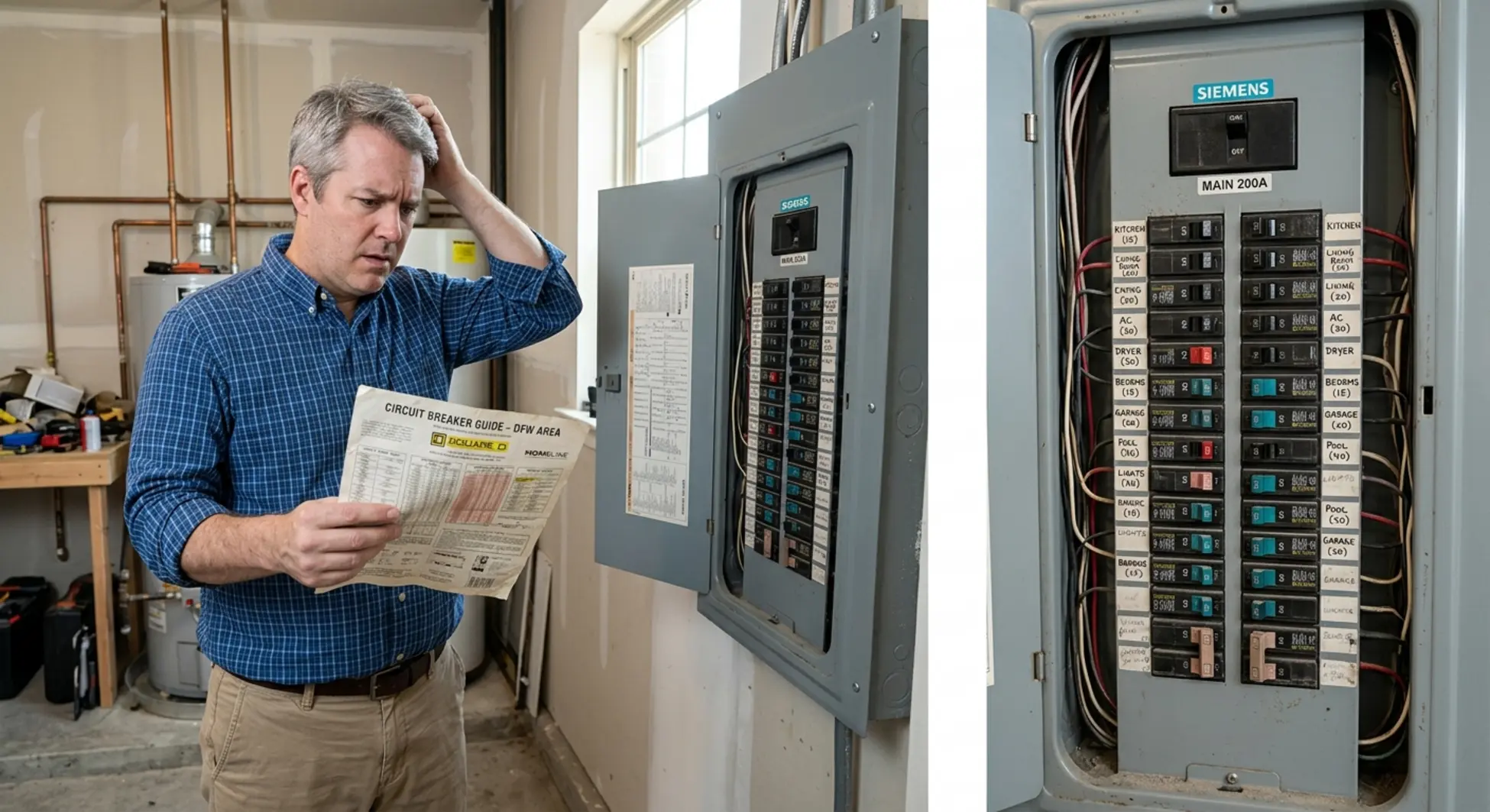
Most homeowners open their panel door once every few years when something trips. Here’s how to actually read what you’re looking at. Each breaker has a number stamped on it — that’s the amp rating. A breaker labeled “20” is a 20A breaker. A breaker labeled “15” is a 15A breaker. Double-pole breakers (the ones that take up two slots and are connected) are typically for 240V circuits — dryers, AC units, water heaters.
If you want to verify that the wire gauge matches the breaker, you’d need to look at the wire entering the breaker. The wire gauge is often printed on the wire’s insulation jacket — something like “12 AWG” or “12/2 NM-B.” If you can safely see the wire without touching anything inside the panel, you can cross-reference it against the chart above. If the numbers don’t match — say, you see 14 AWG wire on a 20A breaker — that’s a red flag that needs a professional evaluation, not a DIY fix.
If you can’t identify what a breaker controls, don’t assume. A circuit tester and 30 minutes of your time can map out your whole panel. Write the results on the inside of the panel door. It sounds tedious, but it’s one of the most useful things you can do as a homeowner — and it helps any electrician who works on your home in the future.
💡 Pro Tip: Label Your Breaker Panel
Spend 30 minutes with a circuit tester to figure out which breaker controls which outlets and lights. Plug a lamp into an outlet, then flip breakers one at a time until the lamp goes off. Write it on the panel door. This simple step saves hours of frustration later — and it helps any electrician who works on your home know exactly what they’re dealing with before they start.
Circuit Breaker Size Calculator: Step-by-Step
Now let’s get into the actual math. This is the circuit breaker size calculator logic that electricians use when sizing a new circuit. You can apply this same logic to understand whether an existing circuit is correctly sized or to plan for a new appliance. It’s not complicated — it’s just five steps.
Step 1: Find the appliance’s maximum amperage. Check the nameplate on the appliance — it’s usually on the back or bottom, or inside the door on appliances like washers and dryers. It will list the wattage or amperage draw. If it lists watts, divide by the voltage (120V for standard outlets, 240V for large appliances) to get amps. Example: a 1,200-watt microwave on a 120V circuit draws 10 amps.
Step 2: Add a 25% safety margin. Multiply the amperage by 1.25. This accounts for startup surges (motors draw more current when they first start), continuous load requirements, and the fact that electrical code requires circuits to be sized at 125% of the continuous load. So that 10A microwave needs a circuit sized for at least 12.5A.
Step 3: Round up to the next standard breaker size. Standard breaker sizes are 15A, 20A, 30A, 40A, 50A, and 60A. If your calculation gives you 12.5A, the next standard size up is 15A. If it gives you 37.5A, you round up to 40A.
Step 4: Verify the wire gauge supports that breaker size. Use the chart in the previous section. A 15A breaker needs at least 14 AWG wire. A 20A breaker needs at least 12 AWG wire. A 40A breaker needs at least 8 AWG wire. The wire must be rated for the breaker — not the other way around.
Step 5: Check your panel for available capacity. Do you have an empty breaker slot? Does your main panel have enough total capacity to add this circuit? If your panel is full or you’re already running close to your main breaker’s limit, you may need to look at panel upgrade services before adding new circuits. This is where a professional assessment becomes genuinely useful — not because we’re trying to sell you something, but because panel capacity calculations involve your total load, and getting that wrong has real consequences.
Real Example: Adding a 240V Dryer Circuit
Let’s walk through a real scenario that comes up constantly in DFW homes — adding or replacing a dryer circuit. A typical electric dryer draws between 5,000 and 6,000 watts at 240 volts. To convert that to amps: 6,000 watts ÷ 240 volts = 25 amps at full load.
Now apply the 25% safety margin: 25A × 1.25 = 31.25A. Round up to the next standard breaker size: that’s 40A. Cross-reference the wire gauge chart: a 40A breaker requires 8 AWG wire. So your dryer circuit needs a 40A double-pole breaker and 8 AWG wire run from the panel to the dryer outlet location.
This is why you can’t just use whatever breaker happens to be available. If someone installed a 30A breaker on that circuit, the dryer would still run — but it would be operating right at the edge of the breaker’s capacity, and the breaker would trip regularly under full load. If someone installed a 50A breaker with 10 AWG wire to “give it more room,” the wire would be undersized for the breaker and could overheat. The math matters. Every step of it.
Real Example: Kitchen Countertop Outlet Circuit
Here’s a simpler example that applies to almost every DFW home. Kitchen countertop outlets are required by code to be on 20A circuits. This isn’t a suggestion — it’s a building code requirement based on the fact that kitchen appliances (toasters, coffee makers, stand mixers, microwaves) draw significant current and are often used simultaneously.
A 20A kitchen circuit requires 12 AWG wire. It also requires GFCI (Ground Fault Circuit Interrupter) protection — either a GFCI breaker or GFCI outlets — because of the proximity to water. Note that GFCI protection is a separate requirement from the breaker size; they work together but address different hazards. The breaker protects the wire from overcurrent. The GFCI protects people from electrocution if a ground fault occurs near water.
Never downsize a kitchen circuit to 15A to save a few dollars on wire. The cost difference between 14 AWG and 12 AWG wire is minimal. The risk difference is not. Kitchen circuits are high-use, high-draw circuits, and they’re one of the most common sources of electrical problems in older DFW homes that weren’t wired to current standards.
Common Breaker Size Mistakes Homeowners Make
We’ve been doing electrical work in DFW for three generations, and we see the same mistakes come up over and over. Not because homeowners are careless — but because the information isn’t always easy to find, and some of these mistakes seem logical until you understand the underlying safety principles. Here are the ones that matter most.
Oversizing a breaker to stop nuisance tripping. This is the big one. A breaker trips because the circuit is overloaded — drawing more current than the breaker is rated for. The logical-seeming solution is to put in a bigger breaker so it doesn’t trip. But that’s like removing the smoke detector because it keeps going off. The tripping is a symptom. The cause is too much load on the circuit. Putting in a bigger breaker doesn’t fix the load — it just removes the protection. Now the wire can overheat before the breaker trips, and you have a fire hazard inside your walls. Fix the load problem, not the breaker.
Assuming all 20A breakers are the same. A 20A breaker is only safe on a circuit wired with 12 AWG wire. If someone replaced a 15A breaker with a 20A breaker on a circuit that still has 14 AWG wire — which happens more often than you’d think — that’s a serious electrical code violation and a fire risk. The breaker brand and style also matter for compatibility with your specific panel. Not all breakers are interchangeable across panel brands.
Ignoring the 25% safety margin. Sizing a breaker exactly to the appliance’s maximum draw with no margin is like filling your gas tank to the absolute brim and then driving over a speed bump. Electrical systems generate heat under load, and that heat builds up over time. The 25% margin isn’t padding — it’s the difference between a circuit that runs safely for decades and one that degrades prematurely or trips under normal use.
DIY installing a breaker without checking panel capacity. Even if you buy the right breaker and the right wire, installing it yourself in most DFW cities requires a permit and inspection. Beyond the legal issue, working inside a live electrical panel is genuinely dangerous. The main lugs at the top of the panel remain energized even when the main breaker is off. This is not a DIY project — it’s a task for a licensed electrician with the right training and equipment.
Mixing old and new breaker types in the same panel. Older panels — particularly Federal Pacific and Zinsco panels, which are common in DFW homes built in the 1970s and 1980s — have known compatibility and safety issues. Adding modern breakers to these panels doesn’t fix the underlying problems. If you have one of these panels, the right conversation is about replacement, not modification.
⚠️ Never Oversize a Breaker to Stop Tripping
If a breaker keeps tripping, the problem isn’t the breaker size — it’s usually an overloaded circuit or a short somewhere in the wiring. Putting in a larger breaker is like removing the smoke detector because it keeps going off. The alarm is doing its job. So is the breaker. Call a pro to find the actual cause instead of masking it with a bigger breaker.
Worried you might have made one of these mistakes — or that a previous owner did? A quick inspection from a DFW electrician can confirm everything is safe and give you peace of mind without the guesswork.
When You Need a Professional Electrician (Not Just a Calculator)
We want to be straight with you here, because we think honesty is more useful than a sales pitch. This guide gives you the knowledge to understand your circuit breaker system — to read your panel, do the math on a new circuit, recognize warning signs, and have an informed conversation with an electrician. That’s genuinely valuable, and most homeowners don’t have it.
But understanding your breaker panel and installing breakers are two completely different things. The panel interior — specifically the main lugs where power comes in from the utility — remains energized even when your main breaker is off. Working in that space without the right training and equipment is dangerous in a way that’s hard to overstate. We’re not saying this to protect our business. We’re saying it because we’ve seen what happens when it goes wrong.
If your breaker keeps tripping, the problem is almost never the breaker itself. It’s either an overloaded circuit (too many devices drawing too much current) or a fault somewhere in the wiring. A professional electrical inspection can identify which one it is and give you an honest assessment of what it will take to fix it. Sometimes the answer is “move the toaster to a different outlet.” Sometimes it’s “you need a new circuit.” We’ll tell you which one it is — and if it’s the cheap fix, we’ll tell you that first.
Panel upgrades, subpanel installations, and new circuit runs all require permits and licensed electricians under DFW electrical code. This isn’t bureaucratic red tape — it’s how the system ensures that electrical work is done safely and inspected by someone who knows what they’re looking for. Unpermitted electrical work can also cause problems when you sell your home, as inspectors will flag it and buyers will ask questions.
Red Flags That Require Immediate Professional Help
Some things shouldn’t wait for a scheduled appointment. If you notice any of the following, stop using the affected circuit and call an electrician promptly:
- A breaker that trips repeatedly — even after you’ve reset it and removed the load
- A burning smell near the panel — this is not a “wait and see” situation
- Visible scorch marks or discoloration on any breaker or the panel interior
- A panel that’s warm or hot to the touch — panels should be at or near room temperature
- Breakers that won’t stay reset — they trip again immediately after you flip them back
- Circuits you can’t identify — unknown circuits are a safety and liability issue
None of these are situations where a circuit breaker size calculator helps you. These are situations where you need eyes on the panel from someone who knows what they’re looking at. We’re a family business, not a scare-tactics operation — but these specific warning signs are real and worth taking seriously.
Breaker Size by Appliance: Quick Reference Guide
Here’s the practical reference you came for. This table covers the most common household appliances and their typical breaker and wire requirements. Keep in mind that specific appliances vary — always check the nameplate on your actual appliance and apply the 25% safety margin calculation for a new circuit. These are the standard starting points, not universal absolutes.
| Appliance / Circuit | Typical Breaker Size | Wire Gauge | Notes |
|---|---|---|---|
| Lighting circuits | 15A | 14 AWG | Standard for bedroom/living room lights |
| Standard outlets (bedroom, living room) | 15A or 20A | 14 or 12 AWG | Match wire to breaker size |
| Kitchen countertop outlets | 20A | 12 AWG | Code-required; GFCI protection required |
| Bathroom outlets | 20A | 12 AWG | GFCI protection required near water |
| Garage circuits | 20A | 12 AWG | GFCI recommended; tools draw significant current |
| Electric water heater | 30–40A | 10 AWG | Dedicated circuit; 240V double-pole breaker |
| Central AC unit | 30–60A | 10–6 AWG | Depends on tonnage; check unit nameplate |
| Electric range / oven | 40–50A | 8 AWG | Dedicated 240V circuit; check appliance specs |
| Electric dryer | 30–50A | 10–8 AWG | Most standard dryers use 30A; larger models need 40A+ |
| EV charger (Level 2) | 40–60A | 8–6 AWG | Growing need in DFW; dedicated circuit required |
This table is a starting point, not a final answer. The specific breaker size for your appliance depends on its actual nameplate amperage, the length of the wire run (longer runs sometimes require upsizing the wire), and your local electrical code requirements. When in doubt, the appliance manufacturer’s installation instructions will specify the minimum circuit requirements.
🌡️ DFW Heat Tip: Check Your Panel Ventilation
Texas heat stresses electrical panels in ways that homeowners in cooler climates don’t have to think about. If your panel is in direct sunlight, in a hot garage corner, or in an attic space, the ambient heat adds to the heat generated by the panel itself. Make sure there’s reasonable airflow around your panel. This is especially important during DFW summers when ambient temperatures in enclosed spaces can exceed 100°F — and that background heat affects how your breakers perform under load.
DFW-Specific Electrical Code Considerations
Texas follows the National Electrical Code (NEC) as its base standard for residential electrical work, with the state and individual municipalities sometimes adopting amendments or newer versions at different times. In practice, this means that DFW electrical permits and inspections are governed by a combination of state code and local city requirements — and those requirements aren’t always identical across Dallas, Fort Worth, Arlington, Keller, Southlake, and the surrounding suburbs.
This matters for homeowners because a circuit that was legal when your home was built may not meet current code requirements. That doesn’t necessarily mean it needs to be replaced immediately — code changes aren’t always retroactive for existing installations — but it does mean that any new work on your home needs to meet current standards. And if you’re selling your home, a buyer’s inspector will flag anything that looks like it doesn’t meet current code, even if it was legal when installed.
GFCI (Ground Fault Circuit Interrupter) and AFCI (Arc Fault Circuit Interrupter) requirements have expanded significantly over the past two decades. AFCI protection, which detects the kind of electrical arcing that causes house fires, is now required for most bedroom circuits and many other areas in new construction. Homes built before these requirements were adopted may not have AFCI protection — which is worth knowing, especially in older DFW neighborhoods.
DFW’s climate also creates specific electrical considerations that don’t show up in national code guides. The combination of extreme summer heat and occasional ice storms creates thermal cycling stress on electrical systems. Wire insulation degrades faster in high-heat environments. Panels in unconditioned spaces — garages, attics, exterior walls — are exposed to temperature extremes that affect component longevity. This is one reason why slightly upsizing wire gauge is sometimes recommended in DFW applications, even when code allows the minimum.
Older Homes vs. New Construction in DFW
DFW has a wide range of housing stock, from pre-WWII bungalows in Dallas neighborhoods to brand-new construction in Frisco and Celina. The electrical systems in these homes are very different, and understanding which era your home falls into helps set realistic expectations.
Pre-1980s homes often have 100-amp main panels. In the 1960s and 1970s, 100A was considered adequate for a typical home. It isn’t anymore. Modern homes with central AC, electric ranges, multiple refrigerators, EV chargers, and whole-home entertainment systems routinely exceed what a 100A panel was designed to handle. If you have a pre-1980s home and you’re planning to add major appliances or a significant renovation, a panel upgrade conversation is worth having.
1980s through early 2000s homes typically have 150A or 200A panels. These are generally adequate for modern loads, though the specific breakers and wiring inside the panel may have aged. Homes from this era are also where you’re most likely to encounter Federal Pacific Stab-Lok panels — a brand with a documented history of breaker failure that many electricians and insurance companies consider a safety concern worth addressing.
Post-2010 new construction in DFW is almost universally wired with 200A panels and built to current NEC standards, including AFCI protection in bedrooms and GFCI protection in all wet areas. If you’re in a newer home, your panel is likely fine — but it can still fill up fast if you’re adding circuits for a workshop, EV charger, or home addition.
Upgrading an older panel in DFW is a normal maintenance item — not a sign that something catastrophic is wrong. Think of it like replacing a 40-year-old water heater. It served its purpose, but the technology and standards have moved on. A panel upgrade is a one-time investment that increases your home’s safety, increases its resale value, and gives you the capacity to add the circuits modern life requires.
Not sure if your panel needs an upgrade or if it’s fine for another decade? We can assess your current setup and give you honest advice on whether an upgrade is necessary now, soon, or not at all.
How to Avoid Overloading Your Circuits
Understanding breaker sizes is one thing. Using your circuits wisely is another. Even a correctly sized, properly installed circuit can be overloaded if you’re running too many high-draw devices on it simultaneously. This section is about the practical habits that keep your electrical system running safely without constant trips or long-term wear.
The most common cause of nuisance tripping in DFW homes isn’t a bad breaker or undersized wire — it’s too much load on a single circuit. Space heaters are the single biggest offender. A typical portable space heater draws 1,500 watts, which is 12.5 amps on a 120V circuit. That’s nearly the full capacity of a 15A circuit all by itself. Add a lamp and a laptop charger and you’re already at the edge. Add a hair dryer and you’ve tripped the breaker.
Hair dryers and microwaves are the next most common culprits. A 1,800-watt hair dryer draws 15 amps — the full rated capacity of a 15A breaker, all by itself. A microwave draws 10 to 15 amps depending on wattage. These aren’t devices you run simultaneously on the same circuit if you want that circuit to stay happy.
One thing that surprises homeowners: adding more outlets to a circuit doesn’t add capacity. It just spreads the same total wire capacity across more plug-in points. If you have a 15A circuit with three outlets and you add two more, you still have a 15A circuit. You’ve just given yourself more ways to overload it. If you genuinely need more capacity in an area, the answer is a new circuit — not more outlets on the existing one.
The 80% Rule Explained
The National Electrical Code has a concept called the continuous load rule: circuits are designed to handle 100% of their rated current, but continuous loads — loads that run for three hours or more — should only draw 80% of the circuit’s rated capacity. This is sometimes called the 80% rule, and it’s worth understanding even if you never look at a code book.
In practical terms: a 20A breaker should carry no more than 16 amps of continuous load. A 15A breaker should carry no more than 12 amps continuously. This isn’t about the breaker failing — it’s about heat management. Electrical components generate heat under load, and that heat builds up over time. Running a circuit at 100% of its rated capacity continuously causes the components to run hotter than they’re designed for, which shortens their lifespan and increases the risk of problems over time.
This is also why adding a new circuit is sometimes the smarter long-term answer compared to rearranging your existing load. If you’re consistently running a circuit near its capacity, the 80% rule means you’re already in the zone where adding one more device causes a trip. A new dedicated circuit for a high-draw appliance solves the problem permanently rather than requiring you to constantly manage which devices are running simultaneously.
“The 80% rule isn’t about being conservative — it’s about building in the margin that keeps your system running safely for decades, not just until the next trip.”
Upgrading Your Panel: When and Why
If you’ve made it this far, you might be wondering: okay, I understand my breaker sizes — but what if my panel itself is the problem? Panel upgrades come up in a lot of conversations about circuit breaker sizing, and it’s worth addressing directly so you know what you’re looking at and what it actually involves.
First, the reassuring part: most homeowners don’t need a panel upgrade right now. If your panel is less than 40 years old, has available breaker slots, and isn’t showing any of the red flags we mentioned earlier, you’re probably fine for the foreseeable future. Panel upgrades are a normal part of home ownership — like replacing a roof or a water heater — but they’re not urgent for every home.
That said, there are specific situations where a panel upgrade goes from “eventually” to “now.” If you’re adding a major appliance — particularly an electric vehicle charger, a heat pump, a second AC unit, or a large workshop — you need to verify that your panel has both the available slots and the total capacity to support the new load. Adding a 50A EV charger circuit to a panel that’s already running at 80% of its main breaker capacity is a problem waiting to happen. Our electrical panel upgrade services include a full load calculation so you know exactly where you stand before any work begins.
The cost of a panel upgrade in DFW varies based on your current panel size, the target size, the complexity of the installation, and whether any additional work (like upgrading the meter base or running new conduit) is required. It’s not a small expense — typically in the range of $1,500 to $4,000 depending on the scope — but it’s a one-time investment that adds real value to your home and eliminates a category of electrical problems permanently. Homes with upgraded 200A panels are easier to sell, easier to insure, and safer to live in than homes with aging 100A panels.
Signs Your Panel Needs an Upgrade
Here’s a straightforward checklist. If more than one of these applies to your situation, it’s worth having a professional look at your panel:
- Your panel is full — no empty breaker slots for new circuits
- You’re adding a major appliance — EV charger, heat pump, second AC unit, large workshop equipment
- Your panel is more than 40 years old — components age, and older panels may not meet current code
- You’re planning a major renovation or addition — new square footage means new electrical load
- You have a 100A main panel in a home with modern appliances and central AC
- Multiple circuits trip frequently — not just one problem circuit, but a pattern across the panel
- You have a Federal Pacific, Zinsco, or Pushmatic panel — these brands have documented reliability and safety issues
In DFW, panel upgrades are one of the most common electrical projects we do — particularly in established neighborhoods in Fort Worth, Arlington, and older parts of Dallas where homes were built in the 1960s through 1980s. It’s not a sign that something went wrong. It’s a sign that your home has been lived in and that modern life has outgrown what was standard 40 years ago.
Frequently Asked Questions About Circuit Breaker Sizing
What size breaker do I need for a 240V circuit?
It depends entirely on what you’re powering. A standard electric dryer typically needs a 30A to 50A breaker, a water heater needs 30A to 40A, and a central AC unit needs 30A to 60A depending on the tonnage. The right approach is to check the appliance’s nameplate for its maximum amperage draw, then apply the 25% safety margin rule: multiply that number by 1.25 and round up to the next standard breaker size. Always verify that the wire gauge you’re using matches the breaker size you’ve calculated — 240V circuits use double-pole breakers and require appropriately sized wire for both legs.
Can I use a 20A breaker on 14 AWG wire?
No — and this is one of the most dangerous mistakes a homeowner can make. 14 AWG wire is only rated to safely carry 15 amps of current. If you put a 20A breaker on that wire, the wire can carry 20 amps and overheat before the breaker ever trips — because the breaker doesn’t know the wire is too thin, it only knows whether the current exceeds 20A. The heat builds up inside your wall where you can’t see it. You must use 12 AWG wire with a 20A breaker. The wire gauge and breaker size are a matched pair, and that match is mandated by the National Electrical Code for exactly this reason.
Why does my breaker keep tripping?
A tripping breaker is doing its job — it’s telling you that the circuit is drawing more current than it’s rated for, or that there’s a fault somewhere in the wiring. The most common cause is an overloaded circuit: too many high-draw devices running simultaneously on the same circuit. The solution is to unplug something, move a device to a different circuit, or add a new dedicated circuit for the high-draw appliance. If the breaker trips even after you’ve removed the load, or if it trips immediately after resetting, there may be a short circuit or ground fault that requires professional diagnosis. Replacing the breaker with a larger one will not fix either of these problems — it will just remove the protection the breaker provides.
Do I need a permit to replace a breaker in my DFW home?
Yes — in most DFW cities, any work inside the electrical panel requires a permit and inspection by a licensed electrician. This applies to replacing individual breakers, adding new circuits, and upgrading the panel itself. DIY breaker work is not only dangerous (the main lugs inside the panel remain energized even with the main breaker off) — it’s also a code violation that can create problems when you sell your home, as a buyer’s inspector will flag unpermitted electrical work. The permit process exists to ensure the work is done safely and inspected by someone qualified to verify it. It’s worth the cost and the few extra days it takes.
How do I know if my panel needs an upgrade?
Your panel likely needs an upgrade if it’s full with no empty breaker slots, you’re planning to add a major appliance (EV charger, heat pump, large workshop), the panel is more than 40 years old, or you’re planning a significant renovation or addition. Frequent tripping across multiple circuits — not just one problem circuit — can also indicate that your panel is running near its total capacity limit. A professional electrical inspection can assess your current load, calculate available capacity, and give you an honest answer about whether an upgrade is necessary now, in the near future, or not at all. We’ll tell you if you can wait.
What’s the difference between a 15A and 20A breaker?
A 15A breaker is designed to protect circuits wired with 14 AWG wire and is used for lower-draw applications like bedroom lighting, general outlets in living areas, and other circuits where the total load stays well under 15 amps. A 20A breaker protects circuits wired with 12 AWG wire and is required for higher-draw areas like kitchen countertop circuits, bathroom outlets, and garage circuits. They are not interchangeable — the wire gauge must match the breaker size, and using a 20A breaker on 14 AWG wire creates a fire hazard. You can identify which type you have by looking at the number stamped on the breaker itself, and you can verify the wire gauge by checking the printing on the wire’s insulation jacket.
Ready to Know Exactly What Your Breaker Panel Can Handle?
Whether you’re troubleshooting a tripping breaker, planning to add a new appliance, or just want to know your panel is safe — our DFW electricians can walk you through it without the sales pressure. We’re a family business, third generation. We’ll tell you what you actually need, and we’ll tell you first if the answer is “nothing right now.”
No obligation. We’ll assess your panel and give you honest advice on what’s needed and what can wait.
Serving Fort Worth, Arlington, Keller, Southlake, Colleyville, Grapevine, Lewisville, and all of DFW | (682) 478-6088